Fan Email List for DJs: What to Do After the Gate
Collecting fan emails is the easy half. What to send, how often, and how to keep a DJ mailing list alive instead of letting it quietly rot in an inbox.

Quick Answer
Most DJs who run download gates end up with a list they never email, and a list nobody emails is worth nothing — worse than nothing, because it decays into spam complaints the first time it is used. The fix is unglamorous: send the first message within 48 hours of somebody joining, while they remember who you are, then send something roughly monthly whether or not you have a release. Segment by which track someone downloaded, because that is the only piece of information a gate gives you and it is a genuinely useful one. Keep messages short, one link, no design template. Expect a slow start: the first campaign to a cold list always performs worst, and lists built through gates behave differently from lists built at shows. The goal is not open rate. It is having somewhere to announce a release that no platform controls.
I have watched a lot of artists build a fan list correctly and then do nothing with it for a year.
The gate works, the addresses arrive, the CSV grows, and at some point there are two thousand people on it who have never heard from you. Then a release comes, you send your first email in fourteen months, and it goes badly in a way that feels personal but is entirely mechanical.
This is the second half of the job. What a download gate is covers the collection side. This is what happens after.
Why the List Rots
Three things kill DJ mailing lists, and none of them is the writing.
The gap. Somebody gives you their address to get a track. If the next contact is eleven months later, they do not remember the transaction. To them, an unfamiliar sender appeared in their inbox — and the button for that is marked spam.
No reason to send. Artists wait for a release to justify an email, and releases are infrequent. So the list goes quiet for months at a time by design.
Fear of the unsubscribe. People treat unsubscribes as failure and so send less, which makes each send colder, which produces more unsubscribes. The loop runs one direction.
An unsubscribe is somebody removing themselves from a list they were never going to act on. That is maintenance, not loss.
The First Email Decides Everything
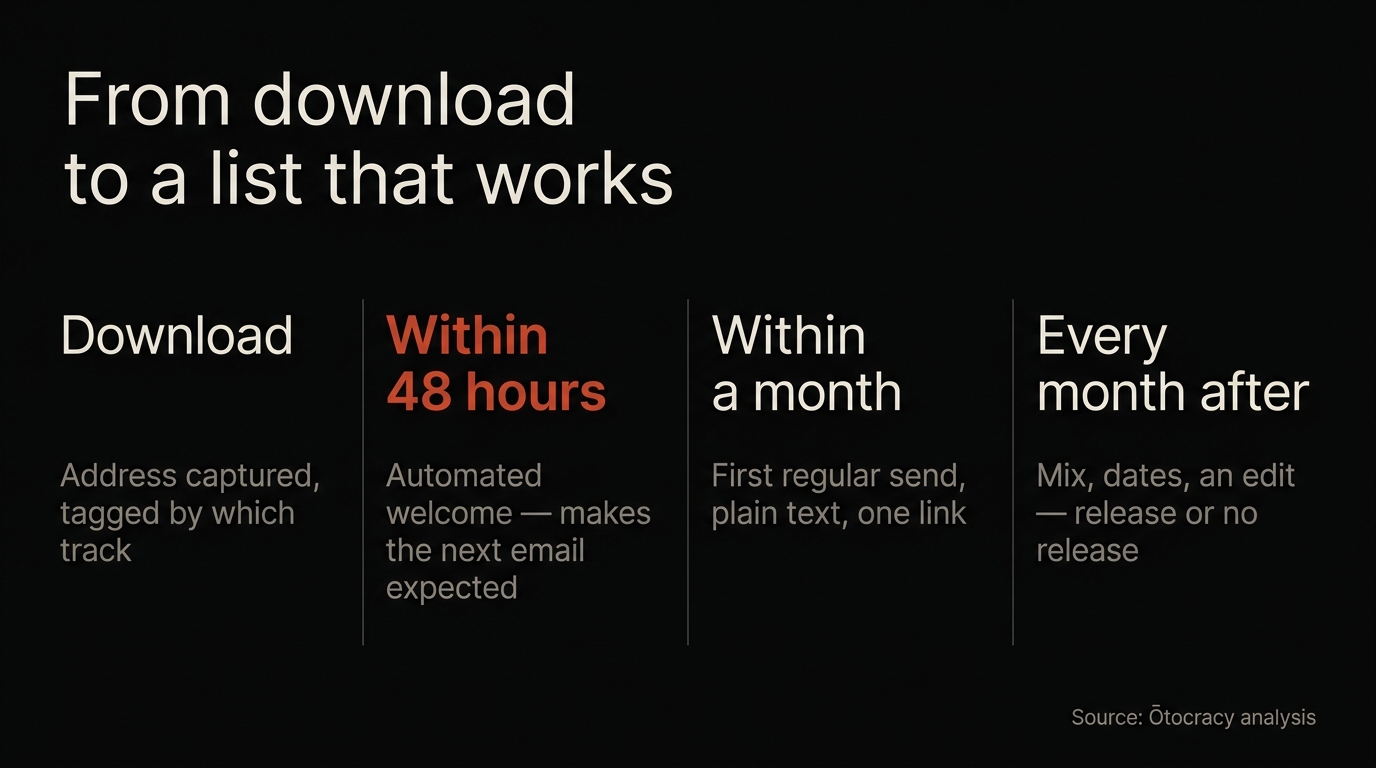
Send it within 48 hours. Automated, triggered by the gate, not written by hand each time.
It has one job: make the next email expected. That is it. It should confirm what they downloaded, say in one line who you are, and tell them roughly what they will get and how often.
Three sentences is plenty. What matters is that when your name appears again in six weeks, it is recognised rather than investigated.
If your gate tool cannot send that automatically, that is worth fixing before you collect another address. On Ōtocracy Gates it is part of the flow, and the exports are yours regardless of what any platform does later.
What to Send When You Have No Release
This is the actual blocker, so it deserves a real answer. Monthly, roughly, and none of these requires a release.
- A mix. The single easiest email a DJ can send, and the one people most reliably open.
- A track you have been playing. Somebody else's record. This costs nothing and builds the thing that makes the list valuable — that your taste is worth following.
- Dates. Where you are playing, with links. Short.
- An unreleased edit, gated again. The list feeds itself.
- Something from the studio. A loop, a photo of a broken piece of gear, a story about a show that went wrong. This is the one artists resist and it is consistently the one that gets replies.
The register that works is the one you would use texting a friend who likes the same music. Plain text, one link, no header image, no template with your logo at 400 pixels wide. A newsletter that looks like a brand email from a DJ reads as an advert. A short message that looks like it came from a person reads as a message.
Segment by What They Downloaded
A gate hands you exactly one useful piece of information beyond the address: which track somebody wanted.
Use it. Somebody who downloaded a hypnotic edit and somebody who downloaded a peak-time tool are not the same audience, and sending both the same release announcement wastes half of each send. Tag on capture, per gate, and let the tags accumulate.
The practical payoff arrives at release. A record that sits closest to one of those tags goes to that segment first, with a line acknowledging why they are getting it. Response to that is consistently better than a blanket send, and the reason is not clever copy — it is that the email is actually relevant.
Across the 2,400+ campaigns run by our founding team, the artists who tag at capture end up with something usable. The ones who plan to sort it out later never do, because retrofitting segments onto an undifferentiated list is not possible.
Where Else to Collect
Gates do the volume, but they are not the only door, and the other doors produce noticeably better addresses.
At shows. A QR code on the merch table and one spoken line from the booth. Somebody who saw you play and signed up is the highest-intent address you will ever get, and almost nobody bothers to collect it.
Link-in-bio. One email field, above the fold, on whatever page your socials point at. Low volume, permanent, zero effort once it exists.
Pre-saves. Several pre-save tools capture an address alongside the save. Worth turning on, though these people signed up for a release rather than for you — expect them to be softer than gate signups.
Another gate. The most reliable engine a DJ has. An edit or unreleased tool behind a gate, promoted to the list you already have, brings in the friends of people already listening.
Across the 2,400+ campaigns run by our founding team, lists assembled from several of these outperform single-source lists at the same size, because they are not all people who wanted one particular free file.
Deliverability, Briefly
The part that quietly decides whether any of this works.
Confirm addresses. A double opt-in, where somebody clicks a link once, is what keeps typos and throwaways off the list. Unconfirmed capture fills with addresses that bounce, and enough bounces damage delivery for the people who are real.
Warm up gradually. Sending to two thousand cold addresses on day one from a new sender is the fastest route to a spam folder. Start with your most recent signups and expand.
Prune. Somebody who has not opened anything in a year should come off. Keeping them lowers delivery for everyone else, and they were not going to come to a show anyway.
Own the export. Any tool that will not let you download your list in a usable format is holding your audience hostage. Check this before you build on it, not after.
The reason to bother with all of this is narrow but real: it is the only channel where the relationship survives a platform changing its rules. Techno and house fanbases have watched that happen repeatedly — the June 2026 SoundCloud gate change removed forced follows across every tool at once, and the artists who had been collecting addresses lost nothing.
What Not to Do
Do not buy a list. The "DJ email list, 6,000 verified contacts" products in search results are promo-contact scrapes, not fans. Sending to them damages your sender reputation and reaches nobody who wanted you.
Do not import your promo list into your fan list. DJs who receive your promos did not sign up for a fan newsletter, and treating those as one list annoys the people you most need.
Do not send only when you want something. A list that hears from you exclusively at release is trained to ignore release emails.
Do not chase the open rate. Apple's mail privacy protections inflate it and it has been a soft number for years. Clicks, replies and ticket links are the readouts worth watching.
When It Starts Paying
Slowly, then suddenly, and the timing surprises people.
For the first months a fan list feels like effort with no return — a few hundred addresses, modest clicks, no obvious revenue. The value shows up the first time you need something specific from a specific group of people: a release that has to move in its first week, a show in a city where you need three hundred bodies, a crowdfund, a vinyl pre-order.
At that point the list is the only asset you have that does not require permission from anyone. Which is the entire argument for building it during the quiet stretch when it feels pointless.
To see what free downloads are actually pulling in the scene right now, the Ōtocracy Top 100 ranks live gates by download volume — useful for calibrating what a gate can realistically collect for music like yours.
Frequently Asked Questions
How do DJs build a fan email list?
Predominantly through download gates: a free track, edit or unreleased tool in exchange for an address. Supplement with a QR code at shows, an email field on your link-in-bio page, and pre-save flows that include capture. Buying a list does not work and damages your ability to reach real fans.
How often should a DJ email their fan list?
Roughly monthly, whether or not there is a release. The gap between sends is what kills lists — an audience that hears from you twice a year does not remember signing up, and long silences convert into spam complaints when you finally send.
What should I send when I have no new music?
A mix, a track you are playing, upcoming dates, an unreleased edit behind another gate, or something from the studio. The purpose of the monthly send is to remain recognised, not to announce things.
Should I use double opt-in for a music mailing list?
Yes. Confirmed addresses keep typos and throwaway addresses off the list, which protects delivery for everyone real on it. The small drop in signups is worth the difference in whether your emails arrive at all.
Is open rate a useful metric for artist emails?
Not particularly. Mail privacy features inflate opens, so the number moves without meaning. Clicks, replies and completed actions — tickets bought, tracks saved, downloads taken — are the readouts that reflect anything.
What do I do with a list I have not emailed in a year?
Restart carefully. Send to your most recent signups first with a short message reintroducing yourself and an easy way to leave, then expand gradually to older segments. Do not send to the whole cold list at once, which is the single fastest way to land in spam.
How big does a DJ mailing list need to be to matter?
Smaller than most people assume. A few hundred engaged addresses who actually open and click will move a release week more than several thousand who never hear from you. Size is the least important variable after recency and relevance.
Can I email fans who downloaded a track without asking separately?
You need their consent for marketing, which is why the gate should state clearly that signing up means hearing from you and use a confirmed opt-in. A gate that collects an address without saying what it is for creates a list you cannot legitimately use.
The Bottom Line
Collecting addresses is the easy half and the half everybody does. The list becomes an asset only if somebody hears from you while they still remember why they gave it to you.
Welcome email inside 48 hours, something roughly monthly, tags applied at capture, plain text, and honest pruning. None of that is difficult and all of it compounds.
Start collecting with a free download gate if you have not already, and if the release itself needs a push behind it once the list exists, our campaign packages handle the paid layer.