What Is a Download Gate? How Music Gates Work in 2026
What a download gate is, how gating works after SoundCloud's June 2026 change, and how EDM artists turn free downloads into fan email lists they own.

Quick Answer
A download gate is a web page that trades a free track for a small fan action — historically a SoundCloud follow, like, or repost, and increasingly an email address. The artist uploads a track, shares the gate link in a SoundCloud description or bio, and fans complete the requested step to unlock the download. The mechanic matters because free downloads are load-bearing culture in electronic music: DJs play edits and remixes that never see an official release, and gates turn that giveaway traffic into an audience you can reach again. One thing changed fundamentally on June 11, 2026: SoundCloud paused the API that let third-party gates force social actions before unlocking, so follow and repost steps are now voluntary on every tool. What survived — and what gates are actually for in 2026 — is email capture: a fan list you own, export, and keep regardless of what any platform does next.
I have given away more music through download gates than I have ever sold. That is not a confession — it is how the economics of a DJ scene work, and once you understand why, gates stop looking like a growth hack and start looking like what they are: the oldest fair trade in electronic music, updated for whoever owns the audience relationship. This guide covers the whole mechanic — what a gate is, how it works technically, what the June 2026 change broke, and how to run gates that build something you keep.
The Definition, and Why Dance Music Invented It
A download gate is a page where a free download is unlocked by a fan action — a follow, a like, a repost, or an email address. That is the whole mechanic. You will also see it called a fan gate or a SoundCloud gate; all three name the same thing, and this guide uses them interchangeably.
It exists because electronic music runs on a parallel economy of free tracks. Edits of other people's records cannot be sold. Remixes without clearance cannot be sold. VIPs, tools, and bootlegs live outside stores by definition — but they are exactly what DJs hunt for, and exactly what makes a producer's name travel through a scene. From the booth side: half the IDs that get asked about in my sets are edits that were never for sale. The only way to "release" them is to give them away.
Gating is how the giveaway stopped being a dead end. Instead of a naked download link that hands out the file and ends the interaction, the gate asks for one small thing first. The fan gets the track either way; the artist gets a growing audience instead of a download counter.
How a Download Gate Works, Mechanically
The flow has four moving parts, and it is worth seeing them plainly because every gate tool is some arrangement of these:
- The upload. You give the gate tool your track — the audio file itself, or a link to the SoundCloud stream it should deliver.
- The gate page. The tool generates a public page with your artwork, title, and the requested action. This link is what you put in your SoundCloud description, your bio, your DM replies.
- The action. The fan does the thing: enters an email, or taps the voluntary follow and repost prompts.
- The unlock. The file delivers, and the fan lands in your dashboard — as an email contact, with the gate that captured them attached.
| Gate step | Where it happens | What the artist gets |
|---|---|---|
| Fan clicks gate link | SoundCloud description, bio, link page | A visit, tracked per gate |
| Fan completes the ask | The gate page | An email address (confirmed), voluntary social actions |
| File unlocks | The gate page | A download counted against that gate |
| Afterwards | Your dashboard | A reachable fan attached to a specific track |
A detail that separates good gates from annoying ones: the ask should happen once, quickly, on a page that loads fast. Every extra step on a gate page is a fan who closes the tab — the same drop-off math as any funnel, except here the "customer" is someone you wanted to impress.
A Short History: From Forced Follows to Fan Emails
Gates have been through three eras. Understanding them explains why the tools look the way they do in 2026.
The wild era. Early platforms like The Artist Union (shut down in 2020) and ToneDen (wound down in 2024) built gating around SoundCloud's API: log in with SoundCloud, and the follow, like, and repost executed automatically before the download unlocked. It worked — follower counts inflated fast — and it bred a generation of gates asking for five actions across three platforms before a fan heard a note.
The consolidation era. Hypeddit outlasted the early tools and became the default, bundling gates with smart links and pre-saves into a paid suite — how it stacks up feature by feature today is its own comparison. The enforcement mechanic stayed central: the paid product was, in large part, automated social actions.
The voluntary era — where we are now. On June 11, 2026, SoundCloud paused the third-party API that made enforcement possible. Hypeddit announced the change on its own site, its founder pointing to industry pressure over what third-party tools may automate; other gate tools confirmed the same thing, while SoundCloud itself said nothing detailed publicly. The steps still appear on gate pages — but fans can decline and download anyway, on every tool, and switching tools does not restore enforcement. Our breakdown of the June change covers the details; the one-line version is that forced social growth via gates is over.
Notice what survived every era: the email address. It was never enforced by any API, so no API change could kill it — and it is the only thing a gate collects that lives outside every platform.
What Gates Are For in 2026: The Email Math
Strip away the dead enforcement layer and a download gate in 2026 is an email-capture page with a track attached. That is not a demotion — it is a promotion, because the email list is the strongest asset on the board.
Consider what each thing a gate ever collected is actually worth. A follow is worth whatever SoundCloud's notification algorithm decides it is worth this quarter. A repost reaches a fraction of the reposter's followers, once. An email address reaches its owner directly, forever, on infrastructure no platform controls — and it retargets. Based on 2,400+ campaigns run by our founding team, audiences built from captured fans are consistently the cheapest to convert in paid campaigns: you are advertising to people who already took an action to get your music.
One useful sanity check on what a gate can realistically pull: the Ōtocracy Top 100 ranks live gates by actual downloads, so you can see what volume looks like for tracks in your own corner of the scene rather than guessing from a marketing page.
There is a quality dimension too. A confirmed, double opt-in address — where the fan clicks a verification link once — is deliverable by definition. An unconfirmed capture list fills with typos and throwaways that bounce, and enough bounces poison your sender reputation for the fans who are real. If your list will ever carry a newsletter, a presale, or a tour announcement, confirmation is not bureaucracy; it is what makes the list usable.
Anatomy of a Gate That Converts
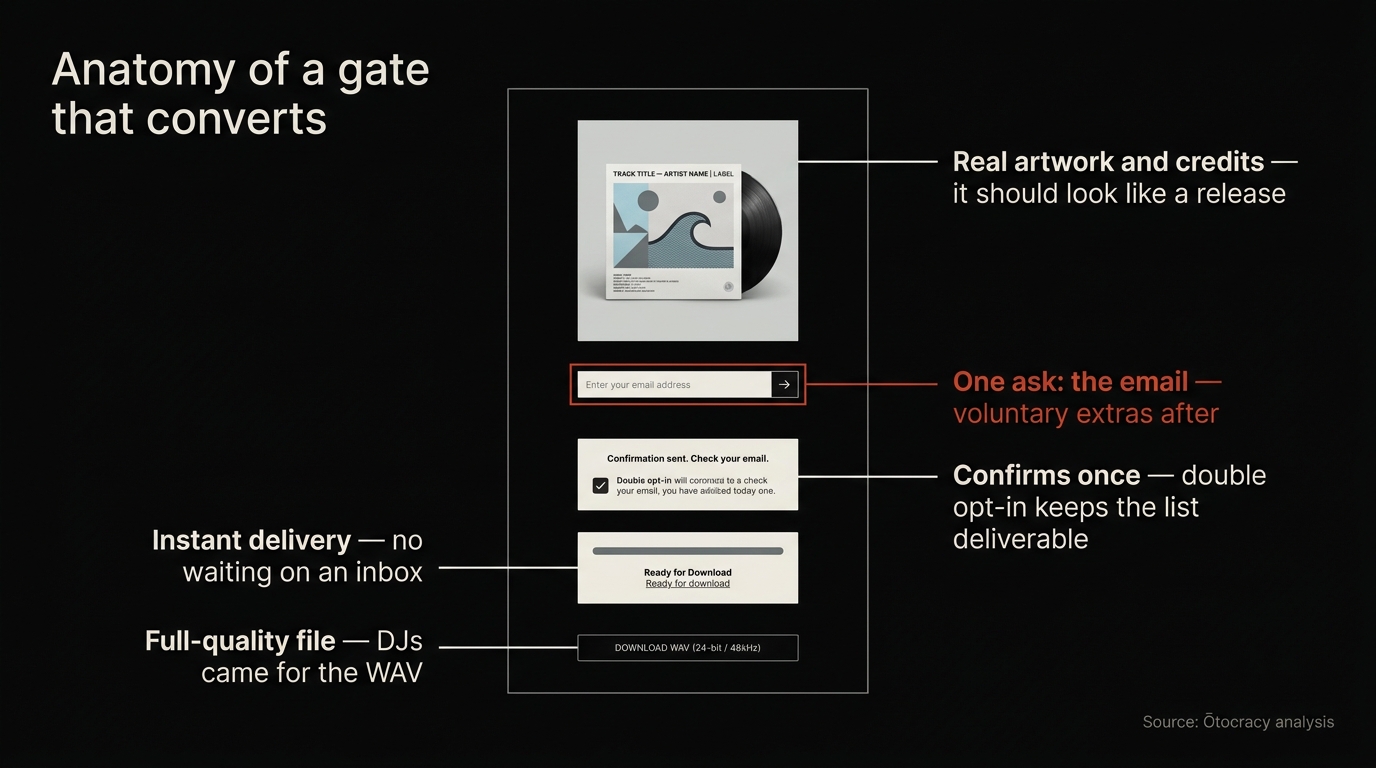
Years of putting gates in front of real crowds — mine and other artists' — reduce to a short list of what matters on the page:
- One ask, not five. Every additional required step costs completions. Ask for the email; let the social steps be the voluntary extras they now are anyway.
- Real artwork and correct credits. The gate page is a first impression, often arriving from a DM or a description link. It should look like a release, not a form.
- Speed. The page loads fast or the fan is gone. This is boring and decisive.
- Instant delivery. Confirm, download, done. Gates that make fans wait for an email that "may take a few minutes" leak completions at the last step.
- The right file. DJs downloading your edit want the full-quality version — gating a low-bitrate file wastes the one moment someone actively wanted your music.
What you gate matters as much as how. The tracks that pull hardest through gates are the ones that cannot be bought: edits, remixes, VIPs, extended mixes, tools. Gating your official single that is on every store dilutes both the store release and the gate; gating the version only you can give away makes the gate the only door.
Say the quiet part about that material, because most guides skip it: an unofficial edit is someone else's copyright, and gating one is a giveaway, not a licence. In practice the scene runs on tolerance — most rights holders ignore a free edit that drives attention, and the usual consequence when they do not is a takedown of the file, not a lawyer. Two habits keep it boring: credit the original artist plainly on the gate page, and pull the file the moment anyone asks. Anything you intend to sell needs actual clearance, and a gate is not a substitute for one.
Consent: What a Gate-Collected Address Actually Permits
A gate collects personal data, which means it comes with obligations — and for anyone with European fans, the rules apply regardless of where you are based.
The short version: an email address given in exchange for a download is not blanket permission to market to that person forever. Consent has to be specific and freely given, which is why double opt-in matters for more than deliverability. The confirmation click is your record that a real person agreed, timestamped and attributable; a single-capture list has no such record, and if a fan later disputes it you have nothing to show.
Three practices cover most of it. Say on the gate page what the address is for — the download plus occasional mail about new music, not "partner offers" you have not thought through. Put a working one-click unsubscribe on every message you send, and honor it immediately. And keep the list yours rather than a platform's, because the obligation to answer a fan's deletion request sits with you whether or not your gate tool makes it easy.
None of this is legal advice, and a label or a serious release schedule warrants a real look at your own obligations. But the gap between a compliant list and a risky one is mostly the confirmation step you were already taking for deliverability reasons.
Making One, Start to Finish
The mechanics take minutes on any modern tool — and if you want to choose one deliberately, our comparison of all seven live gate tools runs the market with verified pricing. On Ōtocracy Gates — ours, free with no paid tier — the sequence is: upload your file or paste the SoundCloud URL, and the title, artwork, and credits fill in automatically; put the gate link in your track description; fans enter an email, confirm once, and download. No fan accounts, no app.
From there the loop is: watch per-gate analytics (visits, unlocks, downloads) to see which descriptions and posts actually drive traffic, export your list as CSV whenever you want it, and let your own Meta, TikTok, and Google pixels fire on the gate pages so every downloader also lands in a retargeting audience. If you are running gates on Hypeddit already, the migration guide walks the switch step by step, fan list included.
Download Gates vs Smart Links vs Pre-Saves
These three get bundled in the same tools and confused constantly. They do different jobs at different moments:
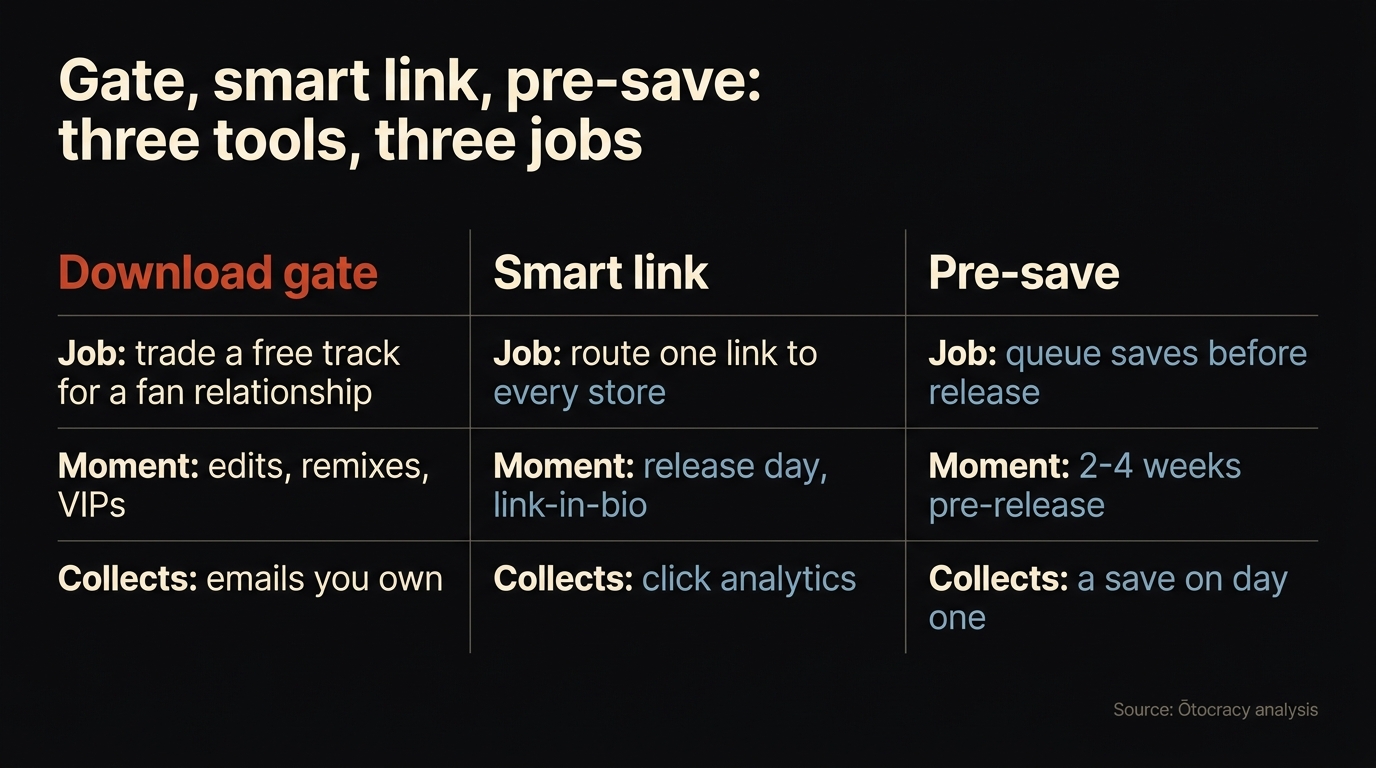
| Download gate | Smart link | Pre-save | |
|---|---|---|---|
| The job | Trade a free track for a fan relationship | Route one link to every store and DSP | Queue a save before release day |
| Best moment | Edits, remixes, VIPs — anything unsellable | Release day, link-in-bio, ads | The 2-4 weeks before a release |
| What you collect | Emails; voluntary social actions | Click analytics | A save on release day; sometimes an email |
| Who it serves | DJs and core fans who want the file | Casual listeners choosing their platform | Fans you already reached once |
They stack rather than compete: a pre-save warms the release, the smart link carries release day, and the gate monetizes — in audience, not money — all the unofficial material around it. Where the whole stack sits in a release plan is the subject of our complete EDM promotion guide.
Where Gates Fit in a Release Cycle
The mistake I see most is treating gates as a one-off stunt attached to a single track. Gates work as a rhythm, slotted into the gaps of a release calendar — because the gap is exactly when you have nothing official to point people at.
The pattern that has worked for me and the artists around our label work: release the official single through the stores, and two or three weeks later — when the release-day push has faded — gate the club edit or extended mix of the same record. The people who found the single get a reason to come back; the DJs who ignored the radio edit get the version they actually wanted; and the release earns a second wave of descriptions, posts, and stories without a second distribution cycle.
Between releases, gates are how the list keeps growing while the catalog rests. An edit of a classic, a remix for a friend's record, a VIP of your own biggest track — each is a giveaway you were probably making anyway, and each one gated adds another door into your audience. When I hand a USB to another DJ after a set, the follow-up is a gate link, not a naked file: the track travels either way, but only one of those two paths tells me where it landed.
Two rhythm rules keep it honest. Never let the gate replace the release — gated material is the material that cannot be sold, and the moment you start gating your lead singles you are cannibalizing your own stores. And never let the list sit cold: a gate-built list that hears from you only when you want something decays like any other. A short mail when the next record drops is enough to keep the addresses warm and the unsubscribes low.
Reading Gate Metrics Like an Operator
Three numbers tell you almost everything, and they come as a funnel: visits (the gate link got clicked), unlocks (a fan completed the ask), downloads (the file actually delivered). Across the 2,400+ campaigns run by our founding team, the pattern holds: artists who read a funnel weekly out-execute artists who watch a follower count.
The ratios are the diagnosis. Lots of visits and few unlocks means the page is asking wrong — too many steps, or an audience mismatch between where you posted the link and what the track is. Unlocks without downloads point at delivery friction. Few visits means the problem is upstream in your descriptions and posts, not on the gate at all. And a spike in one gate's visits tells you which post, which description, which DM did the work — which is exactly the information that should shape what you make next. If your broader numbers are behaving strangely — streams up while gates and follows stay flat, say — the free audit breaks down where your listeners actually come from, source by source. For the SoundCloud side of that picture specifically, the 20-minute profile audit walks the same checks by hand against benchmarks measured from 2,000 profiles.
After the Gate
Collecting addresses is the half everybody does. Emailing them is the half that turns a gate into an asset, and a list nobody contacts for a year decays into spam complaints the first time it is used. What to do with a DJ fan list covers the welcome email, the monthly send and the deliverability basics that decide whether any of it arrives.
Frequently Asked Questions
What does a download gate do?
It trades a free download for a fan action. The artist uploads a track and shares the gate link; the fan enters an email or completes voluntary social steps, and the file unlocks. The artist ends up with a reachable audience attached to specific tracks instead of an anonymous download count.
Are download gates still worth it in 2026?
Yes, but for a different reason than five years ago. Forced follows died with SoundCloud's June 2026 API change; email capture did not. A gate is now the cheapest way to turn giveaway traffic — edits, remixes, VIPs — into a fan list you own and can export, which no platform change can confiscate.
Do download gates force fans to follow or repost?
Not anymore, on any tool. SoundCloud paused the third-party enforcement API on June 11, 2026, so follow, like, and repost steps are voluntary everywhere — gates can ask, fans can decline and still download. Tools still marketing enforced actions are describing the era that ended that day.
What should I put behind a download gate?
The music that cannot be sold: edits, unofficial remixes, VIPs, tools, and extended mixes. That material is what DJs and core fans actively hunt for, and gating it costs you no store revenue. Gating an official release that is already on every platform mostly just adds friction to something people could stream anyway.
Are download gates free?
The gate itself can be. Ōtocracy Gates — ours — is free with no paid tier, including email capture and CSV export; Hypeddit lists email collection from $10/month; other tools land between with storage caps or per-feature pricing. Since the June 2026 change removed enforced actions everywhere, price differences now buy suite features, not gating power.
Do fans need a SoundCloud account to use a gate?
On email-first gates, no — a fan enters an address, confirms it once, and downloads. Gates built around SoundCloud login historically required an account so the API could execute the social actions; with that API paused since June 2026, the login-first flow lost its reason to exist.
The Bottom Line
A download gate is the fair trade dance music always ran on — free music for a real connection — and the June 2026 change just clarified which half of the trade was load-bearing. Follows evaporate with an API decision; the email list is yours in a file, forever. Gate the music only you can give away, ask once, and make your first gate — it takes about two minutes, and it is the only promotion channel where the asset at the end belongs entirely to you.