The SoundCloud Download Gate Change, Explained (2026)
What SoundCloud's June 11, 2026 gate change actually did, who confirmed it, why switching tools won't fix it, and what download gates are for now.

Quick Answer
On June 11, 2026, SoundCloud paused the third-party API connection that let download gate tools enforce social actions — the mechanic where a fan had to log in with SoundCloud and complete a follow, like, or repost before a free download unlocked. Hypeddit confirmed the change in a public announcement, with founder John Gold pointing to industry pressure over what third-party tools are allowed to automate; Valorizd published the same confirmation, and SoundCloud itself has released no detailed statement. The practical result: every gate tool's social steps became voluntary on the same day, fans can decline and download anyway, and switching tools does not bring enforcement back because the pause is on SoundCloud's side. Email capture, file delivery, and tracking pixels were untouched. If your gates suddenly stopped producing followers in mid-June 2026, nothing is broken in your account — the mechanic itself is gone, industry-wide.
The support threads all ask some version of the same question: "my Hypeddit gates stopped forcing follows — what setting do I change?" There is no setting. This is what actually happened, who has confirmed what, and the math on what gates are for now that the enforcement era is over. (New to the mechanic entirely? Start with what a download gate is — this page assumes you were running them before June.)
What Actually Happened to SoundCloud Download Gates on June 11
Download gates historically worked through SoundCloud's API: the fan authenticated with their SoundCloud account, the gate tool executed the follow, like, or repost through that connection, and only then did the download unlock. That server-side enforcement is what made gate-driven follower growth reliable — the action was not a request, it was a toll.
On June 11, 2026, SoundCloud paused that API connection for gate tools. The steps still render on gate pages, but completion cannot be verified or required — a fan can skip every one of them and still get the file.
| Before June 11, 2026 | After | |
|---|---|---|
| Follow / like / repost steps | Enforced via SoundCloud login before unlock | Displayed, voluntary, skippable |
| Fan email capture | Works | Works — unaffected |
| File delivery | Works | Works — unaffected |
| Tracking pixels on gate pages | Work | Work — unaffected |
| Fixable by switching gate tools | — | No — the pause is platform-side |
Who Has Confirmed What
Getting the sourcing straight matters, because the information vacuum has filled with guesswork.
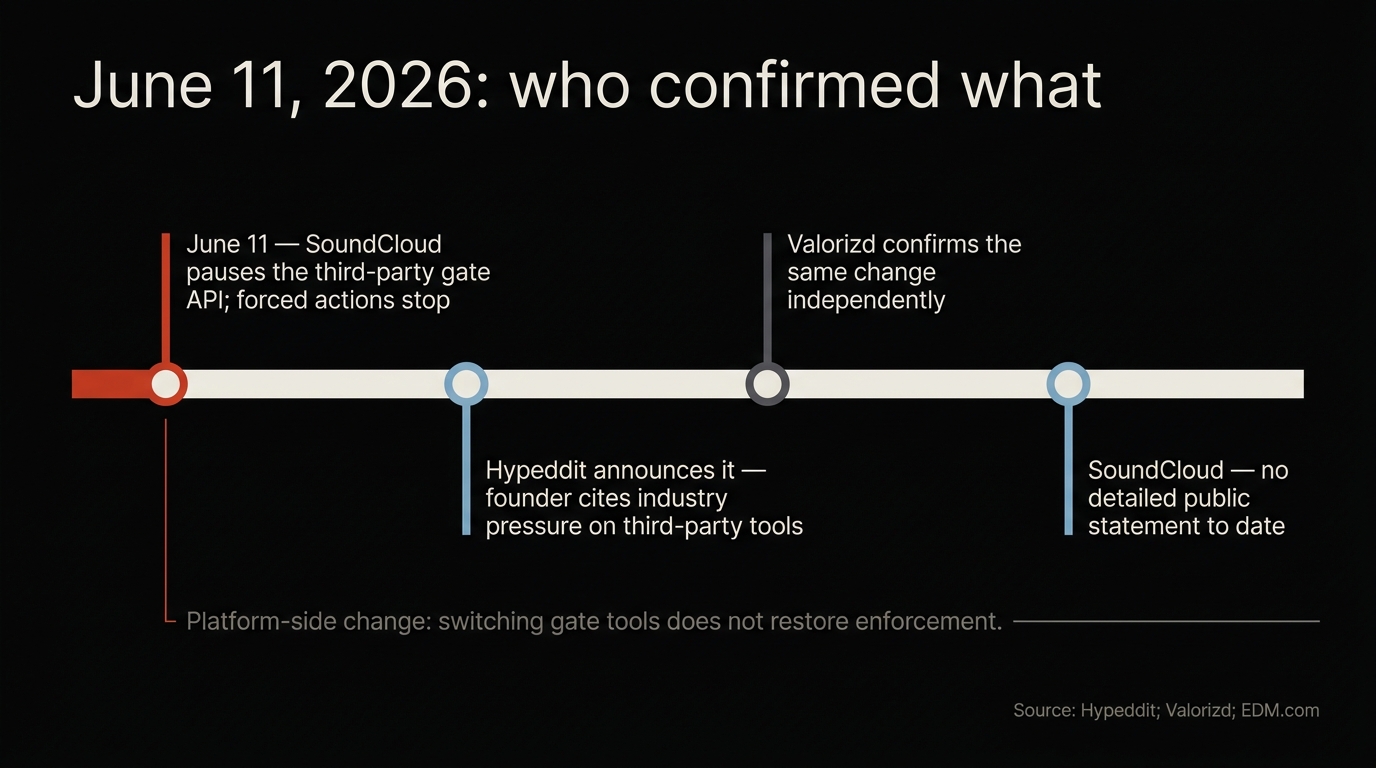
Hypeddit published the clearest account on its own site, describing its SoundCloud API connection as paused. Founder John Gold framed the cause as streaming platforms managing pressure from parts of the industry over what third-party tools are allowed to integrate, and said Hypeddit is in contact with SoundCloud about what comes next. Valorizd confirmed the same change independently. SoundCloud has published no detailed public statement — the closest thing to an official record is the tools' own announcements. Electronic music press including EDM.com covered the cut, and fans have circulated a petition asking SoundCloud to build download gates natively. None of that changes the operational reality: no tool has announced a restored integration.
Treat any gate tool still marketing "enforced" SoundCloud actions with appropriate skepticism — per the confirmations above, enforcement is not currently something a third party can sell.
The Math of What Died
Be honest about what was lost: enforced gating was efficient. A gate that converts visitors into followers at a high rate because the follow is mandatory will always outperform a polite request on that metric. Follower growth from gates stopped being enforceable industry-wide the day the API paused — where a gate used to collect a follow, it now collects whatever the fan volunteers, and no amount of copy on the page fully replaces a toll with a tip jar.
But run the value of what each asset was actually worth. Based on 2,400+ campaigns run by our founding team, the follower counts that enforcement inflated were always the weakest asset a gate produced: a forced follow is a low-intent connection whose reach depends entirely on SoundCloud's notification behavior. The email address the same gate captured is a direct line you own — and email was never enforced by any API, which is precisely why June 11 could not touch it. The change did not destroy the value of gating; it repriced it, away from the metric that looked best and toward the one that converts.
What to Do With Your Gates Now
Three moves, in order of return:
- Make email the primary ask. It is the one step that still reliably converts, and the only collected asset that survives platform decisions. Confirmed, double opt-in addresses keep the list deliverable.
- Keep the social steps as voluntary asks. Some fans still follow when asked — the marginal cost of asking is zero. Just stop paying for enforcement that no longer exists.
- Put your pixels on your gate pages. Every visitor is retargetable on Meta, TikTok, and Google whether or not they complete anything — and across the 2,400+ campaigns run by our founding team, warm audiences rebuilt from people who already took an action convert at a fraction of cold-prospecting cost, which is the same logic behind every Meta campaign we run for artists. For many artists that audience is now worth more than the follows ever were.
If you are paying a subscription primarily for gate enforcement, this is the moment to re-read your invoice: the feature you were paying for is voluntary everywhere now, and free tools cover what remains — ours, Ōtocracy Gates, among them, which we should disclose before you weigh anything below. The full comparison of seven gate tools runs that table with verified pricing, and the feature-by-feature Hypeddit comparison goes deeper on the incumbent — including where it still wins.
The Bigger Pattern: Rented Mechanics Break
Zoom out and June 11 is not an anomaly — it is the third time the same lesson has landed in this niche. The Artist Union built gating on SoundCloud's API and shut down in 2020; artists' gates went dark with it. ToneDen wound down in 2024, and with it went smart links, pixels, and — for artists who had not exported — mailing lists. Now the enforcement layer itself, the mechanic every gate subscription was priced on, has been switched off by a single platform decision.
The common thread is not that these tools were bad. It is that every growth mechanic that lives on someone else's API is rented, and rent can be raised or the lease ended without notice. The assets that survived all three events are the ones that live in files you hold: your audio, your artwork, and above all your exported fan list. Build on those, and platform news becomes something you read rather than something that happens to you.
Your Three Options as a Download Gate User
Every artist running gates in mid-2026 lands in one of three positions. The honest decision table:
| Option | Who it fits | The cost |
|---|---|---|
| Stay on your paid suite | You actively use smart links, pre-saves, and ad tools beyond gating | Subscription continues; the enforcement you originally paid for is gone |
| Switch to a free email-first gate | Gates and fan emails are what you actually use | An afternoon of migration; suite features stay behind |
| Run both | You want the suite AND free gating with no paid tier | Two dashboards, but each does what it is best at |
Whichever you choose, do one thing this week regardless: export your fan list to a CSV. The June change was a platform decision that landed overnight with no public SoundCloud statement — the next platform decision will not announce itself either, and an exported list is the only version of your audience that no announcement can touch. If you decide to move, the step-by-step migration guide covers the exact export-rebuild-repoint sequence, with the guided import doing the heavy lifting at about two minutes per gate.
Frequently Asked Questions
Why did my Hypeddit gates stop forcing follows?
Because SoundCloud paused the third-party API that enforced them, on June 11, 2026. Hypeddit confirmed this publicly — it is a platform-side change, not an account problem or a bug, and no dashboard setting on any tool switches enforcement back on.
Did SoundCloud remove download gates entirely?
No. Gate pages, free downloads, email capture, and tracking pixels all still work. What SoundCloud paused is enforcement — requiring a completed follow, like, or repost before the download unlocks. Gates still ask; fans can now decline and download anyway.
Will forced actions come back?
Unknown. Hypeddit says it is in contact with SoundCloud and remains optimistic, but no restored integration has been announced by any tool, and SoundCloud has made no public commitment. Building your growth plan on enforcement returning is a bet with no confirmed timeline behind it.
Does any gate tool still enforce SoundCloud actions?
Per the public confirmations from Hypeddit and Valorizd, no — the pause is on SoundCloud's side, so it applies to every third-party tool at once. A tool marketing enforced actions in 2026 is describing the pre-June mechanic; test it as a fan before trusting the claim.
What should a download gate collect now?
Fan emails, first and always — confirmed addresses you can export and own. Voluntary social actions second, since asking costs nothing. And retargeting pixel data third: every gate visitor can feed your Meta, TikTok, and Google audiences regardless of what they complete on the page.
Reading Your SoundCloud Numbers After the Change
With forced follows gone, the metrics worth watching moved. Follower growth attributable to gates fell for everybody at once, so year-on-year comparisons across that date are meaningless — and an artist who reads a post-June follower curve as a personal failure is misreading a platform change.
Engagement ratios did not move, because they never depended on the API. If you want to know whether your profile is performing normally now, compare likes, reposts and comments against artists your own size: we published the measured bands in SoundCloud engagement rate benchmarks, and the reach side in plays per follower.
The Bottom Line
June 11, 2026 ended the era when gates could manufacture followers, and no tool switch, setting, or workaround changes that — the pause sits with SoundCloud, not with your dashboard. What is left is the part of gating that was always yours: the fan list. If your current tool charges for an enforcement layer that no longer exists, rebuild your gates on Ōtocracy Gates — ours, free with no paid tier — around the asset that survived.
This page is maintained as tools announce changes. Last verified August 12, 2026.