SoundCloud Engagement Rate: What 2,000 Profiles Show (2026)
What a normal SoundCloud engagement rate is, measured across 2,000 profiles, plus the widely repeated comment-rate figure the data does not support.
Quick Answer
Three engagement benchmarks circulate as settled fact for SoundCloud: comment rates of 0.5% to 2% of plays, likes above 5% signalling strong resonance, and reposts above 1% signalling real reach. Measured across 2,000 public profiles on 28 August 2026, two of the three hold and one collapses. Likes above 5% describe roughly the top quartile — 23.2% of artists clear it. Reposts above 1% describe roughly the top quartile too, cleared by 17.4%. The comment figure does not survive contact with data at all: no follower tier has a median comment rate that reaches even 0.5%, and the platform-wide medians run from 0.36% down to 0.05%. The widely quoted "typical" range starts above where every measured band actually sits. If you have been judging your comment rate against it, you have been failing a bar that does not exist.
Search for SoundCloud engagement benchmarks and you will find the same three numbers on a dozen sites, phrased almost identically, sourced to nothing.
That is not unusual for music-marketing content. What is unusual is that the numbers are checkable — SoundCloud exposes plays, likes, reposts and comments on every public profile — and nobody appears to have checked them.
This matters to us because we are asked to interpret these ratios constantly. Across the 2,400+ campaigns run by our founding team, "is my engagement normal?" is the question that arrives before almost every brief, and until now the honest answer was that nobody knew.
So we sampled 2,000 public profiles on 28 August 2026 and checked. Here is what held and what did not.
The Three Claims
| Circulating claim | What it implies | Verdict |
|---|---|---|
| Comment rate typically 0.5% to 2% of plays | A profile below 0.5% is underperforming | Does not survive |
| Likes above 5% of plays signal strong resonance | 5% is a meaningful upper marker | Holds — roughly the top quartile |
| Reposts above 1% of plays signal real reach | 1% is a meaningful upper marker | Holds — roughly the top quartile |
Two of three is a better hit rate than we expected. The one that fails, though, is the one most likely to make an artist believe something is wrong with their music.
What the Comment-Rate Claim Gets Wrong
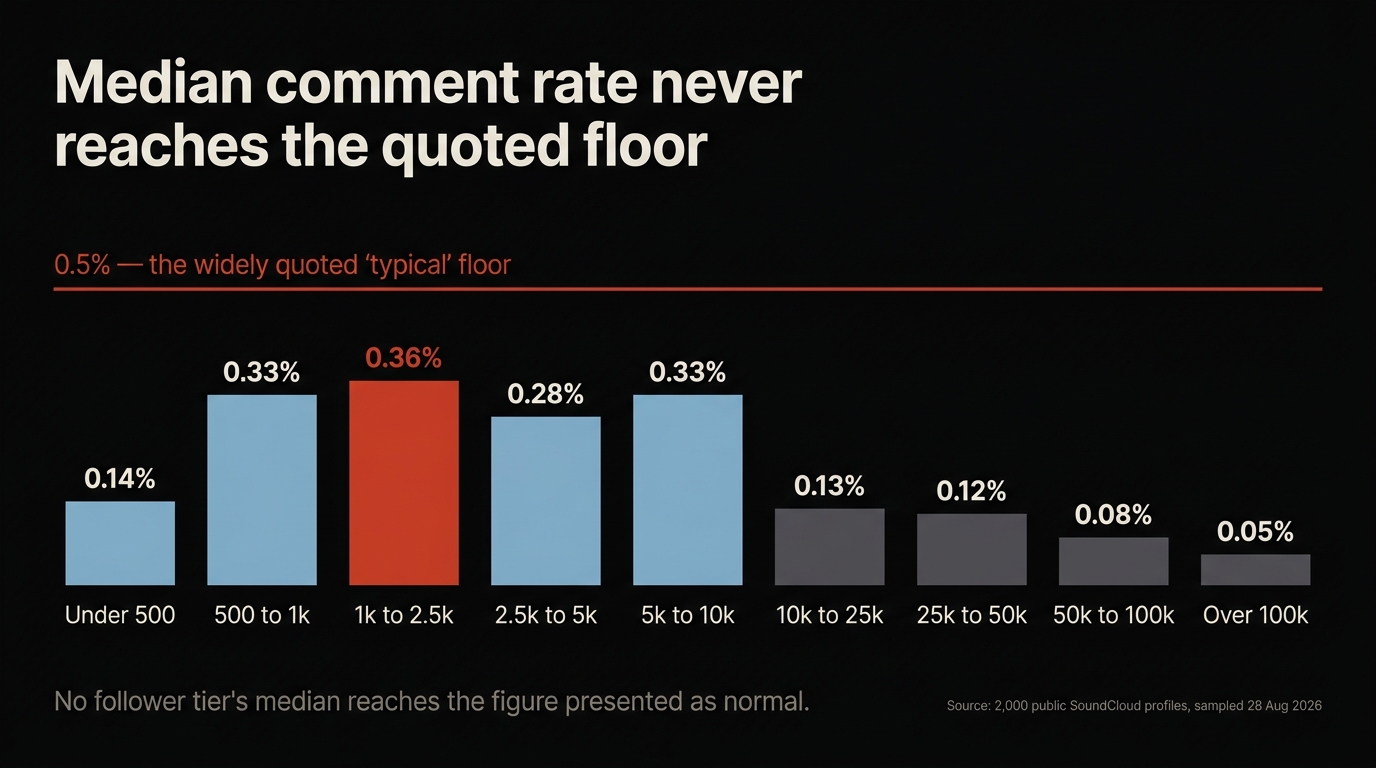
Here is measured comment rate as a share of plays, by follower tier.
| Follower tier | 25th percentile | Median | 75th percentile |
|---|---|---|---|
| Under 500 | 0.00% | 0.14% | 1.01% |
| 500 to 1k | 0.00% | 0.33% | 0.84% |
| 1k to 2.5k | 0.07% | 0.36% | 1.22% |
| 2.5k to 5k | 0.07% | 0.28% | 0.94% |
| 5k to 10k | 0.08% | 0.33% | 0.98% |
| 10k to 25k | 0.03% | 0.13% | 0.53% |
| 25k to 50k | 0.04% | 0.12% | 0.34% |
| 50k to 100k | 0.04% | 0.08% | 0.16% |
| Over 100k | 0.03% | 0.05% | 0.11% |
The highest median in the entire sample is 0.36%, in the 1,000-to-2,500 follower band. The claimed typical floor is 0.5%.
Put plainly: the range presented as normal begins above the median of every measured tier. Even at the 75th percentile, only the bands under 25,000 followers clear 0.5%, and no band comes near 2% at any percentile we measured.
An artist with 8,000 followers and a 0.3% comment rate is sitting almost exactly at their band's median. Judged against the circulating figure, they would conclude their audience is disengaged. They would be wrong, and they would probably go buy something to fix it.
What Survived
The two like and repost markers do hold up, though not quite in the way they are usually presented.
Measured, 23.2% of artists clear 5% likes-to-plays and 17.4% clear 1% reposts-to-plays. So both figures describe approximately the top quartile of working artists. They are not thresholds of adequacy — they are markers of doing well, and reading them as a passing grade inverts their meaning.
That distinction matters. "Above 5% is strong" is true. "Below 5% is weak" does not follow, and three quarters of the artists we measured sit below it.
Like Rate Does Not Rise With Size
The received picture has engagement improving as an artist grows. For likes, it does the opposite.
| Follower tier | Median likes as a share of plays |
|---|---|
| Under 500 | 4.3% |
| 500 to 1k | 4.0% |
| 1k to 2.5k | 4.2% |
| 2.5k to 5k | 4.2% |
| 5k to 10k | 4.0% |
| 10k to 25k | 3.7% |
| 25k to 50k | 3.7% |
| 50k to 100k | 3.5% |
| Over 100k | 3.1% |
The drift is downward — 4.3% to 3.1% — and the correlation with follower count is only −0.16. Like rate is close to a platform constant, sagging gently as audiences get larger and more casual.
Our own earlier benchmarks had this backwards, showing like rate climbing from 2.6% to 4.3% with size. That version rested on 110 profiles. This one rests on 2,000, and the direction reversed.
The Repost Hump Nobody Mentions
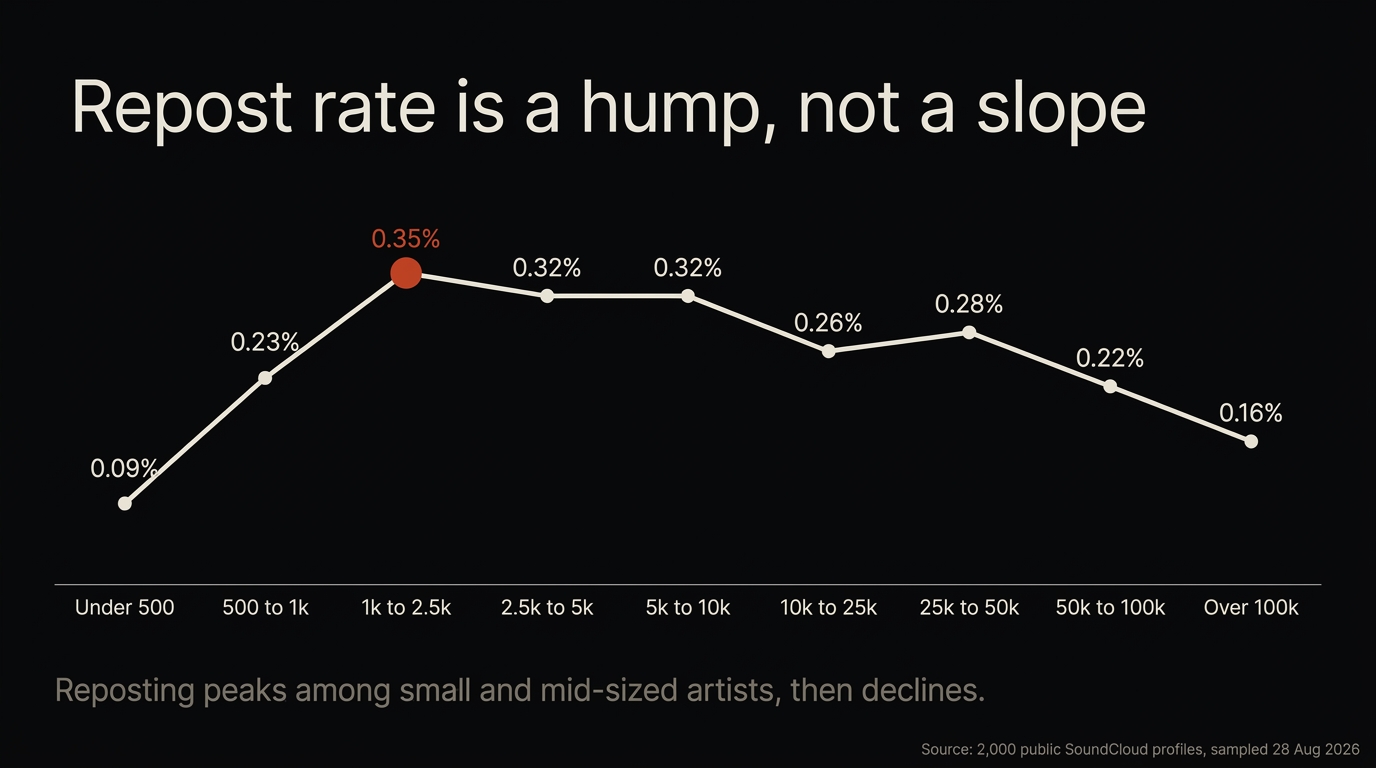
Repost rate is the one metric here that is not a slope at all. It is a hump.
| Follower tier | Median reposts as a share of plays |
|---|---|
| Under 500 | 0.09% |
| 500 to 1k | 0.23% |
| 1k to 2.5k | 0.35% |
| 2.5k to 5k | 0.32% |
| 5k to 10k | 0.32% |
| 10k to 25k | 0.26% |
| 25k to 50k | 0.28% |
| 50k to 100k | 0.22% |
| Over 100k | 0.16% |
It climbs from 0.09% at the bottom, peaks around 0.35% in the 1,000-to-2,500 band, then falls away to 0.16% above 100,000 followers. Overall correlation with follower count is 0.003 — statistically, nothing.
This has a practical reading. The repost economy of SoundCloud is at its most active among small and mid-sized artists, which is precisely the population that trades reposts with each other. Large accounts get played, not passed along. If your promotion plan depends on reposts carrying a release outward, the accounts most likely to actually do it are smaller than the ones you are probably chasing.
It is also why a single global repost benchmark would be worse than useless. A 0.3% repost rate is unremarkable at 2,000 followers and top-quartile at 200,000.
Why Nine Tiers Instead of Three
Our first version used three bands: 1k, 10k, 100k. Most working artists live inside that first jump, so the scale did its least discriminating exactly where the most people needed it. An artist with 1,200 followers was being judged against one with 9,000.
Nine tiers fixes that. To see how much the underlying populations differ, follower-to-following ratio moves from a median of 0.3 in the smallest band to 3,922 in the largest. Those are not the same kind of account, and comparing them was never going to produce a useful answer.
What to Do With Your Own Numbers
Engagement rates are diagnostic, not targets. Chasing them directly produces comment-pod behaviour and reciprocal-repost rings, both of which move the ratio and neither of which moves a career.
The useful reads are narrow. A like rate far below your band suggests the plays are not coming from people who chose you — worth checking against traffic source before anything else. A repost rate far below your band, in the tiers where reposting is most active, suggests you are not in circulation among peer artists. A comment rate near zero is normal and means very little on its own.
Across the 2,400+ campaigns run by our founding team, the profiles that turned out to have a genuine problem almost always showed it in two metrics at once. A single ratio sitting low, on its own, is usually noise.
Anomalies in the other direction are worth just as much attention. Engagement far above a band's 75th percentile alongside flat follower growth is one of the shapes that artificial activity makes, and the same logic applies across platforms — we cover the streaming version of it in the label's guide to spotting fake streams.
For the ratio that most often gets misread — plays against followers — the denominator matters more than anything on this page, and we broke that out separately in SoundCloud plays per follower.
The full percentile reference for all five metrics across all nine tiers sits on the SoundCloud benchmarks page. If you would rather have your own profile placed against it automatically, the free SoundCloud audit does the comparison and names which band you are in.
How This Was Measured
2,000 public SoundCloud profiles, sampled 28 August 2026, stratified into nine follower tiers at roughly 223 profiles each. Every artist's full catalogue was read rather than a recent handful — a median of 26 releases per profile.
The per-artist median is computed before the cross-artist percentile, so one viral track cannot distort a whole band.
The limitation worth stating: the sample is our own reachable graph, snowballed through reposts and follows. It carries a follower floor and describes working artists rather than SoundCloud's long tail. Every band here means "typical for artists your size", never "typical for everyone".
Frequently Asked Questions
What is a good engagement rate on SoundCloud?
Judged by our sample, roughly the top quartile of working artists clears 5% likes-to-plays and 1% reposts-to-plays. Median like rate runs 3.1% to 4.3% depending on follower tier, and median repost rate runs 0.09% to 0.35%. Compare within your tier rather than against a single global figure.
Is a 0.5% to 2% comment rate normal on SoundCloud?
No. No follower tier in our 2,000-profile sample has a median comment rate reaching 0.5%. Medians run from 0.36% at the top down to 0.05% for the largest accounts. The circulating range describes performance well above typical, despite being presented as typical.
Why does my engagement rate fall as I gain followers?
For likes, that is the measured pattern — median like rate drifts from 4.3% down to 3.1% as accounts grow, because larger audiences are more casual. It is normal and not a sign that anything has broken.
What repost rate should I aim for?
Aim for circulation, not a ratio. Median repost rate peaks around 0.35% in the 1,000-to-2,500 follower band and falls to 0.16% above 100,000. Reposting is most active among small and mid-sized artists, so peer-level relationships move this number more than chasing large accounts does.
Can engagement rates reveal fake plays?
Sometimes. Plays acquired artificially usually arrive without likes, reposts or comments, so the ratios collapse while play counts climb. Engagement far above a band's 75th percentile with flat follower growth is the opposite anomaly and equally worth investigating.
How often are these benchmarks updated?
The current bands were measured on 28 August 2026 from a stratified 2,000-profile sample. They replaced an earlier 110-profile version that got the like-rate direction and the deep-catalogue reach figure wrong, which is why the sample size and date are published alongside every table.
The Bottom Line
Two of the three engagement numbers everyone repeats about SoundCloud are roughly right, and describe the top quartile rather than a passing grade. The third describes a comment rate that essentially no band in our sample achieves.
Check your own numbers inside your follower tier, treat them as diagnostics rather than targets, and be suspicious of any benchmark that arrives without a sample size attached to it — including ours, which is why we publish the method next to the tables.
These bands are platform-wide. Where your scene behaves differently from the platform, the genre-segmented benchmarks measure techno, tech house and hard dance separately, and the repost figure gets its own treatment in what counts as a good repost rate.
Place your profile against every band at once with the free SoundCloud audit, and turn the plays you already have into a fan list you keep with a free download gate.