Fake Spotify Streams: How Labels Audit a Roster (2026)
Fake Spotify streams are a label liability: per-track penalties, removed tracks, damaged pitches. The roster audit that finds them before Spotify does.
Quick Answer
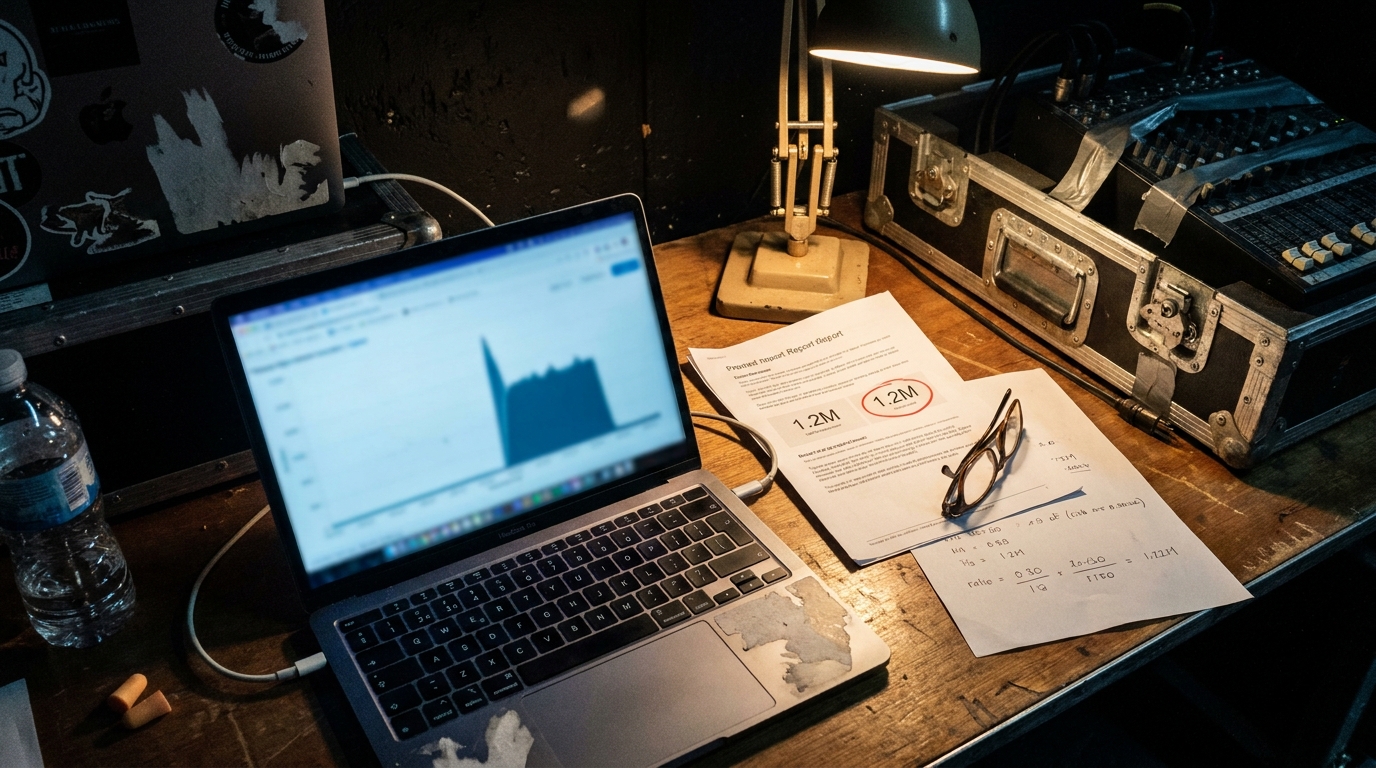
Fake Spotify streams stopped being a vanity problem and became a balance-sheet problem: Spotify has charged labels and distributors per-track penalties for artificial streaming since 2024, removed more than 75 million spam tracks in the twelve months to September 2025, and withholds royalties on detected fraud. The label's exposure is structural — penalties land on the account that delivered the track, which means a label inherits every botted campaign an artist ran before signing. The audit method: read listener-source mix for placement-heavy profiles, check stream-to-save and follower-to-listener ratios against genre norms, look for geographic patterns that do not match the artist's real audience, and match historical spikes to what was actually happening at the time. Based on 2,400+ campaigns run by our founding team, roughly the same ratios that predict algorithmic pickup also expose bought streams — real demand and rented demand leave different fingerprints everywhere.
Why Fake Streams Are Now a Label Problem
For years, botted streams were treated as the artist's embarrassment: inflated numbers, awkward questions, nothing more. The enforcement era changed the address the bill goes to.
Spotify's artificial-streaming penalties, in force since 2024, are charged per track to labels and distributors — the entities that delivered the music, not the artist who bought the bots. Detected artificial streams are removed from royalty calculations, tracks can be taken down, and repeat patterns put the delivering account's whole catalog under scrutiny. The scale of enforcement is not theoretical: more than 75 million spam tracks removed in a single year through September 2025.
For a label this creates three distinct exposures. Direct cost, when penalties hit the label's distribution account. Inherited risk, when a new signing arrives with botted history from a pre-signing promo run — the history transfers with the catalog, the penalties arrive later. And reputational drag, the quietest one: editors, bookers and playlist curators read ratios, and a roster whose numbers do not hold together pitches worse everywhere, forever.
The uncomfortable conclusion follows directly: a stream audit is no longer optional hygiene. It is signing diligence and quarterly maintenance, the same as accounting.
The Fingerprints: Real Demand vs Rented Demand
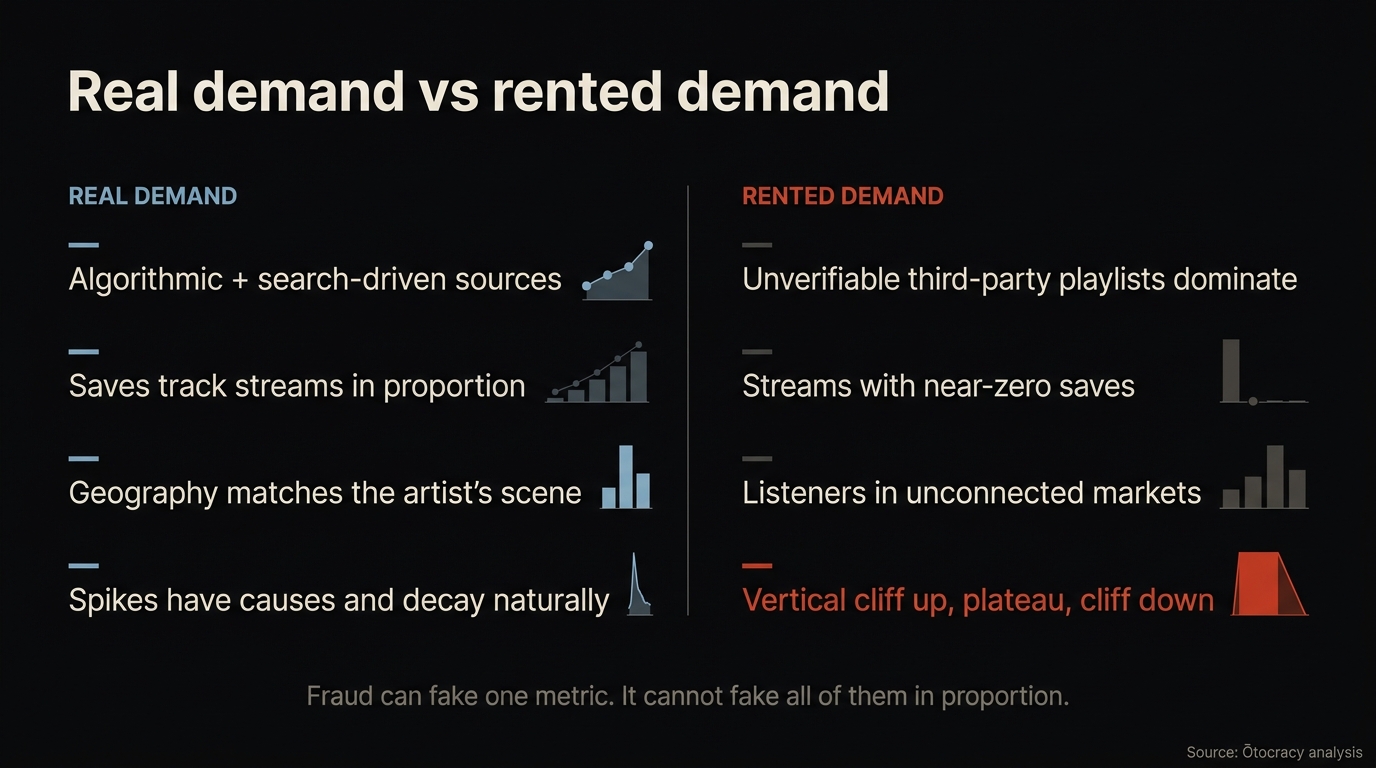
Bought streams are manufactured to inflate one number. Real listening moves many numbers together — and that difference is the entire basis of the audit. Based on 2,400+ campaigns run by our founding team, a record with genuine demand shows saves, repeats and follower conversion rising in proportion to streams; fraud can afford to fake one of those, never all of them at once.
| Signal | Real demand looks like | Rented demand looks like |
|---|---|---|
| Listener source mix | Meaningful algorithmic share (Release Radar, Discover Weekly, radio) plus search and library plays | Dominated by third-party playlists you cannot verify; algorithmic share near zero |
| Stream-to-save ratio | Saves track streams at a steady genre-typical rate | Tens of thousands of streams, near-zero saves — bots do not build libraries |
| Follower-to-listener ratio | Monthly listeners in plausible proportion to followers | Enormous listener counts on a profile almost nobody follows |
| Geography | Concentrated where the artist actually has an audience — home market, tour cities, scene hubs | Spread across countries with no connection to the artist, or concentrated in known farm regions |
| Spike shape | Rises with a cause: a release, a support, a TikTok moment — and decays naturally | Vertical cliff up, plateau, vertical cliff down; no external event matches the dates |
| Playlist quality | Playlists with real followers, active curation, coherent genre identity | Placement lists with huge track counts, no engagement, follower counts that never move |
None of these signals is decisive alone; a genuine viral moment can look spiky, and a great record can over-index on playlists briefly. The audit's strength is convergence — rented demand fails several checks at once, because faking one metric coherently across all of them costs more than the fraud earns.
The Roster Audit, Step by Step
Run this per artist at signing, and across the roster quarterly. With practice it takes under an hour per profile.
- Pull the listener-source breakdown. Spotify for Artists shows where streams originate. A profile earning most of its volume from unverifiable third-party playlists carries rented weight even when no bots are involved — attention that stops the day the placement does. This is the single highest-value read, and it is the one Otocracy's free AI audit automates source by source.
- Compute the two ratios. Streams to saves, and followers to monthly listeners, benchmarked against your own roster's clean profiles rather than abstract norms. Electronic subgenres differ — completion behaves differently on a seven-minute record, as the afro house breakdown covers — but within a genre the clean band is surprisingly narrow.
- Map geography against reality. Plot the top listener cities against where the artist has actually played, charted or trended. A techno act from Leipzig with its audience in Leipzig, Berlin and Amsterdam makes sense. The same act with dominant listenership in markets it has never touched needs an explanation, and "the algorithm" is not one.
- Match every historical spike to a cause. Take the streaming timeline and annotate it: release dates, supports, playlist adds, TikTok moments. Spikes with no annotation are the audit's core finding. Ask the artist directly — the honest ones usually know exactly which promo purchase produced which bump, and honesty here is a good signing signal in itself.
- Vet the playlists by hand. For the top placements driving volume: does the playlist have real followers, coherent curation, engagement that moves? Ten minutes of manual checking separates curator playlists from placement farms — the same vetting discipline covered in Spotify promotion for electronic artists.
- Write the verdict down. Clean, explainable, or flagged — with the evidence attached. At signing, flagged history becomes a conversation and sometimes a contract clause. In-roster, it becomes a decision about what stops.
The same shape shows up off Spotify. On SoundCloud, artificial plays arrive without likes, reposts or comments, so the ratios collapse while the play count climbs — which is only legible if you know what normal looks like for that follower tier. The measured bands are in SoundCloud engagement rate benchmarks.
What to Do With What You Find
Pre-signing, flagged history is negotiating material, not automatically a dealbreaker. Plenty of artists bought a botted "promotion" package once, believing it was real marketing — the industry sells the two in identical packaging. What matters is scale, recency and candor. A small old purchase, disclosed when asked, is survivable. A profile whose entire baseline is manufactured is not a catalog; it is a liability with artwork.
In-roster, stop feeding flagged records first. Pause paid promotion into any profile whose numbers will not survive scrutiny — amplifying a compromised profile spends money teaching algorithms to serve listeners who do not exist. Rebuild from the real audience segment, however small the audit says it is. Real numbers that grow beat big numbers that evaporate under a curator's thirty-second ratio check.
Never buy your way out. The temptation after a bad audit is to "fix" the ratios with more purchased activity. Every enforcement mechanism above is built to catch exactly that, and the penalties are now priced per track. The only exit is the slow one: legitimate seeding, real playlisting, actual listeners — the same channels in the label marketing stack, pointed at a profile that needs its baseline rebuilt honestly.
Make the audit a standing line item. Quarterly across the roster, always at signing, and before any major budget commitment to a record. The tiered budget in the label allocation guide assumes response data is real; the audit is what makes that assumption safe.
Frequently Asked Questions
How can you tell if an artist has fake Spotify streams?
Look for convergence across signals: a listener-source mix dominated by unverifiable third-party playlists, streams without proportional saves, monthly listeners wildly out of line with followers, geography unconnected to the artist's real audience, and historical spikes no release or event explains. One anomaly is a question; several together are a finding.
Does Spotify punish labels for artificial streaming?
Yes, directly. Since 2024 Spotify has charged per-track penalties to the labels and distributors that delivered music with detected artificial streaming, alongside removing fraudulent streams from royalty calculations and taking tracks down. It removed over 75 million spam tracks in the year to September 2025. The bill goes to the deliverer, not the buyer.
Can a label be penalized for streams an artist bought before signing?
The exposure transfers with the catalog: once the label delivers or re-delivers those tracks, detected artificial history lands on the label's distribution account. That is why a stream audit at signing is now standard diligence — the label prices in inherited risk before the deal, not after the penalty notice.
What is a normal stream-to-save ratio on Spotify?
There is no universal number — it varies by genre, playlist context and track age — which is why the useful benchmark is internal: compare each profile against the clean artists on your own roster in the same subgenre. The pattern that matters is divergence: profiles far outside your roster's band, especially with high streams and near-zero saves.
Are all third-party playlist streams fake?
No — genuine curator playlists with real followings are legitimate and useful. The concern is placement-heavy profiles: when unverifiable lists supply most of a record's volume, the attention is rented even if human, and it vanishes when placements end. Vet the top playlists by hand: real followers, active curation, coherent identity.
How often should a label audit its roster's streams?
Quarterly for the active roster, always at signing, and before any major campaign commitment to a record. A quarterly pass takes under an hour per profile once the method is standard, and it protects the two things a label cannot easily rebuild: its distribution account standing and its credibility with curators and bookers.
Every number on a roster is either an asset or a claim someone will eventually check — Spotify's fraud systems, a festival booker, an editor reading ratios before a pitch. Audit before they do: at signing, quarterly, and before big budget moves. If you want the first pass done in minutes instead of an afternoon, Otocracy's free AI audit breaks any artist's profile down source by source — the same read we run before taking a roster into the label program.