Label Marketing Budget: Allocation Across a Roster (2026)
Build a label marketing budget for 2026: per-release tiers, the honest math for a 12-release year, reserve-pool rules and the leaks that drain rosters.

Quick Answer
A label marketing budget is an allocation rule, not a number. The structure that works: give every release an identical baseline test of roughly €300-500, hold 40-50% of the annual budget in a reserve pool that deploys only toward releases whose test data responds, and keep 10% liquid for catalog moments. For a 12-release year that means roughly €4,200-6,000 in committed testing and a reserve of similar size or larger, deployed unevenly by design. The channel math underneath comes from published benchmarks: €9-14 entertainment CPMs on Meta, €100-500 per micro-creator post, a €50/day TikTok ad-group minimum, and curator pitching from €1-4 per submission. Based on 2,400+ campaigns run by our founding team, rosters that fund releases by measured signal outperform rosters that split budget evenly — the even split is the single most common leak in label spending.
The Allocation Rule Before the Numbers
Ask ten label managers for their marketing budget and you get a number. Ask how it moves between releases and you usually get silence — the number was divided by the release count and that was the plan.
That even split feels fair and performs terribly. Streaming outcomes across a roster are radically unequal: a few records will generate most of the value, and the budget's job is to find them quickly and fund them properly. What follows is the allocation architecture in numbers — the portfolio logic behind it is covered in the music label marketing guide, which is worth reading first if you have not.
The rule in one line: test everything identically, scale only what responds, and never commit the reserve at signing.
Per-Release Tiers: What Each Level of Spend Buys
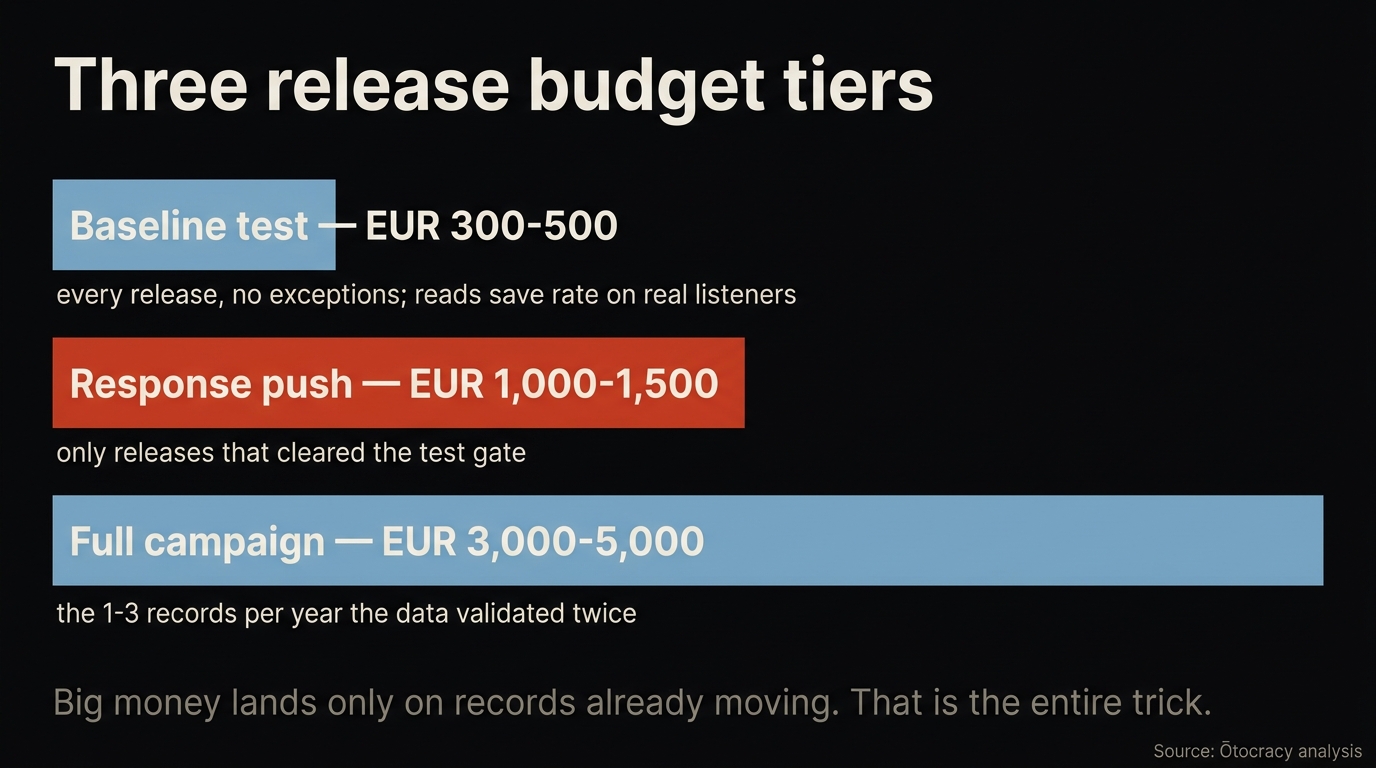
Every figure below is anchored to published channel benchmarks — the same ones detailed line-by-line in what €500, €1,500 and €5,000 actually buy, adapted here for label workflow.
| Tier | Spend per release | What it buys | Which releases get it |
|---|---|---|---|
| Baseline test | €300-500 | Micro-creator seeding (2-4 posts at €100-500 published rates) or a 3-4 week Meta flight at €9-14 CPM; save-rate and completion read on real listeners | Every release, no exceptions |
| Response push | €1,000-1,500 | Creator wave on the proven clip, paid amplification behind it, legitimate curator pitching (€1-4 per SubmitHub submission; campaigns from €285 at Playlist Push) | Releases whose test cleared your save-rate benchmark |
| Full campaign | €3,000-5,000 | Multi-week creator wave plus Meta and TikTok paid (the €50/day ad-group minimum makes TikTok ads viable only at this tier), retargeting, sustain flight | The 1-3 records per year the data has already validated twice |
Notice what the structure refuses to do: it never spends €5,000 on instinct. A record reaches the full-campaign tier only by clearing two measured gates, which means the big money almost always lands on records already moving. That is the entire trick.
The Honest Math for a 12-Release Year
Here is the full-year table for an independent electronic label running one release a month:
| Budget line | Share | 12-release year at €15K | 12-release year at €30K |
|---|---|---|---|
| Baseline tests (12 × €350-500) | ~30% | €4,500 | €5,500 (richer tests) |
| Reserve pool (follows signal) | 45% | €6,750 | €13,500 |
| Catalog moments (held liquid) | 10% | €1,500 | €3,000 |
| Tooling, content, contingency | 15% | €2,250 | €4,500 (more per-release content) |
Read the reserve line carefully — it is the budget's center of gravity. At €15K total, the reserve funds roughly four response pushes and one full campaign; at €30K it funds the same pushes plus two or three full campaigns. In both cases most releases receive only their baseline test, and that is not a failure of the budget. It is the budget working: the test gave every record a fair, measured shot, and the money went where listeners actually responded.
The catalog line is the one labels cut first and regret most. When an old record starts moving — a TikTok edit, a sync moment, a DJ support run — amplification inside the first days captures the wave. Re-promotion mechanics are covered in the catalog strategy guide; the budget's only job here is existing when the moment arrives.
Where Label Budgets Leak

Based on 2,400+ campaigns run by our founding team, the recurring leaks at label level are remarkably consistent:
- The even split. Covered above, still worth naming: dividing budget by release count guarantees underfunding your winners to overfund your non-responders.
- Guaranteed playlist placements. Legitimate curator pitching costs €1-4 per submission. Anyone selling "guaranteed adds" at a flat fee is selling either payola or bots, both of which Spotify penalizes — and since 2024 those per-track penalties land on labels and distributors directly. If a profile's history looks suspicious, audit the roster for fake streams before another euro touches it.
- Boosted posts. Boosting optimizes for engagement from people predicted to react, not to listen. At label scale this leak compounds monthly across every artist page. Ads Manager, always.
- Renewing vendors nobody measures. Every label carries at least one legacy line — a PR retainer, a pitching service — that survived because cancelling requires a decision. Zero-base the vendor list quarterly against one question: what number did this line move?
- Paying full campaign prices for unproven records. The tier structure exists precisely to stop this. If a vendor's minimum engagement exceeds your baseline-test tier, they are the wrong vendor for testing — whatever their quality at campaign scale.
Running the Budget: Cadence and Triggers
An allocation rule only works if reallocation actually happens. Three mechanics keep it honest:
- Define the gate in advance. Write down the save-rate and completion thresholds that promote a release from test to push before the release goes out. Deciding after the fact converts every gate into a negotiation with whoever loves the record most.
- Review weekly, move monthly. Delivery data gets read every week; reserve deployments happen on a monthly rhythm unless a signal is time-critical. Faster than monthly invites noise-chasing; slower lets signals decay.
- Track cost per engaged listener across the roster. One number, comparable between releases and between channels: what the label paid for a listener who saved, followed or repeated. When a release's cost per engaged listener runs multiples of the roster median, stop funding it regardless of anyone's feelings — the free AI audit gives you the per-source baseline for any artist before you even sign them.
Labels running several releases a month can also simply move the whole problem onto shared infrastructure — Otocracy's label program prices campaigns at wholesale across a roster, with per-release projections in writing and one delivery dashboard instead of twelve vendor threads.
If You Are a Manager Rather Than a Label
The allocation logic is the same; the accountability is not. A label spends its own money, while a manager spends each artist's money and has to get approval first and prove results afterwards, per artist. That changes what pricing and reporting need to look like — covered in roster marketing for artist managers.
Frequently Asked Questions
How much do independent labels spend on marketing per release?
Meaningful spend starts around €300-500 per release for a single properly funded channel — below that, most paid options underperform or are outright scams. Releases with measured response justify €1,000-1,500 pushes, and validated records support €3,000-5,000 multi-channel campaigns. The tiers matter more than the totals.
What percentage of label revenue should go to marketing?
Working backwards from releases beats working forwards from revenue: the schedule times the tier structure gives a defensible number, then check it against cash flow. Early-stage labels commonly land between 15% and 30% of expected annual revenue, but a budget derived from release math survives scrutiny better than a ratio.
Should every release on a roster get promotion budget?
Every release should get the identical baseline test — €300-500 of measured exposure that reads save rate and completion on real listeners. Beyond the test, no: reserve budget follows response data. Funding all releases equally past the test stage systematically drains money from the records that are actually working.
Is paid playlist placement ever worth including in a label budget?
Legitimate curator pitching is — €1-4 per submission via SubmitHub, campaigns from €285 via Playlist Push, always with the right to reject. Guaranteed placements are not: Spotify prohibits them, penalizes artificial streaming with per-track charges to labels since 2024, and removed over 75 million spam tracks in the year to September 2025.
How do I budget for TikTok as a label?
Creator seeding first: micro creators run €100-500 per post at published rates, and 2-4 posts read a sound's potential. TikTok's own ads carry a €50/day ad-group minimum, which makes paid amplification a full-campaign-tier tool, not a testing tool. Seed, read the data, then amplify what the sound page proves.
What should a label cut first when the budget shrinks?
Cut the response-push tier before the baseline tests. Testing is how the label learns which records deserve money at all; losing it turns every remaining euro into a blind bet. Shrink the reserve, protect the tests, and keep the catalog line — small budgets make captured catalog moments proportionally more valuable.
A label budget is a decision system wearing a spreadsheet. Set the tiers, write the gates down before release day, and let the reserve follow the data instead of the room's loudest opinion. If you want the same math run on your actual roster — every artist broken down source by source before you allocate a euro — Otocracy's free AI audit is the place to start, and the label program is what it feeds into.