Roster Marketing for Artist Managers: Approval and Proof
Roster marketing is an approval and accountability problem, not a campaign problem. Why published prices and per-artist reports are what decide it.

Quick Answer
Marketing across a roster is not primarily a campaign problem. It is an approval and accountability problem: a manager has to get each artist to agree to spend their money, then prove afterwards what that money did, per artist, in a form the artist can read without the manager in the room. Artist management software does not solve this — Stagent, Artist Growth and Artist HUB handle calendars, contracts, bookings and invoices, and none of them runs or reports a campaign. The two things that actually unblock a manager are unglamorous: a published price list, because an approval email needs a number the artist can verify independently, and per-artist reporting they can forward without editing. Everything else, including which channels a campaign uses, is downstream of being able to get a yes and then show what happened.
Managers are the most under-served buyer in music marketing, and it is because everybody sells to them as though they were a small label.
They are not. A label spends its own money and answers to itself. A manager spends somebody else's money and answers to that person, several times over, across a roster of artists who talk to each other.
That difference changes what a manager needs, and almost nothing in the market is built around it.
What Management Software Does Not Do
Search for tools and you will find the artist-management software category: Stagent for booking agencies juggling contracts and invoices, Artist Growth for calendars, tickets and finances, Artist HUB as a CRM for management companies. There is a real market there and the tools are reasonable at what they do.
None of them runs a campaign, and none of them reports on one. They manage the administration around an artist's career; the marketing sits outside them entirely, usually in a spreadsheet and an agency's PDF.
So the manager running promotion across eight artists is stitching together a booking tool, a smart-link tool, whatever each agency sends, and a spreadsheet that only they understand. The stitching is the job nobody has built for.
The Approval Problem
Before any campaign runs, a manager has to get a yes.
That conversation is not about strategy. It is an artist being asked to spend two or four thousand euros of their own money on something they cannot evaluate, on the recommendation of somebody who benefits from the relationship continuing. It is a trust transaction, and it goes wrong in a specific way: the artist asks what it costs, the manager says they will find out, and the momentum dies in the gap.
What resolves it is a number the artist can check themselves.
Why Published Prices Beat Negotiated Ones
This is the counter-intuitive part, and it took us a while to understand why managers care about it so much.
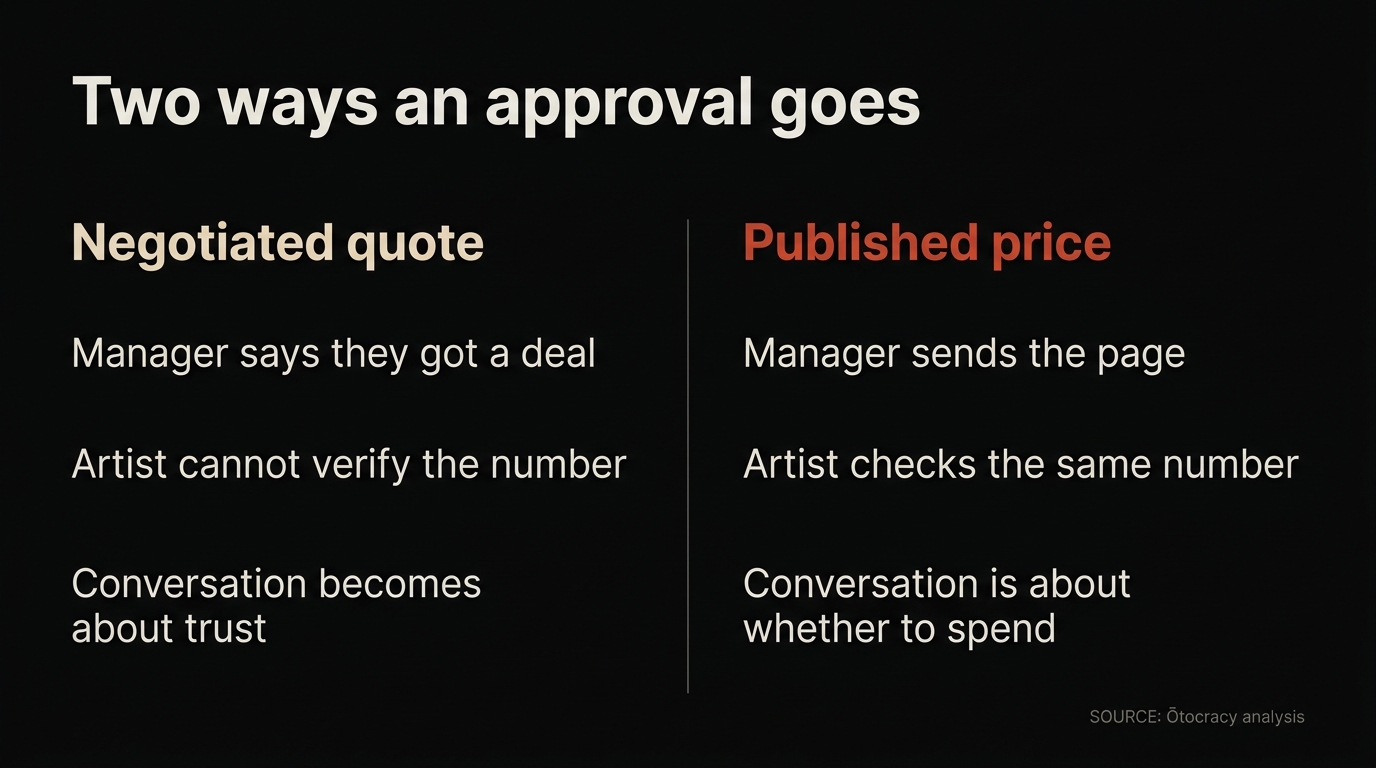
A negotiated rate is worse for a manager than a published one, even when it is cheaper. A quoted price means the approval email says "I got us a deal" — which invites the artist to wonder what the real price was, whether the manager is getting something, and why it needed negotiating at all.
A published price means the email says "it costs this, here is the page." The artist checks the link, sees the same number, and the conversation is about whether to do it rather than about whether the manager is straight. Transparent pricing is consistently the thing B2B buyers say they want first, and in management the reason is unusually sharp: the buyer has to justify the number to somebody else.
The practical rule for anyone selling to managers, and the one we hold ourselves to: whatever a manager pays should be visible on a public page, and any roster benefit should apply automatically rather than through a code they had to ask for. A manager should never have to explain a discount they negotiated.
The Reporting a Management Contract Requires
The second half arrives after the campaign, and it is where most agency relationships quietly fail a manager.
A standard campaign report is written to the person who bought it. The manager cannot forward it, because it is addressed to them, discusses several artists, or contains commercial detail that is theirs rather than the artist's. So the manager rewrites it — summarising results into an email, by hand, per artist, every time.
That is the tax nobody prices in. It is also the thing a management contract usually requires in some form: an accounting of what was spent on that artist and what it produced.
What removes it is per-artist reporting produced as a matter of course. One version for the manager, and an artist-named version written to be forwarded without editing — covering what ran, what it cost, and what happened, for that artist only.
Two details make the difference between a report that works and one that does not:
- Per-artist ledgers from the first purchase. Not a roster total split retroactively. If accounting is not per artist at the point of spend, it cannot be cleanly reconstructed later.
- Fees and ad budget kept separate and never summed. An artist reading a single blended number cannot tell what went to a platform and what went to a service, and a manager who presents it that way will eventually be asked to explain it.
Pooling Spend Without Punishing Anyone
The other structural need is scale benefit that does not create an internal fairness problem.
A manager buying campaigns for eight artists is a larger customer than any one of them, and should be treated as one. But if that benefit arrives as a discount on some artists and not others, the manager has invented a conversation they do not want to have.
The clean structure is that fee volume accumulates across the whole roster and improves the price for every artist at once, automatically, at thresholds published in advance. No codes, no negotiating, and no artist wondering why another artist got the better rate. Each artist keeps their own ledger; the buying power is shared.
This is what Ōtocracy's roster account is built around, and it is free to open — the pricing is the public list price, with the ladder applying by itself as volume accumulates. How a label month is built shows the campaign structure underneath it.
The Handover Problem
Every manager eventually loses an artist, and the marketing history is the part nobody plans for.
When an artist leaves, they are usually entitled to an accounting of what was spent on their behalf. If your reporting is per artist and forwardable, that is a five-minute export. If it is a roster spreadsheet with campaigns blended across eight people, it is a week of reconstruction and an uncomfortable conversation about numbers that do not quite reconcile.
The same applies in reverse when you sign somebody. An artist arriving from another manager usually brings nothing usable — no campaign history, no record of what was tried, no idea what worked. You will rebuild that knowledge with their money.
Two things worth setting up before you need them. Keep the artist-facing reports somewhere the artist can be given access to rather than sent copies, so handover is a permission change. And make sure the account structure separates artists cleanly enough that one leaving does not require unpicking the others.
Across the 2,400+ campaigns run by our founding team, the managers who handle departures well are simply the ones whose accounting was already per artist. Nobody reconstructs it gracefully after the fact.
Running a Roster Without Eight Systems
Practically, a manager wants four things visible in one place: who has work running, who has gone quiet, what each artist has spent, and what is scheduled next.
Across the 2,400+ campaigns run by our founding team, the managers who scale past roughly five artists are the ones who stopped tracking marketing per artist in separate places. Not because the tooling is magic, but because per-artist tracking in eight places means the quiet artist is invisible until they complain.
The diagnostic worth running before any of this: for each artist on your roster, can you say in ten seconds what was last spent on them and what it produced? Where the answer is no, the problem is usually reporting rather than performance — and it is the artists you cannot answer for who are most likely to be the ones considering a change.
If you want a read on where a given artist's audience is actually coming from before committing anyone's budget, the free audit does it per artist at no cost. The roster-economics view sits in label marketing budget allocation, and distributors facing a version of the same problem across many labels will find it in white-label marketing for distributors.
Frequently Asked Questions
What software do artist managers use for roster marketing?
Mostly none, because the category does not exist. Artist management platforms like Stagent, Artist Growth and Artist HUB handle bookings, contracts, calendars and invoices but do not run or report campaigns, so marketing typically lives in a spreadsheet alongside whatever each agency reports separately.
How does a manager get an artist to approve marketing spend?
With a number the artist can verify independently. A published price on a public page lets the approval conversation be about whether to spend, rather than about whether the manager negotiated fairly. Quoted rates create a question that slows approvals down.
What should a per-artist campaign report contain?
What ran, what it cost, and what it produced for that artist alone, in a version the manager can forward without editing. Fees and advertising budget should be shown separately and never combined into one figure, and the accounting should be per artist from the first purchase rather than split from a roster total afterwards.
Should roster discounts be negotiated?
Preferably not. A negotiated rate creates an internal fairness problem across a roster and forces the manager to explain a deal. Volume benefits that apply automatically at published thresholds, to every artist at once, avoid both.
How many artists can one manager run marketing for?
It depends far more on systems than on effort. Managers tend to hit a wall around five artists when marketing is tracked separately per artist, because quiet artists become invisible until they raise it. Consolidated per-artist reporting moves the ceiling considerably.
Do managers need a different service from labels?
The campaigns are the same; the accountability is not. A label answers to itself, while a manager answers to each artist individually and needs pricing they can show and reporting they can forward. Services built only for labels tend to miss both.
Should a manager or the artist pay for campaigns?
Usually the artist, from their own funds or recoupable against income, with the manager approving and overseeing. That is precisely why published pricing matters — the person paying is not the person buying, and they need to verify the number without a conversation.
What is the first thing to fix on a disorganised roster?
Per-artist accounting, before anything else. Until spend and results are attributed per artist from the point of purchase, no reporting, handover or budget conversation can be done cleanly, and every later fix is built on a number nobody trusts.
The Bottom Line
The hard part of roster marketing is not choosing channels. It is getting eight separate people to approve spending their own money, and then proving to each of them individually what it bought.
Published prices solve the first. Forwardable per-artist reporting solves the second. A service that gets both right is easier to work with than one that is marginally better at campaigns and impossible to explain to an artist.
If that is the shape of your problem, a roster account is free to open and every artist gets their own ledger from the first purchase — or talk to us if you would rather walk the roster through with somebody first.