White Label Music Marketing: The Distributor Gap
Distribution has been white-labelled for a decade. Marketing never has. What a distributor's three existing options cost, and what a fourth looks like.

Quick Answer
Search "white label music marketing" and every result is about white-label distribution — LabelGrid, FUGA, Revelator, SonoSuite and the rest, all selling backend delivery a distributor resells under its own brand. That market is mature. The marketing equivalent essentially does not exist: distributors that wanted to offer campaigns have historically had three options, and none of them is white-labelling a third-party agency. They build it in-house, as ONErpm and Believe did; they acquire, as Downtown did with Found.ee in 2021; or they move labels onto a services deal that takes a larger revenue share, which is what AWAL, Believe, Orchard and ONErpm all publish rates for. The consolidation pressure is live — UMG closed its $775M Downtown acquisition in February 2026 — and mid-tier distributors are looking for differentiation they can ship this year rather than build over three.
There is a category error sitting in the middle of this search term, and it is worth naming before anything else.
White-label distribution is a solved, competitive market. A distributor or label can license a backend, put its own brand on the dashboard, set its own pricing and sell delivery as its own product. LabelGrid, FUGA, Revelator, SonoSuite, Labelcamp and others have been doing this for years.
White-label marketing — a distributor offering campaigns to its roster under its own brand, delivered by somebody else — is not a market. It is close to an empty set. That absence is the whole subject here.
What a Distributor Actually Wants This For
The commercial pressure is straightforward. Distribution margins are thin and the product is largely undifferentiated: delivery to the same stores, at broadly similar speed, for broadly similar money.
What a distributor's labels ask for is not faster delivery. It is help making releases perform. A distributor that can answer that question keeps labels it would otherwise lose to a services deal elsewhere, and it earns on something other than a percentage of delivery.
The barrier has never been demand. It has been that building a campaign operation is a different business from running delivery infrastructure — different staff, different risk, different failure modes.
The Three Options, and What Each Costs
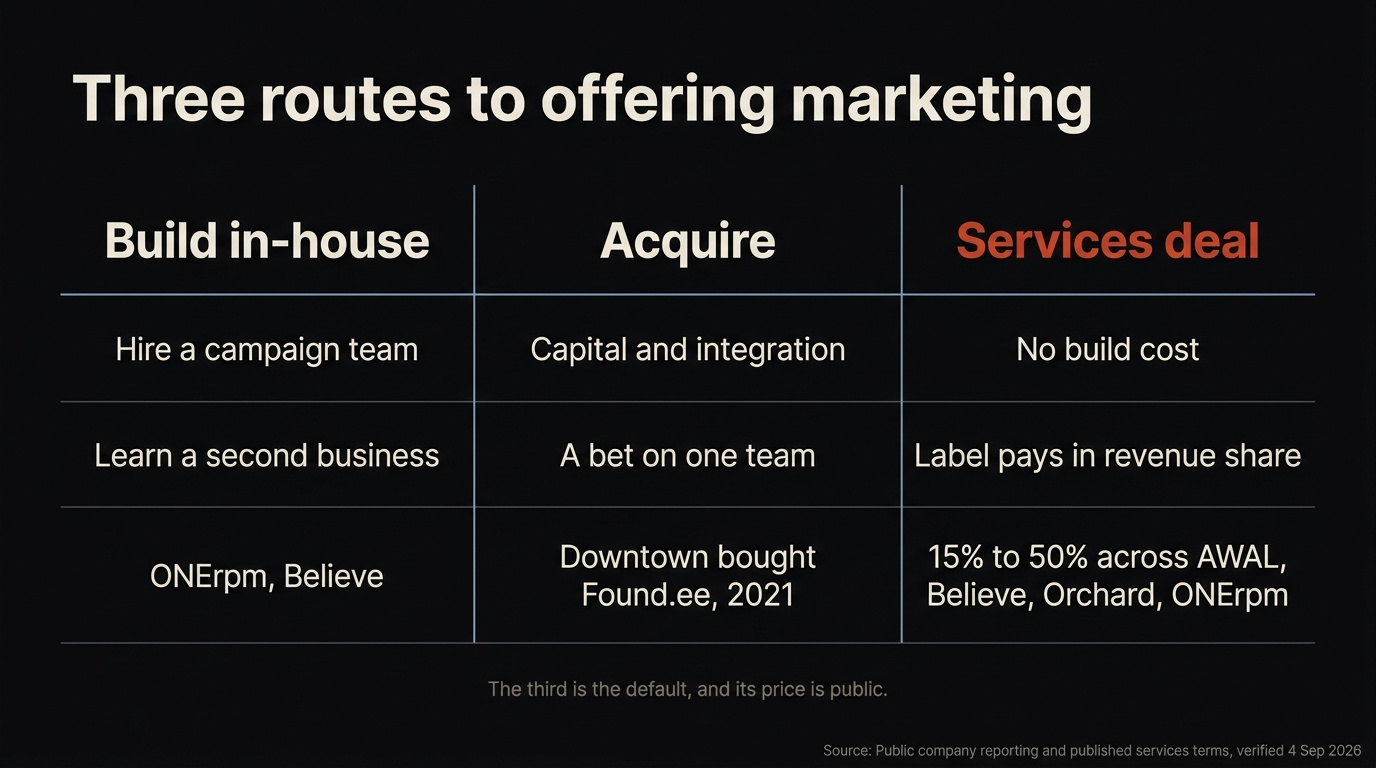
Every distributor facing this has picked from the same short list.
| Option | What it takes | Real examples |
|---|---|---|
| Build in-house | Hiring a campaign team, learning a second business, 18 months minimum | ONErpm, Believe |
| Acquire | Capital, integration, a bet on one team | Downtown acquired Found.ee, January 2021 |
| Push labels to a services deal | No build cost — but the label pays in revenue share, not fees | AWAL, Believe, Orchard, ONErpm |
The third is the one worth examining, because it is the default and its price is public.
Label-services take rates are a matter of record. AWAL publishes roughly 15% on its core tier, rising to 20-30% on higher tiers. Believe's services deals run 15-30% and reach around 50% where marketing is funded — and around 70% of Believe's revenue comes from services deals rather than plain distribution. The Orchard sits around 15-20%. ONErpm's ladder runs 15%, then 30%, then up to 50%. Symphonic's partner tier is roughly 85/15 with a three-year exclusivity.
Read that as a price list, because that is what it is. The cost of a distributor's marketing help, as the market currently prices it, is a materially larger share of the artist's revenue — often permanently, and often with exclusivity attached.
Why Nobody Has Taken the Fourth Route
The pattern across the last decade is acquire-or-build, with no meaningful example of a distributor white-labelling an independent marketing agency at scale.
The reasons are not mysterious, and they are the reasons any arrangement has to solve.
Roster exposure. Handing a third party your label list means handing them a customer list. The obvious fear is that the agency ends up selling to your labels directly, and there is no reason a distributor should take that on trust.
Quality attribution. If a campaign delivered under your brand goes badly, the label blames you. A distributor's brand carries the risk while somebody else does the work.
Method risk. Music marketing has a genuine fraud problem. A distributor whose partner buys bot streams for a label release has imported a catastrophe — the label gets flagged, the distributor gets billed, and the relationship ends. We wrote about what that detection looks like from the label side in the fake streams audit.
No pricing anchor. Distributor marketing pricing is universally unpublished — FUGA, Believe and Symphonic all quote enterprise deals privately — so there is nothing public to benchmark a partner arrangement against.
Each of those is solvable in writing. None of them is solved by goodwill.
What the Arrangement Would Actually Look Like
There is a genre precedent for the shape, if not the substance: Your Army and LabelWorx have run a partner arrangement in dance music where LabelWorx members get discounted rates on Your Army's services. Not white-label, but the same instinct — a distributor bolting a marketing offer onto its member proposition without building one.
A fuller version has to cover four things.
Two commercial modes, not one. Either the distributor refers and its labels contract directly at member rates, or the distributor commits to volume and buys centrally at wholesale, reselling under its own brand. Referral suits a distributor testing the idea; committed suits one that wants margin and control. Both should exist in the same paper so a first conversation can close either way.
Reporting that carries the distributor's brand. Campaign files and monthly roster reports the distributor forwards as its own. With one carve-out that should be non-negotiable in the other direction: factual disclosures inside a report — that campaigns used real listeners, that ad budget ran at cost — stay in. A white-label report that can be edited into a claim nobody can support is worth less than no report.
A method guarantee. Real listeners, never bots. Ad budget running at cost on the client's own accounts. Receipts per campaign. This is the clause that makes referring a roster safe, and it is worth more to a distributor than any discount.
No outcome guarantees. Nobody can promise streams, chart positions or placements, and a partner who lets a distributor represent otherwise to its roster has created a liability rather than a sale.
How a Distributor Should Evaluate a Partner
If the model is going to exist, the diligence has to be real. Five questions worth asking before any roster is exposed.
How do campaigns actually deliver? Not the outcomes claimed — the mechanism. Real listeners on real ad accounts, or supply bought from somewhere unnamed. A partner who cannot answer this precisely is the risk.
Whose ad account does budget run on? Budget running on the client's own account, at cost, is verifiable by the client. Budget running through the agency's account is not.
What does a campaign produce as evidence? Ask to see a real campaign file with the client details removed. Receipts per component, or a summary slide, tells you most of what you need.
What happens when something underperforms? A partner who has a written answer has run enough campaigns to have needed one.
Will they sign a no-solicitation clause without being asked twice? Covered below, and the most informative of the five.
Across the 2,400+ campaigns run by our founding team, the questions that predict a bad partnership are the ones about mechanism rather than results. Results can be selected; mechanism cannot.
The Objection Nobody Puts in Writing
The roster-poaching fear is the real blocker, and in most conversations it goes unspoken because raising it feels like an accusation.
It should be in the contract, offered before it is asked for: a written commitment not to solicit the distributor's labels and artists for services outside the agreement, for the life of the agreement and a defined period after. With the sensible carve-outs — clients who approach independently, and anyone who was already a client before the referral.
The honest math for a distributor is simple. A partner who volunteers that clause has priced in the risk you were worried about. A partner who will not sign it has told you what they intend.
That is the shape of what Ōtocracy offers distributors and catalogue owners: member rates for your labels or a referral share, and for committed partners, wholesale terms, white-label reporting and that covenant offered up front rather than negotiated. Terms are per-partner and quoted privately, which is standard for this kind of arrangement — talk to us if the shape fits.
Frequently Asked Questions
What is white label music marketing?
An arrangement where a marketing agency delivers campaigns for a distributor's or label's roster under that partner's brand, with reporting the partner forwards as its own. Distinct from white-label music distribution, which is backend delivery infrastructure resold under a partner brand and which dominates search results for the term.
Do any distributors white-label a third-party marketing agency?
No meaningful examples exist at scale. The established pattern is to build in-house, as ONErpm and Believe did, or to acquire, as Downtown did with Found.ee in 2021. The absence is the opportunity rather than evidence the model does not work.
What does a distributor's marketing help usually cost a label?
Typically a larger revenue share rather than a fee. Published label-services rates run around 15% at AWAL's core tier, 15-30% at Believe rising to roughly 50% where marketing is funded, 15-20% at the Orchard, and a 15% to 50% ladder at ONErpm. Several attach multi-year exclusivity.
How does a distributor protect its roster in a marketing partnership?
With a written no-solicitation covenant covering the term plus a defined period afterwards, data-processing terms that bar using roster data to market to that roster, and a method commitment on how campaigns are run. Verbal assurance is not protection.
Why is distributor marketing pricing never published?
Because these are enterprise arrangements negotiated per partner — FUGA, Believe and Symphonic all quote privately. The practical effect is that no public benchmark exists, so a distributor evaluating an offer has nothing to anchor against and should ask for the structure in writing early.
Is white-label marketing different from a label services deal?
Yes, and the difference is what the label pays with. A services deal takes a share of revenue, often permanently and often with exclusivity. A white-label marketing arrangement is priced as fees for campaigns run, leaving the label's revenue share alone.
Can a distributor resell campaigns under its own brand?
Under a committed arrangement, yes — the distributor buys at wholesale and resells under its brand with reporting that carries its logo. The carve-out worth insisting on is that factual disclosures about method stay in the report and cannot be edited out.
What should never be white-labelled in a marketing report?
Statements about how results were produced. Across the 2,400+ campaigns run by our founding team, the reports that survive scrutiny are the ones where the method is stated on the page — that campaigns used real listeners, that ad budget ran at cost. Remove those and the report becomes unverifiable.
The Bottom Line
The search term belongs to distribution, and that is precisely why the marketing side is open. A distributor looking for a way to answer "can you help my labels perform?" without an 18-month build or an acquisition has, at the moment, no obvious answer to find.
The pieces that make one workable are not exotic: two commercial modes, branded reporting with non-removable factual disclosures, a method guarantee, and a no-solicitation covenant offered before it is requested.
Consolidation is doing the rest of the arguing. With UMG's $775M Downtown acquisition closed in February 2026, mid-tier distributors are looking for differentiation they can put in front of labels this year. How a label month is built shows what would sit behind such an arrangement, and label marketing in 2026 covers the roster economics underneath it.
Third-party rates and corporate events cited here come from public reporting and companies' own published terms, verified 4 September 2026. Confirm current rates directly — services tiers change frequently.