Music Label Marketing: Scaling a Roster in 2026 [Guide]
Music label marketing is portfolio management, not artist promotion times ten: the channel stack, roster economics and operating cadence for 2026.

Quick Answer
Music label marketing is portfolio management, not artist promotion multiplied by roster size. An independent artist optimizes one release; a label allocates a fixed budget across many releases where outcomes are unequal by design — a few records return most of the value, and the job is making sure the budget finds them. In practice that means three systems: a per-release promotion engine (TikTok seeding, editorial pitching, paid amplification), a portfolio allocation rule that funds signals rather than favorites, and an operating cadence that reads delivery data weekly and moves money toward what responds. The electronic music industry reached $15.1 billion in 2025 per the IMS Business Report, and 51% of 16-24-year-olds discover music on TikTok per MIDiA — the demand is there. Based on 2,400+ campaigns run by our founding team, labels that reallocate mid-cycle outperform labels that set budgets at signing and never touch them.
Why Music Label Marketing Is Not Artist Marketing Times Ten
An artist has one career and every release is existential. A label has a portfolio, and pretending otherwise is the most expensive mistake in label marketing.
The math is unforgiving. Across any roster, streaming outcomes follow a steep power law: a small share of releases generates most of the catalog's consumption, and nobody — not the A&R who signed the record, not the artist, not the marketing lead — reliably knows in advance which ones. The honest response is not to promote everything equally, and not to bet everything on the presumed single. It is to run a system that gives every release a fair test cheaply, then concentrates budget where the data responds.
That single idea separates the two disciplines. Artist marketing asks "how do we make this record work?" Label marketing asks "which of these twelve records is working, and how fast can we move money toward it?" Everything below — the channel stack, the allocation tables, the weekly cadence — exists to answer the second question.
The Channel Stack at Roster Scale
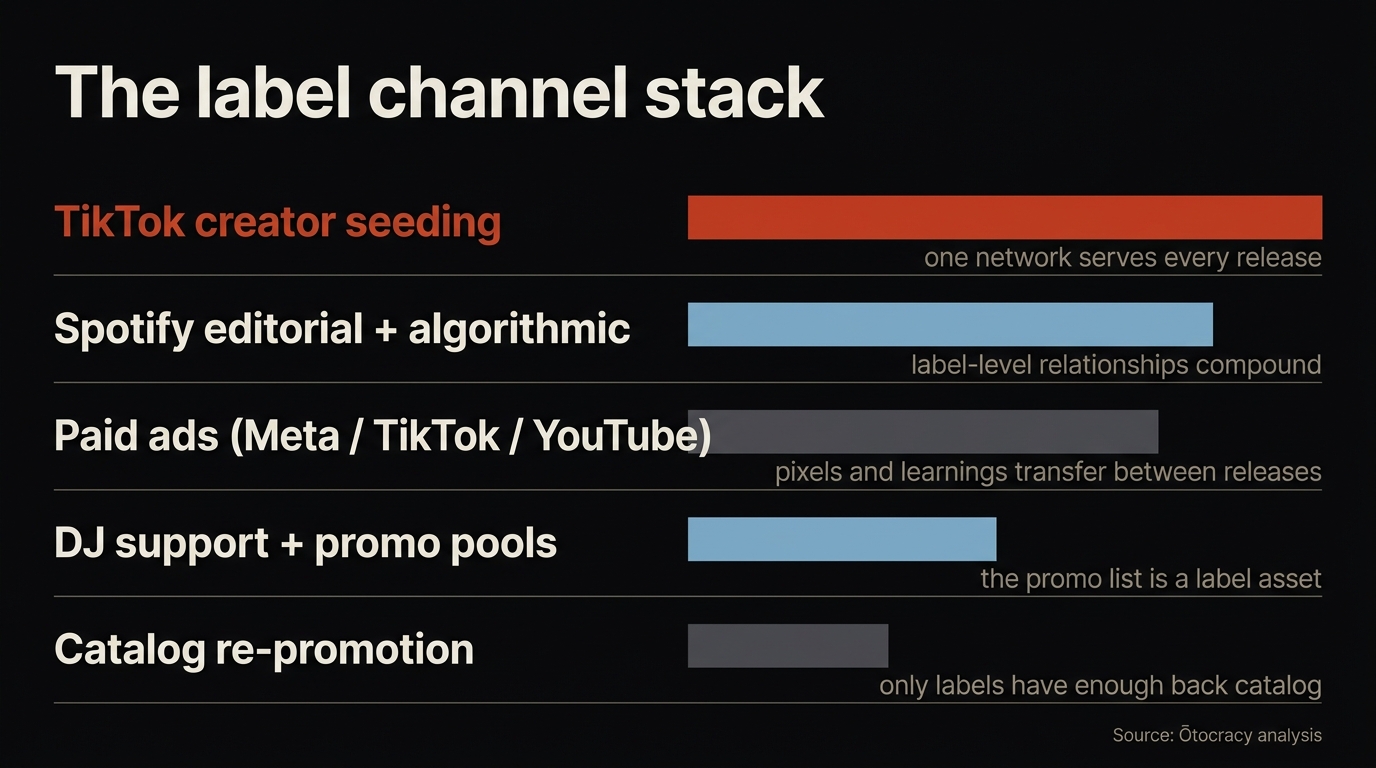
The channels are the same ones any electronic artist uses — the complete EDM promotion guide maps them from the artist side. What changes at label scale is the economics of each.
| Channel | Role | Roster-scale advantage |
|---|---|---|
| TikTok creator seeding | Discovery engine | One creator network serves every release; per-campaign setup cost collapses |
| Spotify editorial + algorithmic | Monetization layer | Label-level editorial relationships compound; one pitching process, many records |
| Paid ads (Meta, TikTok, YouTube) | Amplifier for proven signals | Shared pixels, shared lookalike audiences, creative learnings transfer between releases |
| DJ support + promo pools | Scene credibility | The label's promo list is an asset no single artist can build |
| Catalog re-promotion | Compounding layer | Only labels have enough back catalog for this to matter — see below |
Two of these deserve emphasis. First, creator seeding is where scale pays most visibly: an independent artist negotiates creator rates from zero for every release, while a label running monthly campaigns through the same network gets continuity pricing and — more valuable — accumulated data on which creator types move which subgenres. This is the mechanic behind Otocracy's label program: the roster shares one creator pipeline instead of buying access twelve separate times.
Second, catalog. An artist has five records; a label has five hundred. Every trend cycle, sync placement or viral edit is a chance for an old record to earn again, but only if someone is watching for the signal. Catalog re-promotion is covered in depth in our release pipeline and catalog strategy guide.
Roster Economics: Funding Signals, Not Favorites
Before the money, fix the calendar: Beatport stops considering releases for store features two weeks out and pre-orders open four weeks ahead, so a late delivery forfeits both regardless of budget. How Beatport charts work has the lead times.
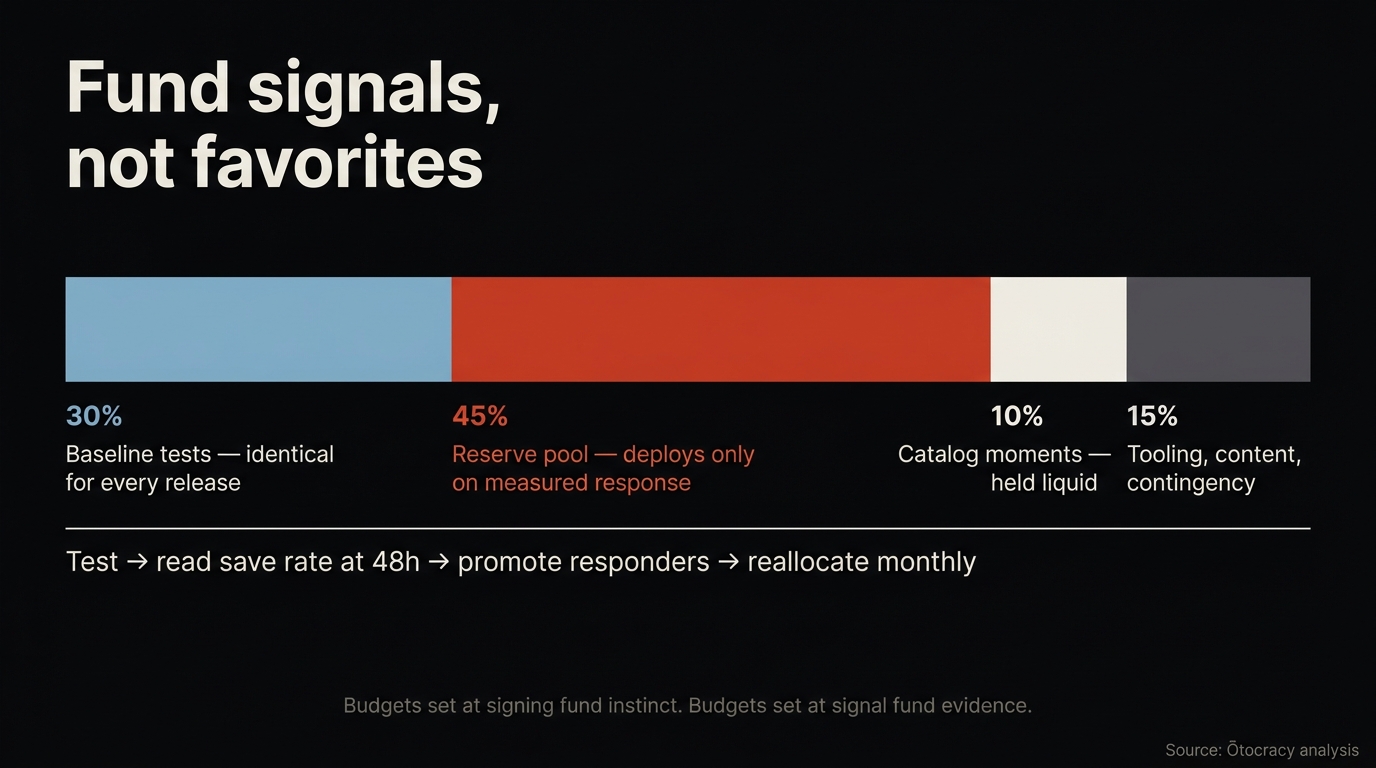
Here is the allocation architecture that survives contact with a real release schedule. The specific numbers per tier — what a €500 test, a €1,500 push and a €5,000 campaign each buy — are in the label budget allocation breakdown, but the structure matters more than the figures.
Every release gets a baseline test. Small, identical, non-negotiable: enough creator seeding or paid traffic to read save rate and completion on real listeners. The test is not promotion — it is price discovery on attention. A release that responds earns the next tranche; a release that does not gets its dignity and no more money.
A reserve pool follows the data. The largest share of the marketing budget is committed to nothing at signing. It deploys mid-cycle, toward whichever releases cleared the test, at the moment the signal appears. This is the part most labels get wrong: budgets set at signing are bets on A&R instinct; budgets deployed at signal are investments in evidence.
A small share holds for catalog moments. When a three-year-old record starts moving on TikTok, the label that can fund amplification within days captures the moment. The label that has to find budget in next quarter's plan reads about it later.
Based on 2,400+ campaigns run by our founding team, the single biggest performance gap between labels is not channel choice or creative quality. It is reallocation speed — how many days pass between a save-rate signal appearing and money moving toward it.
In-House, Outsourced, or Hybrid
The build-versus-buy question arrives at every label between roughly five and fifteen releases a year. The honest comparison:
| Model | Monthly cost shape | Where it wins | Where it breaks |
|---|---|---|---|
| In-house marketer | Fixed salary regardless of release count | Brand voice, artist relationships, long-term consistency | One person cannot be a creator network, a media buyer and an analyst; execution ceilings appear fast |
| Full agency outsourcing | Per-campaign or retainer | Execution depth, existing creator networks, benchmark data across many labels | Costs scale linearly with releases; a bad agency is invisible until the quarter is gone |
| Hybrid | Small fixed core + campaign partner | Label keeps strategy and relationships; partner supplies execution muscle | Requires the label to actually read delivery reports, not just forward them |
The pattern we see work: labels keep A&R, artist relationships and creative direction in-house permanently — those compound and cannot be rented — and buy campaign execution where a partner's infrastructure is simply better than anything a label can build below major-label scale. A creator network with hundreds of scene-matched accounts, negotiated rates and delivery reporting is the clearest example; how creator campaigns actually run shows why that infrastructure is hard to improvise.
Whichever model you choose, apply one filter ruthlessly: the vendor must commit to a number in writing. A projected outcome, a delivery report you can verify against your own Spotify for Artists data, and a stated remedy for underdelivery. Vendors who answer that request with adjectives are telling you their results are adjectives too.
The Operating Cadence: A Label Marketing Week

Strategy documents do not market records; operating rhythms do. The cadence that keeps a roster moving:
- Weekly: the delivery review. Every active campaign's numbers against its projection — save rate, completion, sound-page velocity, listener source. Thirty minutes, same day every week, decisions recorded. This is where reallocation actually happens.
- Per release: the standard sequence. Editorial pitch at least 7 days before release day via Spotify for Artists, creator seeding staged around the date, paid amplification held back until a clip proves itself organically. The sequence is standard so that the exceptions are deliberate.
- Monthly: the portfolio view. Which releases earned follow-on budget, which catalog records show unprompted movement, what the creator data says about the next signing's genre. A&R and marketing in the same room, same numbers.
- Quarterly: the honesty pass. Kill the channels that consistently underdeliver against benchmarks. Every label accumulates legacy spend — the playlist pitching service nobody evaluated since 2024, the boosted posts a distributor recommended once. Zero-base it.
One caution that belongs in the cadence: verify the streams are real before celebrating them — and before your budget rewards them. Spotify removed more than 75 million spam tracks in the twelve months to September 2025 and has charged labels and distributors per-track penalties for artificial streaming since 2024. A roster carrying botted history — including inherited history from an artist's pre-signing promo — is a financial liability now, not a vanity problem. The full diagnostic method is in how labels audit a roster for fake streams, and Otocracy's free AI audit runs the source-by-source breakdown on any profile before you commit budget to it.
What to Measure — and What to Ignore
Label dashboards drown in metrics. Four numbers carry nearly all the decision weight:
- Save rate in the first 48 hours — the strongest early predictor of algorithmic pickup we see across campaigns; a better signal than raw streams, which can be bought and therefore mean little.
- Listener source mix — algorithmic and search-driven streams indicate real demand; a profile dominated by third-party playlist placements indicates rented attention that stops when the placement does.
- Sound-page velocity — for TikTok campaigns, the rate at which strangers adopt the sound after the seeded wave, which separates a campaign that bought posts from one that started something.
- Cost per engaged listener, by release — the portfolio metric. Not cost per stream and not CPM: what the label pays for a listener who saved, followed or repeated. Compare it across the roster monthly and the allocation decisions largely make themselves.
Ignore follower counts, ignore aggregate monthly listeners at label level, and treat any vendor report that leads with impressions as a warning sign.
For Distributors Rather Than Labels
A distributor facing the same question across many labels at once has a different set of options, and they are more expensive than they look — build a campaign team, acquire one, or move labels onto a services deal that takes a materially larger revenue share. White label marketing for distributors works through what each route costs.
Frequently Asked Questions
How much should a record label spend on marketing?
Anchor to the release, not the roster: meaningful electronic release promotion starts around €300-500 per record for a single focused channel, with serious pushes running €1,500-5,000. A label's total is that per-release math times the schedule, plus a reserve pool — the full allocation tables break it down tier by tier.
What is the best marketing channel for a record label in 2026?
TikTok creator seeding is the strongest discovery channel for electronic music — 51% of 16-24-year-olds discover music there per MIDiA — but the label-scale answer is the stack, not a channel. Seeding finds demand, Spotify monetizes it, paid ads amplify proven signals, and DJ support builds the credibility that converts into bookings.
Should a small label hire a marketer or an agency?
Below roughly five releases a year, neither — the founder runs a standard per-release sequence. Between five and fifteen, hybrid usually wins: keep strategy and artist relationships in-house, buy execution from a partner with existing creator infrastructure. A full-time hire makes sense once release volume keeps one person genuinely busy.
How do labels decide which artists get marketing budget?
The defensible method is signal-based allocation: every release gets an identical baseline test, and the reserve pool follows measured response — save rate, completion, sound-page velocity. Budgets fixed at signing systematically overfund instinct and underfund evidence. Speed matters as much as the rule; signals decay in weeks.
Do fake streams put the label at risk, or just the artist?
The label, directly. Spotify has charged labels and distributors per-track penalties for artificial streaming since 2024, and removed over 75 million spam tracks in the year to September 2025. Inherited bot history from an artist's earlier self-promotion lands on the label's account, which is why auditing before signing is now standard diligence.
What makes electronic music label marketing different from other genres?
The scene layer. Electronic records break through DJ support, club validation and festival circuits in a way pop does not, so label marketing has to serve two audiences at once: streaming listeners and the DJs whose supports convert into bookings and remix culture. Ignoring the second audience caps a record at streams.
A label's marketing edge is not a secret channel or a bigger budget — it is the speed of the loop between signal and money. Build the baseline test, hold the reserve, read the numbers weekly, and the roster starts to feel less like twelve bets and more like one system. If you want that system run with existing creator infrastructure and delivery you can verify, Otocracy's label program moves whole rosters through one pipeline — wholesale campaign pricing, one dashboard, one invoice.