Music Catalog Promotion: The Release Pipeline Guide (2026)
Music catalog promotion for labels in 2026: build a release pipeline where cadence compounds, old records earn again, and every drop feeds the next one.

Quick Answer
Music catalog promotion treats a label's releases as one compounding system instead of a sequence of launches. The mechanics: a fixed release cadence that keeps the roster inside Spotify's algorithmic loop, a standard pipeline that moves every record through the same pre-release, launch and sustain stages, and an active back-catalog layer that watches old records for unprompted movement and amplifies within days. The compounding is real — each release warms the audience the next one launches into, and playlist, DJ and creator relationships built on record one are still working on record fifty. Catalog moments arrive on their own schedule: a three-year-old track picked up in a TikTok edit can out-earn a new single, but only for the label that catches the signal early. Based on 2,400+ campaigns run by our founding team, cadence plus catalog attention beats launch-spike promotion on every twelve-month horizon we measure.
Launches Decay. Pipelines Compound.
A release campaign, however good, is a spike: attention rises, peaks around release week, and decays. A pipeline is different — it is the machine that turns a schedule of releases into an audience that carries forward.
The difference shows up in the boring places. The second release launches into the followers the first one earned. The editorial pitch for record six references the save-rate history of records one through five. The creator network already knows which cut lengths work for the label's sound. None of that exists for a label that treats each release as a fresh event.
This is the label-side depth behind a principle the music label marketing guide states at portfolio level: careers and catalogs compound across release cycles, single campaigns do not.
Cadence: The Pipeline's Clock Speed
Spotify's algorithmic surfaces respond to recency and momentum. A roster releasing on a steady rhythm keeps its artists inside Release Radar cycles and Discover Weekly consideration continuously; a roster releasing in bursts goes cold between bursts and pays a re-warming cost every time.
The cadence rules that hold up in practice:
- Pick a rhythm the label can sustain for a year, then protect it. Monthly is the common independent-label answer. A sustainable monthly beats an ambitious fortnightly that collapses in March.
- Sequence for variety inside the rhythm. Two similar records back-to-back split the same audience; alternating styles inside the label's identity keeps each drop additive.
- Never let a strong record queue-jump a weak one out of its window. Move the schedule, not the standards — a weak record released to keep cadence damages the catalog it joins.
- Plan singles as connective tissue. Between EPs, singles and remixes hold the rhythm at lower production cost, and remixes recruit the remixer's audience into the label's.
Cadence also disciplines spending. A predictable schedule is what makes the tiered budget in the label budget allocation guide plannable at all — twelve known release dates convert an annual number into a working system.
The Standard Pipeline, Stage by Stage
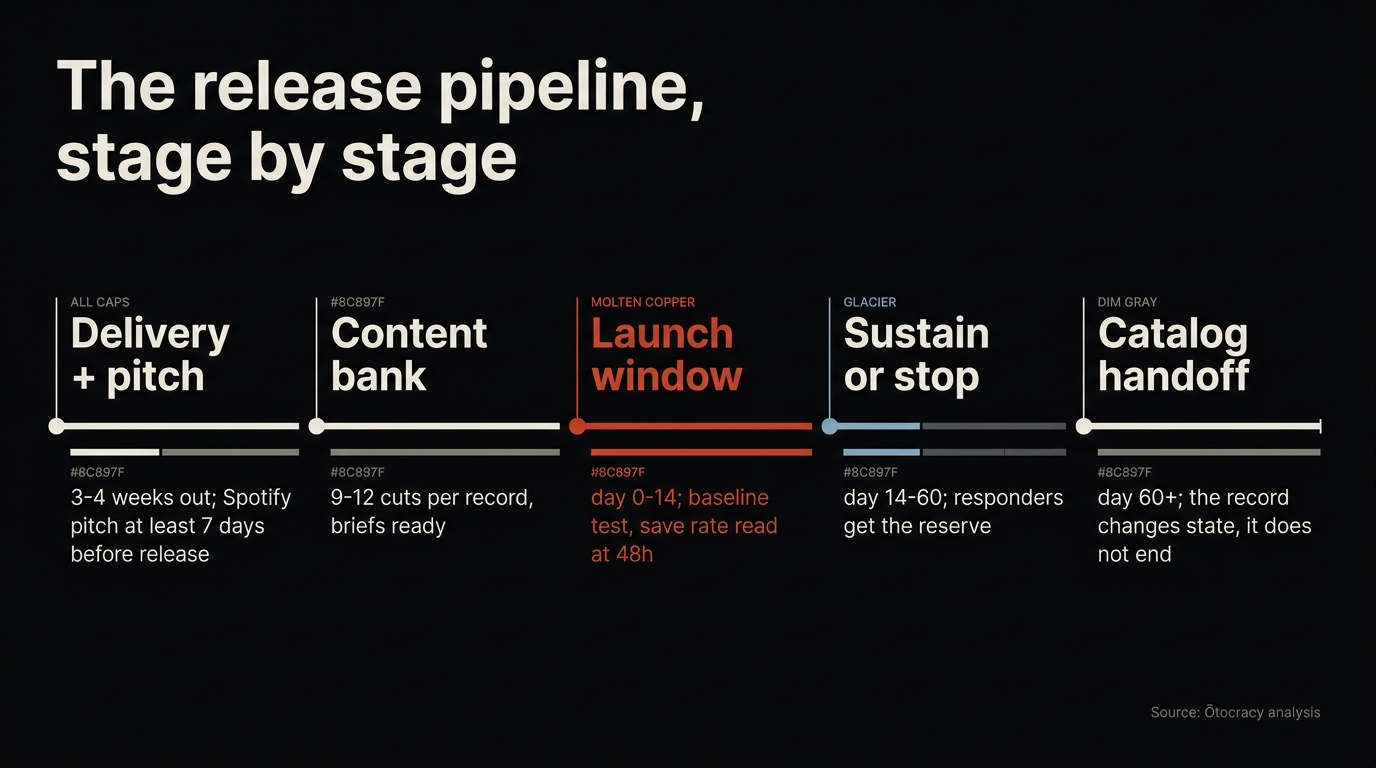
Every record moves through the same stages so that exceptions are decisions, not accidents. The artist-level version of the release sequence is covered in how to release a song on Spotify; the label pipeline wraps it in roster logic:
| Stage | Window | What happens | The label-scale point |
|---|---|---|---|
| Delivery + pitch | 3-4 weeks out | Distributor delivery, Spotify for Artists pitch at least 7 days before release (it also locks Release Radar), DJ promo sends | One pitching process serves every record; DJ list is a shared asset |
| Content bank | 2 weeks out | 9-12 short-form cuts per record, creator briefs ready | Creative learnings transfer between releases; the bank is reusable on catalog moments |
| Launch window | Day 0 to 14 | Baseline test runs — seeding or paid at test tier; save rate and completion read at 48 hours and 14 days | Identical tests make records comparable across the roster |
| Sustain or stop | Day 14 to 60 | Responders get the reserve-funded push; non-responders stop cleanly | The gate was written down in advance; nobody argues with it in the room |
| Catalog handoff | Day 60+ | Record enters the watched catalog with its performance profile attached | Nothing "ends" — it changes state |
The last row is the one most labels do not have. A release that leaves its campaign window should not leave the system — it should enter the catalog layer with everything the label learned about it attached: which clips worked, which creator niches responded, what its save-rate profile looked like. That file is what makes re-promotion fast when the moment comes.
The Back-Catalog Layer: Old Records That Earn Again

One limit worth knowing if catalogue revival is the plan: Beatport's Hype charts only include releases published in the last 365 days, so the programme does nothing for an archive. What Hype actually covers sets out the boundaries.
Catalog is where label economics quietly live. The industry has spent a decade paying enormous multiples for catalogs precisely because old records keep earning — and short-form platforms have made that earning power spiky and capturable rather than a slow annuity.
The mechanic: sounds on TikTok do not care about release dates. A record from 2022 can be picked up in an edit, a meme format or a DJ set clip and start moving with zero label involvement — TikTok activity linked to streaming gains for 96% of artists in Luminate's joint analysis, with measurable lifts arriving within days of a spike. The label's job is not to manufacture these moments; it is to detect and amplify them fast.
What the catalog layer looks like in practice:
- Watch for unprompted movement. A weekly pass over the catalog's streaming and sound-page numbers, looking for records moving without a campaign behind them. Listener-source data separates a real signal from a playlist artifact — the same source-by-source read Otocracy's free AI audit automates for any profile.
- Amplify within days, not quarters. A catalog moment has a half-life measured in weeks. This is exactly what the 10% liquid catalog line in the label budget exists for: creator seeding on the moving sound, paid behind the organic clip formats already working.
- Refresh the record's surfaces. Working links, a current Canvas, the artist's profile in order — the unglamorous checks that decide whether new attention converts to saves or bounces off a stale page.
- Feed the moment back into the pipeline. A catalog spike is information about audience demand. The label that notices which five-year-old sound is moving knows something about its next signing.
Sequenced properly, the layer also creates its own moments rather than waiting for them: anniversary remix packs, a VIP edit timed to festival season, a catalog record seeded to creators when its subgenre trends. TikTok sound campaign mechanics apply to a 2021 record exactly as they do to next month's single.
Measuring the Pipeline, Not Just the Releases
Release metrics answer "did this record work?" Pipeline metrics answer "is the system compounding?" Both matter; only one is usually measured.
- Follower conversion per release — is each drop growing the base the next drop launches into? A flat line here means the pipeline is running on rented attention.
- Catalog share of streams — what fraction of the label's monthly consumption comes from records outside their campaign window? A healthy catalog layer moves this up over time.
- Time from signal to spend — how many days between an unprompted catalog movement and money amplifying it? Based on 2,400+ campaigns run by our founding team, this number predicts captured value better than the size of the amplification budget.
- Cost per engaged listener, new versus catalog — catalog amplification usually buys engaged listeners cheaper than new-release promotion, because the record arrives pre-validated. If yours does not, the moments being funded are not real signals.
Frequently Asked Questions
How often should a label release music?
Pick the fastest rhythm the label can sustain for a full year without dropping quality — for most independents that is monthly, with singles and remixes as connective tissue between larger projects. Consistency inside Spotify's Release Radar cycle beats bursts, and a protected schedule is what makes budget planning possible.
What is music catalog promotion?
It is the active marketing of records outside their launch window: watching the back catalog for unprompted streaming or TikTok movement, amplifying signals within days, and manufacturing moments through remixes, edits and seasonal timing. It treats the catalog as an appreciating asset rather than a shelf of finished campaigns.
How do labels know when a catalog track is worth re-promoting?
Unprompted movement is the trigger: streams or sound-page activity rising without a campaign behind them, confirmed by listener-source data showing algorithmic or search-driven growth rather than a playlist artifact. A genuine signal amplified within days captures the wave; the same spend a quarter later usually buys nothing.
Does re-promoting old music actually work on TikTok?
Yes — sound adoption there ignores release dates, and Luminate's analysis with TikTok linked platform activity to streaming gains for 96% of artists. A catalog record with a proven hook can be seeded to creators exactly like a new single, and it arrives pre-validated, which typically makes the amplification cheaper per engaged listener.
Should a label promote every new release the same way?
Same pipeline, different budgets. Every record runs the identical stages — pitch, content bank, baseline test — because identical tests make results comparable. Spending then diverges by measured response: records that clear the save-rate gate earn pushes, records that do not stop cleanly. The process is uniform so the money does not have to be.
How long should a release stay in active promotion?
The active window runs roughly 60 days: a two-week launch read, then sustain for responders through week eight. After that the record moves to the watched catalog rather than "ending" — its clips, creator data and performance profile stay attached, ready for the moment it moves again on its own.
A label that only markets releases is running spikes; a label that runs a pipeline is building an asset that gets easier to promote every quarter. Set the cadence, standardize the stages, and put real attention — and a real budget line — on the catalog. If you want the pipeline run on shared infrastructure, Otocracy's label program handles roster campaigns and catalog pushes in one system, and the free AI audit will show you which of your existing records are moving on their own right now.