How to Release a Song on Spotify: The 2026 EDM Playbook
How to release a song on Spotify in 2026: the exact EDM playbook — distributor, metadata, the 7-day pitch, and the release-day system that compounds.
Quick Answer
Releasing a song on Spotify is a scheduling problem before it is a music problem. The system that works for EDM in 2026: pick a distributor and set your release date at least three weeks out, deliver clean metadata with precise sub-genre tags, then submit your Spotify for Artists pitch at least 7 days before release day — Spotify's stated minimum, which also locks the track into your followers' Release Radar. Add a looping Canvas, open pre-saves, and keep your profile current. On release day, drive real external traffic from TikTok and ads within the first 48 hours, because saves and completion in that window feed the algorithm. Never buy streams: Spotify removed more than 75 million spam tracks in the year through September 2025, and a real stream pays only $0.003-0.005. Then release again in 4-6 weeks. Cadence, not any single launch, is the growth engine.
Most "how to put music on Spotify" guides stop at "upload to a distributor and wait." That advice ships the file and forgets the release — which is where EDM artists lose the twelve months that follow. This is the full sequence, built for electronic producers: the distributor decision, the metadata that routes your pitch, the Spotify for Artists pitch window, release-day traffic, and the cadence that turns one launch into a catalog. Every step carries the number that decides it.
How to Release a Song on Spotify: Distributor and Timeline
Spotify does not accept uploads directly from independent artists. You go through a distributor, which delivers your master to Spotify and 150-plus other stores and collects the royalties on your behalf. The distributor you choose sets two things that matter downstream: how fast your track goes live, and how much of your money you keep.
Speed is rarely the real constraint. DistroKid delivers to stores in roughly 24-72 hours, and the others land in a similar window. The constraint is your pitch: to distribute music to Spotify with the editorial window intact, set your release date at least three weeks out. That is not a distributor limit — it is a pitching one, and Step 3 explains why.
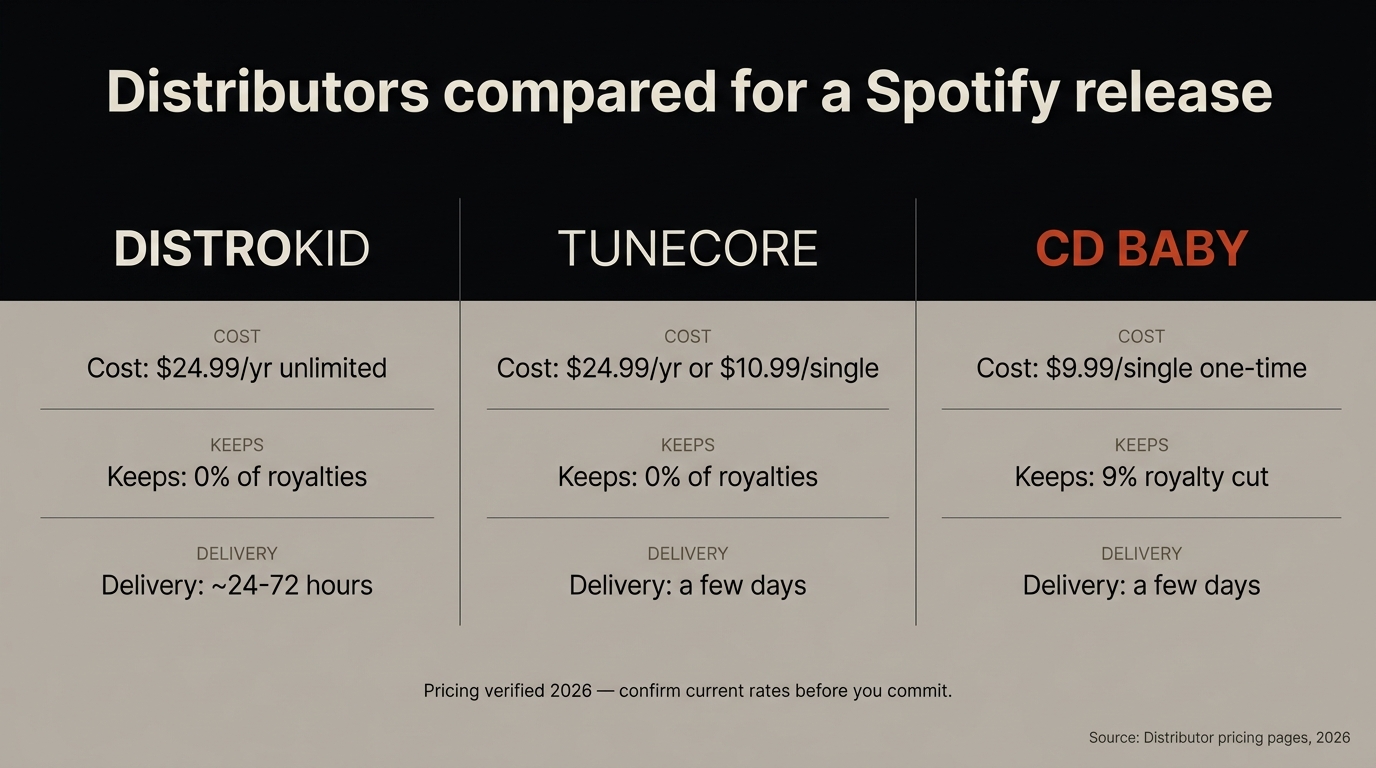
Here is the 2026 cost math on the three distributors most EDM producers actually use:
| Distributor | 2026 cost | Keeps of royalties | Best for |
|---|---|---|---|
| DistroKid | $24.99/yr, unlimited releases (Musician) | 0% | High release cadence — cheapest past ~2 tracks/yr |
| TuneCore | $24.99/yr, or $10.99 per single | 0% | Occasional releases you want up indefinitely |
| CD Baby | $9.99 per single, one-time | 9% of streaming royalties | One-off releases with no subscription |
The pattern is straightforward: if you plan to release on cadence — which this whole guide argues you should — an unlimited annual plan is cheapest per track, and 0% commission beats a one-time fee that skims 9% forever. Pick the distributor, then set the date. The date is the first real decision of your spotify release strategy, and the rest of the plan hangs off it. The full channel sequence around the release sits in our complete EDM promotion guide, and the roster-scale version of the cadence argument — how labels turn a schedule into a compounding catalog — is in the music catalog promotion guide.
Metadata: The Part That Decides Where You Release Music on Spotify
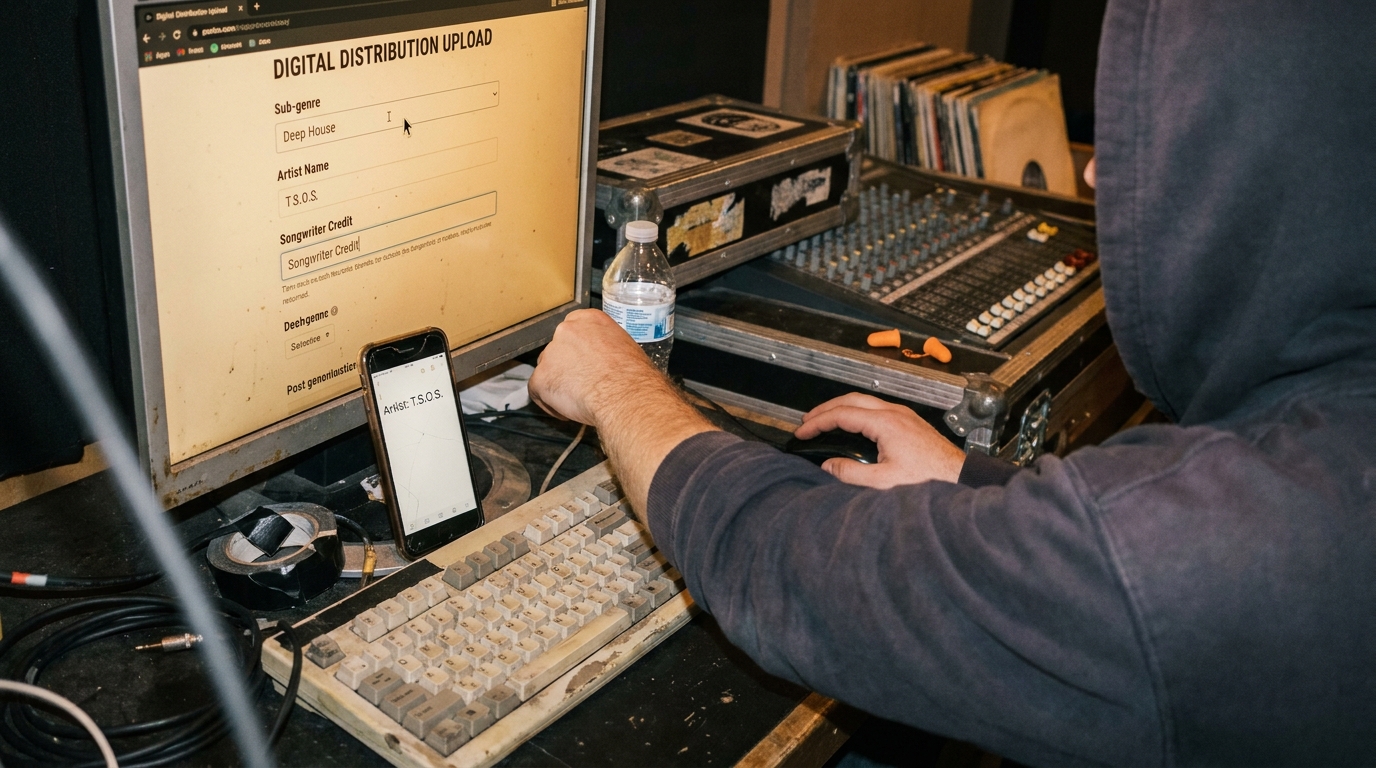
Metadata is not paperwork. Both the editors and the algorithm read the fields you enter, and vague or inconsistent entries route your track to the wrong place — or nowhere. Fill every field like it decides the outcome, because on discovery surfaces it does.
Four fields carry most of the weight when you release music on Spotify:
- Primary artist name. Spell it identically to your TikTok, Instagram, and existing catalog. Search carryover from social platforms breaks on a mismatch, and a broken match costs you the streams your videos should push.
- Genre and sub-genre. Write "melodic techno," "tech house," or "future bass" — never "electronic." A precise tag is what lets an editor route your track to a scene-specific list instead of the reject pile.
- Songwriter and producer splits. Set these before release. Fixing them afterward is a support ticket, and unpaid splits sit frozen until it resolves.
- Explicit flag and language. Wrong here and editorial filters quietly skip you.
Consistency across your metadata is also what makes external traffic convert into recommendation. How the algorithm actually reads these tags for electronic tracks — and why radio edits and club versions perform differently on each surface — is the subject of our Spotify promotion for EDM breakdown.
Your Spotify for Artists Pitch: The 7-Day Rule
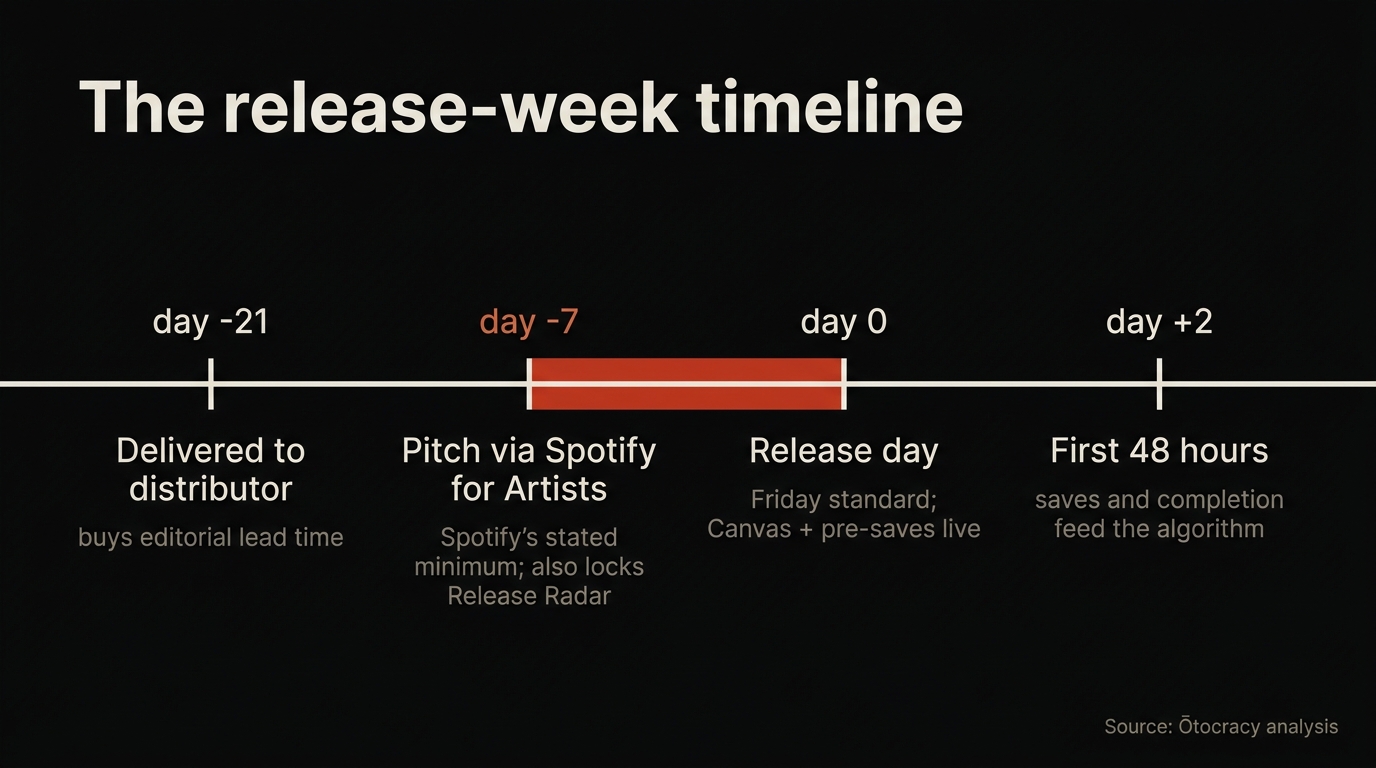
The Spotify for Artists pitch is the single most-fumbled step in the release, and the rule is published in plain language: submit through Spotify for Artists at least 7 days before release day so editors have time to listen (Spotify for Artists support). Meeting that deadline does something most artists undervalue more than the editorial shot — it locks the track into your followers' Release Radar, which for an independent EDM artist is often the bigger prize.
Treat 7 days as the floor, not the target. Editors plan lists weeks ahead, so a pitch that lands 2-4 weeks early gets real consideration, while a deadline-day pitch arrives with the crowd. This is why Step 1 set your release date three weeks out — the pitch window is the reason the calendar comes first.
Two constraints to plan around: you can pitch one upcoming track at a time, and you cannot pitch compilations or tracks where you are only a featured artist. Pick your lead single, fill the sub-genre, mood, and instrumentation fields precisely, and submit early. The pitch does not guarantee a placement — it guarantees the Release Radar push and a real shot at the editorial one.
Canvas, Pre-Saves, and Profile Hygiene
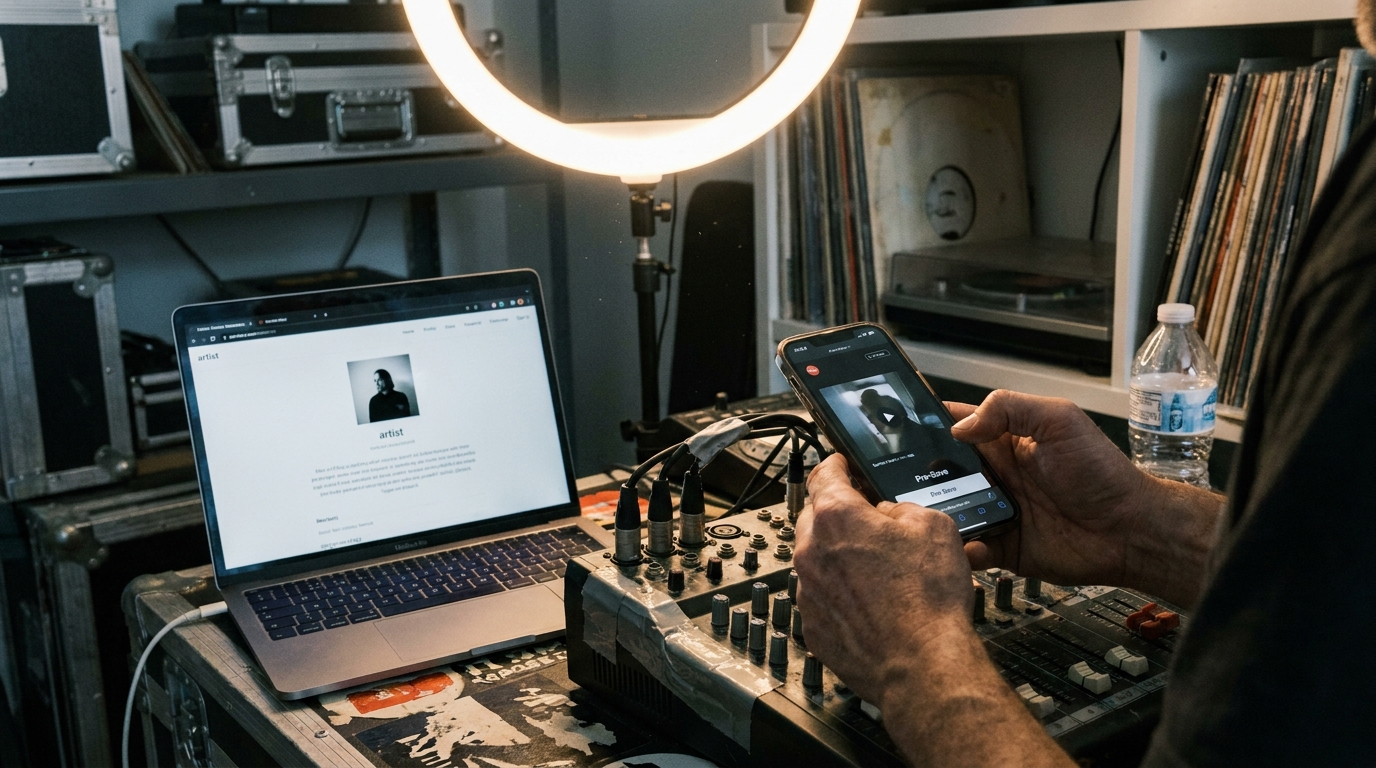
With the pitch submitted, the days before release are for the assets that convert a first listen into a save. A Canvas — the looping 3-8 second visual behind your track — is free, takes ten minutes, and lifts shares and saves on a surface that otherwise shows a static square. Upload one for the lead track before release day.
Open a pre-save campaign next. Every pre-save converts into a first-day stream and a follower, and first-day saves are exactly the signal the algorithm reads while your release is fresh. Then run profile hygiene: a current artist photo, a two-line bio in your scene's language, your Artist Pick set to the new release, and working links out to your other platforms.
Profile hygiene is also what makes the fastest discovery channel pay off. Each release ships with an official TikTok sound, and turning that sound into carryover streams is its own discipline — we break the mechanics down in how TikTok sound promotion actually works. If your artist name and metadata match across platforms, the sound routes searchers straight to the track you just cleaned up.
Release Day and the First 48 Hours
Release day is Friday for a reason — new-music surfaces refresh then, and it aligns your drop with Release Radar. The work on release day is not celebration; it is concentrating real traffic into the window where saves and completion count for the most. Here is the timeline that keeps the pieces in order:
| When | Action | Why it matters |
|---|---|---|
| 3-4 weeks out | Distribute, lock the release date | Preserves the pitch window |
| 7+ days out | Submit the Spotify for Artists pitch | Locks Release Radar, opens the editorial shot |
| 3-5 days out | Upload Canvas, open pre-saves, fix profile | Assets ready before traffic arrives |
| Release day (Friday) | Push TikTok and ads to a smart link | First saves register while the track is fresh |
| First 48 hours | Concentrate paid and organic traffic | Saves and completion feed recommendation |
| Weeks 1-4 | Monitor, pitch clean curators, hold cadence | Extends the release past launch week |
The 48-hour window is where paid money earns its place. A well-targeted €500 test tells you whether a track converts before you scale it — the full budget breakdown by spend tier shows what €500, €1,500, and €5,000 buy line by line, and the carryover mechanics of driving from social sit in our TikTok music promotion guide. Based on 2,400+ campaigns run by our founding team, save rate in the first 48 hours is the most predictive early signal for algorithmic pickup — a better predictor than raw stream count, which can be bought and therefore means little. If you are not sure which of your existing streams are real, playlist-driven, or dead weight, Otocracy's free AI audit breaks your profile down source by source before you spend.
Post-Release Cadence: How to Release a Song on Spotify on Repeat
One release is a data point. The growth comes from doing this again in 4-6 weeks, because every new release is a fresh pitch window, a fresh Release Radar push to your whole follower base, and a fresh node in Spotify's recommendation graph. An artist releasing every 4-6 weeks generates 9-12 of those events a year; an artist releasing annually generates one, and no promotion budget closes that gap.
Electronic music gets catalog math no other genre gets. A club edit, an extended mix, a VIP, and a stripped-back version are separate releases with separate pitch windows — two strong originals a quarter plus their alternate versions reaches full cadence without writing twelve masterpieces a year. Remix packages do the same job while linking your profile to other artists' audiences. Based on 2,400+ campaigns run by our founding team, the same promotion spend retains listeners at a multiple on an artist with 8-12 released tracks compared to an artist with two — the traffic lands, and there is somewhere for it to go.
The one thing cadence never includes is bought streams. Since April 2024, a track must reach 1,000 streams in a rolling 12-month window before it enters Spotify's royalty pool at all (Music Business Worldwide), and a real stream pays only $0.003-0.005 — so small-batch botting does not even clear the payout floor. Layer on the 75 million spam tracks Spotify removed in the year through September 2025 (Spotify Newsroom; Variety) and the per-track penalties distributors now pass on, and fake streams risk your whole catalog to gross a few dollars. Point your budget at real listeners on a repeating schedule. Artists working €70-100 a week can run the same funnel through our self-serve tier.
Frequently Asked Questions
Do I need a distributor to release a song on Spotify?
Yes — Spotify does not accept uploads directly from independent artists. A distributor like DistroKid, TuneCore, or CD Baby delivers your track to Spotify and 150-plus other stores, then collects your royalties. You pick one, set a release date, upload your master and metadata, and it handles delivery.
How many days before release should I submit my Spotify for Artists pitch?
At least 7 days before release day, through Spotify for Artists — that is Spotify's stated minimum, and it also locks your track into your followers' Release Radar. Pitch earlier, ideally 2-4 weeks out, because editors plan lists ahead and a deadline-day pitch arrives with the crowd.
How much does it cost to release a song on Spotify?
Spotify charges artists nothing to host music. The cost is your distributor: DistroKid runs $24.99 a year for unlimited releases, TuneCore charges $10.99 per single, and CD Baby takes a one-time $9.99 per single but keeps 9% of royalties. Frequent releasers save most on an annual plan.
How long does it take for a song to appear on Spotify?
A distributor delivers to Spotify in roughly 24-72 hours, sometimes up to seven business days. But speed is not the real constraint — the pitch window is. Set your release date at least three weeks out so you can submit your Spotify for Artists pitch before the 7-day deadline.
Will my song earn royalties from day one?
Not necessarily. Since April 2024, a track must reach 1,000 streams in a rolling 12-month window before it enters Spotify's royalty pool, and a real stream pays only $0.003-0.005. Build genuine listeners first — the payout math rewards catalog depth and repeat plays, not a single small release.
Should I buy streams to kickstart a release?
No. Spotify removed more than 75 million spam tracks in the year through September 2025 and charges distributors per-track penalties for artificial streaming, so bought streams risk your whole catalog. They also fail as marketing — labels and editors read your streams-to-saves ratio, and rented numbers read as damaged goods.
Releasing a song on Spotify well is not about the upload button — it is a scheduled sequence where the release date, the pitch deadline, and the first 48 hours each carry a number you can hit or miss. Get the timing right, keep every stream real, and let cadence do the compounding that no single launch can. If you want the release-day traffic engineered and measured against a projection you can hold us to, Otocracy's Spotify growth campaigns run the same system at campaign scale.