Music Promotion Budget: What €500–€5K Actually Buys (2026)
What a music promotion budget of €500, €1,500 and €5,000 actually buys in 2026: verified channel costs, allocation tables, and where artists leak money.
Quick Answer
A music promotion budget of €500 buys one channel executed properly, not three channels executed badly. At the €9–14 CPM that published Meta benchmarks show for entertainment audiences, €500 is roughly 35,000–55,000 targeted impressions — enough to test one song on one platform. €1,500 buys a real single campaign: paid traffic, two or three creator posts, and legitimate curator pitching. €5,000 buys a multi-channel release campaign across TikTok, Meta and Spotify with a testing week, retargeting and four weeks of sustained delivery. Every benchmark in this article comes from published sources — WordStream, Gupta Media, Influencer Marketing Hub, platform pricing pages — and every tier gets a line-item allocation table. Based on 2,400+ campaigns run by our founding team, budget size matters less than how much of it survives the leaks. The math is the math. Below: the benchmarks, the tables, and the leak list.
Channel Costs in 2026: The Benchmarks Behind Every Music Promotion Budget
You cannot plan a music promotion budget without knowing what each channel charges. Most articles skip this part because honest numbers make small budgets look small. I am going to do the opposite, because a plan built on fantasy CPMs fails on day three.
One housekeeping note: the benchmarks below are published in US dollars. At mid-2026 exchange rates the euro sits close enough to parity that I treat the figures 1:1 and round conservatively — if anything, your euro buys slightly more than the table shows.
| Channel | Published benchmark | Source | What €100 buys |
|---|---|---|---|
| Meta ads (IG/FB) | €9–14 CPM, entertainment vertical | WordStream 2025 benchmarks, Triple Whale | roughly 7,000–11,000 impressions |
| TikTok ads (Spark Ads) | €4–13 CPM; €50/day ad-group minimum | Gupta Media, Lebesgue benchmark data | roughly 8,000–25,000 impressions |
| TikTok creators (10K–100K followers) | €100–500 per video | Influencer Marketing Hub rate guides | zero to one post |
| Spotify curator pitching | €1–4 per submission (SubmitHub); campaigns from €285 (Playlist Push) | published platform pricing | 25–100 curator submissions |
| YouTube skippable in-stream | €0.01–0.03 per view; entertainment at the low end | Store Growers, cross-industry CPV data | roughly 3,300–10,000 views |
Three things jump out of that table. First, TikTok's €50/day ad-group minimum means paid TikTok is structurally unavailable below a certain budget — you need at least €600–700 to run it for a meaningful window, which is why I cover it in detail in our breakdown of TikTok promotion costs in 2026.
Second, one mid-tier creator post costs the same as two weeks of Meta ads. That is not an argument against creators — it is an argument for knowing which unit of attention you are buying at each price point.
Third, legitimate playlisting is the cheapest line item on the board, and also the one with the widest fraud premium. SubmitHub charges €1–4 per curator submission. Anyone charging €200 for a "guaranteed placement" is charging a 50x markup for something Spotify's terms prohibit. More on that in the leak list.
What a €500 Music Promotion Budget Actually Buys
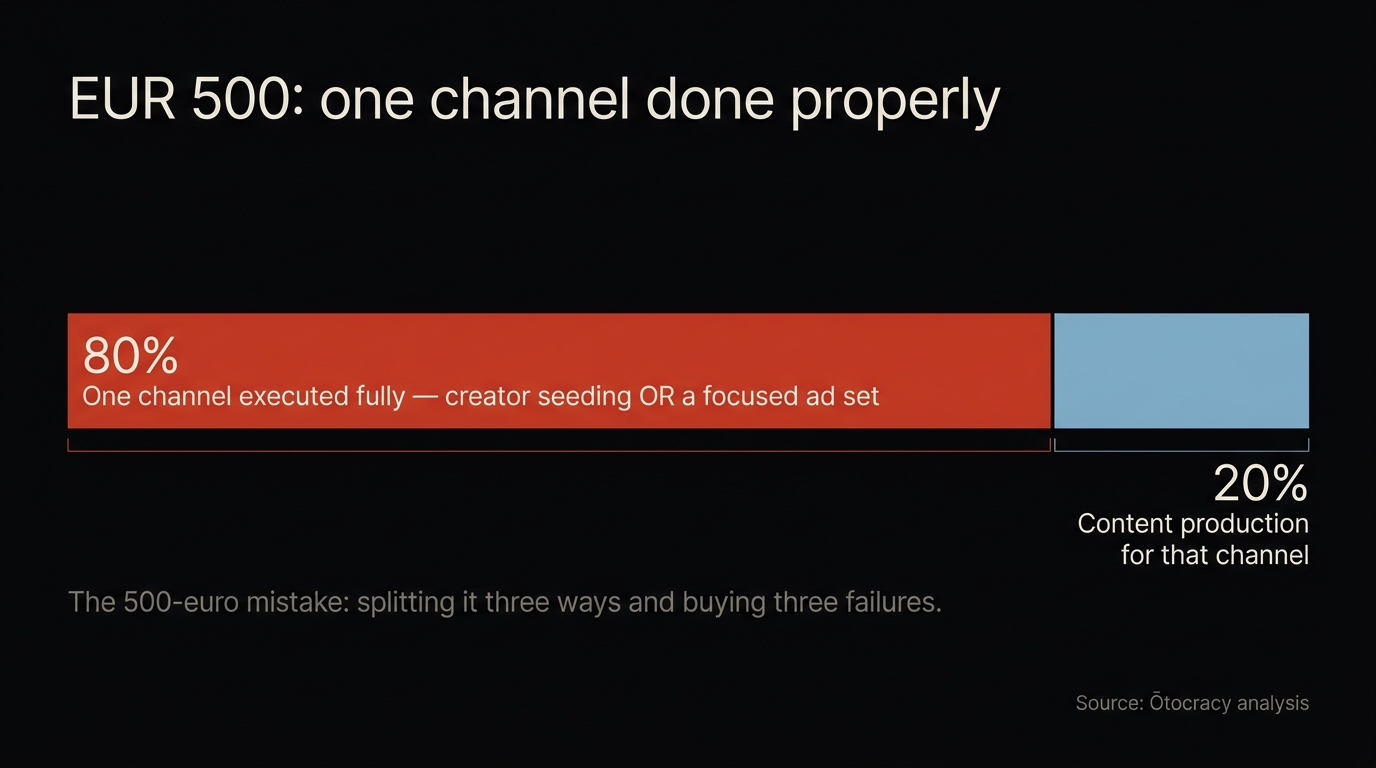
€500 is the most common budget we see from independent EDM artists, and it is also the most commonly wasted one. The failure pattern is always the same: €150 to a playlisting service, €150 to boosted posts, €100 to a creator, €100 to "something on YouTube". Five channels, none funded past its minimum effective dose, zero learnings.
The correct move at €500 is concentration. One song, one channel, four weeks. Here is the allocation that survives contact with the benchmarks:
| Line item | Spend | What it buys at published rates |
|---|---|---|
| Meta ad spend, €15/day for 28 days | €420 | 30,000–46,000 targeted impressions at €9–14 CPM |
| Creative: 3 cut-downs of one performance video | €0–50 | self-edited in CapCut; spend only if you need footage |
| SubmitHub curator test | €30–80 | 8–25 genuine curator submissions with feedback |
| Total | €500 | one channel tested properly |
Why Meta and not TikTok ads? The €50/day TikTok minimum would burn the entire budget in ten days — too short a window for the algorithm to exit learning phase and for you to read the results. Meta lets you run €15/day, which keeps you live for a full month and gives the delivery system time to find your listeners.
Why not one creator post instead? Because €400 buys you exactly one roll of the dice with a mid-tier creator, and single rolls are variance, not strategy. At €1,500 and up, creators enter the plan — with enough volume to average out the duds.
What a €500 budget does not buy: streams in guaranteed quantities, playlist placements, or a career change. It buys data — which hook works, what your cost per engaged listener is, whether this song deserves the €1,500 treatment. If you want to sanity-check your own plan before spending, run it through our free campaign audit first.
€1,500: The First Real Single Campaign
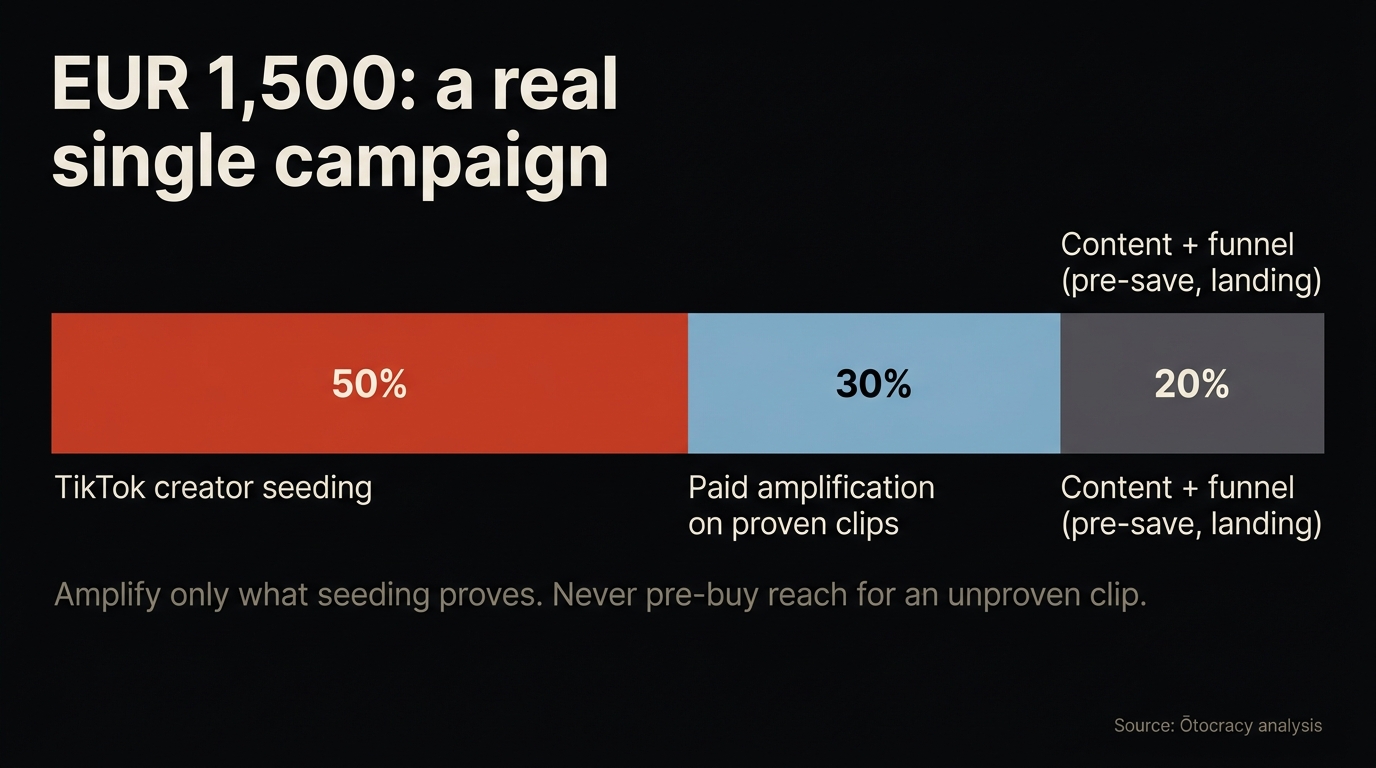
At €1,500 the picture changes because TikTok's paid minimums become affordable and creator volume becomes possible. This is the tier where a campaign starts to look like what a label junior would run, and it is the smallest budget where multi-channel stops being spray-and-pray.
| Line item | Spend | What it buys at published rates |
|---|---|---|
| TikTok Spark Ads, €50/day for 12 days | €600 | roughly 45,000–150,000 impressions at €4–13 CPM |
| 2 micro-creator posts (10K–100K followers) | €300 | two independent tests of your sound, at the low end of the €100–500 published rate band |
| Meta retargeting on video engagers | €400 | roughly 28,000–44,000 impressions aimed at people who already watched |
| Curator pitching (SubmitHub or equivalent) | €150 | 40–100 submissions across electronic playlists |
| Creative budget | €50 | hooks, captions, cut-downs |
| Total | €1,500 | one single, three channels, one sequence |
The word doing the work in that table is sequence. The creators post first and give you Spark Ads codes. The TikTok spend amplifies whichever post shows a pulse. Meta then retargets the engagers — people who watched but did not follow through. Cold curator pitching runs in parallel because playlist adds and paid traffic feed the same algorithmic signals.
Note what the €1,500 tier still excludes: YouTube — priced format by format in YouTube ads for music promotion — PR, and any creator above the micro tier. A single mid-tier TikTok creator can quote €800 per video per Influencer Marketing Hub's published ranges — one post like that would consume more than half this budget. The full mechanics of the creator-first approach are in our TikTok music promotion guide.
Timeline matters as much as allocation here. Run this over five to six weeks, not two. Compressed spending raises frequency, and frequency past 3–4 on a small audience is money spent showing the same person the same ad a fifth time.
€5,000: A Multi-Channel Release Campaign
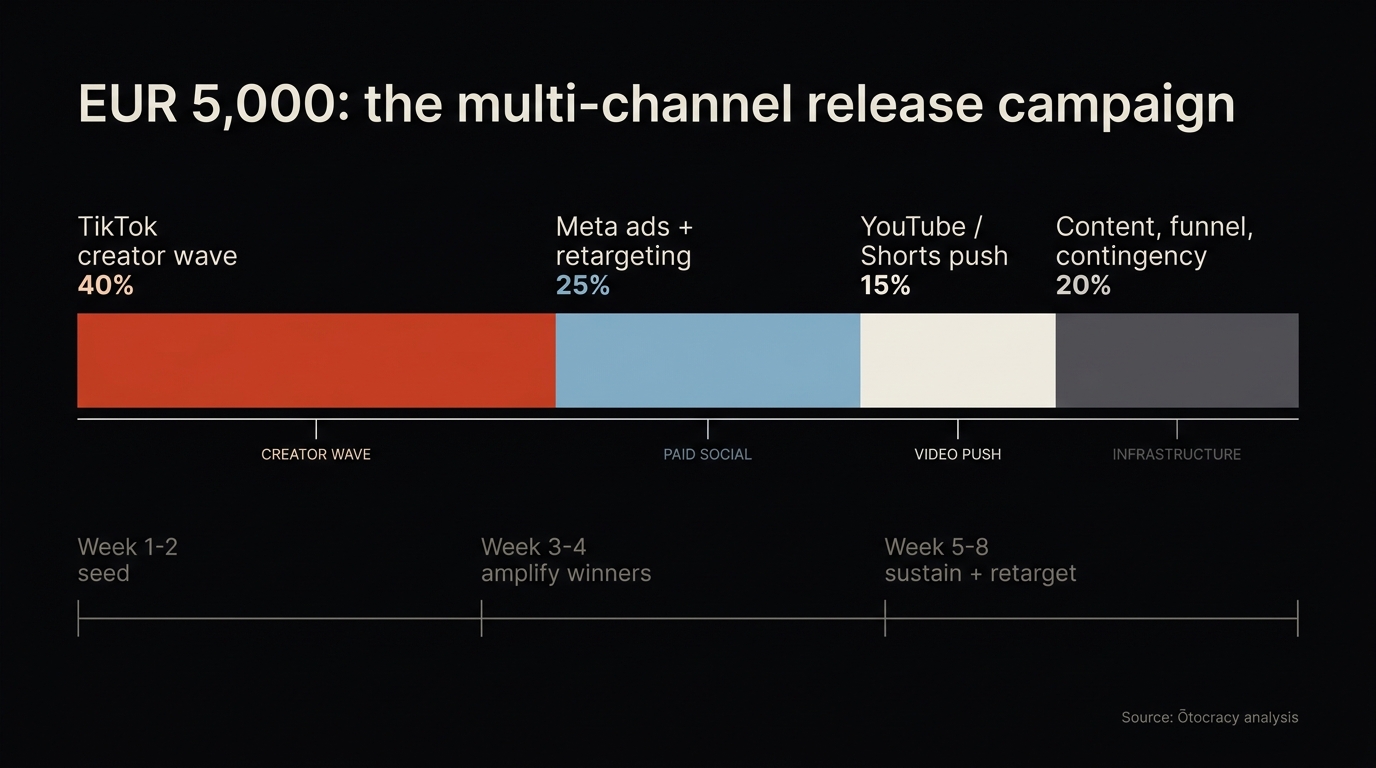
€5,000 is where a release campaign gets a proper structure: a testing phase, a scaling phase, and a sustain phase. It is also the tier where allocation mistakes get expensive, because every misallocated 10% is now €500 — an entire tier-one budget gone.
| Line item | Spend | What it buys at published rates |
|---|---|---|
| Testing week: TikTok + Meta, small ad sets | €500 | 3–5 creative variants tested to find the working hook |
| TikTok creators, 5–6 micro posts | €1,200 | enough volume for the hit-rate math to work in your favor |
| TikTok Spark Ads on winning posts | €1,300 | roughly 100,000–320,000 impressions at €4–13 CPM |
| Meta prospecting + retargeting | €1,200 | roughly 85,000–130,000 impressions across cold and warm audiences |
| Curator pitching campaign | €400 | a full pitching cycle; Playlist Push-scale campaigns start at €285 |
| YouTube in-stream test | €400 | roughly 13,000–40,000 views at €0.01–0.03 CPV |
| Total | €5,000 | a four-to-eight-week multi-channel release campaign |
The testing week is the hardest-working €500 in the table. Based on 2,400+ campaigns run by our founding team, the spread between the best and worst creative on the same song is routinely several multiples in cost per engaged listener. Spending 10% of the budget to find out which variant deserves the other 90% is not overhead — it is the whole discipline.
YouTube enters the plan at this tier for one reason: at €0.01–0.03 per skippable in-stream view, with entertainment sitting at the cheap end of published CPV tables, €400 buys a legitimate read on whether your music video converts viewers into listeners. Below €5,000 that €400 does more work on TikTok or Meta.
Where does genre fit? The allocations above are calibrated for electronic music, where TikTok sound velocity and Spotify editorial both respond to the same early signals. For the scene-level strategy that sits above budget mechanics — release cadence, remix chains, DJ support — see our complete EDM promotion guide.
Where Music Promotion Budgets Leak
If you want to see the reporting before you spend anything, the live demo dashboard is a real campaign account with the numbers left in — spend, delivery and results, laid out the way they arrive.
Every budget tier above assumes the money reaches real inventory. In practice, a large share of independent artist spend never does. These are the five leaks I see most, ranked by how much they typically cost.
Leak 1: botted and pay-for-placement playlists. Any service that guarantees a placement for a flat fee is selling payola, which Spotify's terms explicitly prohibit and their fraud systems actively flag. The damage is double: you lose the fee, and flagged streams can get your track pulled or your profile penalized. Legitimate services — SubmitHub at €1–4 per submission, Playlist Push from €285 — charge for curator access, never for guaranteed outcomes.
Leak 2: boosting posts instead of running ads. The blue "Boost" button optimizes for engagement on the post, not for listeners. Ads Manager gives you conversion objectives, proper audience exclusions, and placement control. Same money, same platform, structurally different outcome — boosting is the single most common way artists convert €300 into likes from people who will never stream the song.
Leak 3: spray-and-pray allocation. €100 across five channels puts every channel below its minimum effective dose. TikTok ads literally cannot run below €50/day per ad group. A budget split too thin does not underperform proportionally — it returns close to nothing on every line simultaneously.
Leak 4: paying follower-count prices for engagement-free creators. Published rate tables price micro creators at €100–500 per video, but the rate bands are wide precisely because engagement varies wildly at identical follower counts. A 50K-follower account with 1% engagement is worth a fraction of a 15K account at 8%. Price against average views, not followers.
Leak 5: spending with no measurement layer. No pixel, no UTM links, no pre-save tracking means the campaign produces impressions but no learnings, and the next budget starts from zero. Measurement costs almost nothing and is the only thing that compounds between releases.
Measuring Spend, and When an Agency Beats DIY
Budget size tells you what you can buy. Two metrics tell you whether it worked.
Save rate — saves divided by listeners on Spotify for Artists — is the strongest single signal that paid traffic found real fans rather than passive scrollers. A track that converts paid listeners into saves is a track the algorithm will start working for; a track that does not is a creative problem no additional budget fixes.
Cost per engaged listener — spend divided by listeners who took a meaningful action (save, follow, playlist add, profile visit) — is the number that makes tiers comparable. It lets you compare a €300 creator post against €300 of Meta spend on equal terms, which raw stream counts never do.
So when does an agency make sense? The math is unsentimental. An agency charging €500/month against a €500 media budget is 50% overhead — indefensible. The same fee against €5,000 of media is 10%, and pays for itself if professional execution improves cost per engaged listener by more than that. Below roughly €1,000, do it yourself with our self-serve tools; at €1,500 and above, compare what you would build against our fixed-price packages, where the fee-to-media ratio is published up front.
One more filter worth applying to any agency, ours included: ask what happens when a campaign misses. Our answer is a measurable target set in writing before the campaign starts, graded against data you can verify — defined mechanics, not vibes. Any agency that cannot answer that question in numbers is asking you to fund their learning curve.
Frequently Asked Questions
How much should I spend to promote a single?
€1,500 over five to six weeks is the smallest budget that funds a genuine multi-channel single campaign: TikTok Spark Ads at the €50/day minimum, two micro-creator posts at published €100–500 rates, Meta retargeting, and legitimate curator pitching. Below that, concentrate everything on one channel instead.
Is €500 enough to promote a song?
Yes — for exactly one channel. €500 buys roughly 30,000–46,000 Meta impressions at the €9–14 entertainment CPM published by WordStream and others, plus a small curator test. It is a data-buying budget: it tells you whether the song deserves a bigger spend, not a results-guaranteeing one.
How much does legitimate Spotify playlist promotion cost?
SubmitHub charges €1–4 per curator submission, and Playlist Push campaigns start at €285, with full independent-curator campaigns running €300–2,500 at published market rates. Legitimate services charge for curator access and feedback. Anyone guaranteeing placement for a flat fee is selling payola, which Spotify prohibits.
Should I boost posts or run ads through Ads Manager?
Ads Manager, always. Boosting optimizes for post engagement — likes from people who will never stream your track. Ads Manager gives you conversion objectives, audience exclusions, retargeting, and placement control at the same media cost. Boosting is the most common leak in small music promotion budgets.
How much do TikTok creators charge to use a sound?
Published rate guides from Influencer Marketing Hub put micro creators (10K–100K followers) at €100–500 per video, with mid-tier creators quoting up to €800 or more. Price against average views and engagement rate, not follower count — the spread at identical follower counts is enormous.
When is hiring a music marketing agency worth it?
When the fee is a small fraction of the media budget. A €500 fee on €500 of media is 50% overhead; the same fee on €5,000 is 10% and only has to improve cost per engaged listener by that much to pay for itself. Under €1,000, run it yourself.
You now have the same tables we use internally. If you want them applied to your release, start with Otocracy's free audit — enter your actual budget, and you get back a line-item plan for your track, not a template. The math is the math; we just run it for you. Running a label? The roster version of these tables — tiers, reserve pools, the honest math for a 12-release year — is in the label marketing budget guide.