Meta Ads for Musicians: Facebook + Instagram Guide (2026)
Facebook ads for musicians, run like an operator: pixel and CAPI setup, campaign architecture, EDM audiences, and verified 2026 CPM and CPC benchmarks.
Quick Answer
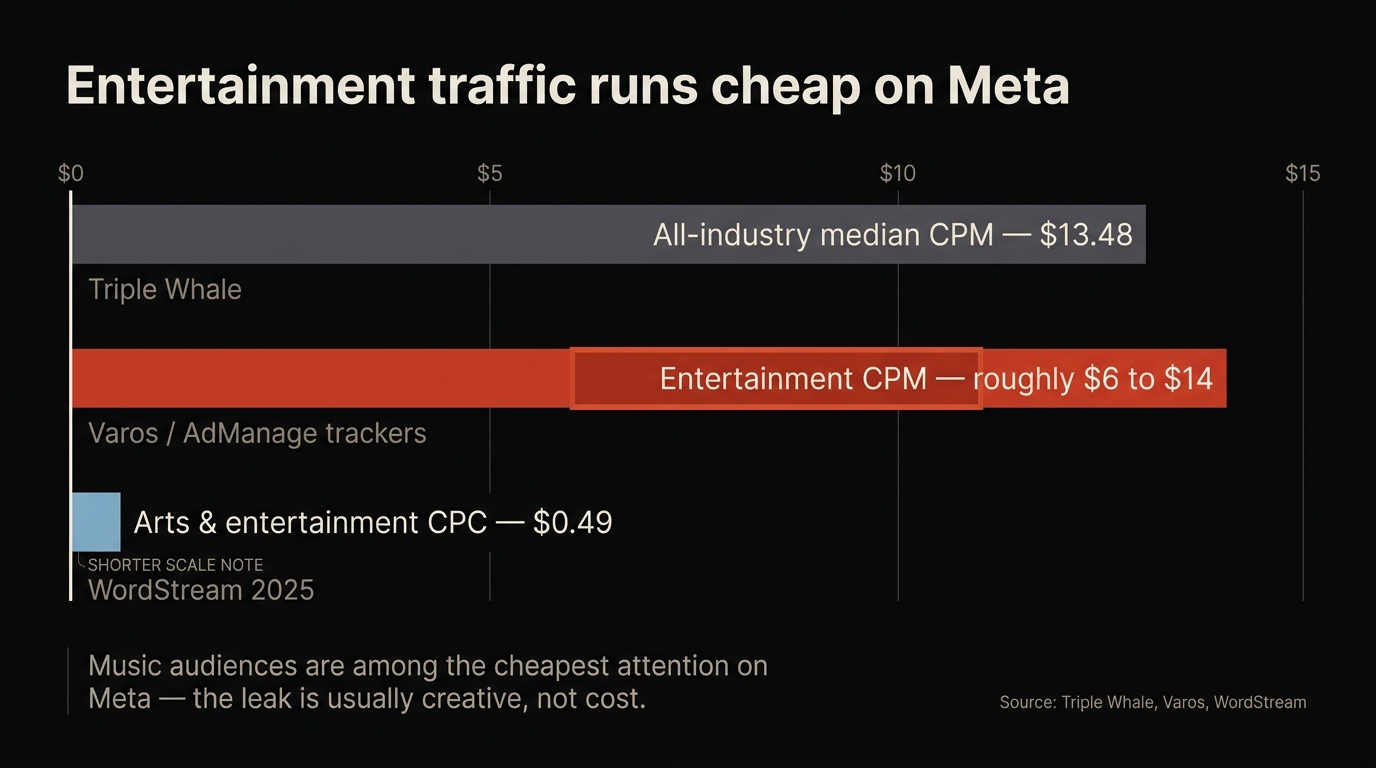
Facebook ads for musicians work when you run actual campaigns in Ads Manager instead of boosting posts. The mechanics: install the Meta pixel plus the Conversions API (Meta reports 17.8 percent lower cost per result for advertisers with CAPI on web events), point a traffic or conversion campaign at a landing page you control, target stacked electronic-music interests plus retargeting on video engagers, and feed the auction 3-5 vertical video variants. Entertainment is one of the cheapest verticals on Meta: published trackers put entertainment CPMs roughly at $6-14 against the $13.48 all-industry median Triple Whale reports, and WordStream's 2025 benchmarks show a $0.49 average CPC for arts-and-entertainment traffic campaigns. Budget $10-20 per day per ad set, leave the learning phase alone until it collects roughly 50 optimization events in a week, and measure cost per engaged listener, not likes. The full procedure is below.
Account Foundation: What Facebook Ads for Musicians Require Before the First Euro
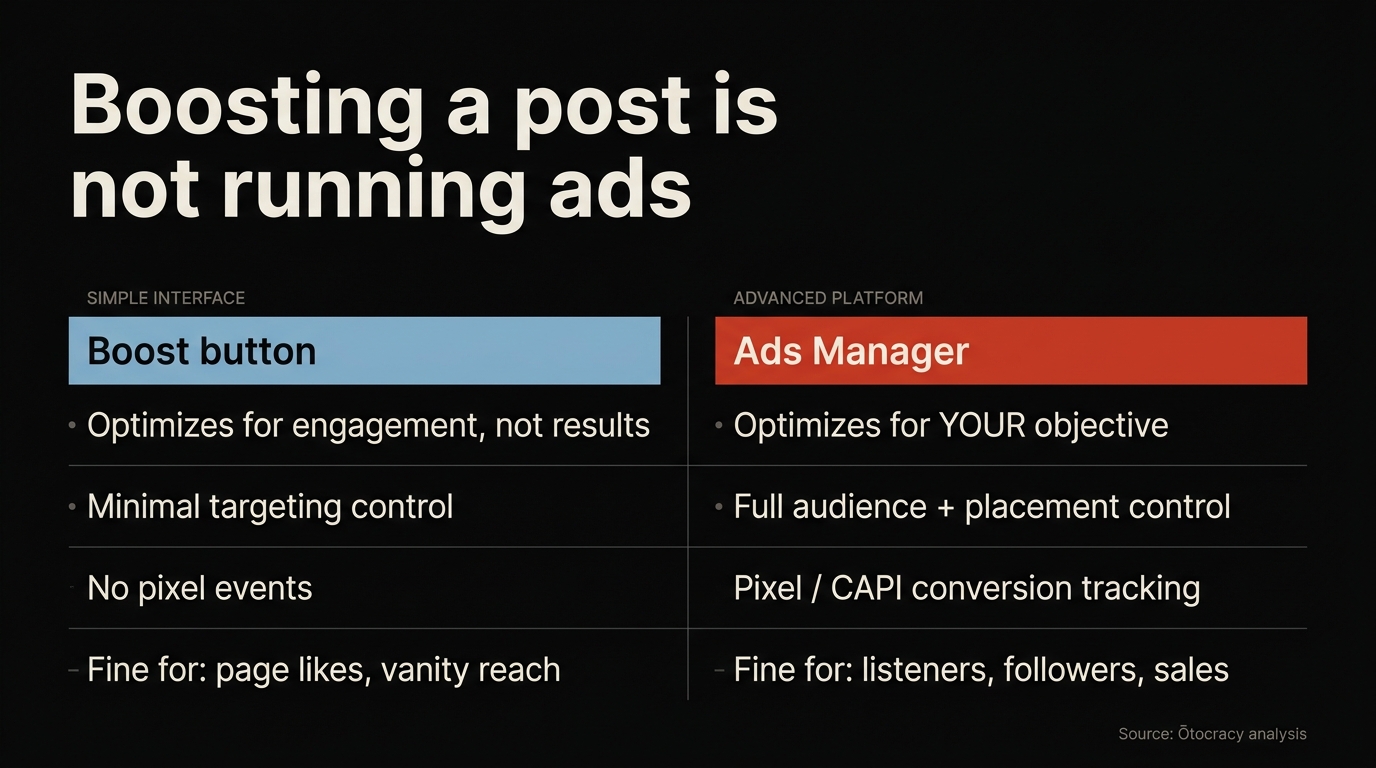
Most guides on Facebook ads for musicians start with targeting. That is backwards. Targeting decisions made on top of a broken account foundation produce clean-looking reports about money that went nowhere.
The foundation is four items, and each one takes under an hour.
One: Business Manager, not a personal ad account. Create it at business.facebook.com, attach your artist page and Instagram profile, and create the ad account inside it. This gives you asset permissions, a second admin for account recovery, and a structure an agency or collaborator can be added to later without password sharing. Meta bans ad accounts routinely and often wrongly; a Business Manager with two admins and a verified domain survives review far better than a personal account running ads off a debit card.
Two: the Meta pixel on a page you own. The pixel is a snippet on your smart link or landing page that records who visited and what they did. Without it, every click you buy evaporates the moment it happens. With it, every click becomes a retargeting audience and a data point.
Three: the Conversions API on top of the pixel. CAPI sends the same events server-side, which recovers signal that browser privacy features strip from the pixel alone. This is not optional polish: Meta's own published figure is a 17.8 percent lower cost per result for advertisers running CAPI on web events. On a $1,000 campaign that is $178 recovered by a one-time setup task. Most smart-link tools (Linkfire, Feature.fm, ToneDen) and landing page builders now offer one-click CAPI connections.
Four: never touch the Boost button again. Boosting optimizes for engagement — reactions and comments from people Meta predicts will react and comment. It hides conversion objectives, audience exclusions, and placement control. Boosting is the single most reliable way to convert €300 into likes from accounts that will never stream the song. Everything in this guide happens in Ads Manager.
If you want this layer built for you rather than by you, our self-serve campaigns are exactly this: a managed Meta funnel where the pixel, CAPI, and account structure come pre-wired.
Campaign Architecture: Which Objective Fits Which Job
Meta gives you six campaign objectives. For music, three matter, and each one is wrong in a specific, expensive way when misapplied.
| Campaign type | Optimizes for | Right when | Wrong when |
|---|---|---|---|
| Traffic (link clicks / landing page views) | The cheapest available clicks | Small budgets, hook testing, driving a smart link | You count clicks as listeners without checking what happens after the click |
| Engagement (video views, page engagement) | Cheap attention | Building warm retargeting pools 2-4 weeks before a release | It is your only campaign — views are not streams and never convert on their own |
| Conversion (pixel / CAPI events) | People likely to complete your chosen event | You can generate roughly 50 events per week: pre-saves, email signups, outbound Spotify clicks | Event volume is too low and the ad set never exits the learning phase |
The sequencing for a release looks like this. Weeks minus 4 to minus 2: an engagement campaign runs cheap video views on your best clips and quietly builds an audience of people who watched. Week minus 1 through week 4: a traffic or conversion campaign hits cold interest audiences while a second ad set retargets the video viewers with a direct ask.
The smart-link question. Should ads point straight at Spotify or at a landing page you control? Straight-to-Spotify buys a cheaper click and total blindness: Spotify shows you nothing about who arrived from your ad, and Meta gets no post-click event to optimize against. A smart link or landing page costs you some click-through on the extra step but returns pixel events, retargeting audiences, and per-platform click data. Below roughly $200 of total spend the difference is academic. Above it, the landing page wins every time, because the data compounds and the direct link's savings do not.
One structural rule regardless of objective: one campaign, few ad sets, several ads. Artists love making five campaigns with one ad each. That fragments budget below the learning threshold everywhere at once and guarantees that nothing gets read properly.
Audience Construction for Electronic Music
Meta's targeting in 2026 pushes hard toward broad: Advantage+ audience expands whatever you give it, and at high budgets broad genuinely wins because the algorithm has room to find patterns. At artist budgets — $10-50 per day — you do not have the event volume to teach broad targeting anything, so structured audiences still earn their keep.
Layer 1: interest stacks. For EDM, build stacks from four interest families and combine them with narrowing, not just OR-logic piles:
- Artists adjacent to your sound that exist as Meta interests: think the tier of Fisher, Charlotte de Witte, Lane 8, Fred again — whoever your sound actually neighbors.
- Festivals: Tomorrowland, Ultra Music Festival, EDC, Awakenings, DGTL.
- Platforms and infrastructure: Beatport, SoundCloud, Boiler Room, Mixmag, Resident Advisor.
- Genre terms: techno, house music, drum and bass, trance — these are broad and work best as the "must also match" narrowing layer on top of an artist or festival stack.
A stack of "listens to adjacent artists AND must also match Beatport or Boiler Room" is a few hundred thousand to a few million people in most European markets — the right size for a $15-per-day ad set. Which stack fits which subgenre is scene knowledge more than ads knowledge; our complete EDM promotion guide covers the scene layer that sits underneath the targeting.
Layer 2: warm retargeting. These audiences cost nothing to build and outperform cold traffic on every metric that matters. Build all of them on day one: video viewers at the 25 percent and 75 percent marks (180-day window), Instagram engagers (90 days), landing page visitors (30 days), and — if you sell anything — pixel purchasers (180 days). The 75 percent video viewers are the crown jewel: people who voluntarily watched three quarters of your track's clip are pre-qualified listeners at a CPM discount.
Layer 3: lookalikes from engagers. Once a source audience passes roughly 1,000 people, build a 1 percent lookalike from your 75 percent video viewers or your smart-link visitors. Do not build lookalikes from page likes — page likes are the lowest-intent signal on the platform, polluted by a decade of like-farming.
Exclusions are half the discipline. Every cold ad set excludes your warm audiences; every warm ad set excludes recent converters. Skipping exclusions means your ad sets bid against each other for the same people, and you pay Meta twice to annoy one fan.
Creative That Converts: What Instagram Ads for Musicians Actually Deliver
Instagram ads for musicians and Facebook ads for musicians are one system — placements inside the same Meta campaign — and for music the delivery skews heavily to Instagram Reels and Stories because that is where vertical video wins the auction. So creative strategy is really Reels strategy.
Hook-first, always. The first 1-2 seconds decide everything. Open on the drop, the crowd reaction, the moment the vocal hits — never on an intro, a logo, or you saying "hey guys". The scroll decision happens before second two; nothing you place after it matters to the people who already left.
Vertical, 9:16, shot for sound-on. Music is the one product category where sound-on viewing is the point. Design for sound-on, but caption everything anyway, because Stories placements and public-transport listeners still watch muted.
3-5 variants per concept, minimum. Same track, different hooks: live-crowd clip, studio visualizer, artist-to-camera one-liner, lyric moment, remix tease. Based on 2,400+ campaigns run by our founding team, the spread between the best and worst variant of the same song is routinely a multiple of 3 or more in cost per engaged listener. Testing 10 percent of budget on variants is not overhead; it decides what the other 90 percent buys.
Refresh on frequency, not on calendar. When frequency crosses 3-4 on a given audience and CPM starts climbing, the audience is telling you it has seen enough. Rotate the next variant in. If you are already producing clips for TikTok, the same hook-first grammar transfers almost directly — our TikTok music promotion guide covers that pipeline, and the winning TikTok clips are usually your best Meta ads waiting to be imported.
Verified Benchmarks: What Facebook Ads for Musicians Cost in 2026
Every number below is from a published source, not a screenshot on someone's sales page. Ranges are wide because auction prices move by country, season, and audience — Q4 is always the expensive quarter.
| Metric | Published figure | Source |
|---|---|---|
| All-industry median CPM | $13.48, up about 20 percent year over year | Triple Whale Facebook ad benchmarks |
| Entertainment-vertical CPM | Roughly $6-14 across trackers; consistently 40-60 percent below the all-industry level | Varos and AdManage entertainment CPM benchmark data |
| Arts and entertainment CPC, traffic campaigns | $0.49 average — among the lowest of any industry | WordStream Facebook Ads Benchmarks 2025 |
| Arts and entertainment CTR, lead campaigns | 3.92 percent — the highest of any tracked vertical | WordStream Facebook Ads Benchmarks 2025 |
| Effect of Conversions API | 17.8 percent lower cost per result on web events | Meta |
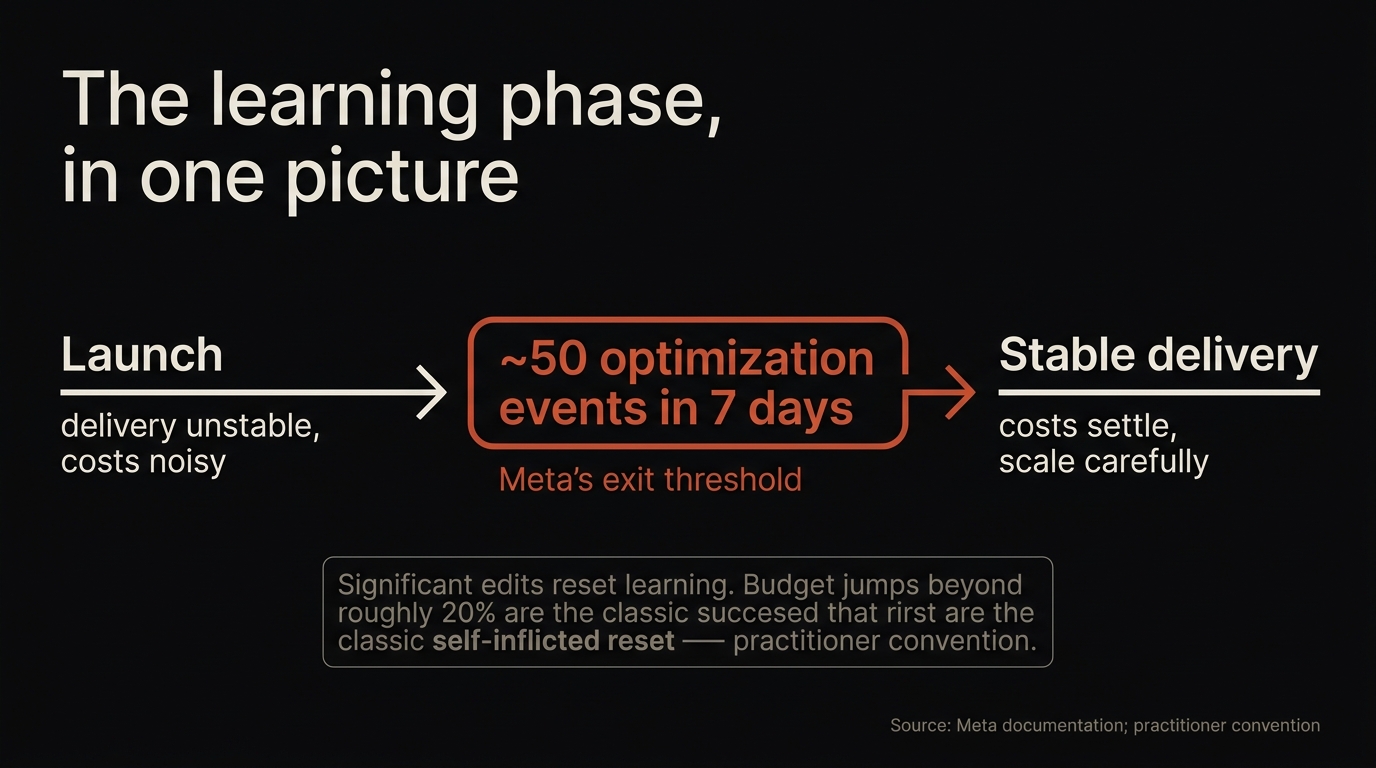
| Learning-phase exit threshold | About 50 optimization events within a 7-day window | Meta Business Help Center |
Read that table the way an operator does. Entertainment audiences are structurally cheap to reach and unusually willing to click — musicians hold the best hand at the Meta table and still mostly lose it on execution. At a $10 entertainment CPM, €500 buys roughly 50,000 targeted impressions; at $0.49 per click, the same money is roughly 1,000 visits to your smart link. What that spend produces in engaged listeners depends on the two variables benchmarks cannot publish: your creative and your song.
For the number nobody publishes: based on 2,400+ campaigns run by our founding team, cold-traffic cost per engaged listener for EDM — a click that continues into a platform session — typically lands between $0.20 and $0.60, and warm retargeting runs at a fraction of that. Treat those as directional, not as promises. For how Meta spend fits inside a full multi-channel budget, the allocation tables in our breakdown of what a music promotion budget actually buys pick up where this table stops.
Budget Pacing and the Learning Phase
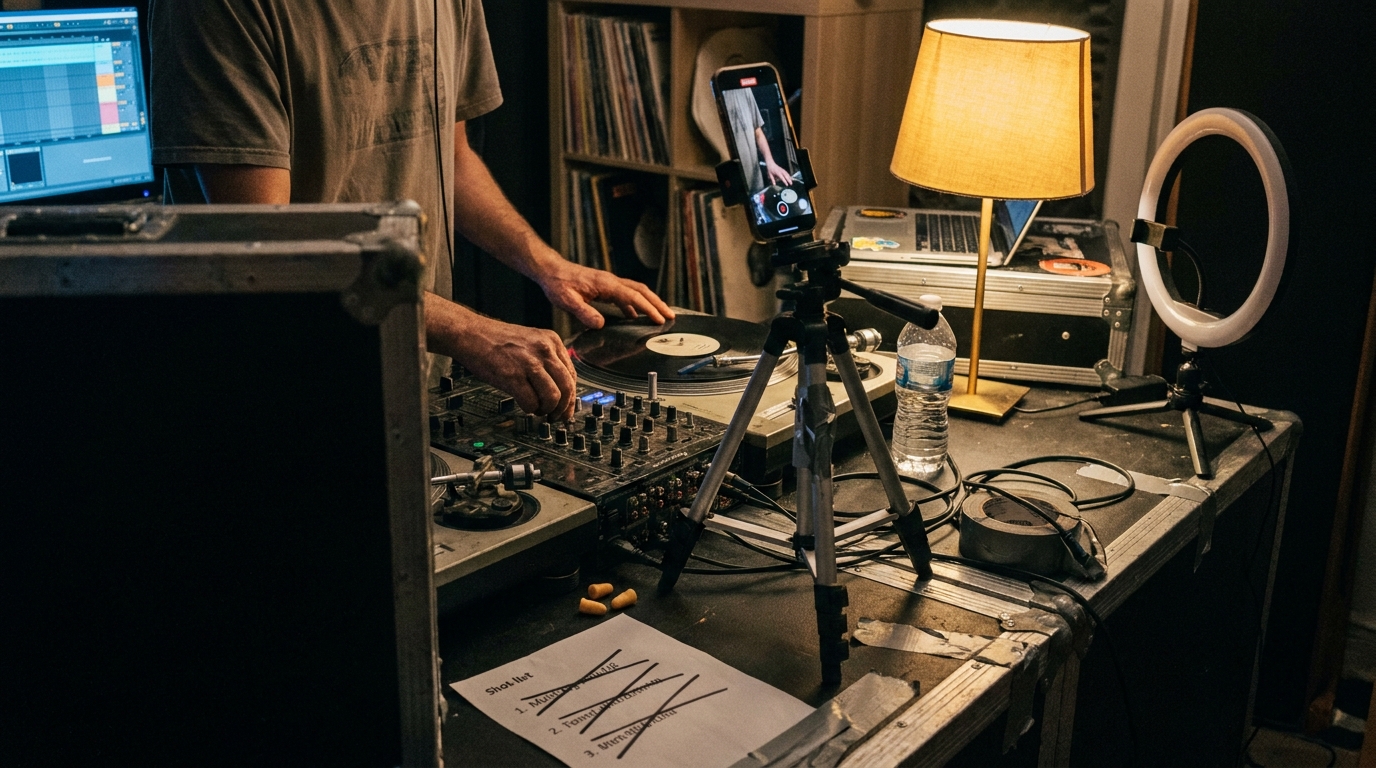
Meta's delivery system needs data before it performs, and the published threshold is specific: an ad set exits the learning phase after roughly 50 optimization events inside a rolling 7-day window, per the Meta Business Help Center. During learning, costs are volatile and every significant edit — budget jumps, audience changes, new creative — resets the clock.
Two operating rules fall straight out of that number.
Pick an event you can afford 50 of per week. At $15 per day you will never generate 50 pre-saves weekly, so optimizing for pre-saves parks the ad set in learning forever. Optimize for landing page views instead — you can hit 50 of those daily — and move down-funnel only when budget supports it.
Change budgets in steps of about 20 percent. Doubling a budget overnight re-triggers learning on an ad set that was performing. The widely used practitioner rule is to raise in roughly 20 percent increments every 2-3 days; Meta's documentation confirms significant edits reset learning without defining "significant", so the 20 percent convention is the community's safety margin, not a Meta-published number.
| Daily budget | Structure | Optimization event | What it can tell you |
|---|---|---|---|
| $10-15 | 1 campaign, 1 ad set, 3-5 ad variants | Landing page views | Which hook wins, within 7-10 days |
| $20-35 | Testing ad set, then consolidate into the winner plus a small retargeting set | Landing page views | Cost per engaged listener, within 2 weeks |
| $50-80 | Prospecting plus retargeting split | Smart-link click-through or pre-save | A full-funnel read; 50 weekly events becomes realistic |
| $100 and up | 2-3 prospecting ad sets, 1 percent lookalike, always-on retargeting | Conversions | Scaling decisions on 20 percent budget steps |
The pattern across all four rows: fewer ad sets than you want, more ads than you have, and no edits between Monday and Monday. Impatience is the most expensive targeting setting on the platform.
Measurement, the Five Leaks, and the DIY Question
Spotify for Artists cannot see your ads, and Meta cannot see your streams. The same gap exists on Google's side, where the added wrinkle is that a "view" means different things by format — see YouTube ads for music promotion. The bridge between platform and streams is UTM discipline: every ad URL carries utm_source, utm_medium, and a campaign name that encodes track, audience, and creative variant. Do this from ad one, and your smart-link analytics become a per-variant scoreboard instead of an undifferentiated traffic blob.
The view worth building is cost per engaged listener: spend divided by the number of people who clicked your ad and then clicked through the smart link to a streaming platform. It is not a perfect stream count — nothing available to independents is — but it is consistent, comparable across campaigns, and impossible to fake with cheap clicks. When that number holds steady while spend scales, you have a campaign; when it degrades, you have a frequency or creative problem, and the platform is telling you which.
Five leaks account for most of the money Meta quietly absorbs from artists:
- Boosting posts. Engagement-optimized, exclusion-free, structurally incapable of buying listeners. Covered above; repeated because it is leak number one by volume.
- Straight-to-Spotify links with no pixel. Every click paid for, no audience built, no event recorded, nothing learned. The next campaign starts from zero.
- Editing during learning. Each "small tweak" on day three resets the 50-event clock and re-buys volatility you already paid for once.
- One creative. A single ad is a coin flip presented as a strategy. Below 3 variants you are not testing, you are hoping.
- Overlapping ad sets with no exclusions. Two ad sets bidding on the same warm audience inflate your own CPM and double-charge you per fan reached.
When to DIY and when not to. Below roughly $500 per month in ad spend, run it yourself with this guide — management fees at that scale eat the budget they manage. Above roughly $1,000 per month, the math flips: a 17.8 percent CAPI gain here, a 20 percent creative-testing gain there, and professional management pays for itself out of recovered waste. That is the exact gap our managed Meta campaigns exist for, with measurable targets committed to in writing before we start. And if you have already been running ads and suspect the leaks above, a free campaign audit will locate them in your account before you spend another euro.
Frequently Asked Questions
How much do Facebook ads for musicians cost in 2026?
Entertainment sits at the cheap end of Meta's auction. WordStream's 2025 benchmarks show a $0.49 average CPC for arts-and-entertainment traffic campaigns, and entertainment CPMs run well below the $13.48 all-industry median Triple Whale reports. Plan on $300-600 per single campaign as the realistic minimum for readable results.
Should I send ad traffic straight to Spotify?
Only if you accept flying blind. A direct Spotify link produces a click and then silence: no pixel event, no retargeting audience, no per-variant data. A smart link or landing page costs some click-through on the extra step but returns data you can optimize against. At any real budget, the data wins.
Are Instagram ads different from Facebook ads for musicians?
Same auction, same Ads Manager, same campaign. Instagram and Facebook are placements inside one Meta campaign, and for music, Instagram Reels and Stories usually take most of the delivery because vertical video wins there. Start with Advantage+ placements, read the placement breakdown after a week, then trim what underperforms.
Why is boosting a post worse than running a campaign?
Boosting optimizes for engagement — reactions and comments from people Meta predicts will react, not listen. Ads Manager gives you conversion objectives, audience exclusions, placement control, and retargeting. Same money, structurally different outcome. Boosting is the most common way artists convert a few hundred euros into likes from non-listeners.
How long until Facebook ads show results for music?
Give an ad set roughly 50 optimization events inside a seven-day window before judging it — Meta's own learning-phase threshold. In practice, plan a two-week read for creative testing and four weeks for a full campaign verdict. Killing ads on day two means paying for data and then throwing it away.
Do Facebook ads grow Spotify streams directly?
Indirectly. Meta cannot see streams and Spotify cannot see your ads, so ads buy qualified listeners at the door — what happens next depends on the song. Based on 2,400+ campaigns run by our founding team, strong creative on a strong track moves saves and follows; ads on a weak track buy expensive proof.
Run the checklist in this guide and you will already be ahead of most of the artists bidding against you. If you would rather have the pixel, the audiences, the creative testing, and the pacing handled by people who do this daily, see how Otocracy's managed Meta campaigns work — or start with a free audit of your current setup and find out exactly where your last budget leaked.