TikTok Music Promotion: The Complete 2026 Guide
TikTok music promotion explained from the supply side: how sounds actually spread, what campaigns cost in 2026, and how virality converts to streams.
Quick Answer
TikTok music promotion runs on one mechanic: a sound spreads when enough creators use it that the algorithm starts recommending both the videos and the sound page itself. Everything else — the Promote button, creator campaigns, seeding agencies — is a way of forcing that first wave. The channel is worth the effort: 84% of songs that entered the Billboard Global 200 in 2024 went viral on TikTok first, and 62% of US TikTok users pay for a music streaming service, against 43% of all consumers (TikTok x Luminate Music Impact Report). The honest playbook for artists: publish your track as an official sound, post hook-first clips of 21-34 seconds yourself, and when you pay, pay for creator placements — never for views. Serious creator campaigns start around €1,000-2,000. Anyone selling guaranteed virality is selling you a view farm.
I run campaigns from the supply side. Otocracy buys placements directly from creator networks and sound-placement operators — the people labels quietly hire when they want a record moving on TikTok. That means I've seen the rate cards, the delivery reports, and the campaigns that died quietly after the invoice cleared.
This guide explains TikTok music promotion the way it actually works behind the curtain: how sounds spread, what you can do organically, what the paid options really buy, what campaigns cost, and how virality converts — or fails to convert — into Spotify streams. It sits inside our wider EDM promotion playbook for 2026, but everything here applies whether you make melodic techno or pop edits of it.
One framing rule before we start. TikTok has roughly 1.9 billion monthly active users by early 2026, according to Business of Apps estimates. You are not marketing to them. You are marketing to a few thousand creators who might use your sound — and letting the algorithm do the rest.
How TikTok Music Promotion Actually Works
Most artists picture TikTok promotion as "my video goes viral." That is the rare case. The common case — the one labels engineer on purpose — is that your sound goes viral while other people's videos carry it.
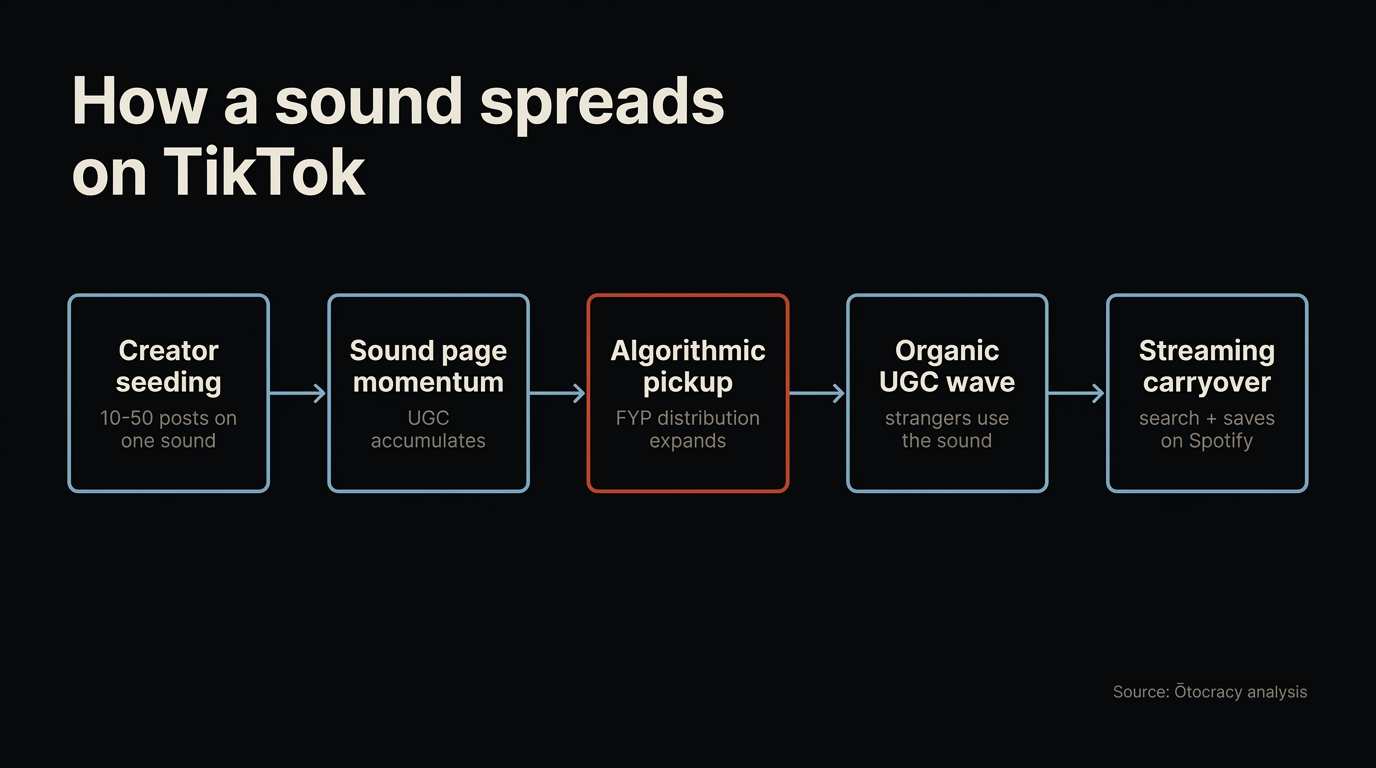
Every campaign I've run or bought placements for follows the same three-stage pipeline. Understand it and every service pitch you receive becomes easy to evaluate.
Stage 1: Creator seeding
Seeding means paying or briefing a batch of creators to post videos using your sound within a short window, usually 3-10 days. Labels do this through creator networks; independent operators do it through rosters they manage directly. The point is not the views on those videos — it's manufacturing the appearance of an emerging trend.
A typical seed wave for an electronic track is 15-40 creators, weighted toward niche accounts whose audiences actually use sounds: dance, festival, car, gym, edit pages. Based on 2,400+ campaigns run by our founding team, seed waves built from scene-matched micro creators consistently outperform one big-name placement at the same budget.
Stage 2: Sound-page mechanics
Every TikTok sound has its own page listing every video that used it, sorted with the top performers first. This page is the real product of a music campaign. When a user taps the spinning record on any video, they land there — and the "Use this sound" button is the conversion event you're optimizing for.
The sound page compounds. More creations push the sound into TikTok's viral sounds surfaces and Creative Center trend lists, which other creators actively mine for material. A sound page with 50 videos looks like a dead end; one with 800 looks like a train worth jumping on.
Stage 3: Algorithmic pickup
TikTok's recommendation system treats a sound accumulating fresh creations from unconnected accounts as a trend signal. When that happens, the algorithm starts doing your distribution: it shows sound-using videos to more users, more of them tap through and create, and the loop feeds itself.
This is the part nobody can buy directly. Seeding raises the probability of pickup; it cannot force it. Billboard's coverage of the first Luminate study on TikTok put it plainly: TikTok drives streaming, but there is no magic bullet for going viral. Any vendor claiming otherwise is lying — more on them later.
Organic Tactics: How to Promote Music on TikTok Yourself
Before spending a euro, get the organic foundation right. Paid campaigns amplify what already works; they cannot fix a track with no working clip. This is the same sequencing we teach in our guide on how to promote EDM music from zero.
Publish your track as an official sound
Your distributor delivers your release to TikTok's music library (via SoundOn, DistroKid, TuneCore, and the rest). Confirm the sound shows your correct artist name and track title — this is how people find you after hearing the clip. Then use your own official sound on every video you post, so your content feeds your sound page instead of a random upload.
If your track isn't released yet, you can still upload a snippet as an original sound to test reactions. But move creations to the official sound at release, because a split sound page is a wasted trend — the full breakdown of that mechanic is in our explainer on how TikTok sound promotion works.
Cut for the hook, not the arrangement
Nobody hears your intro. Open every clip inside the best 1-2 bars of the track — the vocal hook, the drop, the moment that would make someone at a festival grab their phone. From the booth I can tell you which 5 seconds of a track make a crowd react, and that's the 5 seconds your clip opens with.
TikTok itself has recommended videos of 21 to 34 seconds, and a WIRED analysis found one in four of the platform's most-liked videos sit in that range. For music clips this length is a feature: hook, one visual idea, payoff, done.
Post volume, not perfection
One clip per track is a lottery ticket. Ten different cuts of the same track — different hooks, different captions, different visual framings — is a test matrix. Based on 2,400+ campaigns run by our founding team, the winning clip is rarely the one the artist predicted, which is exactly why you post variants instead of arguing about the best one.
Practical cadence: 1-2 posts per day while a release is in cycle, filmed in batches. Don't delete underperformers; old clips regularly resurface when a sound starts moving.
Make the sound usable by strangers
A sound spreads when someone with no connection to you can imagine their own video on it. Loopable sections, a clear emotional read (euphoric, menacing, funny), and space for a person to talk or move over it all raise usability. Watch what the dance and edit communities in your genre are already doing, and cut your sound so it drops exactly where their format needs it to.
Paid TikTok Music Promotion Options Compared
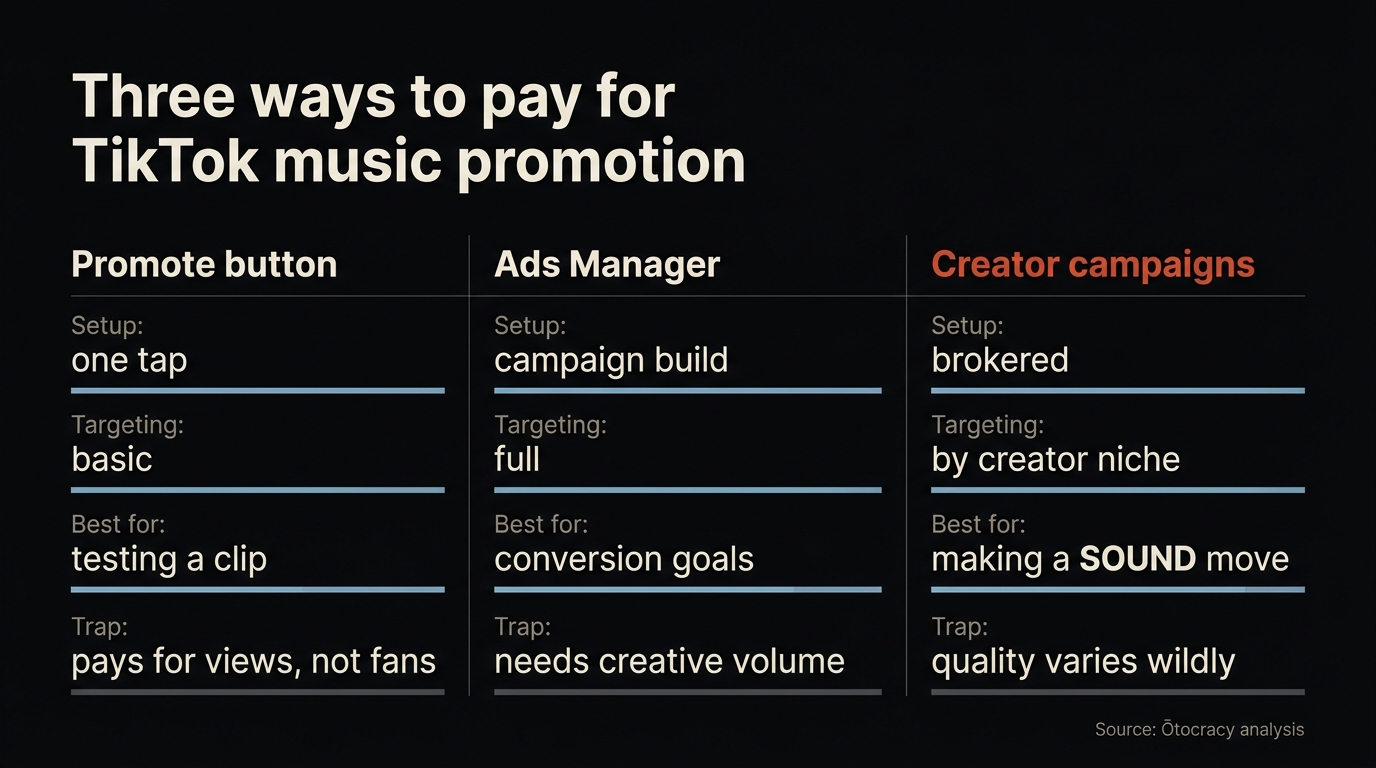
There are four legitimate ways to put money behind a track on TikTok. They do different jobs, and most wasted budget I see comes from buying the wrong one.
| Option | What it actually buys | Typical cost | Spreads your sound? | Best for |
|---|---|---|---|---|
| Organic posting | Your own clips feeding your sound page | €0 (time) | Slowly, if a clip hits | Every artist, always |
| Promote button | Boosted reach on your own videos | From about $3 per day | No — views, not creations | Testing hooks, profile growth |
| Creator campaigns | Other creators posting on your sound | €500-6,000+ per wave | Yes — this is the mechanism | Release pushes, trend attempts |
| Commercial Music Library | Brands using your track in their content | Revenue to you, not from you | Indirectly, over time | Catalog income, passive reach |
| Ads Manager (Spark Ads) | Auction ads amplifying existing posts | From $20 per day per ad group | Amplifies, doesn't start | Retargeting, off-platform conversion |
The Promote button
Promote is TikTok's in-app boost tool, starting around $3 per day — far below the Ads Manager minimums of $50 per day at campaign level and $20 per ad group. It buys guaranteed impressions on a video you already posted.
Here's what the sellers won't tell you: Promote buys views on your video, and views don't create trends — creations do. It's genuinely useful for A/B testing which hook stops the scroll before you fund a creator wave, and for nudging a video that's already converting. As a standalone music strategy, it's a rounding error.
Creator campaigns
This is the supply side I work on, and it's the only paid option that directly triggers the seeding-to-pickup pipeline described above. You brief a set of creators, they post on your official sound, and their audiences become the first strangers to encounter the trend.
Quality varies enormously between operators. The good ones match creators to your genre's actual communities and stagger posting over days; the bad ones blast your sound to whoever's cheapest and screenshot the view counts. If you are hiring creators yourself, the checks that separate the two are covered in how to vet TikTok creators. This gap is exactly why Otocracy's TikTok campaigns are built on named creators you approve before anything posts, with a projected number set in writing and delivery you verify against real data.
Commercial Music Library
TikTok's Commercial Music Library (CML) is a pre-cleared catalog of roughly 1 million tracks that business accounts must use for branded content — regular chart music isn't licensed for brand posts. Getting your music into the CML through your distributor or a licensing partner flips the economics: brands pay to use your track.
For EDM producers this is underrated. Instrumental, high-energy, mood-clear tracks are exactly what brand accounts search for. It won't make you a viral TikTok song by itself, but it's passive placement volume plus licensing income while your active campaigns run.
Ads Manager and Spark Ads
Spark Ads let you run auction ads through an existing organic post — yours or a creator's, with their permission. In music campaigns they have one killer use: once a clip proves it converts, Spark Ads scale it to lookalike audiences and retarget engaged viewers with a link out to Spotify or a pre-save.
This is where TikTok stops being a discovery channel and becomes a performance channel. If you want the full cross-platform math on that, our breakdown of what a music promotion budget actually buys runs the numbers channel by channel.
What TikTok Music Promotion Costs in 2026
Costs on the supply side are more standardized than artists think. These are the tiers we see negotiating directly with creator networks and sound-placement operators; retail prices from agencies typically sit 30-100% above the underlying creator rates, which is the margin for sourcing, briefing, and quality control.
| Tier | Budget | What it buys | Realistic outcome |
|---|---|---|---|
| DIY organic | €0 | Your own posting, 30+ days | Slow sound-page growth; occasional breakout clip |
| Hook testing | €50-200 | Promote spend across 5-10 clip variants | Data on which cut converts — nothing more |
| Micro seed | €500-1,500 | 10-20 niche creators on your sound | Sound page comes alive; pickup possible, not likely |
| Full seed wave | €1,500-6,000 | 25-50 matched creators, staggered over 1-2 weeks | Real shot at algorithmic pickup; measurable Spotify lift when it works |
| Label-scale push | €10,000+ | Multiple waves, big accounts, Spark Ads layer | Trend engineering; still no guarantee of virality |
Two honest caveats. First, results distribute brutally unevenly: most campaigns produce a modest, measurable lift, and a minority produce the outsized wins that get screenshot in sales decks. Based on 2,400+ campaigns run by our founding team, the reliable predictor of the good outcomes is creator-audience match, not raw budget.
Second, judge campaigns on creations and sound-page growth, not video views. A million views with 40 creations is a failed music campaign; 300,000 views with 1,500 creations is a trend forming. For a line-by-line breakdown of pricing across every service type, see our TikTok promotion cost guide for 2026.
From Viral TikTok Song to Spotify Streams
The conversion question decides whether any of this matters. The macro data is encouraging: Luminate found 62% of US TikTok users pay for a music streaming service versus 43% of all consumers, and 89% subscribe to at least one streaming service including free tiers, versus 74% overall. TikTok's audience is disproportionately made of people who actually stream music.
US TikTok users are also 74% more likely to discover and share new music on short-form platforms than the average short-form video user, per the same Music Impact Report. Discovery is happening there. Whether it lands on your Spotify profile is a plumbing problem, and the plumbing fails in predictable ways.
Why conversion fails
The most common failure is identity loss: the sound trends but users never learn whose track it is. Meme usage strips context fast — people know the audio, not the artist. The fixes are boring and effective: correct artist name and title on the official sound, your handle matching your artist name, a pinned comment with the track name on every trending video you control, and the full track findable within seconds of a Spotify search.
The second failure is timing. A sound that trends before the full track is released sends thousands of people to search for a song that doesn't exist; by release day the trend has moved on. Never fund a seed wave until the track is live on streaming platforms — snippet-first strategies work for major labels with release machinery on standby, and almost nobody else.
What conversion looks like when it works
When the plumbing holds, the pattern is consistent: Shazam activity and Spotify search-driven streams rise first, then algorithmic playlisting follows because Spotify's system reads the search-and-save spike as organic demand. The TikTok trend effectively becomes a trigger for Spotify's own recommendation engine.
That knock-on effect is why we treat TikTok as the top of the streaming funnel rather than a vanity channel. If you can't tell whether your current streams come from real listener demand or dead playlist placements, Otocracy's free AI audit breaks your Spotify profile down source by source before you put money behind a TikTok push.
What Predicts Sound Pickup (and What Doesn't)
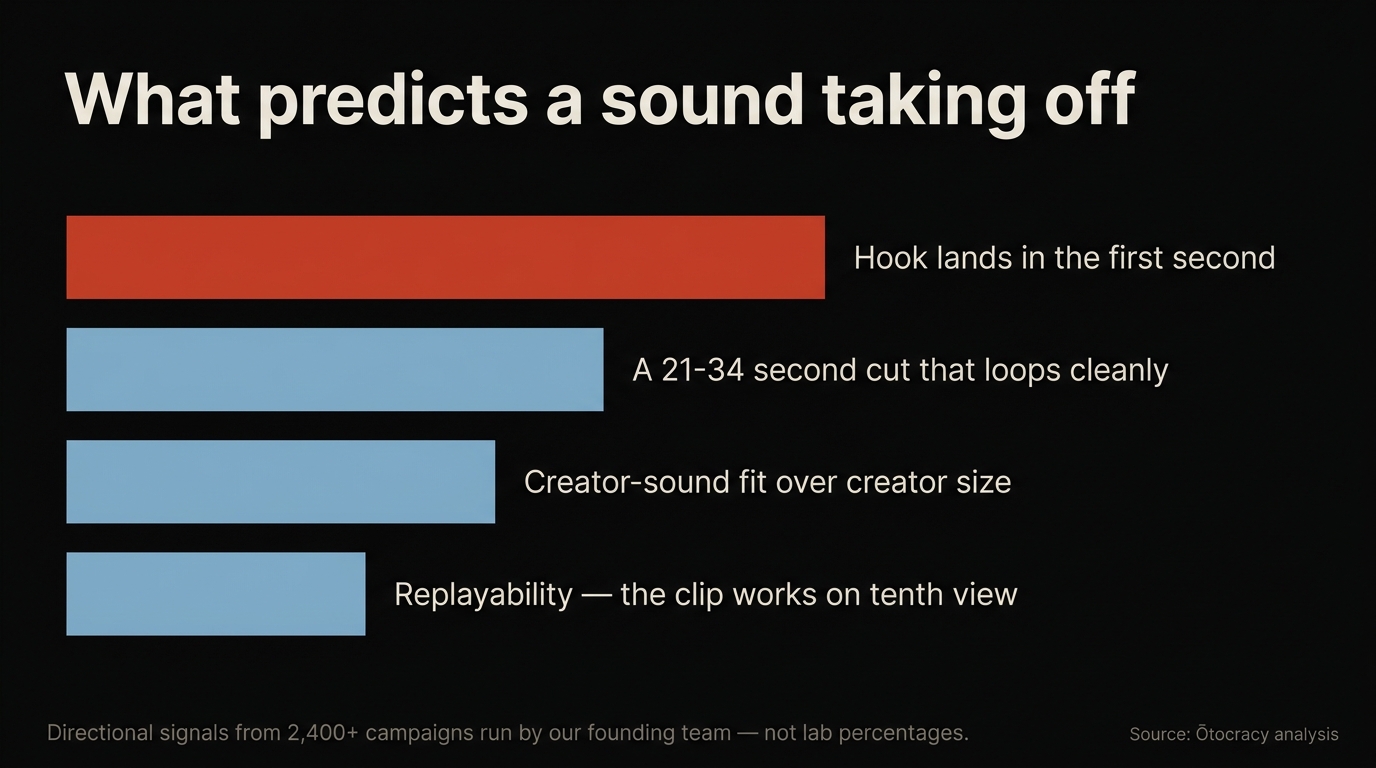
After enough seed waves you stop guessing. These are the signals we read in the first 72 hours of a campaign — directional findings from the 2,400+ campaigns our founding team has run, not lab science.
| Signal | What it looks like | Why it matters |
|---|---|---|
| Creations-to-views ratio | Strangers using the sound unprompted after seeing seed videos | The single strongest pickup predictor — it means the loop is starting |
| Completion on the clip | Viewers watching the 21-34 second cut to the end | The algorithm reads completion as content quality |
| Comment specificity | Comments quoting the lyric or naming the drop | Signals the music is the draw, not the video |
| Saves and favorites on seed videos | Users bookmarking to use the sound later | Leading indicator of next-week creations |
| Format transferability | Different communities adapting the sound to their own formats | Trends that cross niches are the ones that scale |
| Raw view count | Big numbers on seed videos | Weak predictor alone — views without creations is a dead campaign |
The practical use: if 72 hours in you see views but no organic creations, kill the wave and fix the cut or the creator match. Spending the rest of the budget on a sound the platform has already judged is how artists burn €3,000 learning nothing.
What a TikTok Music Campaign Actually Contains
People search for TikTok music promotion, TikTok music campaigns and TikTok music promo interchangeably, and they mean roughly the same thing. Worth setting out what is actually inside one, because "campaign" implies a structure that most artists never see itemised.
A complete campaign for a single release has six components. Very few artists run all six, and the ones that underperform are usually missing the same two.
| Component | What it is | Skipped by most |
|---|---|---|
| Sound setup | Official sound delivered, linked, unsplit, verified before anything posts | Often |
| Creator seeding | Paid creators posting with the sound, selected on audience fit | No |
| Owned posting | Your own clips, several a week, feeding the same sound | Often |
| Amplification | Paid spend behind the clips that already show traction | Sometimes |
| Conversion path | Sound to profile to streaming, with somewhere to land | Very often |
| Measurement | Sound-page growth, not view counts | Almost always |
The two consistently missing are the first and the last, which is not a coincidence — they are the unglamorous ends. A campaign without sound setup spends money into a page that does not accumulate. A campaign measured on views cannot tell a result from a coincidence.
Each of these has its own guide. Sound setup and the page itself are covered in TikTok sound promotion, with the troubleshooting list for when the sound is missing or unlinked. Creator seeding, pricing and selection are in TikTok influencer music promotion, and running that yourself through TikTok's own tooling is in the Creator Marketplace guide. What the whole thing costs is in TikTok promotion cost, whether TikTok's own boost is worth buying is in is TikTok Promote worth it, and how this spend compares against advertising inside Spotify is in TikTok vs Spotify Ads for EDM. If you would rather see the providers side by side with verified pricing, that is the services comparison.
Red Flags: View Farms and Guaranteed-Viral Scams
The TikTok promotion market has a thick scam layer, and it feeds on exactly the artists reading guides like this one. From the supply side, these are the tells that a seller is not running real creator campaigns.
"Guaranteed viral" or guaranteed view counts. Nobody controls algorithmic pickup — not TikTok's own ad platform, not the biggest label in the world. A guaranteed number of views can only be delivered one way: bot traffic pointed at your videos. It converts to zero streams and can get content flagged.
Prices too low for the promised delivery. Real creators cost real money. If someone offers "50 influencer posts" for €200, the placements are bot accounts, recycled content farms, or creators with purchased followings whose audiences will never touch your sound.
No creator names before you pay. Legitimate operators tell you who is posting, when, and to what audience, and let you veto mismatches. Sellers who show you nothing until "delivery" are hiding the fact that there's nothing to show.
Views sold on the sound page itself. Some sellers inflate sound-page video counts with junk uploads from dead accounts. TikTok's trend surfaces weight fresh creations from active, unconnected users — a padded page fools artists, not the algorithm.
Screenshot reporting with no analytics access. Real campaigns report links to every posted video plus the sound-page trajectory. Screenshots of view counters are the easiest artifacts on earth to fake.
The clean test for any vendor is one question: "What exactly happens if you underdeliver?" Honest operators answer with numbers and remedies in writing — it's the reason Otocracy commits to measurable targets instead of adjectives. Scammers answer with vibes.
Frequently Asked Questions
How much does TikTok music promotion cost?
Realistic 2026 pricing: the Promote button starts around $3 per day for reach testing, micro creator seeding runs €500-1,500, and a full seed wave of 25-50 matched creators costs €1,500-6,000. Label-scale pushes with ad amplification start above €10,000. Budget for creations on your sound, never for raw views.
Can you promote music on TikTok for free?
Yes — organic posting is the foundation every paid campaign is built on. Publish your track as an official sound, post 1-2 hook-first clips daily in the 21-34 second range, and cut variants of the same track. Free promotion costs consistency instead of money, and it produces the converting clip that paid budget later scales.
How many videos does a sound need to go viral?
There's no fixed threshold — pickup depends on the creations-to-views ratio, not a magic number. As a directional marker from our campaign work, sounds that reach several hundred creations from unconnected accounts within two weeks are trend candidates; sound pages stuck below 50-100 creations rarely trigger algorithmic distribution.
Does the TikTok Promote button work for musicians?
For its actual job, yes: Promote cheaply tests which hook and cut stop the scroll before you fund creator placements. What it cannot do is spread your sound, because it buys views on your own videos rather than creations by other people. Treat it as a testing tool, never as the campaign itself.
How do I get my music on TikTok as an official sound?
Your distributor — SoundOn, DistroKid, TuneCore, and similar — delivers your release to TikTok's music library automatically or as an add-on. Verify the sound carries your exact artist name and title, then use it on all your own posts. Separately, licensing into the Commercial Music Library lets brand accounts legally use your track.
Do viral TikTok songs actually convert to Spotify streams?
The audience overlap is real: 62% of US TikTok users pay for music streaming versus 43% of consumers overall (Luminate). Conversion fails when the trend outruns identity — wrong sound metadata, unreleased track, unsearchable artist name. Fix the plumbing before the campaign and the Shazam-to-search-to-algorithm chain follows.
TikTok is the closest thing electronic music has to a global A&R desk that works while you sleep — but it rewards artists who understand the sound-page machine and punishes anyone buying views to feel productive. Get the organic foundation live, test your hooks for pocket change, and put real budget only into creator placements you can verify.
If you want that executed by people who buy these placements at the source, Otocracy's TikTok campaigns run scene-matched creator waves with named creators, full delivery reporting, and a written projection you can hold us to. Not sure TikTok is even your next move? Start with the free AI audit and let your own data pick the channel.