TikTok Sound Promotion: How to Get Your Sound Used (2026)
How TikTok sound promotion works: why sounds spread when videos do not, how to set up your official sound page, and how to seed it so creators use it.
Quick Answer
TikTok sound promotion is not about your video going viral — it is about the audio object itself spreading while other people's clips carry it. Every release becomes a sound with its own official sound page: a feed of every video using the track, a title, artwork, and an Add to Music App button that saves the song to Spotify or Apple Music in one tap. That page is the product you are promoting. A sound spreads when unconnected creators keep posting on it, which trips TikTok's trend signal and hands you free distribution. The channel converts: Luminate's Music Impact Report with TikTok found a statistically significant link between TikTok activity and streaming for 96% of artists studied, with an average 11% stream lift within three days of a TikTok peak — and 84% of songs entering the Billboard Global 200 in 2024 went viral on TikTok first. Set the sound up right, then seed creators, never views.
Most producers promote a song on TikTok by posting a video and hoping the video wins. That is the wrong object. The thing that actually travels is the sound — the audio file TikTok assigns a page to — and once you see the platform that way, every campaign decision gets simpler. This is the deep-dive companion to our broader TikTok music promotion guide: where that piece covers the whole channel, this one is only about the sound object, its official sound page, and the mechanics of moving it.
What a TikTok Sound Actually Is
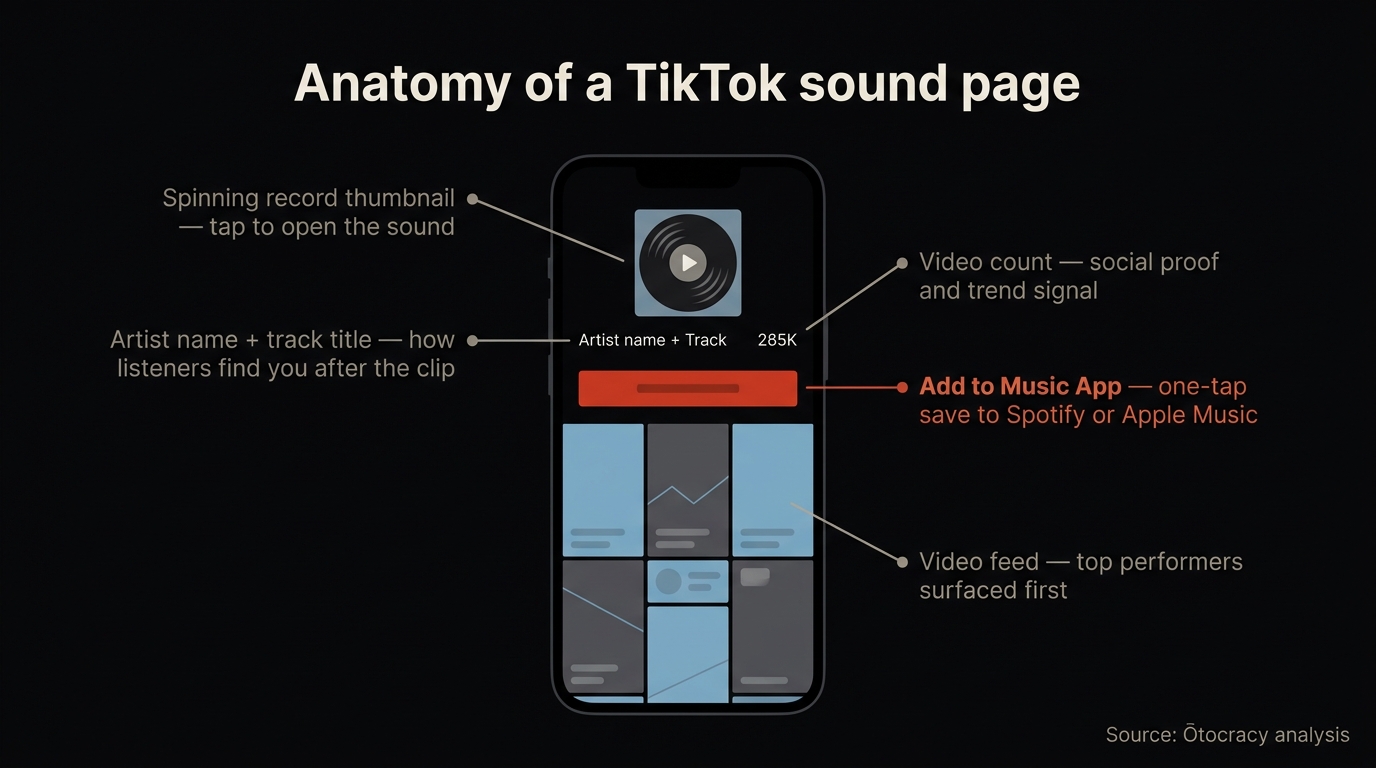
A sound is the audio object TikTok creates the first time a track appears on the platform. It is separate from any single video. When someone taps the spinning record in the corner of a clip, they land on that sound's page — and every video that used the audio is collected there.
The official sound is the version tied to your release through your distributor, carrying your artist name, your title, and your cover art. That is the difference between a sound and a random upload. TikTok distinguishes tracks delivered through the music library from a person filming with background audio, and only the official version earns the artist-facing tools.
The sound page has three jobs, and each one matters to you. It is a discovery surface, a social-proof counter, and a conversion point in a single screen:
| Element on the sound page | What it does | Why it matters for promotion |
|---|---|---|
| Video feed (top-performers first) | Shows every clip using the sound | This is where a browsing creator decides the track is worth using |
| Video count | Signals how "alive" the sound is | 30 videos reads as a dead end; 1,000 reads as a trend worth joining |
| Artist name and title | Tells the viewer whose track it is | The single point where identity is kept or lost |
| Add to Music App button | Saves the song to Spotify or Apple Music in one tap | The direct bridge from a TikTok clip to a stream |
That Add to Music App button is not a small detail. TikTok rolled it out with Spotify, Apple Music, and Amazon Music so a listener can save a track to their streaming library without leaving the app (Variety, 2023). On the official sound page, it turns the whole audience of a trend into one-tap savers — which is the entire point of doing this instead of chasing view counts.
How a Sound Spreads vs How a Video Spreads
Ten years in booths and three years running Temple of Sinners taught me the difference between a track people applaud and a track people steal. On TikTok that distinction is literal: a video earns you views, a sound earns you a movement. They travel through different machinery.
A video spreads when the For You algorithm decides that one clip holds attention, and it rewards the account that posted it. A sound spreads when many unconnected people keep making new videos on it — the platform reads a rising count of fresh creations from strangers as a trend and starts pushing the sound itself into discovery surfaces and the Creative Center. One is a spike on your profile; the other is a wave you barely appear in.
That is why "my video didn't blow up" is the wrong scoreboard. Here is the split I hold every campaign to:
| Dimension | Video-first | Sound-first |
|---|---|---|
| What wins | One clip catches the algorithm | Many creators keep posting on the audio |
| Who benefits | The posting account's follower count | The track, across everyone's videos |
| Failure mode | A viral clip nobody links to the song | A used sound with the wrong artist name |
| Signal TikTok reads | Watch time on a single video | Creation velocity from unconnected accounts |
| Payoff for a producer | Followers, maybe | Streams, Shazams, playlist pickup |
The sound-first case is the one labels engineer on purpose and the one this whole discipline is built around. Your own clips are seeds for it, not the goal. If you want the wider view of how organic posting, paid boosts, and creator waves all feed into this, our complete EDM promotion guide puts TikTok in sequence with the rest of a release.
Setting Up Your Official Sound at Release
Sound promotion fails before it starts more often than it fails during. The most common own goal is a broken or split sound at the moment the track goes live. Fix this when you release the track, not after a clip is already moving.
Your distributor delivers the release to TikTok's music library — SoundOn, DistroKid, TuneCore, and the rest handle it automatically or as an add-on. The job is to verify, not assume. Open the sound after delivery and confirm three things: your exact artist name, your exact title, and your cover art. A misspelled name or a "provided to TikTok by" credit instead of your handle is a leak in the pipe.
Then consolidate. If you tested a snippet as an original sound before release, move your posting to the official sound the day the track is live — a split page divides the trend across two dead ends. The release-day mechanics for the streaming side of the same launch are laid out in our guide on how to release a song on Spotify in 2026, and the TikTok setup should line up with it beat for beat.
Run this check before you post a single clip:
| Setup step | The correct state | The common failure |
|---|---|---|
| Official sound exists | Delivered via your distributor, artist-verified | Only an "original sound" from your own upload |
| Artist name and title | Exactly match your DSP metadata | Typos, feature credits, distributor tags |
| Handle matches artist name | @yourname reads as the artist | A username nobody connects to the track |
| One sound, not two | All posts feed the official sound | Snippet and release split across pages |
| Track is live on streaming | Searchable the moment a clip lands | Trend outruns a release that does not exist yet |
Get those five right and every clip you or a creator posts compounds onto one page that points cleanly at your streaming profile. Get one wrong and you are seeding a trend that leaks.
Anatomy of a Sound Page
Worth being concrete about what you are actually building, because "the sound page" gets used loosely and it is the only asset in TikTok music promotion that accumulates.
A sound page is a single URL that collects every video anybody has made with your track. It carries your artist name and cover art at the top, a running count of videos using it, a "use this sound" button that sends a viewer straight into the editor with your track loaded, and — when the release is delivered and linked properly — a route out to streaming.
Three properties make it the asset rather than a by-product:
It compounds. A video peaks and dies within days. A sound page keeps every clip that ever used the track, so a creator who posts in March still adds to the same page a fan lands on in November.
It is the only shareable thing. You cannot send somebody "my TikTok trend". You can send them a sound page, and so can a label, a booker or a playlist editor evaluating whether a record has traction.
It converts. The path from hearing a clip to opening your track on a streaming service runs through this page. Break the link and the trend is entertainment rather than promotion.
Which is why a split or missing sound page is worth more attention than another round of clips. If yours is not appearing, or your profile has no Music Tab attached to it, that is a delivery and linking problem with its own fixes — we work through them in why your song is not showing on TikTok.
The Sound-to-Stream Carryover Mechanic
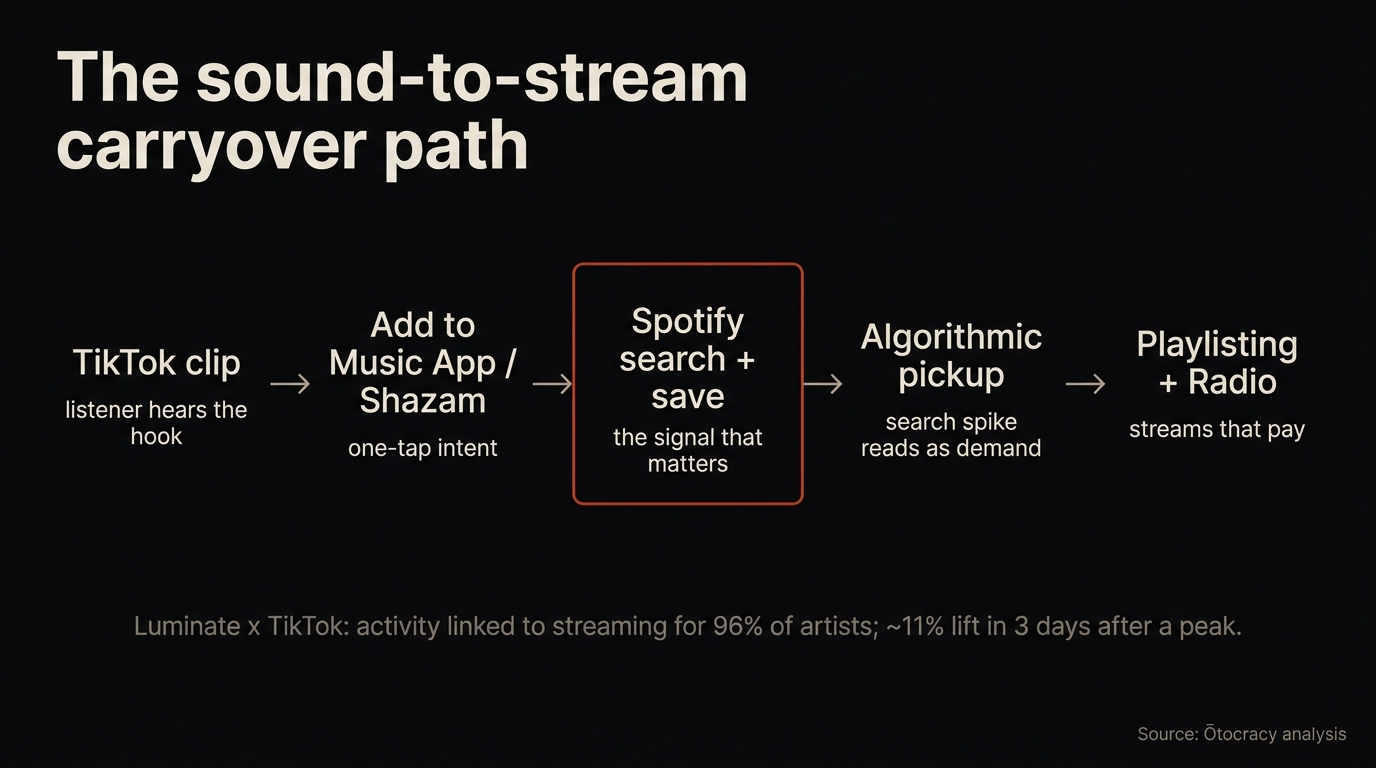
Carryover is the reason any of this pays. A sound trending on TikTok is a vanity number until it moves streams, and the path from one to the other is measurable, not mystical.
The macro evidence is strong. Luminate's Music Impact Report with TikTok found a statistically significant link between TikTok activity and on-demand streaming for 96% of the artists it studied, with an average 11% stream lift in the three days after a peak in TikTok activity (TikTok Newsroom; Billboard). The audience is also built to convert: 62% of US TikTok users pay for a music streaming service, against 43% of all consumers.
The mechanism runs in a specific order, and knowing it tells you what to protect. A listener hears the hook, taps Add to Music App or opens Shazam, searches your name on Spotify, and saves the track — then Spotify reads that search-and-save spike as organic demand and starts feeding the song into its own recommendations. The TikTok trend becomes the trigger for the streaming algorithm, which is the same handoff we describe from the Spotify side in our Spotify promotion guide for EDM artists.
Based on 2,400+ campaigns run by our founding team, the sounds that carry over cleanest are the ones set up before the first creator ever posts — official sound claimed, artist name matched across platforms, and the track already live to stream. The seeding wave only converts when there is somewhere for the search traffic to land.
The carryover breaks in two predictable places. The first is identity loss — the sound trends but nobody learns whose track it is, because the metadata is wrong or the meme strips the context. The second is timing — a sound peaks before the track is streamable, sending thousands of people to search for a song that does not exist yet. If you cannot tell whether your current streams come from real demand or dead placements, Otocracy's free AI audit breaks your profile down source by source before you put money behind a push.
How to Seed a Sound With Creators
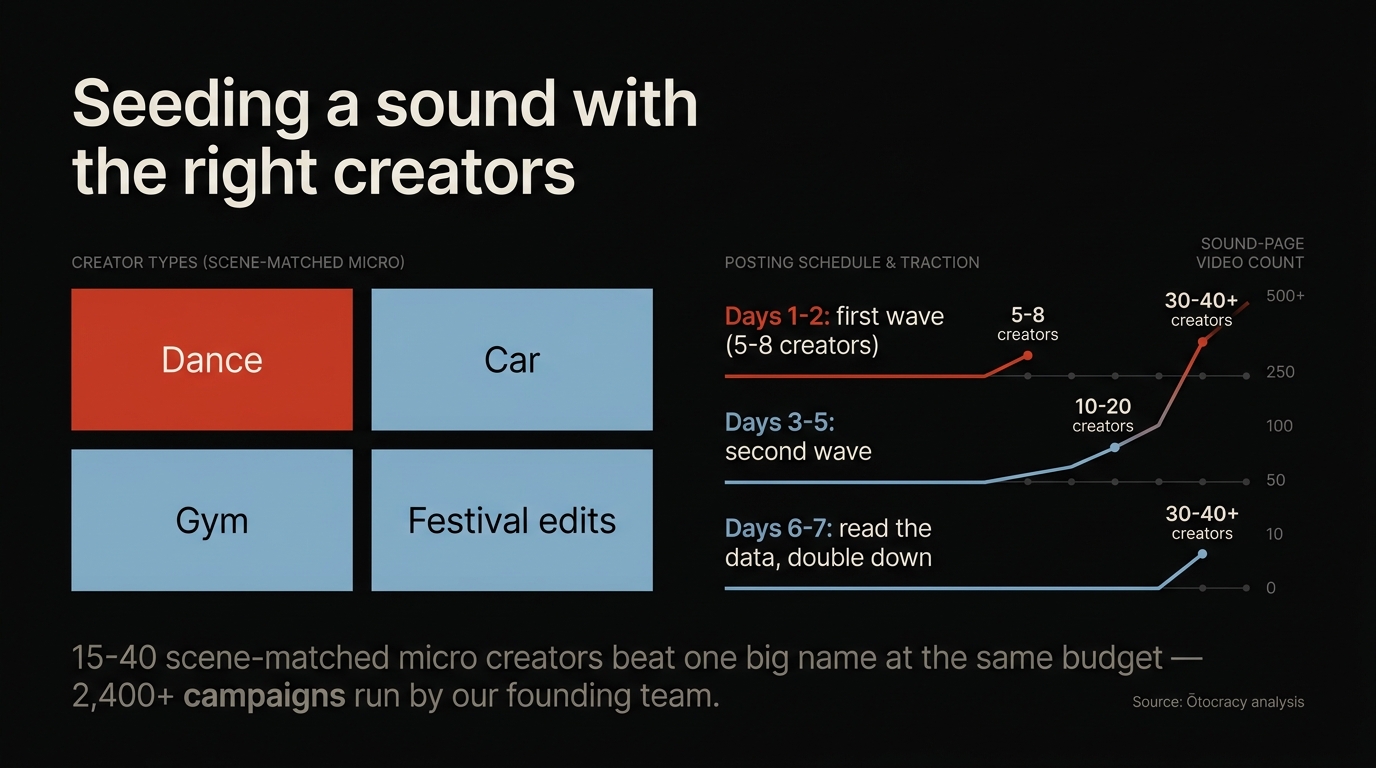
Seeding is the paid shortcut to the first wave. You brief a batch of creators to post on your official sound inside a short window so the page fills with fresh creations from unconnected accounts — the exact signal that makes TikTok start distributing the sound for you. The videos are not the product. The creation velocity is.
For an electronic track, a working seed wave is usually 15-40 creators weighted toward niche pages whose audiences actually reuse sounds: dance, festival, car, gym, and edit accounts. Based on 2,400+ campaigns run by our founding team, scene-matched micro creators consistently outperform one big-name placement at the same budget, because their audiences are the people who make the second wave. Finding those creators and confirming their audiences are real is its own job — the vetting process is here.
The choice most producers get wrong is spending on the wrong paid object. The Promote button and boosted views amplify one video; they do not add creations, so they cannot start a sound. That trade-off is worth understanding in full — we walk through it in is TikTok Promote worth it for musicians. Here is the honest comparison for moving a sound specifically:
| Organic seeding (your own posts) | Paid creator campaign | |
|---|---|---|
| What it does | Feeds your sound page yourself | Fills the page with creations from strangers |
| Cost | Time and consistency | Roughly €500-1,500 micro, €1,500-6,000 full wave |
| Speed | Slow — weeks of volume | Days — a concentrated window |
| Spreads the sound? | Only if a clip catches | Directly triggers the seeding-to-pickup loop |
| Main risk | Never reaching creation velocity | Paying an operator who buys views, not creations |
Two rules keep seed money honest. Judge the campaign on creations and sound-page growth, never on raw view counts — a million views with 40 creations is a failed music campaign. And insist on named creators you can veto before anyone posts. The full price map across every service tier is in our TikTok promotion cost guide for 2026, and it is the fastest way to spot an operator charging trend money for view-farm delivery.
Honest Limits: What Sound Promotion Cannot Do
Sound promotion is powerful and oversold in equal measure, so here is the part the sellers skip. No amount of seeding forces algorithmic pickup — it raises the probability, and the platform still gets the final vote. Billboard's coverage of the first Luminate study said it plainly: TikTok drives streaming, but there is no magic bullet for going viral.
A sound also cannot rescue a clip that does not stop the scroll. From the booth I can tell which five seconds of a track make a crowd grab their phones, and that is the section your sound has to open on — if the hook is not there, seeding just buys you an expensive dead page. Nobody's audience reuses a sound they scrolled past.
And virality is not the goal for most releases — carryover is. A modest, measurable lift on every release beats one screenshot-worthy spike a year, because cadence compounds and one-off luck does not. Anyone guaranteeing viral or guaranteeing view counts is selling bot traffic, which converts to zero streams and can get your content flagged. Real operators commit to a number and a remedy in writing, which is exactly how Otocracy's TikTok creator campaigns are structured, and why the campaign packages quote projections instead of adjectives.
Frequently Asked Questions
What is a TikTok sound versus a TikTok video?
A sound is the audio object TikTok assigns its own page, separate from any clip; a video is one post. Sounds spread when many unconnected creators keep posting on them, which the algorithm reads as a trend. Videos spread when one clip holds attention. For music promotion, the sound is what you move.
How do I make my track an official sound on TikTok?
Your distributor — SoundOn, DistroKid, TuneCore, and similar — delivers your release to TikTok's music library automatically or as an add-on. After delivery, open the sound and verify your exact artist name, title, and cover art. Then use that official sound on every clip you post so nothing splits your sound page.
Does a viral TikTok sound actually increase Spotify streams?
Measurably, when the setup holds. Luminate's Music Impact Report with TikTok found a statistically significant link between TikTok activity and streaming for 96% of artists studied, averaging an 11% stream lift within three days of a TikTok peak. The path runs through Add to Music App, Shazam, and search — so correct metadata is non-negotiable.
How many videos does a sound need before it takes off?
There is no fixed threshold — pickup depends on creation velocity from unconnected accounts, not a magic count. As a directional marker from our campaign work, sounds reaching several hundred creations from strangers within two weeks are trend candidates, while pages stuck below 50-100 creations rarely trigger algorithmic distribution on their own.
Is the official sound page the same as the Promote button?
No, and confusing them wastes budget. The official sound page is where creations collect and where the Add to Music App button converts listeners. The Promote button buys views on one of your own videos — useful for testing a hook, but it adds no creations, so it cannot spread a sound.
Should I seed a sound before or after the track is released?
After, in almost every case. A sound that peaks before the track is streamable sends thousands of people to search for a song that does not exist, and the trend moves on by release day. Snippet-first strategies belong to major labels with release machinery on standby — for everyone else, release first, then seed.
The sound is the object that travels, the official sound page is where you win or lose the audience, and carryover is the only number that pays. Set the sound up clean at release, cut every clip to open on the five seconds that actually move a room, and spend paid budget on creations rather than views.
If you want that run by people who buy creator placements at the source, Otocracy's TikTok campaigns seed scene-matched creators on your official sound with named accounts you approve and a written projection you can hold us to.