TikTok Creator Marketplace for Musicians (Now TikTok One)
The Creator Marketplace moved inside TikTok One in 2026. What it gives a music artist, what it costs to run yourself, and when it is the wrong tool.
Quick Answer
The TikTok Creator Marketplace is no longer a standalone product — it now sits inside TikTok One, TikTok's consolidated platform for creator collaborations, ad tools and creative insights, and is reached through TikTok One or TikTok Ads Manager. The core function is unchanged: discover creators, filter them by location, category, follower count and views, run a collaboration project, approve deliverables, then publish organically or amplify with paid. It is available in roughly 24 countries as of 2026. The important thing for an artist to understand is that it is a brand-side tool. You access it through a business and ads account rather than an artist profile, and it assumes a buyer who runs campaigns regularly. Its discovery filters are demographic, with nothing identifying whether a creator's audience actually listens to your genre — the only filter a dance record needs. For a single release the overhead usually costs more than it saves; for a label running campaigns monthly it pays for itself.
Most guides to the TikTok Creator Marketplace describe a product that has been restructured. It is worth ten minutes to get the current shape right, because the change affects how you reach it and what account you need.
The short version: the Creator Marketplace still exists, still does the same job, and is now a component of TikTok One rather than a destination of its own.
What Actually Changed
TikTok One is TikTok's consolidated platform bringing creator collaborations, ad tooling and creative insights together in one place. The Creator Marketplace is now accessed inside it, and inside TikTok Ads Manager.
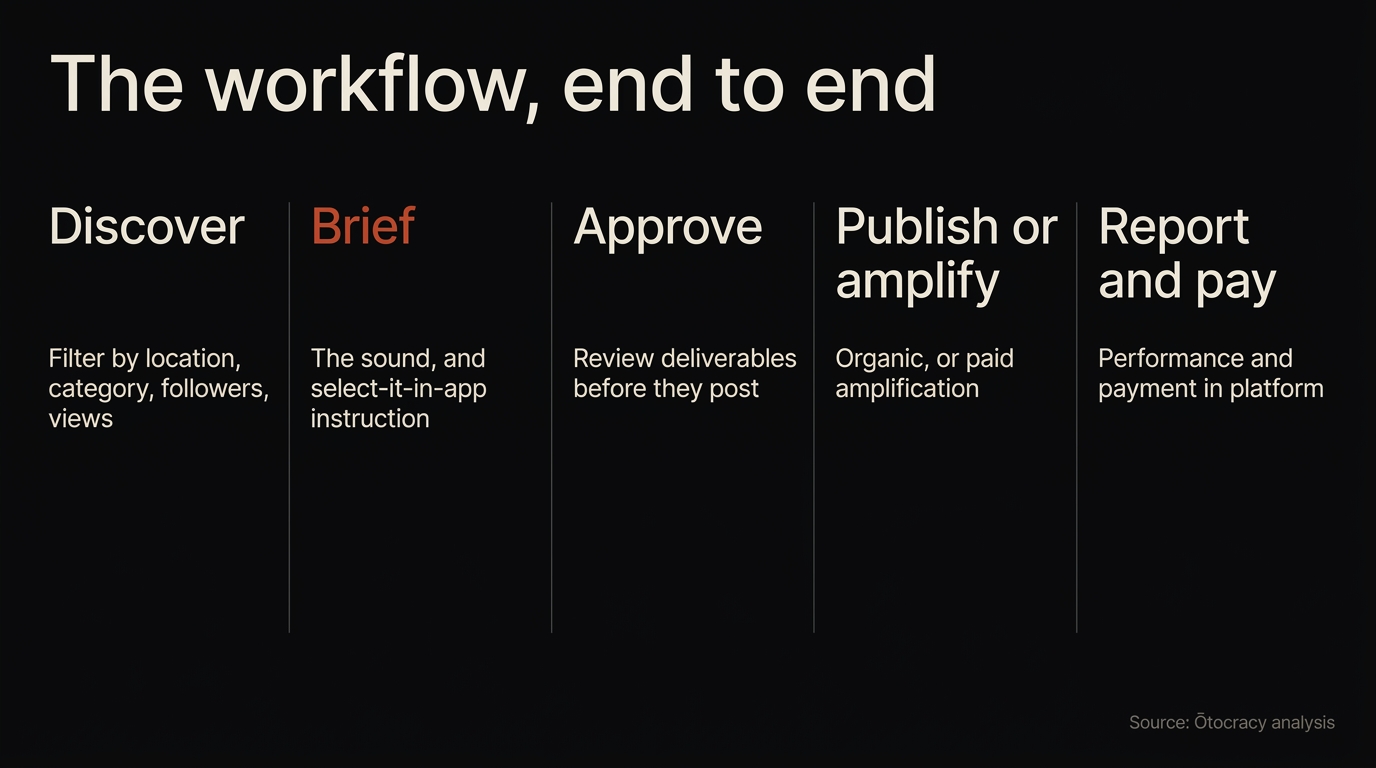
Nothing was removed. A brand can still build a profile, discover creators, launch a collaboration project, manage deliverables, then take approved content to organic publishing or paid amplification — with performance reporting and creator payments handled in-platform.
| Before | Now | |
|---|---|---|
| Where you access it | Standalone Creator Marketplace | Inside TikTok One or Ads Manager |
| Core function | Discover, brief, approve, pay creators | Unchanged |
| Added around it | — | Ad tools and creative insights in the same surface |
| Availability | Selected markets | Roughly 24 countries in 2026 |
If a guide sends you to a standalone marketplace login, it predates the consolidation and anything else in it is worth checking too.
It Is a Brand Tool, and That Matters
This is the part artist-facing coverage tends to skip.
The Creator Marketplace was built for brands buying creator content — filtering by audience demographics, running structured projects with deliverables and approvals, and reporting on paid performance. Artists and labels can absolutely use it, but you are using a tool designed around a different buyer, and the consequences are practical rather than philosophical.
You need a business and ads account to reach it, not an artist profile. The workflow assumes briefs, approvals and structured deliverables. And the discovery filters are demographic — location, category, follower count, views — rather than musical. There is no filter for "creators whose audience actually listens to melodic techno", which is the only filter a dance record really needs.
The Account Question
Worth settling before you start, because it decides what you can do.
A Business account includes the full Commercial Music Library. A Creator account does not. That matters if you plan to use other people's licensed music in your own content, and it catches people out when they switch account types to reach the marketplace and lose access to something else.
For your own music, neither account type is what makes your track usable — that is a distribution question, and if your own sound is missing or unlinked, the marketplace will not fix it. Sort that first: why your song is not showing on TikTok covers the five causes.
Running It Yourself vs Not
The honest comparison, since this is the actual decision.
| Direct through TikTok One | Through a creator network | |
|---|---|---|
| Creator discovery | Demographic filters, no genre signal | Curated by scene and sound |
| Setup cost | Business + ads account, learning the workflow | None |
| Negotiation | Per creator, by you | Handled |
| Best for | Recurring campaigns, brand-style budgets | A release, or a first campaign |
| Worst for | One release, no prior campaign experience | Anyone who wants full platform control |
The break-even is frequency, not budget. A label running creator campaigns every month amortises the setup and gains real control. An artist running one campaign around one release spends the first campaign learning the tool, which is the expensive way to learn it.
Across the 2,400+ campaigns run by our founding team, the variable that separates a creator campaign that moves a sound from one that produces views and nothing else is creator-to-audience fit, and that is precisely the thing the platform's own filters cannot see. Follower count is not a proxy for whether a creator's audience plays your genre.
When It Is Worth Running Yourself
Three conditions, and I would want all three.
You are in a supported market. Roughly 24 countries have it. Check before you plan around it.
You will run it more than once. The workflow rewards repetition. A single project does not repay the account setup, the briefing template and the learning curve.
You already know which creators you want. The marketplace is far better at managing a relationship than at finding the right creator for a dance record. If you have a list from watching who actually posts in your scene, the tool is genuinely useful for briefing, approving and paying them.
If none of those hold, the sensible route is a campaign run for you — our TikTok creator campaigns do the discovery on scene fit rather than follower count — and the mechanics of what you are buying are in TikTok influencer music promotion.
The Overhead Nobody Prices
Running it directly is not free just because there is no agency margin. The costs are real, they are just paid in time.
Account setup. A business account and an ads account, with billing, before you can see a creator.
Briefing. Each creator needs a brief covering the sound, the in-app selection instruction, the deliverable and the deadline. Writing the first good one takes longer than you expect; reusing it is cheap.
Selection. The filters narrow by demographics, so the actual work — checking whether a creator's recent posts suggest an audience that plays your genre — is manual, per creator, and is the part that decides the campaign.
Negotiation and chasing. Rates, revisions, late deliverables. Structured in-platform, still your time.
Across the 2,400+ campaigns run by our founding team, selection is where the hours go and where the outcome is decided, and it is the one part the platform does not help with. Budget the time for it or the campaign becomes a follower-count exercise.
Whether any of this is worth running at all starts with knowing where your listeners come from now — the free audit answers that before you commit a budget.
What It Does Not Solve
Two things worth being blunt about.
It does not create demand. A creator posting your sound to an audience with no interest in your genre produces a view count and no sound-page growth. The sound page is the asset, and it only grows when the right people post.
It does not fix your sound. Every clip a creator makes needs to attach to your official sound, which means selecting it from TikTok's in-app library rather than baking the audio into an upload. That instruction belongs in every brief you write, and it is the most common reason a paid campaign leaves the sound page empty.
Frequently Asked Questions
Is the TikTok Creator Marketplace still available?
Yes. It now sits inside TikTok One, TikTok's consolidated platform for creator collaborations, ad tools and creative insights, and is reached through TikTok One or TikTok Ads Manager rather than as a standalone product. The core discovery, briefing, approval and payment functions are unchanged.
Can musicians use the TikTok Creator Marketplace?
Yes, but it is designed for brands buying creator content, so you access it through a business and ads account rather than an artist profile. The discovery filters are demographic rather than musical, which is its main limitation for a genre-specific record.
What countries is the Creator Marketplace available in?
Roughly 24 as of 2026, spanning North America, Europe, Asia-Pacific and selected Middle Eastern markets. Confirm your market before building a campaign plan around it.
Do I need a Business account or a Creator account?
A Business account for the full Commercial Music Library and for marketplace access through the ads side. A Creator account does not include the Commercial Music Library, which matters if you intend to use other artists' licensed tracks in your own content.
Is it cheaper than using an agency?
Only if you run campaigns repeatedly. The platform removes the intermediary but adds account setup, briefing, negotiation and approval work. For a single release the time cost usually exceeds the saving, and the first campaign is spent learning the workflow.
Will creator videos automatically boost my sound?
No. A clip only contributes to your official sound page if the creator selects your track from TikTok's in-app Sound Library rather than adding the audio before uploading. Put that instruction in every brief.
What to Put in a Brief
Since the platform structures deliverables but not instructions, the brief is where a campaign is won or lost. Five lines cover almost everything.
The sound, by name and link. Not the track title alone — a link to the official sound page, so there is no ambiguity about which of several similarly named sounds to use.
Select it in the app. State explicitly that the creator must choose the track from TikTok's in-app Sound Library rather than adding the audio in an editor. Without this line you will get videos that do nothing for the sound page.
The section of the track. Which fifteen seconds. Leaving this open means creators pick the intro, which is rarely the part that carries a record.
What not to do. No captions claiming the artist endorsed something untrue, no implying a partnership that does not exist, and disclosure per the platform's rules where the post is paid.
The deadline, and whether posts should cluster. Several creators posting within a short window builds a sound page faster than the same creators spread across a month.
Is TikTok One the same as TikTok Ads Manager?
Not quite. TikTok One is the consolidated creative and collaboration surface, bringing creator partnerships, ad tooling and creative insights together; Ads Manager is where campaigns are built and bought. The Creator Marketplace is reachable through both, which is why guides disagree about where to find it.
Can I find creators by music genre in the marketplace?
No. Filtering is demographic — location, category, follower count, views — with no signal for whether a creator's audience actually listens to your genre. That check is manual, per creator, and it is the part that decides whether a campaign moves your sound.
The Bottom Line
The Creator Marketplace has not gone anywhere, it has moved — into TikTok One, alongside the ad tools. Most of what is written about it describes the previous shape.
For a label running creator campaigns monthly in a supported market, learning it directly is worth the setup. For an artist with one release and no campaign history, the tool's own weakness — demographic filters with no sense of whether a creator's audience plays your genre — is exactly the problem you most needed solved.
The wider picture sits in the complete TikTok music promotion guide, and what creator campaigns actually cost is in TikTok promotion cost.
Platform structure, availability and account requirements verified 5 September 2026. TikTok restructures these products regularly — confirm current behaviour before planning around it.