TikTok Influencer Music Promotion: Vetting Creators (2026)
TikTok influencer music promotion in 2026: sourcing creators via TikTok One, spotting fake audiences with real benchmarks, briefing and attribution.
Quick Answer
TikTok influencer music promotion is gated by one rule most artists never read: TikTok's Branded Content Policy states that brands may only partner with content creators through the TikTok One platform, which houses the Creator Marketplace. Creator eligibility sits at 10,000 followers, 1,000 post views in 30 days, and three posts a month per TikTok's support documentation, though project-level and regional requirements vary. The vetting number that matters is engagement rate by views. Socialinsider's analysis of 2 million videos across 214,507 profiles puts the 10,000 to 50,000 follower tier at 3.90 percent and the 50,000 to 100,000 tier at 3.75 percent. A creator quoting 15 percent is either buying engagement or measuring against followers instead of views — ask which. Based on 2,400+ campaigns run by our founding team, campaigns rarely fail on budget. They fail because nobody vetted the audience, briefed the video, or tracked which creator moved the track.
I get pitched by fake creators most weeks. The DM is always the same shape: a media kit with a screenshot instead of a dashboard, a follower count that looks impressive, and a rate that feels slightly too reasonable for the reach being claimed.
Artists pay those invoices constantly, because the part of TikTok influencer music promotion that decides the outcome happens before any money moves — and almost nobody writes about it. The TikTok music promotion guide covers how sounds spread. This page covers the operational layer underneath: who you hire, how you check them, what you put in writing, and how you find out afterwards which one actually worked.
Two things this page deliberately does not repeat. Creator pricing is covered line by line in what TikTok promotion costs, and the question of when to seed relative to release date is answered in how sound promotion works. Assume you have read those and know your budget.
Why TikTok Influencer Music Promotion Runs Through TikTok One Now
TikTok One is the platform TikTok now points brands and creators at. Per TikTok's support documentation it bundles three tools: Creative Center for campaign development, Creator Marketplace for connecting with creators, and Creative Exchange for finding production partners.
The line that changes how you run campaigns sits in TikTok's Branded Content Policy: "Brands may only partner with content creators through the TikTok One platform."
Read plainly, that makes off-platform paid partnerships a policy problem rather than a grey area. It does not mean a DM to a creator is forbidden — it means the commercial relationship is expected to be constituted inside TikTok's own system, where the disclosure and Commercial Content Library machinery can see it.
For an artist this is mostly good news. A marketplace relationship gives you first-party audience data on the creator instead of a screenshot they made themselves, which is the single biggest upgrade to your vetting.
Where to Source Creators for a Music Campaign
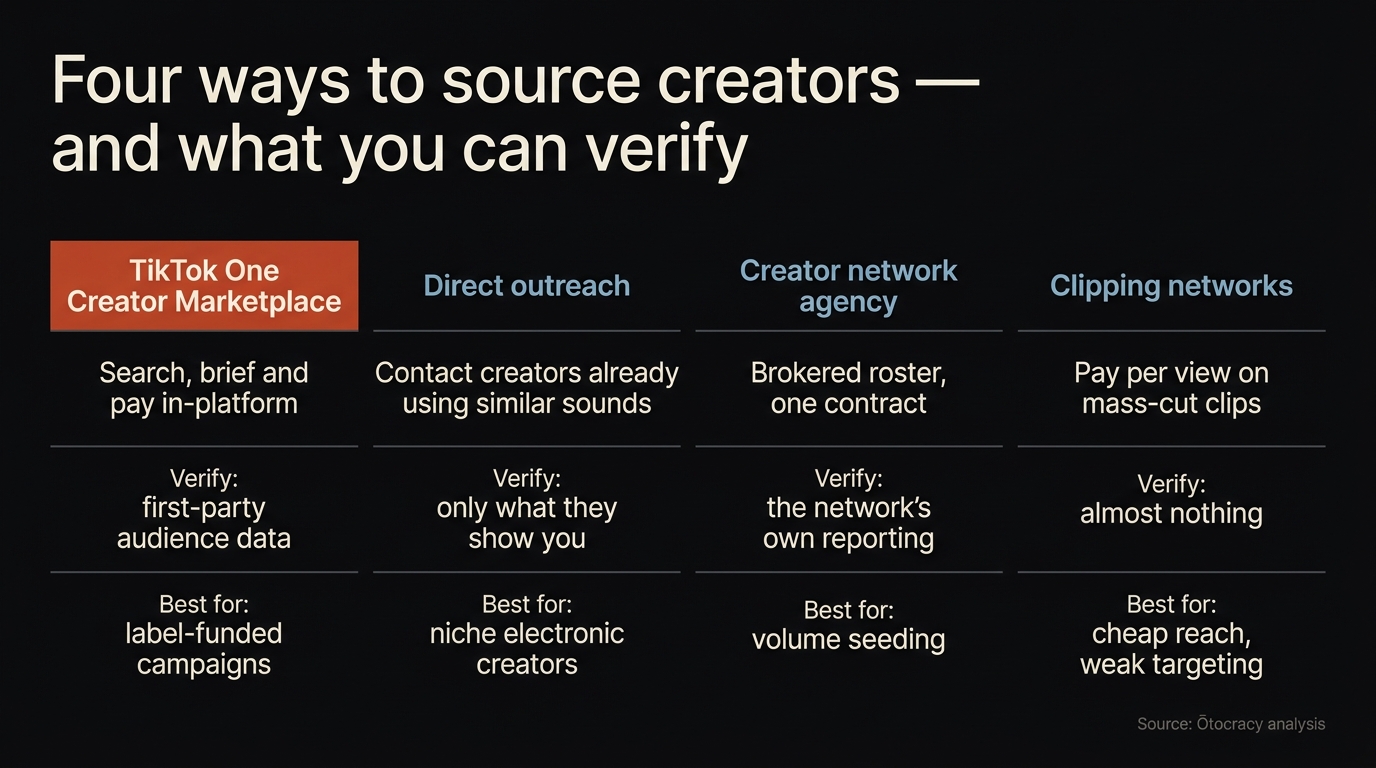
Four routes exist. They differ less on price than on how much you can verify before you commit.
| Route | How it works | What you can verify | Best for |
|---|---|---|---|
| TikTok One / Creator Marketplace | Search by niche, location, follower count and engagement; brief and pay in-platform | First-party audience data from TikTok | Compliance-sensitive and label-funded campaigns |
| Direct outreach | Find creators already using sounds like yours, contact them | Only what they show you | Niche electronic creators below marketplace thresholds |
| Creator network or agency | Brokered roster, one contract | The network's own reporting | Volume seeding across many creators |
| Clipping networks | Pay per view on mass-cut clips | Almost nothing at creator level | Cheap reach, weak targeting |
The route artists underuse is the second one, and it is the one I would start with for electronic music. Open the sound page of a track adjacent to yours — same tempo, same scene, released three to six months ago — and read who actually made videos with it. Those creators have already demonstrated they will use a sound like yours, which no marketplace filter can tell you.
Marketplace eligibility requires 10,000 followers, so a genuine chunk of the most scene-native EDM creators are not in it at all. In practice we run both: marketplace for the verifiable core of a campaign, direct outreach for the small accounts that actually live in the subgenre.
Vetting: How to Spot a Fake Audience Before You Pay
This is the hour that saves the campaign. Run every candidate through the same five checks.
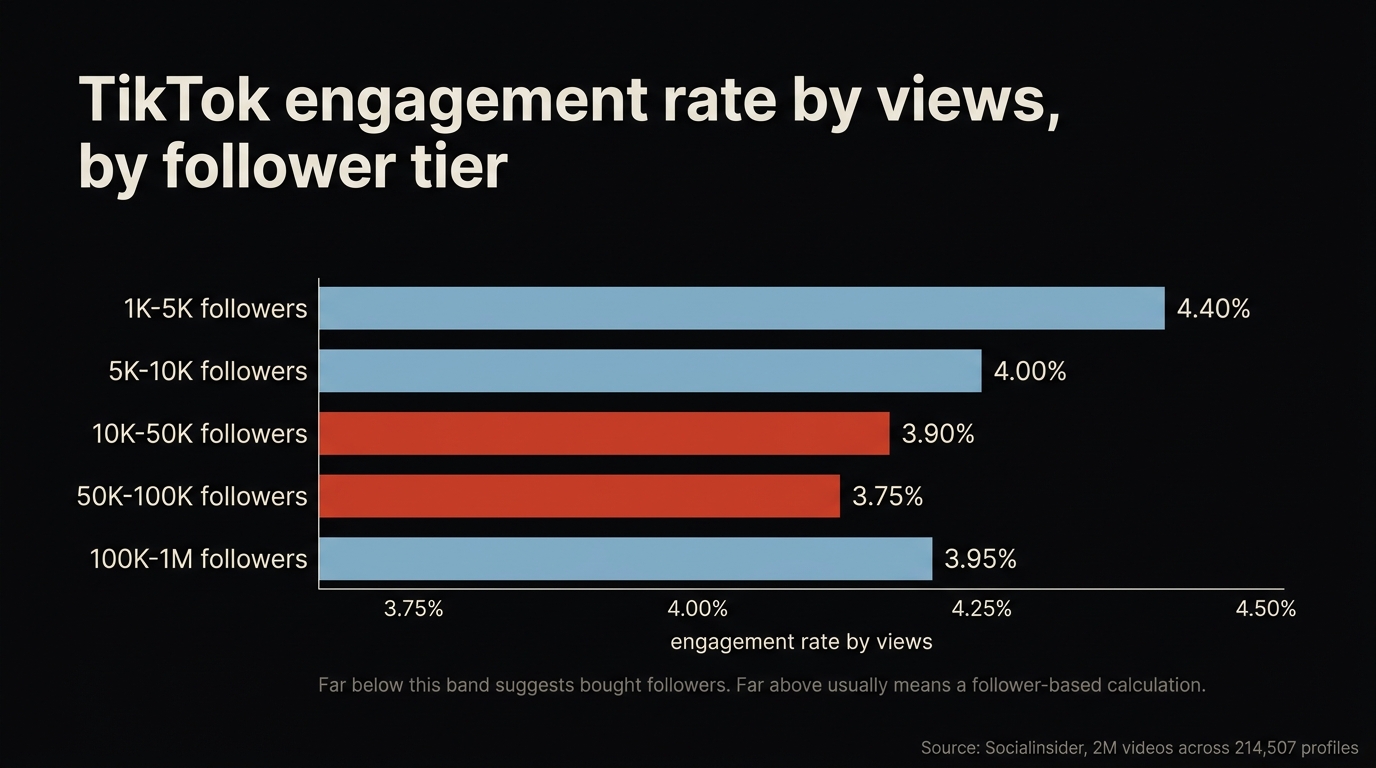
1. Engagement rate, measured against views. TikTok distributes to non-followers, so follower-based percentages are close to meaningless. Socialinsider's benchmark study — 2 million videos across 214,507 profiles, tracked January 2024 to December 2025 — gives the ranges to measure against:
| Follower tier | Engagement rate by views |
|---|---|
| 1,000 to 5,000 | 4.40% |
| 5,000 to 10,000 | 4.00% |
| 10,000 to 50,000 | 3.90% |
| 50,000 to 100,000 | 3.75% |
| 100,000 to 1M | 3.95% |
Sitting far below the band suggests bought followers. Sitting far above it usually means the creator is quoting a follower-based figure, which inflates the number substantially. Neither is automatically disqualifying. Both need an answer.
2. The comment section. Real audiences argue, name the track, tag friends, ask what the ID is. Farmed audiences post emoji strings and generic praise. Sixty seconds of reading tells you more than any media kit.
3. The view distribution across recent posts. Healthy TikTok accounts are spiky — most videos modest, occasional breakout. A creator whose last twenty videos all landed within a narrow band of each other is showing you a purchased floor.
4. Audience geography against your release strategy. A creator with 80 percent of their audience outside the markets where your track has distribution or DJ support is reach you cannot convert. This is where marketplace first-party data earns its restrictions.
5. Whether they have ever posted to a sound. Some creators are excellent and have simply never made sound-led content. Their format is talking-head or text-overlay, and your track will sit under it as wallpaper. Based on 2,400+ campaigns run by our founding team, prior sound-led posts are the strongest single predictor of whether a creator's video does anything for a track.
If a creator will not share dashboard access or marketplace data, that is the answer. Move on. There are more creators than there is budget.
The Creator Brief That Actually Produces Usable Videos
Most briefs are too long and specify the wrong things. Creators know their audience better than you do; what they cannot know is which eight seconds of your track carry it.
| Brief element | What to specify | What to leave open |
|---|---|---|
| The sound | Exact section, timestamped, and the official sound link | — |
| Hook timing | That the drop or vocal hits inside the first three seconds | How they get there |
| Format | Sound-led, not talking-head with music underneath | Concept, setting, styling |
| Disclosure | Commercial content toggle on, before posting | Caption wording |
| Deliverable | One video, posting window, whether a repost is included | Time of day |
| Rights | Usage-rights term if you intend paid amplification | — |
Give them the timestamp. That single line is the difference between a video built on your drop and a video where your track is background texture under someone talking. If you are unsure which section carries, the answer is usually whichever eight seconds you would open a set with.
Keep creative control light. The videos that travel look like the creator's normal output, and a brief that dictates concept produces something that reads as an advert to the exact audience you are trying to reach.
Rights, Disclosure, and the Paperwork That Protects the Campaign
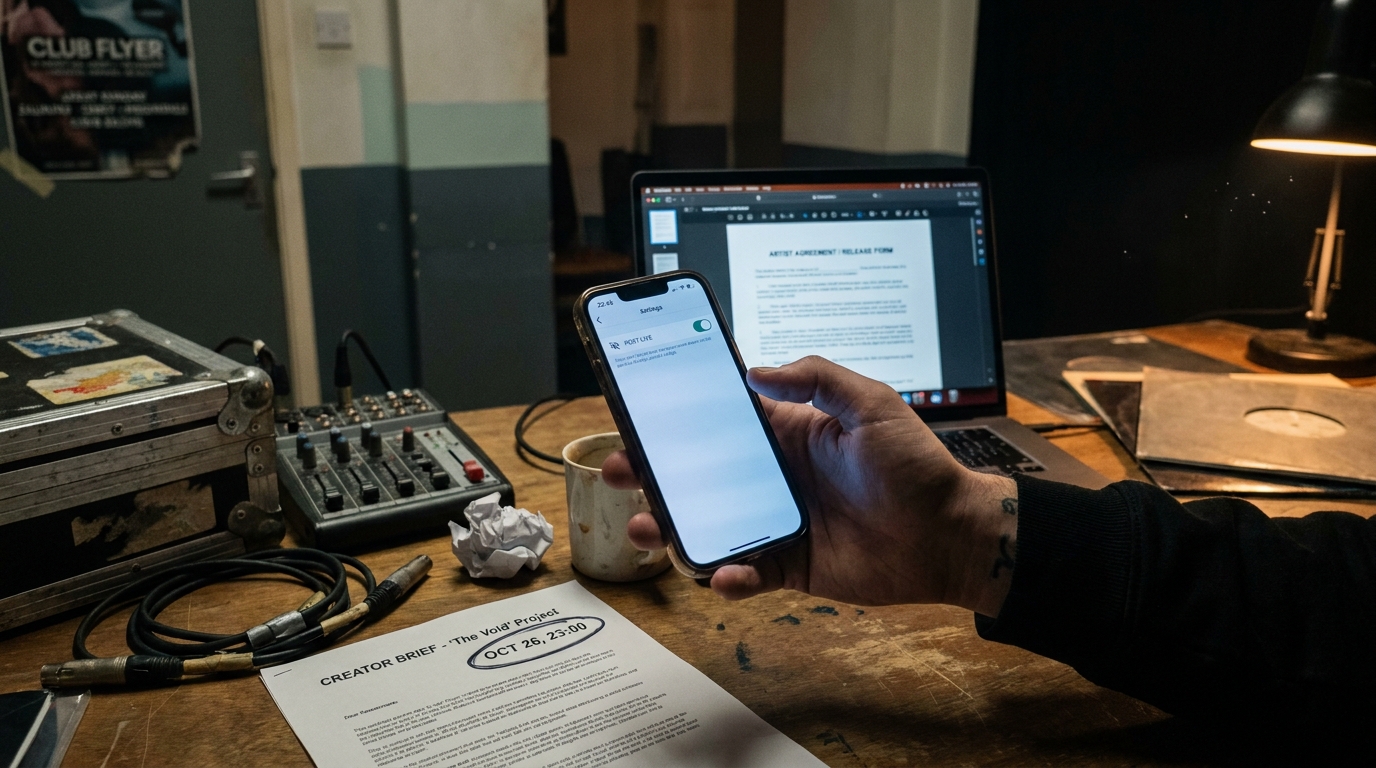
Three things go in writing before anyone posts.
Disclosure is not optional and not yours to skip. TikTok's Branded Content Policy requires creators to enable the commercial content disclosure toggle when posting branded content, which applies the paid-partnership label. The policy also requires that what is being promoted is "sufficiently clear, without requiring viewers to access your profile page or any links."
Two operational details matter. The toggle has to be set at the point of posting — it cannot be added to a live video, so a creator who forgets has to delete and repost, losing whatever the video had accumulated. And enabling it may add the video to TikTok's Commercial Content Library, which can remain publicly available even if the original post is deleted.
Platform disclosure also is not the same as legal disclosure. Regulators in the EU, UK and US expect the disclosure to be legible in the content itself — caption, on-screen text, or spoken — not only in a platform label that renders inconsistently across devices.
Usage rights are separate from the post. If you intend to amplify a creator's video with paid spend, that permission is a distinct commercial term to agree upfront, and it carries a surcharge. The mechanics and the cost of that surcharge are covered in the cost breakdown.
Term and exclusivity. How long the video stays up, and whether the creator can post for a directly competing release inside a window. Thirty days up and a short exclusivity window is normal and rarely contested.
Attribution: Knowing Which Creator Actually Moved the Track
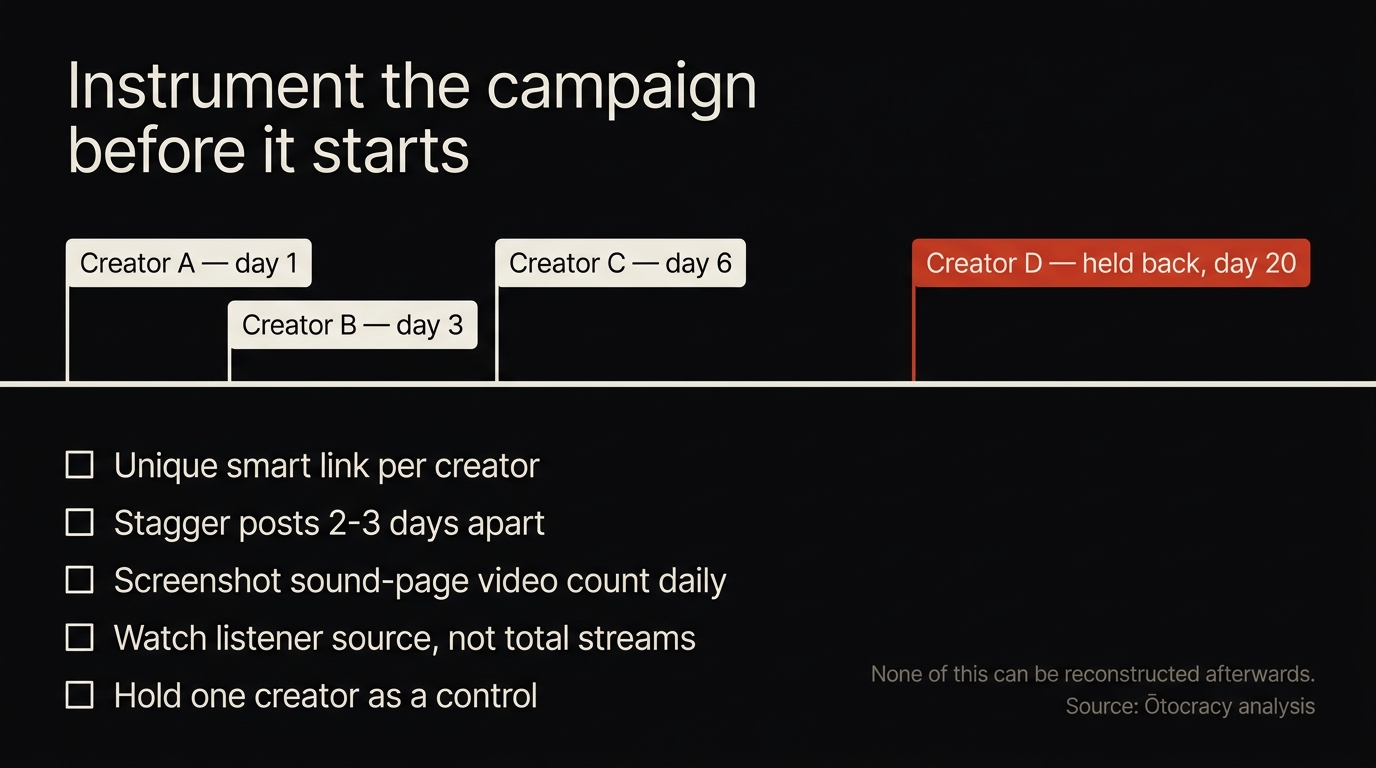
Here is the part almost every artist skips, and the reason so many are unsure whether their last campaign worked.
Neither TikTok nor Spotify will hand you a clean line from one creator's video to a stream. You have to instrument it before the campaign starts, because none of it can be reconstructed afterwards.
- Give each creator a distinct smart link. A unique link per creator, not one campaign link shared across all of them. This is the only clean per-creator conversion signal you will get.
- Stagger posting dates. Creators posting on the same day makes the data unreadable. Two or three days apart turns your Spotify for Artists chart into a legible sequence of steps.
- Screenshot the sound page video count daily. TikTok does not give you history on this. If you do not capture it, it is gone.
- Watch listener source in Spotify for Artists, not just total streams. The number that indicates a working campaign is the shift in where listeners arrive from.
- Hold one creator back. Running one comparable creator two weeks later, after everything else has settled, is the closest thing to a control you can get on a small budget.
Based on 2,400+ campaigns run by our founding team, per-creator attribution changes the second campaign more than it changes the first. The first campaign buys you the data about which kind of creator converts for your sound; the second one spends against it.
What TikTok Influencer Music Promotion Cannot Fix
Creator campaigns amplify a signal. They do not create one.
If the eight seconds you are seeding do not make a stranger want to use them, more creators produce more videos that nobody copies. The campaign ends with a sound page full of paid posts and no organic tail — which is the specific failure mode that makes artists conclude TikTok does not work for their genre.
Vetting protects you from paying for fake audiences. It does not protect you from seeding a hook that is not a hook. That judgement stays with you, and honestly, it is the one part of this nobody can outsource.
Not sure whether your last release actually reached anyone, or just reached a dashboard? Otocracy's free audit reads your profile source by source and tells you where the next spend belongs. If you want the creator layer sourced, vetted and briefed for you, that is what our TikTok campaigns do — and labels running several releases a month can put the whole roster through one pipeline.
Running It Through TikTok's Own Tooling
Everything above assumes somebody is doing the discovery and negotiation. You can do it yourself through TikTok's Creator Marketplace, which now sits inside TikTok One rather than as a standalone product.
It is worth it if you are in a supported market and will run campaigns repeatedly — the workflow rewards repetition and the setup does not repay a single release. The catch is that its filters are demographic, with no signal for whether a creator's audience plays your genre, which is the selection work that actually decides a campaign. The Creator Marketplace guide covers the workflow, the account requirements and what to put in a brief.
Frequently Asked Questions
Do I have to use TikTok One to work with creators?
TikTok's Branded Content Policy states that brands may only partner with content creators through the TikTok One platform. Direct discovery of creators is fine, but constituting the paid relationship inside TikTok's system is what the policy expects, and it gives you first-party audience data for vetting.
What engagement rate should a TikTok creator have?
Measure against views, not followers. Socialinsider's study of 2 million videos found 3.90 percent for the 10,000 to 50,000 follower tier and 3.75 percent for 50,000 to 100,000. Well below that band suggests bought followers; well above usually means a follower-based calculation.
How do I know if a TikTok creator has fake followers?
Check four things: engagement rate against view-based benchmarks, whether comments are specific or generic emoji strings, whether recent view counts sit unnaturally close together, and whether audience geography matches your release markets. A creator who will not share dashboard or marketplace data has already answered the question.
Does the creator or the artist add the paid partnership label?
The creator does, using the commercial content disclosure toggle, and it must be set at the moment of posting. It cannot be added to a live video. Put this in the brief explicitly, because a forgotten toggle means deleting and reposting.
How many creators does a music campaign need?
Fewer than most artists assume, and staggered rather than simultaneous. Posting creators two to three days apart makes per-creator performance readable, which is worth more on a first campaign than raw volume. Budget ranges are covered in the cost breakdown.
Can I run paid ads on a creator's video?
Only with usage rights agreed upfront, as a separate commercial term carrying a surcharge on the base rate. Agree it before the campaign, not after a video starts performing — that is the point where both your bargaining position and the price move against you.