Spotify Promotion for EDM Artists: The 2026 Guide
Spotify promotion for EDM artists in 2026: how the algorithm reads electronic music, editorial pitching windows, clean playlisting, and paid routes.
Quick Answer
Spotify promotion for EDM starts from one fact generic guides skip: the algorithm scores electronic music on saves, completion, and repeat listens, and a stream only counts after 30 seconds of play. That penalizes club builds and rewards radio edits on discovery surfaces. The working system in 2026: pitch every release through Spotify for Artists at least 7 days before release day (Spotify's stated minimum, which also secures Release Radar), ship a release every 4-6 weeks using edits and remixes as cheap catalog, vet independent playlists before pitching them, and drive external traffic from TikTok and ads — Luminate found TikTok views significantly linked to streaming volume for 96% of artists analyzed. Never buy streams: Spotify removed more than 75 million spam tracks in the year through September 2025, and a stream pays $0.003-0.005 before removal anyway. The rest of this guide is the math.
Most Spotify promotion advice is written for singer-songwriters and then sold to producers unchanged. Spotify promotion for EDM fails when it copies that playbook, because electronic music behaves differently at every layer of the platform — how streams get counted, which surfaces recommend it, and how its audience listens. This guide covers each layer with the numbers attached: the algorithmic mechanics, the electronic editorial system, the pitch process, release cadence, playlist vetting, and where paid money actually converts.
How the Spotify Algorithm Reads Electronic Music
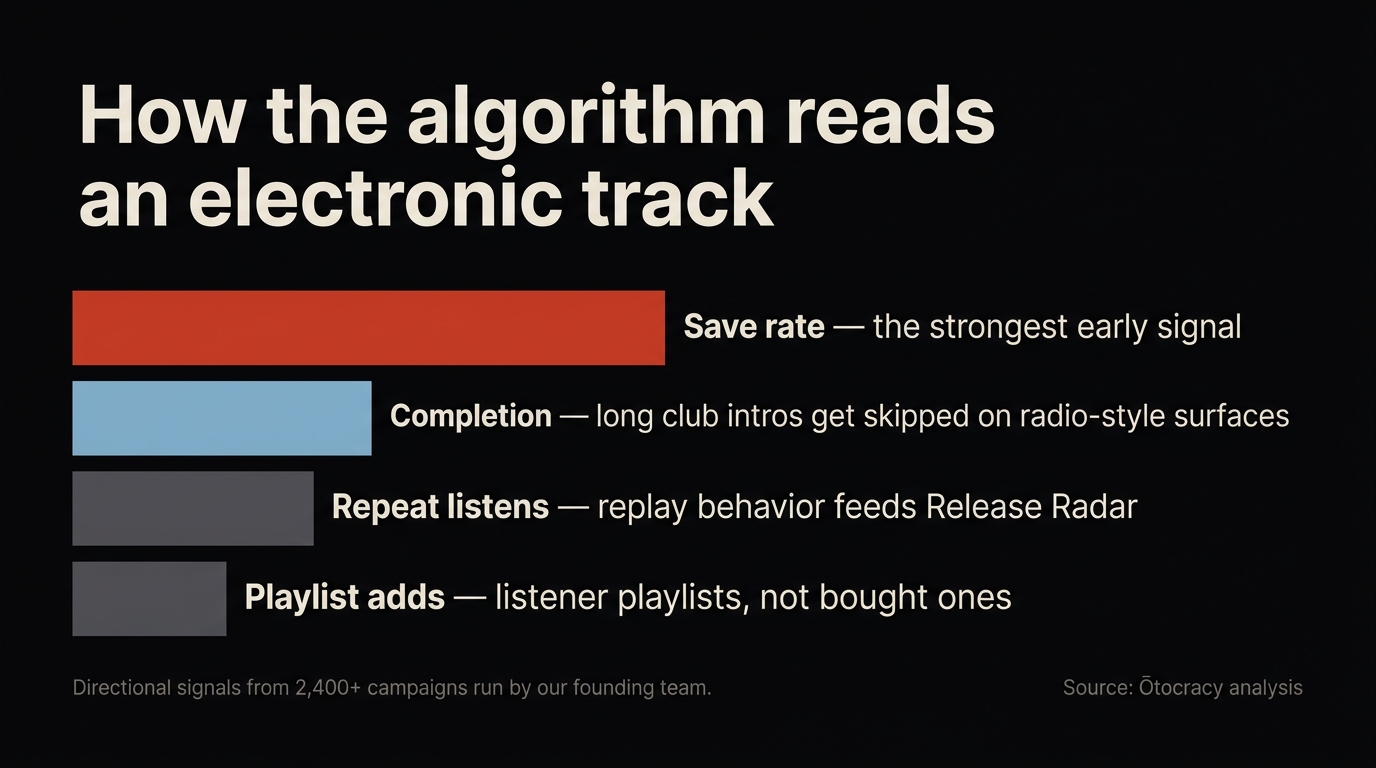
Start with the counting rule, because everything else follows from it. A play registers as a stream — for royalties and for algorithmic signals — once it passes 30 seconds. A skip before that mark is a negative signal recorded against the track on whatever surface served it.
Now look at how electronic music is built. A club-functional techno or house track routinely spends 60-90 seconds in an intro designed to give a DJ mixing room. On a lean-back surface like Discover Weekly, a casual listener meets 32 bars of kick and hats and skips before the track has said anything. The track is not bad; it is answering a question the surface did not ask.
The positive signals cut the other way, in electronic music's favor. Saves, playlist adds, and repeat listens carry heavy weight in algorithmic recommendation, and electronic audiences are session listeners — they save tracks into workout, focus, and pre-game playlists and replay them for months. Based on 2,400+ campaigns run by our founding team, save rate is the most predictive early signal for algorithmic pickup on an electronic release — a better predictor than raw stream count, which can be bought and therefore means little.
Here is how the main algorithmic surfaces read your music, and what that implies for a release:
| Surface | What feeds it | What it means for EDM |
|---|---|---|
| Release Radar | Your followers + a pitch submitted at least 7 days pre-release | Every release re-triggers it for your whole follower base — cadence compounds |
| Discover Weekly | Listening patterns of similar users; save and skip behavior | Radio edits outperform club versions here; long intros bleed skips |
| Radio and Autoplay | Track-similarity graph, completion rates | Extended mixes perform fine — this is session listening |
| Daily Mix and genre mixes | Your existing listeners' habits and your catalog | More released tracks means more slots you can occupy |
The practical conclusion: release the radio edit as the lead track you pitch, and ship the extended mix alongside it for the DJs and the session surfaces. One product, two formats, each pointed at the surface that rewards it.
The Electronic Editorial Ecosystem on Spotify
Spotify's editorial coverage of electronic music is deeper than almost any other genre, and most artists cannot name three playlists in it. The flagship is mint — the dance equivalent of Today's Top Hits, covering the biggest records in the genre. Below it sits a stack of scene-specific lists: Techno Bunker for dark, underground techno; Dance Rising for upfront dance records on their way up; plus dozens of sub-genre and mood lists under Spotify's Dance/Electronic hub.
Two things matter about this system. First, you do not pitch a specific playlist — you pitch the release, and editors route it based on the metadata you supply, which is why vague genre tags kill pitches. Second, editorial placement is temporary by design. A slot on Dance Rising lasts weeks; what persists is the algorithmic response to how that playlist's listeners treated your track. If they saved and completed it, Radio and Discover Weekly carry it forward after the editors rotate you out.
Treat editorial as a lottery ticket with a free entry, not as the plan. The plan is the algorithmic layer, which responds to signals you can actually manufacture with real listeners — the sequencing argument our complete EDM promotion guide makes across every channel, not just Spotify.
Pitching Through Spotify for Artists: Deadlines and Fields
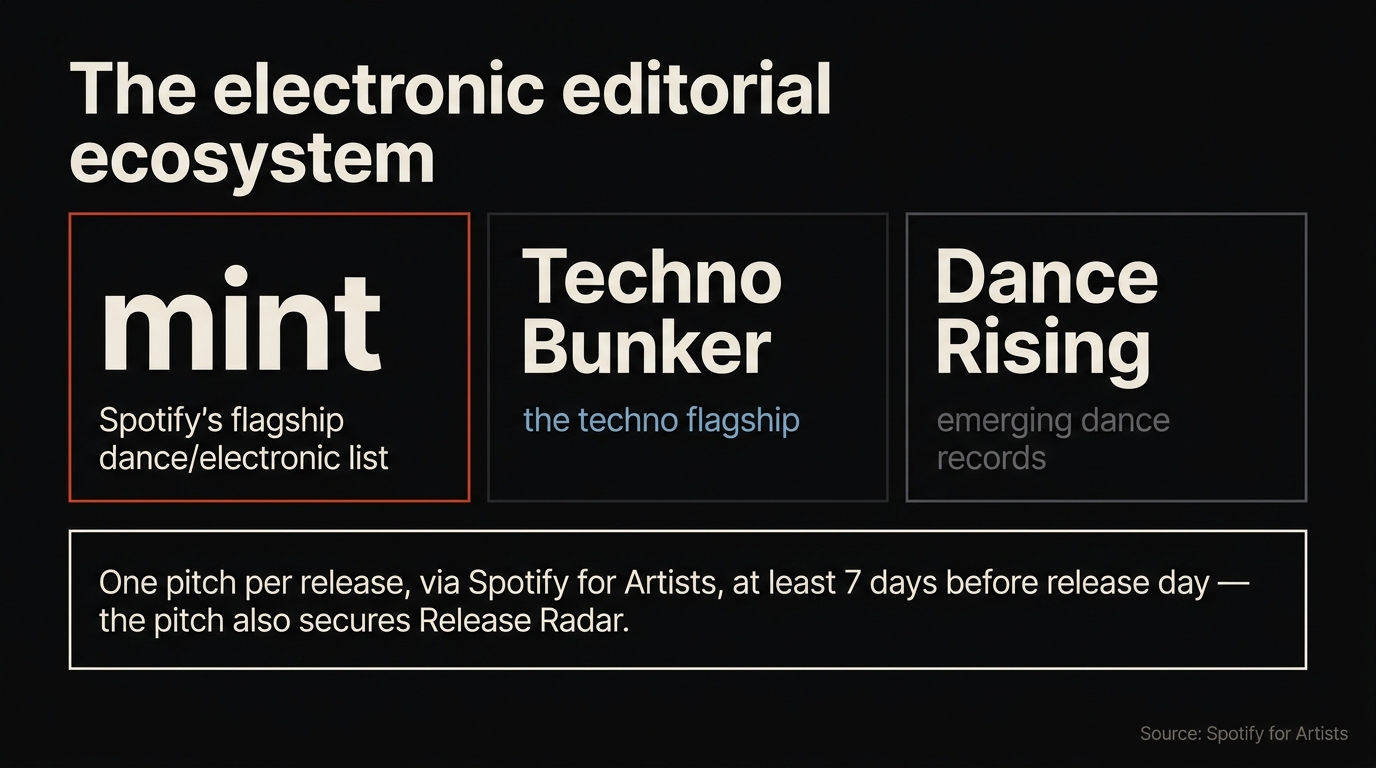
The pitch mechanics are simple and most artists still fumble them. Spotify's own pitching guidance sets the rule: submit through Spotify for Artists at least 7 days before release day so editors have time to listen. Hitting that deadline also guarantees the track lands in your followers' Release Radar — which for most independent EDM artists is worth more than the editorial shot itself.
In practice, 7 days is the floor, not the target. Editors plan lists ahead; a pitch that arrives 2-4 weeks early gets considered, while a pitch that arrives at the deadline joins the crowd. You can pitch one upcoming track at a time, and you cannot pitch compilations or tracks where you are only a featured artist — plan your pitch around your lead release accordingly.
Then fill every field like it decides the outcome, because it does. Editors filter by the metadata you provide:
- Sub-genre, precisely. Write "melodic techno" or "tech house", never "dance" or "electronic". A vague tag cannot be routed to Techno Bunker's editor.
- Mood and energy. Peak-time, sunrise, warm-up — the language of sets is the language editors use.
- Instrumentation and tools. Analog hardware, a notable vocalist, a sampled source worth mentioning.
- Location and story. Your city and scene, in two sentences, no biography padding.
The full release-week checklist around the pitch — Canvas loops, pre-saves, profile hygiene — is covered step by step in our 10-step EDM promotion playbook.
Release Cadence: The Core of Spotify Promotion for EDM
If you take one structural decision from this guide, take this one: cadence beats campaigns. Every new release is a fresh pitch window, a fresh Release Radar push to every follower, and a fresh node in Spotify's recommendation graph. An artist releasing every 4-6 weeks generates 9-12 of those events a year; an artist releasing annually generates one, and no promotion budget fixes the difference.
Electronic music gets catalog math no other genre gets, and most producers leave it unused. A club edit, an extended mix, a VIP, and a stripped-down version are separate releases with separate pitch windows — two strong originals a quarter plus their alternate versions reaches full cadence without writing twelve masterpieces a year. Remix packages do the same job while linking your profile to other artists' audiences in the similarity graph. And the unofficial layer of that same catalog — edits and unclearable remixes that can never reach the stores — still earns its keep through a download gate, converting giveaway traffic into fan emails instead of nothing.
The compounding effect is why this is the core of Spotify promotion for EDM rather than a side tactic. Ten released tracks means ten entry points into Radio and Discover Weekly, and a listener who arrives on track seven has nine more to save. Based on 2,400+ campaigns run by our founding team, the same promotion spend retains listeners at a multiple on an artist with 8-12 released tracks compared to an artist with two — the traffic lands, and there is somewhere for it to go.
Cadence also feeds the fastest-moving discovery channel. Each release ships with an official TikTok sound, and the mechanics of turning a sound into carryover streams are their own discipline — covered in full in our TikTok music promotion guide.
Independent Playlists Without Bots: How to Vet a Curator
The independent playlist economy contains real curators with real audiences, sitting next to the single biggest scam aimed at electronic artists. The difference is checkable in ten minutes, and the check matters because a botted placement is worse than nothing: dead-audience streams poison your skip and save ratios, and artificial streams get flagged and removed under Spotify's rules.
The core test is follower-to-listener conversion. A genuine playlist with 40,000 followers produces a visible, steady stream lift on newly added tracks — and some fraction of those listeners save the track or follow the artist. A botted playlist produces streams with nothing attached: no saves, no follows, no profile visits. If a placement delivered 8,000 streams and your save count moved by a rounding error, the audience was rented.
| Signal | Legitimate playlist | Botted playlist |
|---|---|---|
| Stream lift vs saves | Streams arrive with saves and follows attached | Thousands of streams, near-zero saves |
| Follower growth | Gradual curve, scene-plausible | Vertical spikes on a flat baseline (check Chartmetric) |
| Tracklist | Known and unknown artists mixed, coherent sound | 90% unknown artists with suspiciously identical stream counts |
| Curator behavior | Accepts free pitches, rejects tracks that do not fit | Guarantees placement for payment |
| Listener geography | Matches the genre's real markets | Concentrated in click-farm regions unrelated to the scene |
One red flag settles the question on its own: anyone guaranteeing placement or streams for money is violating Spotify's rules outright, and their playlist will eventually take your track down with it. Pitch clean curators in your exact sub-genre, personally and for free, with a track that fits what they already list — and treat every placement as a bonus on top of the algorithmic system, never as the system.
Paid Spotify Promotion for EDM: What Money Legitimately Buys
Nobody can sell you algorithmic placement, and nobody legitimate sells editorial. What paid promotion buys is real listeners, delivered to your track fast enough that their saves and completion rates register while the release is fresh. Two routes do this at defensible unit costs.
Route one: ads that drive to Spotify. Meta and TikTok ads pointed at a smart link buy targeted first listens, and the audience quality — not the click count — decides whether the algorithm follows. A well-targeted €500 test tells you whether a track converts; the full budget breakdown by spend tier shows what €500, €1,500, and €5,000 buy line by line. Artists running €70-100 a week can execute the same funnel through our self-serve tier.
Route two: TikTok activity with carryover. The correlation is measured, not folklore: Luminate's Music Impact Report with TikTok found TikTok views significantly related to streaming volume for 96% of artists analyzed, with an average 11% stream lift in the three days after a views peak — and TikTok reports 84% of songs entering the Billboard Global 200 in 2024 went viral on the platform first. The views are not the product; the streams they push are.
Here is the routes table, with the one route you should never touch included for contrast:
| Route | Typical cost | What it buys | Algorithmic effect | Risk |
|---|---|---|---|---|
| Editorial pitching | Free | Editorial shot + guaranteed Release Radar | Strong if the audience responds | None |
| Meta/TikTok ads to Spotify | €500 and up per campaign | Targeted real listeners | Saves and completion feed recommendation | Low; creative-dependent |
| TikTok creator campaigns | €1,000-2,000 and up | Discovery plus measured stream carryover | Strong when the track converts | Medium; pickup is probabilistic |
| Clean curator pitching | €1-4 per submission | Independent placements | Mild, additive | Low if vetted |
| Guaranteed-stream services | $50-500 | Bot traffic | Negative — flags, removals, skip damage | Catalog-level |
Based on 2,400+ campaigns run by our founding team, the split that holds up is roughly this: discovery money goes to TikTok and ads, hygiene effort goes to pitching and cadence, and zero goes to anyone guaranteeing outcomes. That last discipline is also why our own Spotify campaigns commit to a measurable target in writing — when the traffic is real, you can put a number on it.
The Fake-Stream Danger: Penalties, Removals, and the Royalty Math
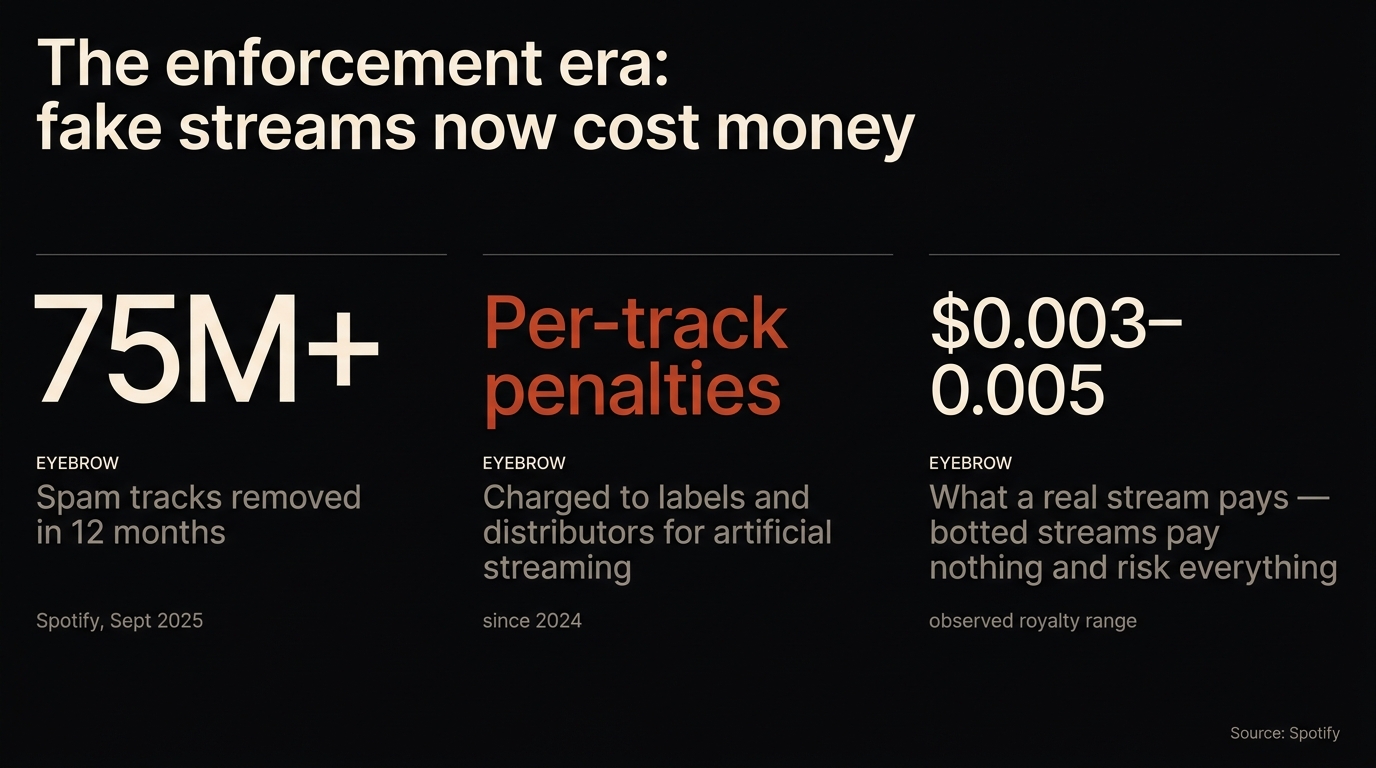
The enforcement side stopped being theoretical years ago. In September 2025, Spotify announced it had removed more than 75 million spam tracks over the preceding twelve months, alongside new spam filtering that stops recommending mass-upload and manipulation-driven content (Spotify Newsroom; Music Business Worldwide). Since 2024, Spotify has charged labels and distributors a per-track penalty when flagrant artificial streaming is detected — which is why distributors now terminate accounts over it. Botted promo does not risk one release; it risks your catalog and your distribution. Labels carry the same exposure at roster scale — including bot history inherited from a signing's earlier promo — which is why auditing a roster for fake streams is now standard label diligence.
Then run the revenue math, because it kills the temptation on its own. Per-stream payouts are not an official rate, but observed estimates across royalty calculators and payout statements consistently land at $0.003-0.005 per stream. Ten thousand fake streams gross $30-50 — before they get flagged, removed, and clawed back. And since April 2024, any track under 1,000 streams in a rolling 12-month window earns exactly zero, so small-batch botting does not even reach the payout floor.
The same math is why fake numbers fail even as marketing. Labels, bookers, and editors all read the ratios — streams against saves, followers against monthly listeners — and a profile with rented streams reads as damaged goods to everyone who matters. If you are not sure which of your existing streams are algorithmic, playlist-driven, or dead weight, Otocracy's free Spotify audit breaks your profile down source by source and tells you where the next €500 should actually go.
Frequently Asked Questions
How far in advance should I pitch a release to Spotify editorial?
Spotify's stated minimum is at least 7 days before release day, submitted through Spotify for Artists — meeting that deadline also places the track in your followers' Release Radar. Practically, pitch 2-4 weeks out: editors plan ahead, and early pitches get genuine consideration instead of arriving with the deadline crowd.
How much does Spotify pay per stream in 2026?
There is no official per-stream rate, but observed estimates from payout statements consistently track at $0.003-0.005 per stream, varying with listener country and free versus premium accounts. Note the floor: since April 2024, tracks under 1,000 streams in a rolling 12-month window earn no recording royalties at all.
Do editorial playlists like mint still matter for EDM artists?
Yes, but as accelerant rather than engine. Placement on mint, Techno Bunker, or Dance Rising is temporary; the lasting value is the algorithmic response from those listeners' saves and completions. Pitch every release on time, then build the system — cadence and real external traffic — that works without editorial luck.
How do I tell if a playlist is botted before pitching it?
Check follower-to-listener conversion: real playlists produce streams with saves, follows, and profile visits attached, while botted lists produce raw streams and nothing else. Red flags include vertical follower spikes, rosters of unknown artists with identical stream counts, and any curator guaranteeing placement for payment — that alone violates Spotify's rules.
Does TikTok activity actually move Spotify streams?
Measurably. Luminate's Music Impact Report with TikTok found TikTok views significantly related to streaming volume for 96% of artists analyzed, with an average 11% stream increase in the three days after a views peak. The mechanism is search carryover — which only works if your sound metadata and artist name match across platforms.
Should I release radio edits of club tracks?
Yes, and pitch the edit as the lead. A stream counts after 30 seconds, and a 90-second DJ intro collects skips on lean-back surfaces like Discover Weekly before the track starts. Ship the extended mix alongside it — DJs and session listeners want it, and both versions count as catalog.
The platform is not mysterious; it is a scoring system with published deadlines and measurable signals, and electronic music holds a structural advantage on the signals that matter most — saves, sessions, and catalog depth. Pitch on time, release on cadence, keep every stream real, and point paid money at listeners instead of numbers.
If you want the traffic side run for you, Otocracy's Spotify growth campaigns deliver real, targeted listeners against a projection you can hold us to — the same system, executed at campaign scale.