How to Promote EDM Music: The Artist Playbook (2026)
How to promote EDM music in 2026: a 10-step artist playbook covering release cadence, TikTok sound content, Spotify pitching, DJ promo pools, and ads.
Quick Answer
To promote EDM music in 2026, work ten steps in the order they compound: ship on a fixed release cadence (every 4-6 weeks), post sound-first TikTok content built on your own official sound, and pitch every release through Spotify for Artists at least 7 days before release day — Spotify's own minimum, and the threshold that puts the track in your followers' Release Radar. Then build the DJ support chain (promo pools, direct sends, label demos), repurpose your clips to Reels, pursue clean playlisting, run micro-budget ads, and trade remixes upward. The order matters: 75% of TikTok users discover new artists on the platform (TikTok/MRC Data), and TikTok reports that 63% of its highest click-through videos hook viewers within the first 3 seconds. Based on 2,400+ campaigns run by our founding team, artists who execute steps 1-3 consistently outperform artists who buy promotion for one single.
Most articles about how to promote EDM music are written by people who have never sent a promo to a DJ, never stood in a booth, and never had a label pass on a demo. They recycle the same "post consistently and engage with your fans" advice that applies equally to a country singer and a candle brand.
This is the other kind of guide. I produce and DJ, I run Temple of Sinners, and with my co-founder I have watched thousands of campaigns succeed and fail across every channel below. These are the ten steps I would execute, in this order, if I were starting an EDM project today — the order is the point, because some steps compound and some just burn hours.
If you want the strategic overview first — channels, budgets, the full ecosystem — read the complete EDM promotion guide for 2026. This article is the execution layer: what you actually do, week by week.
Here is the honest effort-versus-payoff picture before we start:
| Channel | Weekly effort | Time to payoff | Does it compound? |
|---|---|---|---|
| Release cadence + catalog | High (production) | 3-6 months | Yes — every track keeps working |
| TikTok sound-first content | 3-5 hours | 2-8 weeks | Yes — sound library grows |
| Spotify pitching + hygiene | 1 hour per release | Release day | Yes — algorithmic trust builds |
| DJ support chain | 2-3 hours | 1-3 months | Yes — relationships persist |
| Instagram/Reels repurposing | 1 hour | 4-12 weeks | Partially |
| Curator playlisting | 2 hours | 2-6 weeks | Weakly — placements expire |
| Micro-budget paid ads | 1 hour | Days | No — stops when spend stops |
| Collabs and remixes | Per project | Per release | Yes — audience overlap is permanent |
| Local scene + events | Weekends | 6-12 months | Yes — slowly, then suddenly |
How to Promote EDM Music: Build the Catalog First (Step 1)
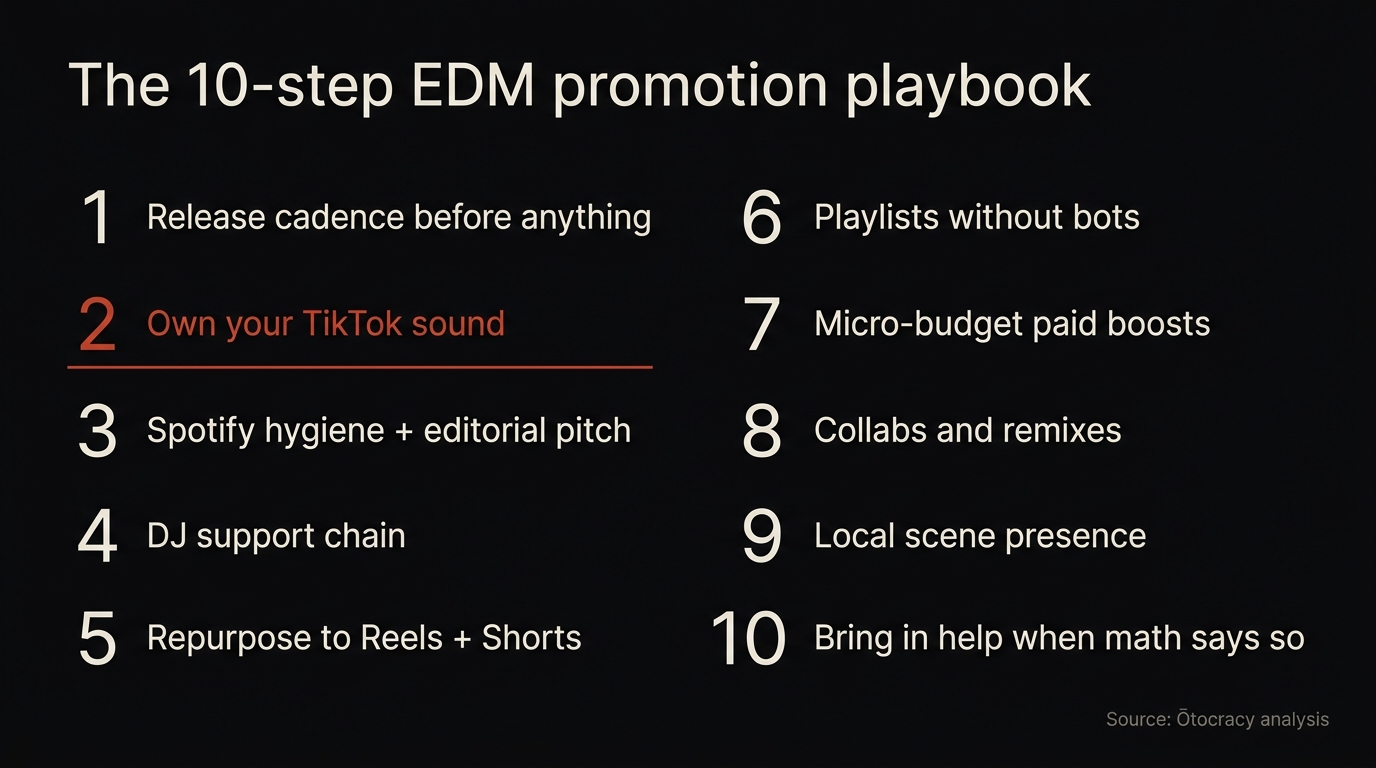
Step 1 is release cadence, and nothing else works without it. One track a year cannot be promoted into a career, no matter how good it is or how much you spend on it. Every channel below feeds on new releases: each one is a fresh Spotify pitch window, a fresh Release Radar push to your followers, a fresh official TikTok sound, and a fresh reason to email a DJ.
The cadence that works for electronic music is a release every 4-6 weeks. That is 9-12 tracks a year — and EDM gives you catalog math no other genre gets. A club edit, an extended mix, a VIP, and a stripped "sunrise" version are all separate releases with separate pitch windows. Two originals a quarter plus their alternate versions gets you to cadence without writing twelve masterpieces.
Catalog math is why this compounds. Ten tracks means ten entry points into Spotify Radio and Discover Weekly, and a listener who arrives on track seven has nine more to save. Based on 2,400+ campaigns run by our founding team, promotion spend on an artist with 8-12 released tracks retains listeners at a multiple of what the same spend does for an artist with two — the traffic lands, and there is somewhere for it to go.
Practical moves this week: map your next three releases with dates, register with a distributor that delivers to TikTok's commercial music library, and stop sitting on finished tracks waiting for the "right moment". The right moment is a scheduled one.
Steps 2-3: TikTok Sound-First Content and Spotify Hygiene
Step 2: post TikTok content built on your own sound. Not trends, not lip-syncs — your track, as an official sound other people can use. The TikTok-commissioned MRC Data study found 75% of TikTok users discover new artists on the platform, and 67% then look the song up on streaming. For electronic music this is the single highest-upside organic channel that exists.
Three rules make it work:
- Your own official sound, always. Your distributor delivers the track to TikTok; every video you or anyone else makes on that sound becomes discoverable promotion for it. Videos on someone else's audio promote someone else — set the sound up correctly at release, walked through in our guide to releasing a song on Spotify and our explainer on how TikTok sound promotion works.
- The hook lands in the first second. TikTok's own creative data shows 63% of the highest click-through videos hook viewers within the first 3 seconds, and 90% of ad recall lands inside 6 seconds. On organic, the scroll decision is even faster. Open at the drop, the vocal chop, or the bass switch — never the intro.
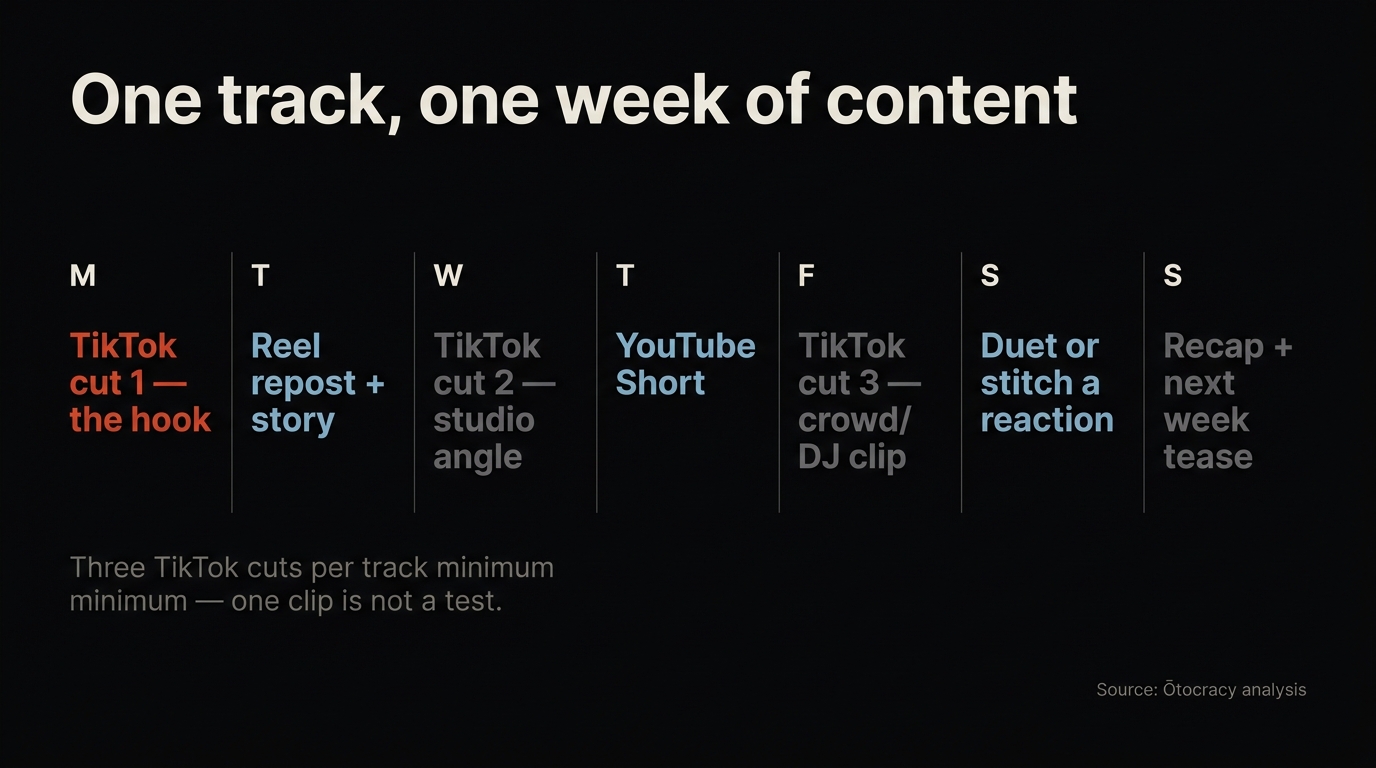
- Three cuts per track. The drop, the build, and the breakdown or vocal moment are three different sounds to three different listeners. Cut all three, post them as separate videos across the week, and let the data tell you which section is the hook.
The deeper mechanics — creator seeding, sound velocity, what a paid sound campaign actually does — are in our TikTok music promotion guide, and if you would rather have a creator network run it, that is what Otocracy's TikTok campaigns are.
Step 3: Spotify hygiene, which most artists get 80% wrong. Pitch every single release through Spotify for Artists at least 7 days before release day — that is Spotify's stated minimum for editors to hear it, and pitching by that deadline is also what places the track in your followers' Release Radar. In practice, submit 2-4 weeks out; editors work ahead, and a pitch that arrives at the deadline is competing with pitches that arrived early.
Fill the pitch completely: subgenre (say "melodic techno", not "dance"), mood, instrumentation, the story, and your city. Editors filter by these fields. Then finish the hygiene list: an 8-second Canvas loop on every track, Spotify Clips where available, a pre-save campaign that converts followers before release day, and a profile with current photos and a bio that names your subgenre. Our Spotify growth service exists for the traffic side, but the hygiene side is free and takes one afternoon per release.
Steps 4-5: The DJ Support Chain and Reels Repurposing
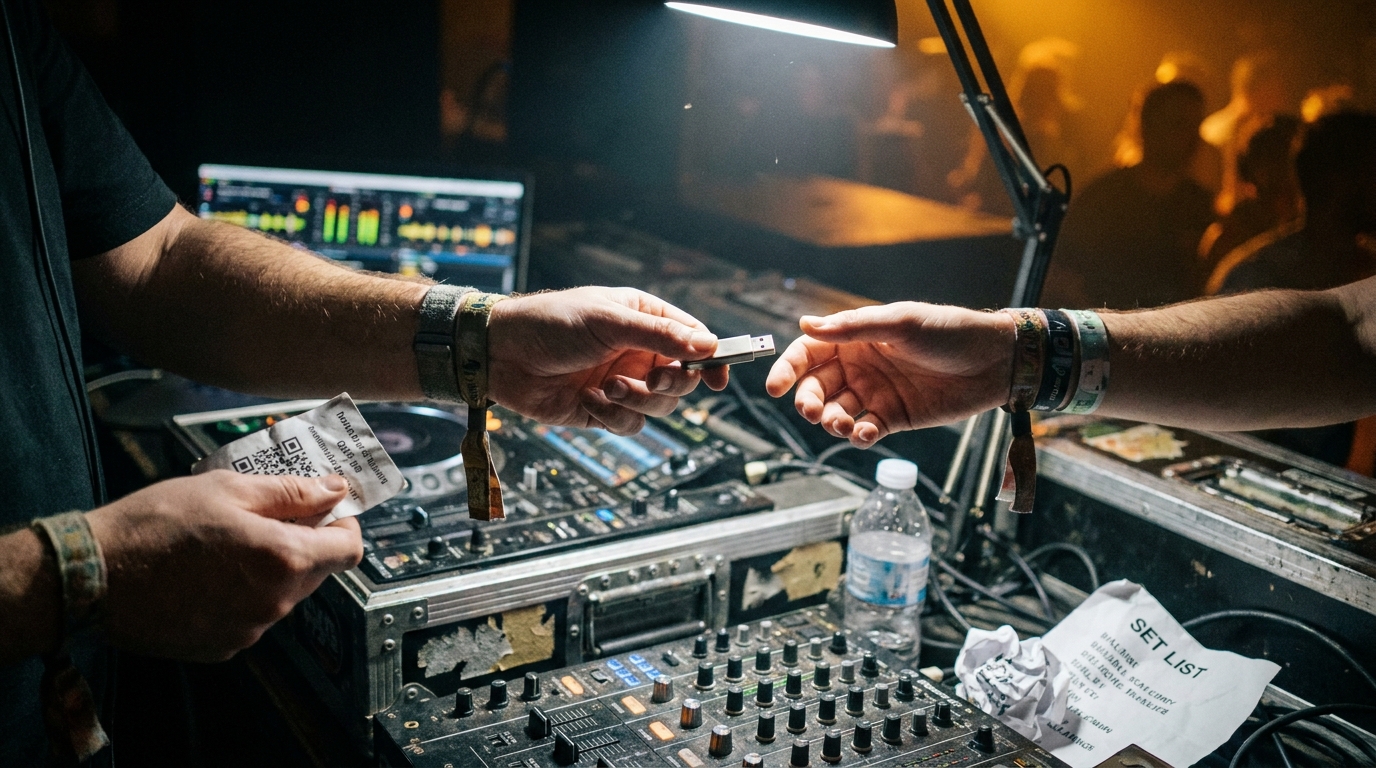
Step 4: build the DJ support chain. This is the step generic "promote your music" listicles never mention, because it only exists in dance music: DJs are a distribution network. One supported track in a club set reaches a floor of people who chose your genre — and a recorded radio or livestream set multiplies that. When you hand tracks out, hand out a download gate link rather than a naked file: same track, but every DJ and fan who grabs it lands on your email list.
The chain has three links, and you work all three:
- Promo pools. Services like ZIPDJ, Digital DJ Pool, and BPM Supreme put your release in front of working DJs who pull weekly, and their feedback scores tell you which track to push hardest.
- Direct DJ sends. Build a list of 30-50 DJs who actually play your subgenre — check their tracklists on 1001Tracklists, not their follower counts. Send a WAV, a two-line personal note that shows you know their sets, and no ask beyond a listen. Ten genuine sends beat five hundred blasts.
- Label demos. Submit through LabelRadar or the label's stated demo channel, one unreleased track, mixed down properly. A label release puts their whole DJ network and playlist ecosystem behind you. This is how I got my own early support — not from playlist pluggers, from DJs and label heads who got a personal send.
Beatport matters here too: a top-100 genre chart position is a signal working DJs actually browse, which streaming numbers are not. The mechanism is public and mostly about your delivery calendar — how Beatport charts work covers the pre-order rule and the feature cutoff that decide where a release starts.
Step 5: repurpose to Instagram Reels. Do not build a second content operation — re-cut the same three clips natively for Reels with captions rewritten for Instagram. Instagram is where promoters, bookers, and labels check whether you are real, so the grid matters more for credibility than for reach. One hour a week, no more.
Here is the weekly cadence that covers steps 2-5 without eating your production time:
| Day | Task | Time |
|---|---|---|
| Monday | Cut 3 clips from the current single (drop, build, breakdown) | 90 min |
| Tuesday | Post clip 1 to TikTok; re-cut for Reels | 45 min |
| Wednesday | DJ outreach: 5 personal sends + promo pool check | 60 min |
| Thursday | Post clip 2 to TikTok + Reels | 45 min |
| Friday | Post clip 3; review analytics, mark the winning cut | 45 min |
| Saturday | Scene work: show, event, or studio session with a collaborator | — |
| Sunday | Off, or prep next release assets (Canvas, artwork, pitch draft) | 60 min |
Steps 6-7: Playlisting Without Bots and Micro-Budget Paid Boosts
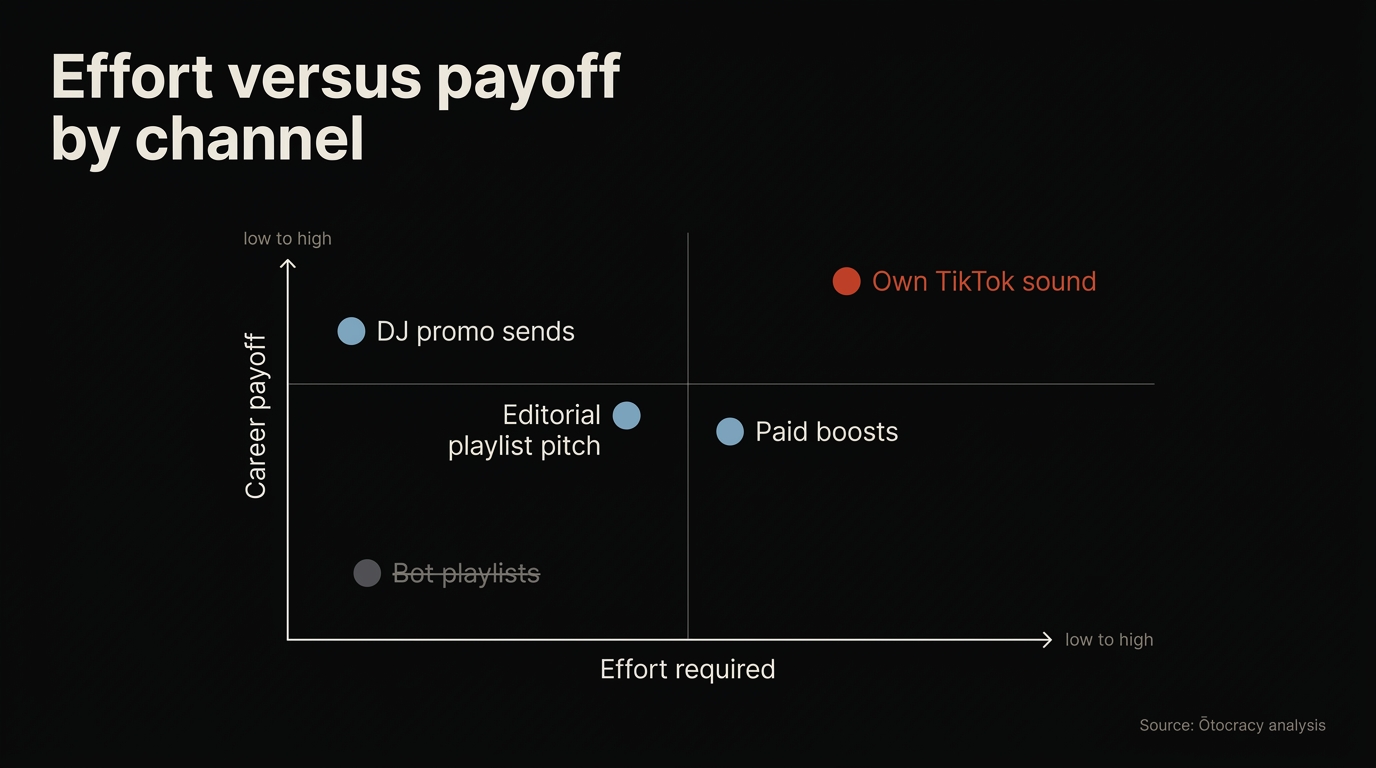
Step 6: playlisting — clean, or not at all. The paid-placement playlist economy is the biggest scam aimed at EDM artists, and it will hurt you twice: botted streams get flagged and removed under Spotify's artificial streaming rules, and dead-audience playlists poison your algorithmic profile with skips.
The clean version: target independent curators in your exact subgenre, and vet before you pitch. Red flags are follower counts wildly out of proportion to stream activity, playlists that are 90% unknown artists with identical stream counts, and any curator who guarantees placement for money — which violates Spotify's rules outright. Pitch free, personally, with the track that fits their existing list.
The honest reframe: third-party playlists are a bonus, not the strategy. The playlists that actually move careers are algorithmic — Release Radar, Discover Weekly, Radio — and you earn those with save rate and completion, which come from sending real fans (steps 2-5), not rented ones.
Step 7: micro-budget paid boosts. Paid ads do not compound, so they come seventh — but at €5-10 a day they do two jobs well: they scale a proven organic clip (Spark Ads on your best TikTok, never a cold Promote), and they drive Meta traffic to a smart link so Spotify sees engaged external listeners. If you have a video asset worth running, YouTube's format economics are worth understanding before you spend there. Run spend only on tracks the organic data already validated.
What each euro of that actually buys — CPVs, conversion math, where budgets leak — is broken down in what a music promotion budget really buys. If you want the same funnel structure we run on label campaigns sized to €70-100 a week, that is the self-serve tier.
Steps 8-9: Collabs, Remixes, and Your Local Scene
Step 8: trade remixes and collabs upward. A remix for an artist one tier above you is the cheapest audience acquisition in electronic music: the release sits on their profile, hits their followers' Release Radar, and permanently links your artist pages in Spotify's recommendation graph. Offer remixes for free early on — the exposure is the payment. Collaborations do the same job in both directions, and a split release means two artists' followings receive the same track.
Aim for one collab or remix per quarter. Choose partners by audience fit, not size: a melodic techno remix for a peer with 20K real listeners in your scene beats a favor from a big-room artist whose audience will never save your music.
Step 9: work the local scene. Every DJ career I respect — including mine — was built in rooms before it was built online. Play every local slot you can get, then start running your own night: booking three local acts makes three allies who push the event, and the promoter cut you keep is your marketing budget. From the booth you also learn something no dashboard shows — which of your tracks actually moves a floor, which is exactly the track to put paid spend behind.
Local compounds slowly, then suddenly. The promoter who books you at 80 capacity is the same person booking the 800-capacity room in three years, and scenes have long memories about who showed up early.
Step 10: When to Promote EDM Music With an Agency
The last step in how to promote EDM music is knowing when to stop doing all of it yourself. Steps 1-9 are genuinely executable solo — but each one has a ceiling, and you will feel it: your best TikTok clip works but you cannot manufacture reach beyond your own account, your ad budget passes €500 a month and mistakes start costing real money, or the weekly cadence table above is crowding out the studio time that produces the actual product.
An agency is not a shortcut past steps 1-9; it is a multiplier on them. What you are buying is infrastructure you cannot build alone — creator networks that seed a sound across dozens of accounts at once, media buying tuned on thousands of music campaigns, and pitching relationships that took years. Based on 2,400+ campaigns run by our founding team, the artists who get the most from an agency arrive with cadence, content, and a defined subgenre already in place — the campaign then scales a machine instead of substituting for one.
If you are at that point, Otocracy's campaign packages run TikTok sound campaigns and Spotify growth in one pipeline, with a measurable target set in writing and delivery you verify against your own data.
Pick the Guide That Matches Your Genre
The advice above is the general case, and the sub-genres each run differently enough to need their own sequence: techno through DJs, hardstyle through events, drum and bass through radio and media, and afro house on its own long-lead clock.
If You Make Techno Specifically
The playbook above holds for most electronic music, but techno's discovery layer is DJs rather than listeners, which changes the order of operations and the lead time. If that is your genre, start with the techno promotion playbook instead — including the Beatport genre split that quietly decides which chart you compete in.
Frequently Asked Questions
How far in advance should I pitch Spotify editorial playlists?
Spotify's stated minimum is 7 days before release day, submitted through Spotify for Artists — that deadline also secures Release Radar placement for your followers. In practice, pitch 2-4 weeks early: editors plan ahead, and an early pitch gets genuine consideration instead of arriving with the deadline crowd.
How many TikToks should I post per track?
Minimum three per track — one cut each from the drop, the build, and the breakdown or vocal moment — posted as separate videos across a week. Different sections hook different listeners, and the analytics on those three cuts tell you which moment to scale with more videos or Spark Ads.
Are promo pools worth it for new EDM artists?
Yes, as one link in the DJ support chain. Pools like ZIPDJ, Digital DJ Pool, and BPM Supreme put releases in front of working DJs cheaply, and their feedback scores show which track has legs. Pair them with 30-50 direct personal sends to DJs who verifiably play your subgenre.
Can I promote EDM music without a budget?
Yes — steps 1-6 and 8-9 cost time, not money: release cadence, TikTok content on your own sound, Spotify pitching, DJ sends, Reels, clean curator outreach, remix trades, and local shows. Paid spend (step 7) accelerates what already works organically; it should never be the first move.
How do I know if a playlist is botted?
Check the ratio of followers to real activity: identical stream counts across every track, follower spikes with no matching saves, and rosters of unknown artists are red flags. Anyone guaranteeing placement for payment violates Spotify's rules, and artificial streams get flagged and removed — skip those playlists entirely.
When should an EDM artist hire an agency?
When steps 1-9 are running and you hit a scaling ceiling: organic clips work but reach is capped, ad spend passes roughly €500 a month unmanaged, or promotion hours crowd out production. An agency multiplies a working system — it cannot substitute for cadence, content, and a defined subgenre.
Ten steps, one honest caveat: none of them rescue weak music, and all of them compound behind strong music released on schedule. Pick the three steps you are not doing, put them in next week's calendar, and let the boring consistency do what viral moments never do.
If you want to know exactly where your project stands before spending another euro, run Otocracy's free AI audit — it breaks your profile down source by source and tells you which of these ten steps should get your next month.