Drum and Bass Promotion: How Records Break in 2026
Drum and bass breaks through media channels and radio before playlists. The label routes, why UKF matters, and the promo discipline the scene expects.
Quick Answer
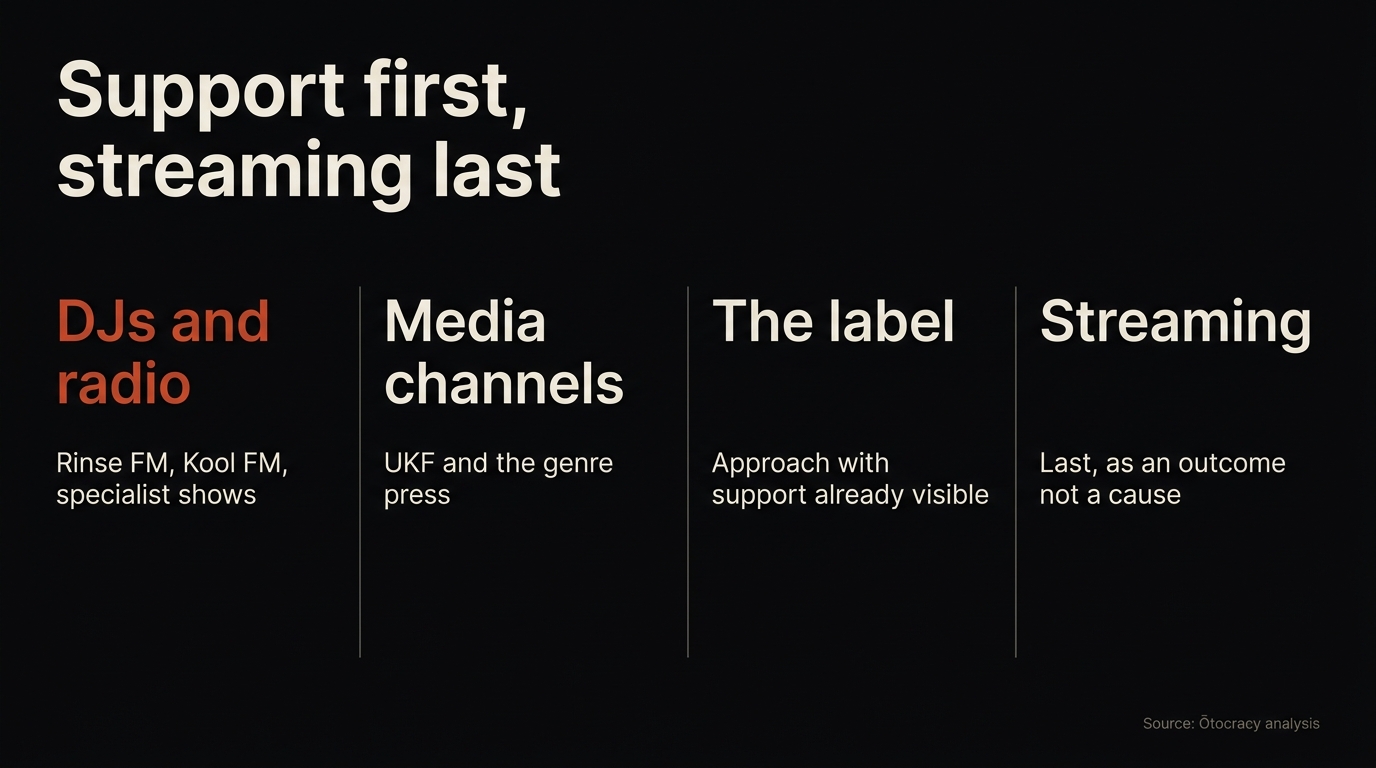
Drum and bass has something most electronic genres lack: a working media layer. UKF, founded in 2009 by Luke Hood as a YouTube channel, still functions as a discovery hub alongside specialist radio like Rinse FM and Kool FM — which means a record can break through media before it ever touches a playlist. The label ecosystem is unusually established and legible: Hospital Records, founded in London in 1996 by Tony Colman and Chris Goss; RAM Records, running since 1992 under Andy C and Red One; Shogun Audio, founded in 2004 by Ed Keeley, better known as Friction; plus Critical Music, Dispatch Recordings and 1985 Music. Most take demos through submission forms or curated platforms rather than open inboxes. The order that works is DJ and radio support first, media second, label third, streaming last.
Drum and bass has been organising itself for over thirty years, and it shows.
The genre has established labels with clear identities, specialist radio that still breaks records, and a media layer that functions as a genuine discovery channel. That is more infrastructure than most electronic genres have, and it means the promotion route is clearer here than almost anywhere else — provided you use it in the right order.
Generic advice will tell you to pitch playlists. In drum and bass that is roughly the last step, not the first.
The Media Layer Is Real, and It Is Unusual
Most electronic sub-genres have no equivalent of this, so it is worth being precise about what it is.
UKF began in 2009 as a YouTube channel promoting dubstep and drum and bass, founded by Luke Hood, and grew into a platform and label that has been central to the scene's online discovery ever since. Alongside it sits specialist radio — Rinse FM, Kool FM and others — where records still get broken by people whose taste an audience actually follows.
The practical consequence: in drum and bass, a track can be discovered by an audience without an algorithm being involved at any point. That is not true in most of dance music in 2026, and it changes what you should spend on.
| Drum and bass | Most electronic genres | |
|---|---|---|
| Primary discovery | Media channels, radio, DJ sets | Playlists and algorithms |
| Label landscape | Established, legible, decades old | Fragmented |
| Demo route | Forms and curated platforms | Open inboxes and mass sending |
| Scene memory | Long — reputation persists | Short |
| Playlists | A later step | Often the whole plan |
The Label Route
The label ecosystem is the genre's biggest advantage for a new artist, because targeting is straightforward when the landscape is this well defined.
Hospital Records, based in south-east London and founded in 1996 by Tony Colman and Chris Goss, is among the most prolific imprints in UK dance music. RAM Records, run by Andy C and Red One since 1992, has shaped the core of the genre. Shogun Audio, founded in 2004 by Ed Keeley — Friction — with Keir Tyrer, has broken a large share of the scene's current names, and operates alongside affiliates including Elevate Records and SGN:LTD. Critical Music sits at the more experimental end. Dispatch Recordings and 1985 Music round out the tier most artists should be looking at seriously.
One process detail that catches people out: most of these take demos through submission forms or curated platforms rather than open email inboxes. Shogun Audio accepts submissions directly; Critical works by email. Sending to a general address that is not the stated route is the fastest way to not be heard, and it signals that you did not check.
The pre-pitch sequence covers how to build a shortlist and what to put in the message. What is genre-specific here is that the label tier is genuinely readable — you can tell from six months of releases exactly where a track belongs.
Promos, and the Sub-Style Problem
Drum and bass spans liquid, neurofunk, jump-up, jungle, halftime and more, and those are different rooms with different DJs.
A promo list segmented by sub-style beats one segmented by name recognition, every time. The person receiving a liquid roller when they play neurofunk knows immediately that you sent the same email to everyone, and in a scene with this much memory that costs more than the one send.
Build the list from evidence: who has actually played records adjacent to yours recently, not who you admire. Ten well-matched DJs are worth more than two hundred names.
Across the 2,400+ campaigns run by our founding team, the most common reason a promo round with a good record produces nothing is that the list was assembled by reputation rather than by register.
Radio Still Breaks Records Here
Worth treating separately, because it is one of the few genres where this is still true and where the route is reachable.
Specialist radio in drum and bass is not a legacy channel. Shows on Rinse FM, Kool FM and equivalents are followed by audiences who trust the selector, which means a play functions as a recommendation rather than as background. That is a fundamentally different thing from a playlist add.
The practical route is unglamorous: send to hosts and show DJs weeks before release, not on release day, and send the finished master rather than a work in progress. Shows are planned ahead, and a record arriving the week of release has missed the window in which it could have been supported.
Two things make a radio send more likely to land. Segment by show rather than by station, because a station carries multiple sub-styles and the host who plays jungle is not the one who plays neurofunk. And say in one line why this record suits that show specifically — the same discipline as any pitch, and equally rare.
Why Streaming Comes Last
Not never — last.
Playlists reach listeners, and listeners are the end of the drum and bass funnel rather than the start. A record arriving at playlist consideration with radio play and DJ support has a story. One arriving with a pitch and nothing else does not.
There is a specific trap worth naming: because drum and bass has a large and loyal streaming audience, it is tempting to treat streaming as the primary channel. But that audience mostly finds records through the media and DJ layer first, then listens on streaming afterwards. Spending on playlists before you have any support is paying to skip the step that actually creates demand.
What Wastes Money
Mass promo sends. Covered above, and it is the most common expensive mistake in the genre.
Buying streams or followers. The people who decide things here read ratios and, more importantly, ask other people about you. A scene this connected finds out.
Ignoring the sub-style. Filing and pitching a record into the wrong corner of the genre does not broaden its reach, it removes it from the only audience that would have played it.
Paying for playlist placement before radio or DJ support. Right channel, wrong order, and the money does not come back.
Sending unfinished work. In a genre where the same labels see everything and remember, one weak demo affects the next three.
What Builds a Career Here
Get played, then get played again. Radio and DJ support compound, and in this scene they are visible to the people who make signing decisions.
Pick a lane and be legible in it. The genre rewards artists whose sound is identifiable within one track. Breadth reads as indecision at the start of a career.
Be part of the scene, not adjacent to it. Community matters here more than in most genres — the sub-style Discords, the nights, the people running small labels.
Own your audience. Drum and bass has one of the most loyal fanbases in electronic music. A free download gate turns that loyalty into an email list nobody can take away, and what to do with the list covers the half most artists skip.
Where Stores Fit
Beatport works the same way here as everywhere: sales in a rolling window, updated daily, with the pre-order the main structural lever and a delivery cutoff that decides feature eligibility. The chart mechanics go through it properly.
The genre-specific note is that drum and bass buyers are DJs to an unusual degree, which makes a store position a more meaningful signal than in genres with mostly consumer buyers. It is read as evidence that working DJs are buying the record.
The Honest Version
Drum and bass is a good genre to be in if you are patient and a bad one if you are not.
The infrastructure exists, the routes are visible, and the labels are reachable. But the scene has been running for three decades, everyone knows everyone, and reputations are built slowly and lost quickly. Across the 2,400+ campaigns run by our founding team, the genres with the longest institutional memory are the ones where shortcuts cost the most — and this is one of them.
If you want to know where your listeners are actually coming from before committing a budget, the free audit reads it source by source.
Frequently Asked Questions
How do you promote drum and bass music?
In this order: get DJ and radio support, use the genre's media channels, approach labels with that support as evidence, and treat streaming playlists as a later step. Reversing that — leading with playlists — is the most common and most expensive mistake.
Which drum and bass labels accept demos?
Hospital Records, RAM Records, Shogun Audio, Critical Music, Dispatch Recordings and 1985 Music are among those actively reading demos. Most use submission forms or curated platforms rather than open inboxes — Shogun accepts submissions directly, Critical works by email — so check each label's stated route before sending.
Does UKF still matter for drum and bass?
Yes. Founded in 2009 by Luke Hood as a YouTube channel for dubstep and drum and bass, it grew into a platform and label that remains a central online discovery hub for the genre. It is one of the few genuine media layers in electronic music.
Do playlists work for drum and bass?
They work, but late. The genre's audience typically discovers records through radio, DJ sets and media channels, then listens on streaming afterwards. Playlist spend before you have that support is paying to skip the step that creates the demand.
How important are sub-styles?
Decisive. Liquid, neurofunk, jump-up, jungle and halftime are different rooms with different DJs, and a promo sent across all of them at once gets filtered. Segment your list by sub-style before anything else.
Is jungle promoted the same way as drum and bass?
Broadly the same routes, different rooms. Jungle has its own DJs, nights and audience within the wider scene, so the infrastructure is shared but the promo list should not be. Treat it as its own sub-style when segmenting.
How long does it take to break a record in drum and bass?
Longer than in genres driven by algorithms, because the route runs through people. Plan in months rather than weeks, and expect the second and third records to move faster than the first once relationships exist.
The Bottom Line
Drum and bass gives you something rare: a genre where you can see exactly who the gatekeepers are, and reach them.
Use that in the right order. Support first, media second, label third, streaming last. Segment promos by sub-style, send finished work only, and treat the scene as something to be part of rather than something to market at.
The wider picture is in the complete EDM promotion guide, and if you want the paid layer run once the support exists, our campaign packages cover it.