What's a Good Repost Rate on SoundCloud? [Measured]
Median repost rate on SoundCloud peaks at 0.35% of plays, and only 17% of artists clear 1%. Measured across 2,000 profiles and 11,525 artists by scene.

Quick Answer
A good repost rate on SoundCloud is far lower than the figure people repeat. Measured across 2,000 public profiles, the median artist gets reposts on 0.09% to 0.35% of plays depending on follower count, and only 17% of artists clear 1% — so 1% is a top-sixth result, not a target. Repost rate is also not a straight line: it climbs to a peak of roughly 0.35% in the 1,000 to 5,000 follower band and falls away above it, which means a large account with a lower repost rate than a small one is behaving normally. Unusually, this is the one engagement metric that does not move much with genre. Across 11,525 artists segmented into three scenes, medians sit between 0.21% and 0.38% everywhere. Size is the variable that matters for reposts; scene is the variable that matters for comments and likes.
"Aim for a 1% repost rate" is the kind of advice that sounds like a benchmark and functions as a discouragement.
It is repeated across promo blogs with no sample attached, and when an artist measures themselves against it they conclude something is wrong. Measured, 1% is not the bar — it is roughly the top sixth of working artists.
Here is what the number actually is, why it moves the way it does, and the one thing about it that surprised us.
The Measured Answer
Median reposts as a share of plays, across 2,000 public profiles banded by follower count.
| Followers | Median repost rate |
|---|---|
| Under 500 | 0.09% |
| 500 to 1k | 0.23% |
| 1k to 2.5k | 0.35% |
| 2.5k to 5k | 0.32% |
| 5k to 10k | 0.32% |
| 10k to 25k | 0.26% |
| 25k to 50k | 0.28% |
| 50k to 100k | 0.22% |
| Over 100k | 0.16% |
And the distribution, which is the part that reframes the advice: only 17% of artists clear 1% of plays in reposts.
So a record at 0.3% is not underperforming. It is median. A record at 1% is in the top sixth of the platform. Treating the top sixth as a floor is how a normal profile gets diagnosed as broken.
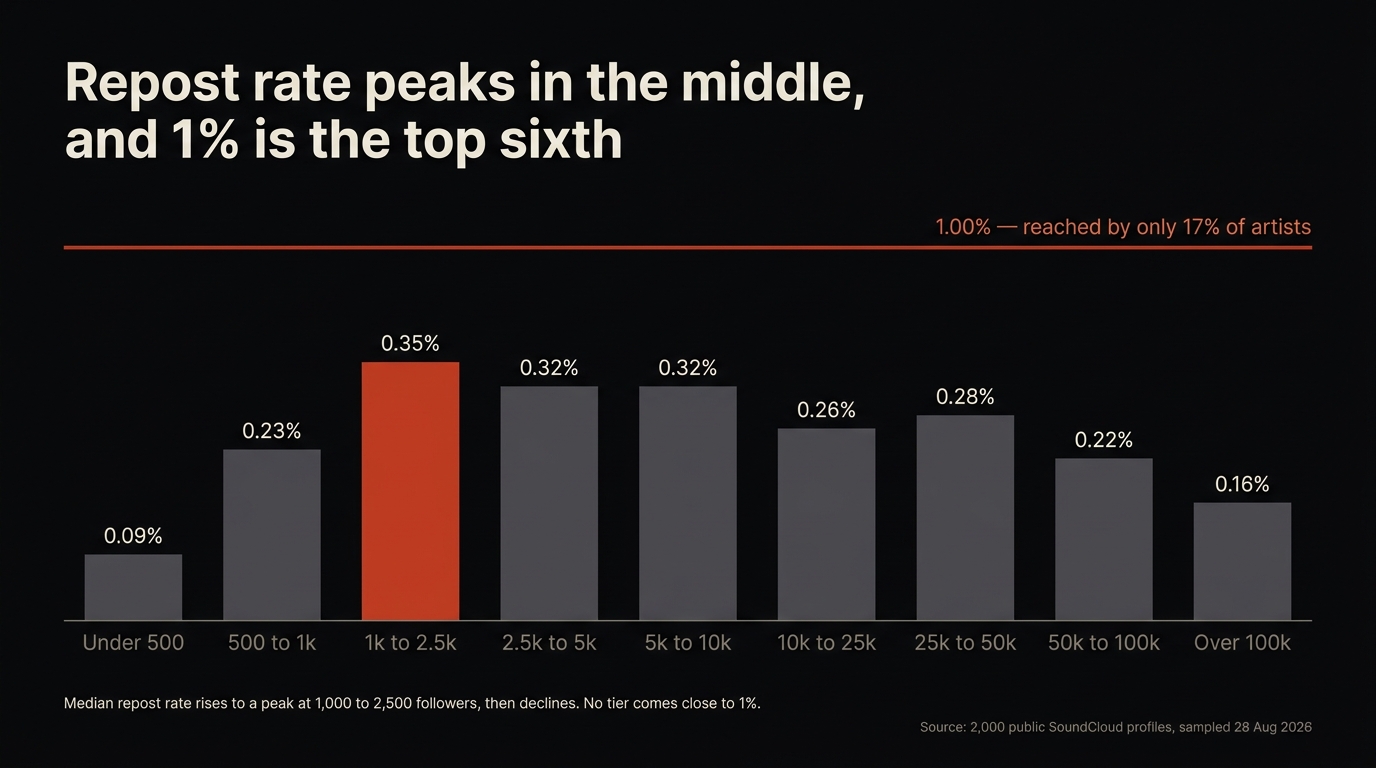
It Is a Hump, Not a Slope
The shape matters more than any single number, and it is the opposite of what most people assume.
Repost rate climbs from 0.09% at the bottom, peaks around 0.35% in the 1,000 to 2,500 band, and declines steadily above it to 0.16% over 100,000 followers. Overall correlation with follower count is 0.003 — statistically nothing, because the relationship is not linear.
The mechanism is not mysterious. Reposting on SoundCloud is largely a peer behaviour: artists and small curators pass records to their own followings. That population is concentrated among small and mid-sized accounts, which is precisely where the peak sits. Large accounts get played rather than passed along — their followers are listeners, not fellow artists with an audience to share into.
Two practical consequences.
A falling repost rate as you grow is expected, not a warning. If you were at 0.35% with 2,000 followers and you are at 0.22% with 60,000, you are tracking the platform.
The accounts most likely to repost you are smaller than the ones you are chasing. If your promotion plan depends on reposts carrying a release outward, target peers, not headliners.
The Surprise: Reposts Barely Move With Genre
We segmented 11,525 artists into three scenes — Tech House, Techno and Hard Techno, Hard Dance and Hardcore — expecting reposting to differ by culture. It does not, or not much.
| Scene | Range of medians across all size groups |
|---|---|
| Tech House | 0.23% to 0.36% |
| Techno / Hard Techno | 0.26% to 0.38% |
| Hard Dance / Hardcore | 0.21% to 0.36% |
Every scene peaks in the same place — the 1,000 to 5,000 band — and every scene falls away above it. The spread between scenes at a given size is small enough to be noise for a single artist.
This is genuinely useful, because it is a rare case where a platform-wide benchmark is the right tool. Comment rate and plays-per-follower diverge sharply by scene, as the genre benchmarks set out. Repost rate does not. Use the size bands above and ignore your genre for this one metric.
Across the 2,400+ campaigns run by our founding team, knowing which metrics need a genre-specific comparison and which do not is worth more than any single number, because it decides when a diagnosis is real.
What a Low Repost Rate Actually Tells You
Once you are comparing against the right band, a genuinely low number has three usual causes.
You are not in circulation among peers. Reposts come from other artists and small curators. If you have no relationships in your scene, there is nobody positioned to pass the record on. This is the most common cause and the slowest to fix.
The record is not repost-shaped. Some tracks get played and not shared — long, functional, mix-tool records especially. That is not a quality problem, it is a format one.
Your followers are not artists. An audience acquired through paid reach or follow-trading contains very few people with an audience of their own. Check your follower-to-following ratio alongside the repost figure before concluding anything.
Reposts Versus the Other Metrics
Worth placing repost rate against the rest, because artists routinely treat all engagement as one number.
| Metric | Median range | Moves with size? | Moves with scene? |
|---|---|---|---|
| Like rate | 3.1% to 5.1% | Gently down as you grow | Yes, modestly |
| Repost rate | 0.09% to 0.38% | Yes — a hump, peaking at 1k to 5k | Barely |
| Comment rate | 0.05% to 0.34% | Down as you grow | Yes, strongly |
| Plays per follower | 0.16 to 1.09 | Down as you grow | Yes, strongly |
Read across that table and the diagnosis order falls out. Like rate is the steadiest, so a like rate far off its band is the clearest single signal that something is wrong with traffic quality. Repost rate is the one to judge purely on size. Comment rate and plays-per-follower need your scene before they mean anything.
Across the 2,400+ campaigns run by our founding team, profiles with a genuine problem show it in two metrics at once. A single ratio sitting low, on its own, is usually noise.
What Not to Do About It
Do not buy reposts. Repost-for-repost networks and paid repost services produce a number with no listening behind it, and the people who read these profiles — labels, bookers, curators — look at whether plays and saves moved, not at a counter.
Do not chase the metric directly. Reciprocal repost rings move the ratio and move nothing else. The number is a diagnostic, not a goal, and optimising it directly is how it stops meaning anything.
Do not read one release. Repost rate is noisy on a single track. Look at the median across your catalogue, which is how these bands were built in the first place.
The One-Track Trap
A note on sampling your own numbers, because it is the most common way artists mis-read this metric.
Repost rate on a single release is extremely noisy. A record that catches one well-followed curator can show 2% while the artist's real median sits at 0.3%; a record released in a quiet week can show 0.05% with nothing wrong. Both readings are true about that track and useless as a diagnosis.
The bands on this page were built from per-artist medians across whole catalogues precisely to avoid that. Do the same with your own: take the median across everything you have released, not the last thing you put out, and compare that.
Where Reposts Fit in a Release
Reposts are a distribution mechanism, not a success metric, and they work best when they are not the whole plan.
In genres where discovery runs through peers and DJs, reposts matter more than playlists — that is the argument in the techno playbook, where circulation among working DJs does what an algorithm does elsewhere. In genres built around events, the same energy goes into rooms instead, as in hardstyle.
Either way, the durable version of the same instinct is an audience you can reach without a platform in the middle. A free download gate converts circulation into email addresses you keep.
How This Was Measured
Two samples, both published in full on the SoundCloud benchmarks hub.
The follower-tier bands come from 2,000 public profiles, stratified into nine tiers at roughly 223 profiles each, with every artist's whole catalogue read and the per-artist median taken before the cross-artist percentile.
The scene bands come from 11,525 artists classified from their own track tags — Tech House 2,698, Techno and Hard Techno 7,184, Hard Dance and Hardcore 1,643 — measured the same way, sampled 9 September 2026.
One limitation worth stating: the sample is our own reachable graph, snowballed through reposts and follows. It carries a follower floor and describes working artists rather than SoundCloud's long tail. These bands mean "typical for artists your size", never "typical for everyone".
Frequently Asked Questions
What is a good repost rate on SoundCloud?
Median runs between 0.09% and 0.35% of plays depending on follower count, peaking in the 1,000 to 2,500 band. Only 17% of artists clear 1%, so 1% is a top-sixth result rather than a target. Anything near your size band's median is normal.
Why is my repost rate falling as I grow?
Because that is the measured pattern. Repost rate peaks around 1,000 to 2,500 followers and declines above it, reaching 0.16% over 100,000. Reposting is a peer behaviour, and large accounts are followed by listeners rather than by artists with audiences to share into.
Does repost rate vary by genre?
Barely. Across 11,525 artists in three scenes, medians sit between 0.21% and 0.38% everywhere, with every scene peaking in the same size band. Comment rate and plays-per-follower do vary by scene; repost rate is the exception.
Is 1% a good repost rate?
It is very good — roughly the top sixth of working artists. It is repeated as a minimum in a lot of promo advice, which is where the discouragement comes from. Measured, it is an outlier result.
Should I buy SoundCloud reposts?
No. Paid reposts and repost-exchange networks produce a count with no listening attached, and the people who evaluate profiles look at whether plays and saves moved. It also does nothing for the peer relationships that generate real reposts.
What counts as a repost on SoundCloud?
Another account sharing your track to their own followers, as distinct from a like. Because it puts the record in someone else's feed, it is the platform's main organic distribution mechanism — which is why it concentrates among artists and small curators rather than among listeners.
How many reposts should a new release get?
Judge the rate rather than the count, and judge it across your catalogue rather than one track. At 5,000 followers a median artist sits around 0.32% of plays; on a track with 10,000 plays that is roughly 32 reposts.
The Bottom Line
One percent is not the benchmark. It is the top sixth, and repeating it as a floor makes most artists think a normal profile is a failing one.
Find your follower band, compare against its median, and expect the rate to fall as you grow — that is the platform behaving as measured, not you losing ground. And for this particular metric, ignore your genre: reposts are one of the few things that do not segment by scene.
Full percentile bands for every metric, size group and scene are on the benchmarks hub. To have your own profile placed against them automatically, the free SoundCloud audit runs the comparison, and the whole-profile version of the check is in the 20-minute audit.