SoundCloud Plays Per Follower: What's Normal in 2026 [Data]
What a normal SoundCloud plays-per-follower ratio is, measured across 2,000 profiles, and why catalogue size sets the bar instead of follower count.

Quick Answer
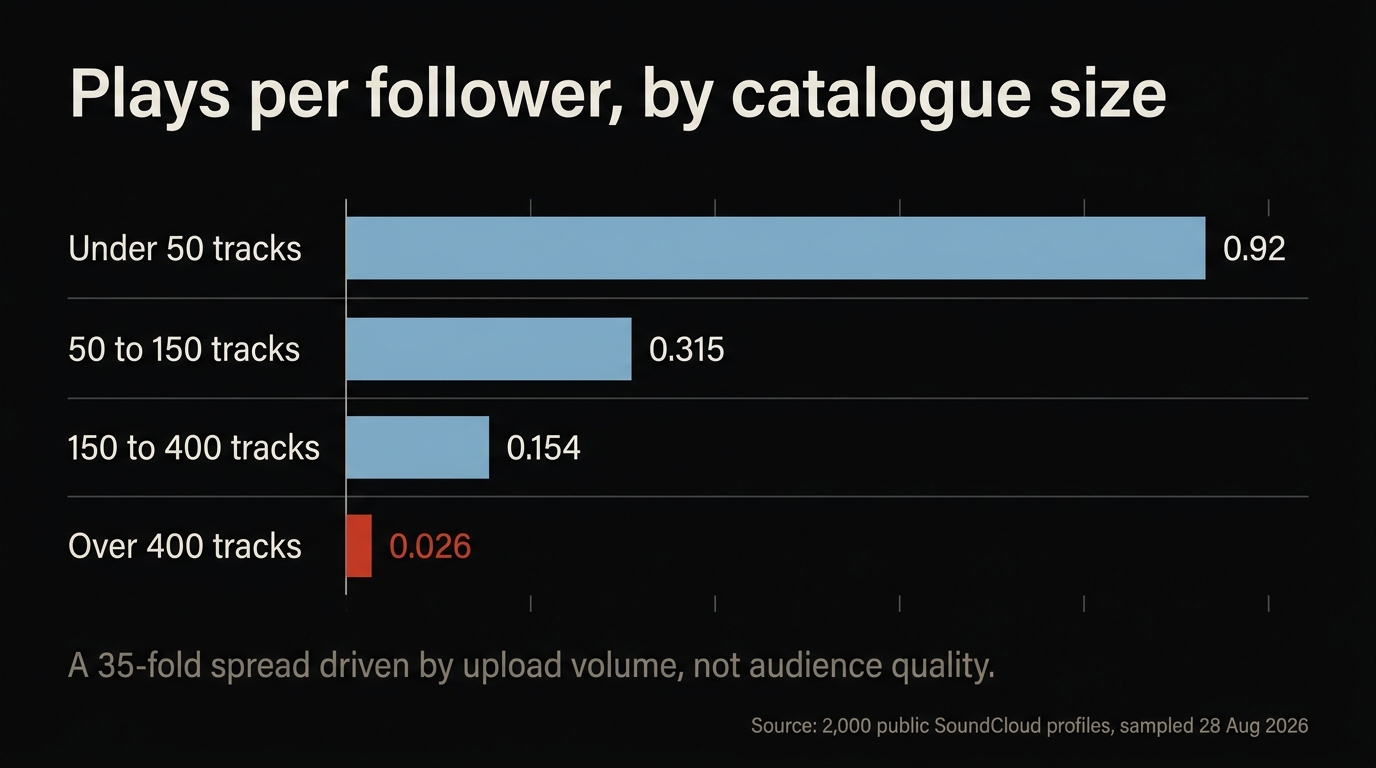
Plays per follower is the wrong number to judge against your follower count, and that single mistake makes most SoundCloud artists think their reach has collapsed. Measured across 2,000 public profiles on 28 August 2026, the ratio tracks catalogue size far more tightly than audience size: a Spearman correlation of −0.61 against track count, against −0.38 for followers. An artist with fewer than 50 tracks posts a median of 0.92 plays per follower. Past 400 tracks the median is 0.026 — a 35-fold spread driven almost entirely by how much somebody uploads. A prolific producer measuring themselves against a five-track EP artist will always look broken, and is not. The practical read: find your catalogue band first, then compare inside it. The bands below are medians and quartiles from that sample, and they describe working artists rather than the whole platform.
Every artist who opens SoundCloud stats eventually does the same division: total plays, divided by followers. It takes four seconds and it feels like it should mean something.
It does mean something. Just not what most people conclude from it, because the number gets compared against the wrong reference — usually a screenshot from a bigger account, or a figure from a promo blog that measured nothing at all.
We sampled 2,000 public SoundCloud profiles on 28 August 2026 to find out what the ratio actually looks like. The answer reorganised how we read it.
The Ratio Everyone Computes, and the Denominator They Get Wrong
Plays per follower is meant to answer one question: when you put something out, does your audience actually hear it?
The intuition behind judging it by follower count is that bigger accounts should have more reach. Measured, that intuition is weak. Follower count correlates with plays per follower at −0.61 for catalogue size versus −0.38 for followers — meaning how much you have uploaded predicts your ratio far better than how many people follow you.
The mechanism is arithmetic rather than mysterious. Plays accumulate across everything you have ever posted, but they accumulate unevenly: recent uploads and a handful of catalogue standouts carry most of the weight. Followers accumulate too. Divide a slow-growing numerator by a steadily-growing denominator across 400 uploads and the ratio compresses, whatever the quality of the work.
What 2,000 Profiles Say Plays Per Follower Actually Is
Here are the measured bands, grouped by catalogue size. Every band rests on at least 213 profiles.
| Catalogue size | 25th percentile | Median | 75th percentile |
|---|---|---|---|
| Under 50 tracks | 0.403 | 0.922 | 2.184 |
| 50 to 150 tracks | 0.133 | 0.315 | 0.680 |
| 150 to 400 tracks | 0.057 | 0.154 | 0.336 |
| Over 400 tracks | 0.014 | 0.026 | 0.057 |
Read one row, not the column. An artist with 60 tracks and a ratio of 0.30 is sitting almost exactly at the median for their band. That same 0.30 would be bottom-quartile for someone with a 20-track profile, and comfortably top-quartile for someone past 400.
The spread between the top and bottom band is roughly 35-fold. No plausible difference in audience quality produces a 35-fold gap. Upload volume does.
Why We Band by Catalogue Instead of Followers
Our first version of these benchmarks banded by follower count. It was wrong in a way that mattered, and the fix is worth explaining because it changes how you should read any benchmark someone hands you.
Banding by followers means a prolific artist gets compared against a sparse one at the same audience size. Because catalogue size is the stronger driver, the prolific artist is told their reach is broken when their number is entirely normal for how much they upload. Across the 2,400+ campaigns run by our founding team, "my plays per follower collapsed" has been one of the more common opening complaints — and in a meaningful share of cases nothing was wrong except the comparison.
Banding by catalogue also dissolves a problem we never solved cleanly by other means: telling label profiles apart from artist profiles. A label simply has a large catalogue, so it lands in a large-catalogue band and gets compared with other large catalogues. No classification step, no guessing.
The 8x Correction
Our earlier bands rested on 110 profiles across four tiers — about 27 each — and read only five recent tracks per artist. Three of their claims did not survive an 18-fold larger sample. One is directly relevant here.
The old bands put the 150-to-400-track range at 0.019 plays per follower. Measured properly, it is 0.154 — off by a factor of eight.
That is not a rounding problem. It is the difference between telling a deep-catalogue artist they are performing normally and telling them their profile is dead. We published the corrected bands and we are flagging the correction here rather than quietly swapping the numbers, because a benchmark you cannot audit is just an assertion with a table around it.
| What the old sample claimed | What 2,000 profiles measured |
|---|---|
| 150-400 tracks: 0.019 plays per follower | 0.154 — an 8x error |
| Repost rate for 1k-10k artists: 0.8% | Nearer 0.32% |
| Like rate climbs with size, 2.6% to 4.3% | Drifts down, 4.3% to 3.1% |
The full percentile reference, including repost, like and comment bands for all nine follower tiers, lives on our SoundCloud benchmarks page.
What a Low Ratio Actually Means
Once you are comparing inside the right band, a genuinely low number has three common causes. They need different responses.
Upload cadence outrunning promotion. The most frequent one. Every release adds to the denominator whether or not it got any push behind it. Six unpromoted uploads in a quarter will pull your ratio down more than one promoted release lifts it.
Followers acquired without intent. Follow-for-follow, bought follows, and reciprocal-follow campaigns inflate the denominator with accounts that will never play anything. This shows up as a low ratio alongside a follower-to-following count near 1 — a combination worth checking before you conclude anything about your music.
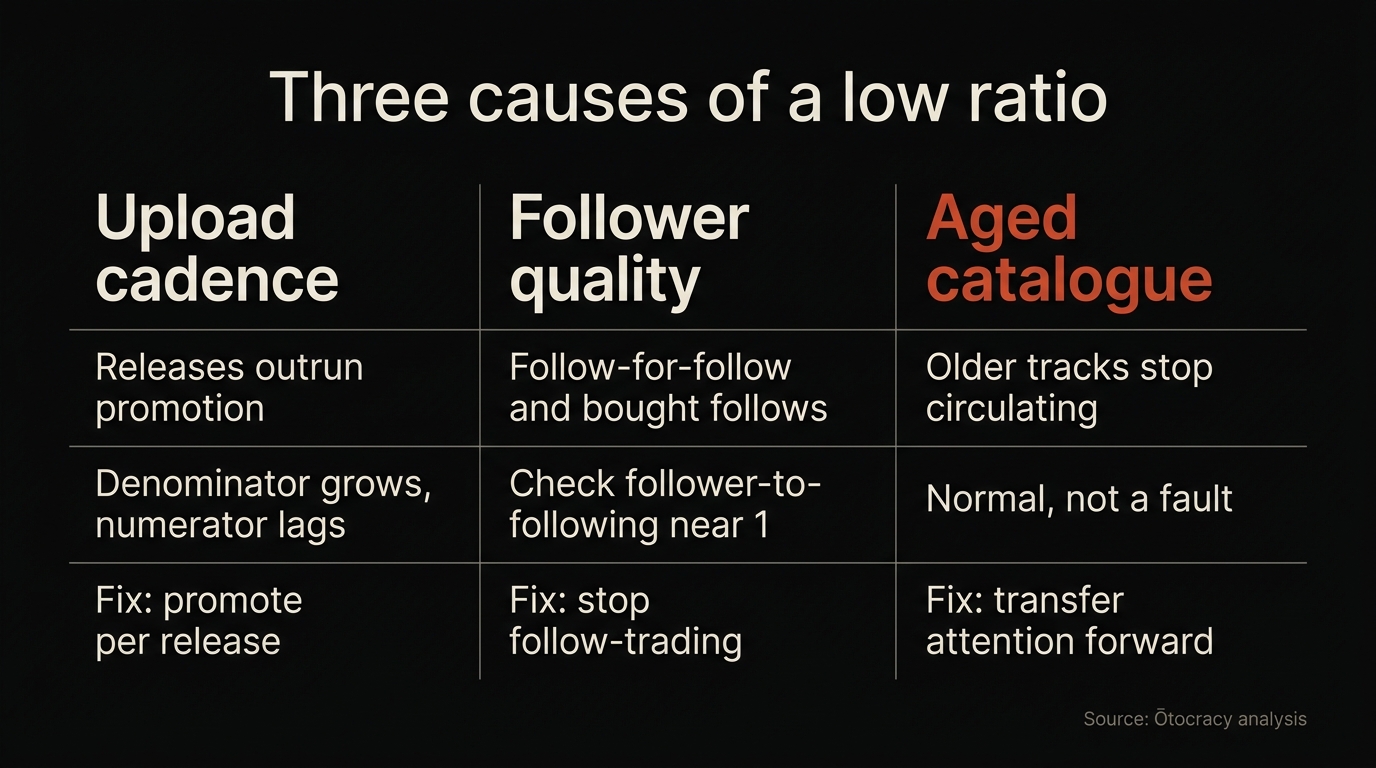
Catalogue that has aged out of circulation. Older tracks stop being surfaced, so the numerator stops growing while the denominator keeps climbing. Normal, not a fault, and the reason a five-year-old profile reads differently from a new one at the same follower count.
Reading Your Own Number in Five Minutes
- Count your public tracks. That gives you a catalogue band from the table above.
- Add total plays across the profile and divide by follower count.
- Place the result against your band's 25th, median and 75th percentile. You want a position, not a grade.
- Check your follower-to-following ratio at the same time. A ratio near 1 at any meaningful follower count is the signal that the denominator, not the music, is the problem.
- Only then decide whether the number is telling you to promote more or upload less.
If you would rather have that read back to you against every band at once, our free SoundCloud audit does the placement automatically and flags which of the three causes above fits your profile shape.
Where This Number Should and Should Not Change Your Plan
Plays per follower is a diagnostic, not a target. Optimising it directly leads somewhere stupid — you can improve it tomorrow by deleting tracks.
It is useful for three decisions. Whether your last release actually reached the audience you already have. Whether your follower growth is bringing real listeners or padding. Whether your upload cadence has drifted ahead of your ability to promote what you post.
It is useless for comparing yourself against another artist, unless you have checked their catalogue size first. That is the entire finding. Across the 2,400+ campaigns run by our founding team, the artists who acted on this number without checking the denominator spent money on reach they already had.
For a track that deserves push rather than diagnosis, a free download gate converts the plays you already get into email addresses you keep — which is the one audience number that does not reset when a platform changes its API. The mechanics are in our guide to what a download gate is, and the wider release picture sits in the complete EDM promotion guide.
If You Run a Label Profile
Label accounts are the clearest case of why the denominator matters. A label uploading every release from a ten-artist roster crosses 400 tracks quickly, which puts it in the band with a median of 0.026 plays per follower.
Judged against artist profiles, that reads as catastrophic. Judged against other large catalogues, it is unremarkable.
This is also why we stopped trying to classify profiles as "label" or "artist" at all. A label simply has a large catalogue and lands in a large-catalogue band automatically, so the comparison corrects itself without anyone having to guess what kind of account they are looking at.
The practical consequence for a label: profile-level reach is close to meaningless as a health metric, because it averages a decade of catalogue against one month of promotion. Judge releases individually and use the profile ratio only to spot long-term drift. Labels running several releases a month can see that per release rather than per profile through Ōtocracy's roster tools.
How This Was Measured
The sample is 2,000 public SoundCloud profiles taken on 28 August 2026, stratified into nine follower tiers at roughly 223 profiles each, with every artist's whole catalogue read rather than a recent handful — a median of 26 releases per artist.
The per-artist median is taken before the cross-artist percentile, so one viral track cannot drag a whole band upward.
One honest limitation: the sample is our own reachable graph, snowballed through reposts and follows. It carries a follower floor and describes working artists rather than SoundCloud's long tail. These bands say "typical for artists your size", and they should never be read as "typical for everyone".
Frequently Asked Questions
What is a good plays-per-follower ratio on SoundCloud?
There is no single good number, because the ratio depends on catalogue size. Median is 0.92 for profiles under 50 tracks, 0.315 for 50 to 150, 0.154 for 150 to 400, and 0.026 past 400 tracks. Find your band first, then compare against its median and quartiles.
Why did my plays per follower drop after I released more music?
Because each upload adds to the denominator immediately and to the numerator gradually. A falling ratio during a period of heavy releasing is the expected pattern, not a warning sign, as long as your absolute plays per release are holding steady.
Does a low plays-per-follower ratio mean I have fake followers?
Not on its own. Check it alongside your follower-to-following ratio — a value near 1 at meaningful follower counts points at reciprocal or purchased follows. A low plays-per-follower with a healthy follower-to-following ratio usually points at upload cadence instead.
Should I delete old tracks to improve the ratio?
No. The ratio is a diagnostic, not a goal, and deleting catalogue removes plays as well as tracks. If the number is telling you something, it is about promotion cadence and follower quality, neither of which improves by hiding work.
How does plays per follower compare to repost rate?
They measure different things. Plays per follower asks whether your existing audience hears you; repost rate asks whether they push you outward. Repost rate is also not a straight slope with size — it peaks around 1,000 to 2,500 followers and falls away above 100,000.
Where do these benchmark numbers come from?
A stratified sample of 2,000 public SoundCloud profiles taken on 28 August 2026, roughly 223 per follower tier, with each artist's full catalogue read through the API. The percentile tables are published in full on our benchmarks page.
The Bottom Line
Plays per follower is one of the few SoundCloud numbers that is genuinely informative, and one of the easiest to misread, because almost every comparison people make ignores the variable that drives it hardest.
Find your catalogue band, place yourself inside it, and check your follower-to-following ratio in the same sitting. If the number still looks wrong after that, it is telling you something real — and the fix is almost always promotion cadence rather than anything about the music.
Catalogue size drives this ratio hardest, but scene matters too: hard dance artists run well above techno at every size, which is the finding in hard dance has SoundCloud's most active audience.
Run the placement automatically with the free SoundCloud audit, or read the full percentile reference if you would rather do the comparison by hand.