EDM Promotion: The Complete 2026 Guide
EDM promotion works differently than generic music marketing. A DJ and label founder maps every channel, real budgets, scams to avoid, and a 90-day plan.
Quick Answer
EDM promotion is scene promotion. Electronic music is a 15.1 billion dollar industry as of 2025, according to the IMS Business Report 2025/26, and it does not break records the way pop does. Tracks travel through DJ support chains, club floors, festival slots, and sound-first platforms before casual listeners ever hear them. The channels that actually move electronic releases in 2026 are TikTok sound campaigns, Spotify's algorithmic ecosystem, targeted paid ads, DJ promo pools, label demos, and festival positioning, roughly in that order of cost efficiency. Budget reality: meaningful movement starts around 300 to 500 dollars per release, and anything under 100 dollars mostly buys risk. Avoid anyone selling guaranteed placements or cheap streams: Spotify removed more than 75 million spam tracks in the twelve months through September 2025, and botted plays now get releases deleted. Work the scene, not the shortcuts.
I have spent more than a decade inside electronic music. First as a DJ and producer playing club shows across Europe, then running Temple of Sinners as an event series, then signing other people's records through my label Underkntrl. EDM promotion is the thing I have done wrong more times than anyone reading this, which is exactly why I can tell you what works.
This guide covers the full picture: why electronic music promotion follows different rules than pop or hip-hop, every channel that matters in 2026, what each tier of budget actually buys, the scams draining artists dry, and a 90-day plan you can start this week. No theory from marketing blogs. Just what I have watched break records and what I have watched burn money.
Why EDM Promotion Is Not Generic Music Promotion
Most music marketing advice is written for singer-songwriters and rappers. It assumes your face is the product, your lyrics carry the story, and your fans follow you as a personality first. Electronic music does not work like that.
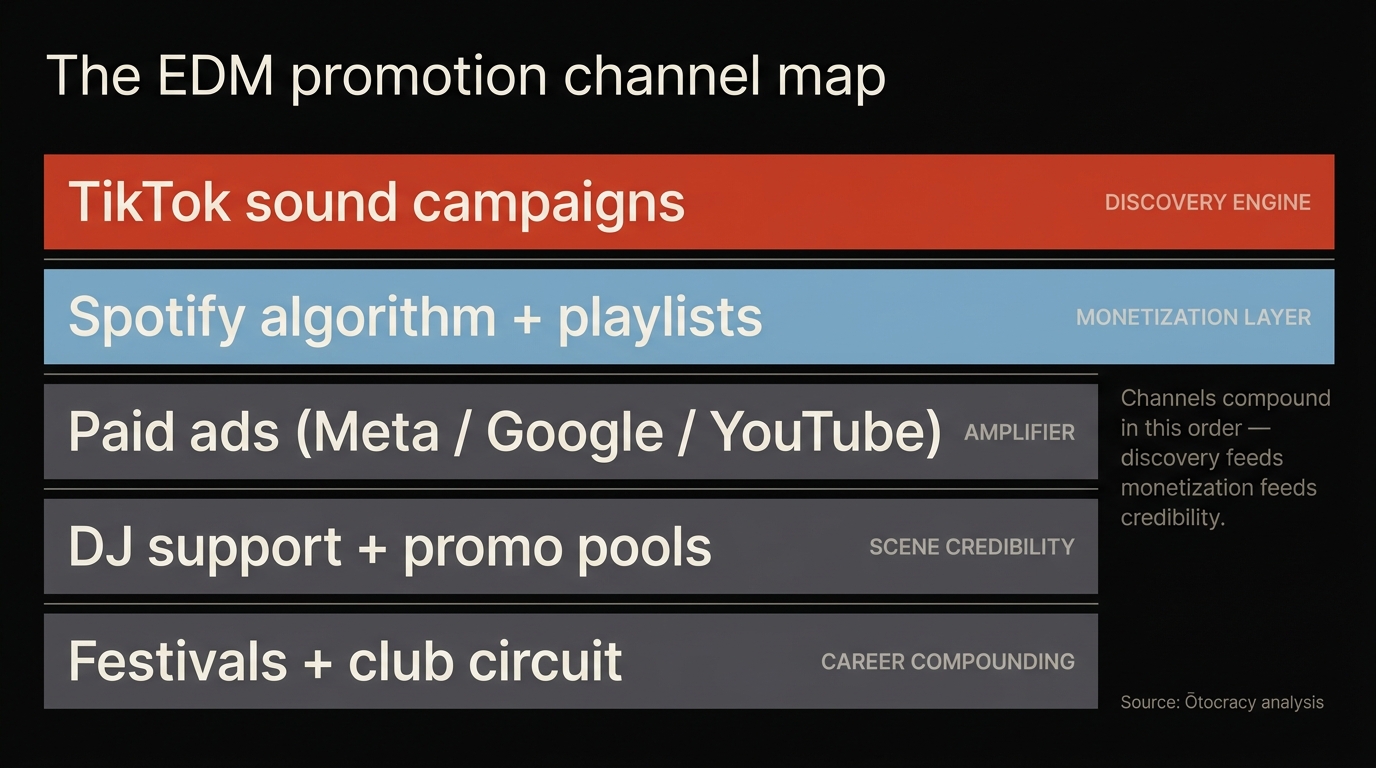
In our scene, the track is the product. A techno record can peak on 500 dancefloors while the producer stays functionally anonymous. That inverts almost every promotion tactic the generic guides teach you.
The scene decides before the algorithm does
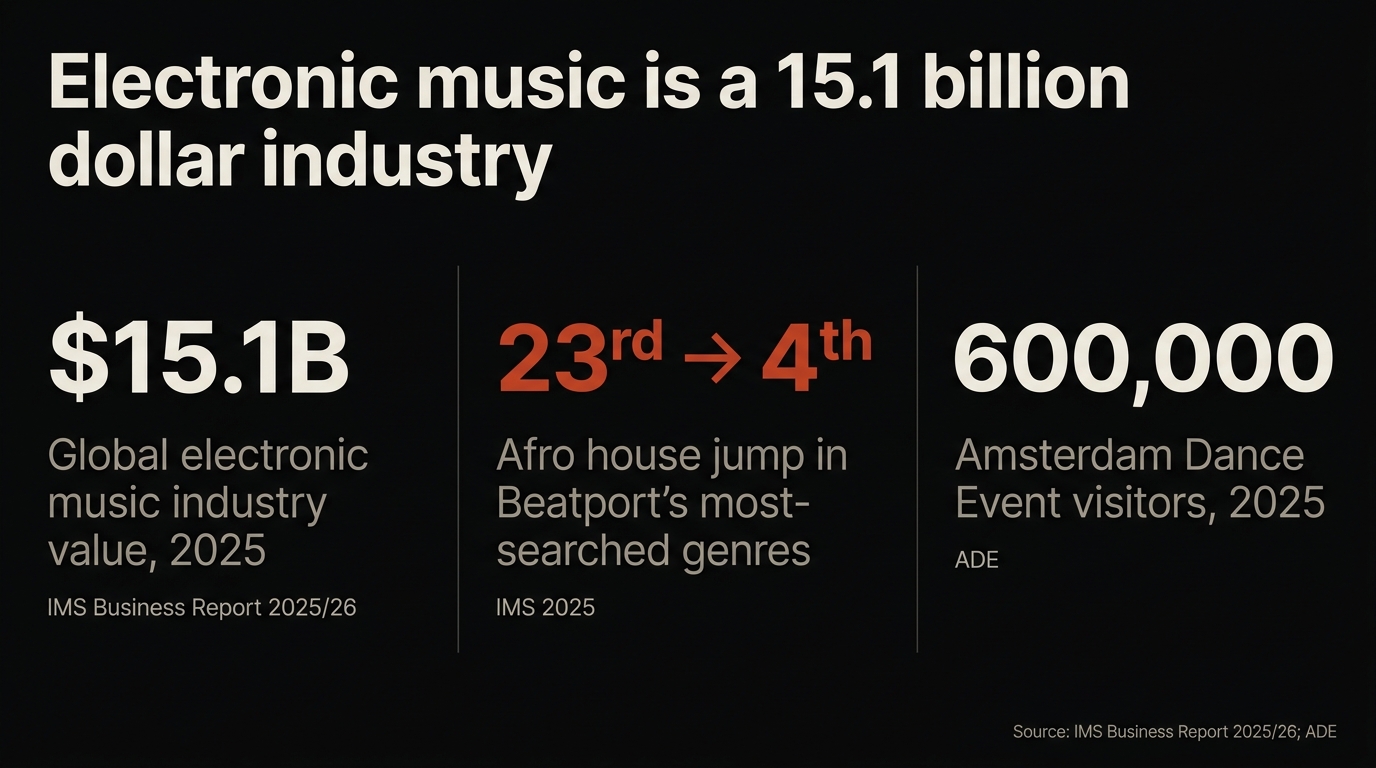
Electronic music breaks bottom-up through scenes: local clubs, genre communities, DJ circles, label ecosystems. According to the IMS Business Report 2025/26, compiled by MIDiA Research, the global electronic music industry grew 7 percent to a record 15.1 billion dollars in 2025, and festivals and clubs remain its largest revenue engine. The money is on dancefloors, not just on streaming dashboards.
That means gatekeepers still matter here in a way they no longer do in pop. A pop single lives or dies on consumer reaction. An underground club record lives or dies on whether 200 relevant DJs put it in their sets. You promote to the scene first and the public second.
Genres move fast and reward early positioning
The same IMS reporting showed afro house jumping from 23rd to 4th among Beatport's most-searched genres in a single year. That kind of whiplash does not happen in rock. Producers who positioned themselves in afro house eighteen months before that spike got carried up with the wave; everyone who arrived after paid full price for attention. The genre-specific version of this — labels, timeline, streaming quirks — is in our afro house promotion guide. For the territory view, the German market and Dutch market guides cover Europe's two biggest dance economies.
Growth is also geographic. IMS data showed Mexico's electronic audience growing 60 percent in 2024 and Indonesia's Spotify electronic listenership jumping 77 percent in 2025. Your next 10,000 fans may not live anywhere near your city, and your promotion should account for that.
Sound-first virality changed the entry point
TikTok rewards electronic music structurally, because the unit of virality is a sound, not a face. A 15-second drop or a hypnotic loop can spread across hundreds of thousands of videos without the producer appearing once. According to MIDiA Research, 51 percent of 16 to 24 year olds name TikTok as a main place they discover new music, against 37 percent of consumers overall.
Put those three things together — scene gatekeepers, fast-moving genres, sound-first discovery — and you get the core thesis of this guide. EDM promotion is a different discipline, and running a generic music-marketing playbook on an electronic release wastes most of the budget.
How Electronic Tracks Actually Break: The DJ Support Chain
Before we map channels, you need to understand the mechanism that generic guides never mention: the support chain. Almost every electronic record that breaks follows some version of it.
It starts with peer DJs playing your unreleased track in sets. Then bigger DJs pick it up from promo pools or from hearing it out. Then a label wants it because credible names are already supporting it. Then the release lands with built-in momentum, radio shows and playlists follow, and streaming numbers become the receipt rather than the cause.
The chain works because every link is a filter with reputation at stake. A DJ who plays your record in a packed room is vouching for it with their booking fee, and a label that signs it is vouching with their catalog. That is why one honest support beats any amount of purchased noise: it carries a signature.
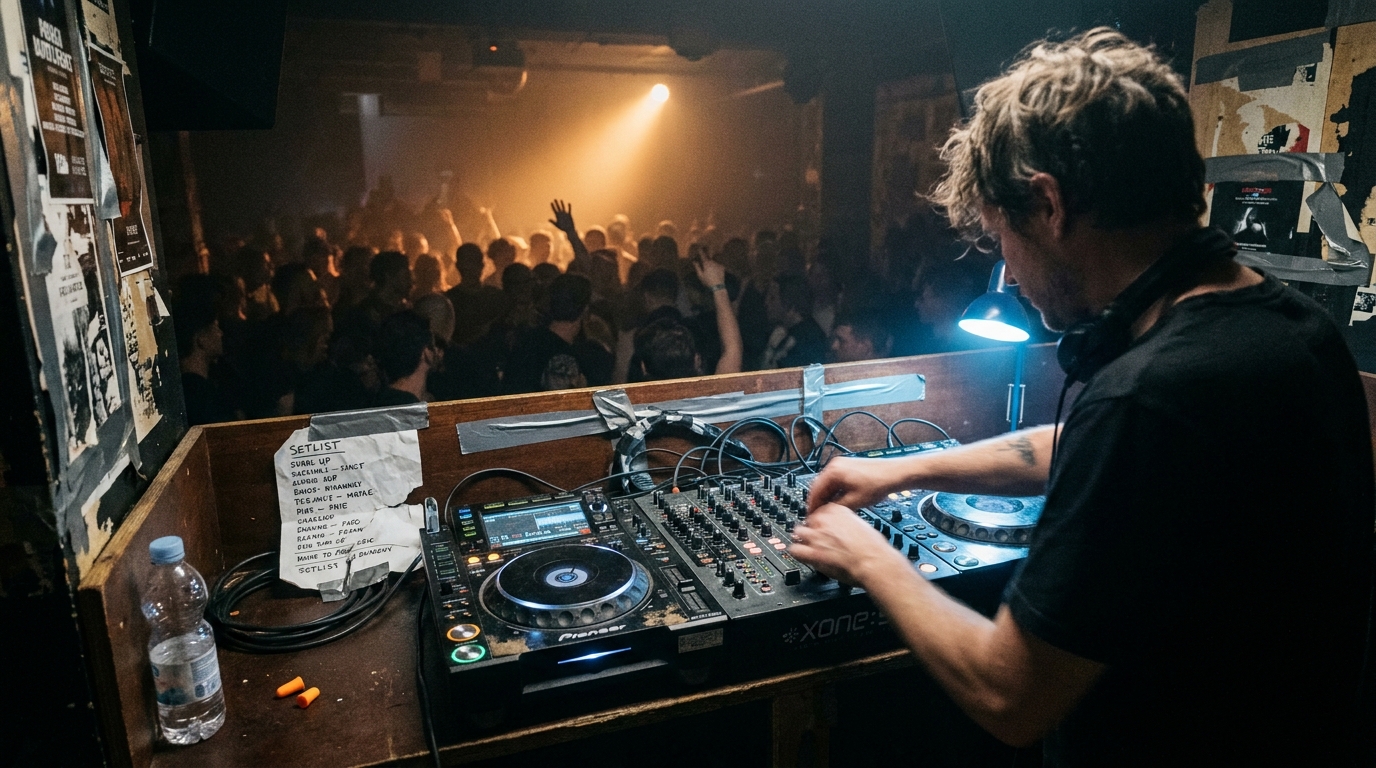
Running Temple of Sinners taught me this from the booking side. When we booked a headliner, the records they hammered that season became the records every local DJ needed. One heavy support from the right artist is worth more than 50,000 anonymous streams, because it converts into more support, bookings, and label attention.
Festival economics shape everything
Festivals are the scene's stock exchange. Amsterdam Dance Event drew a record 600,000 visitors in 2025 across more than 1,200 events in over 300 venues, and a meaningful share of the year's bookings and signings get decided during those five days. A track that peaks in September, right before ADE, does more for your career than the same track peaking in January — we break the exact sequencing down in should you release a track around ADE.
This is why timing is a promotion tool in EDM. You schedule releases so momentum lands when the industry is watching: before ADE in October, before Miami Music Week in March, before festival booking season closes. Based on 2,400+ campaigns run by our founding team, releases timed into those windows consistently convert streaming momentum into real-world outcomes faster than identical campaigns run in dead months.
What this means for your plan
Every channel in the next section should feed the chain, not replace it. Streams create DJ attention, DJ attention creates label interest, labels create festival slots, and festival slots create fans who stream. Promotion that only inflates one number in isolation is decoration.
The EDM Promotion Channel Map for 2026
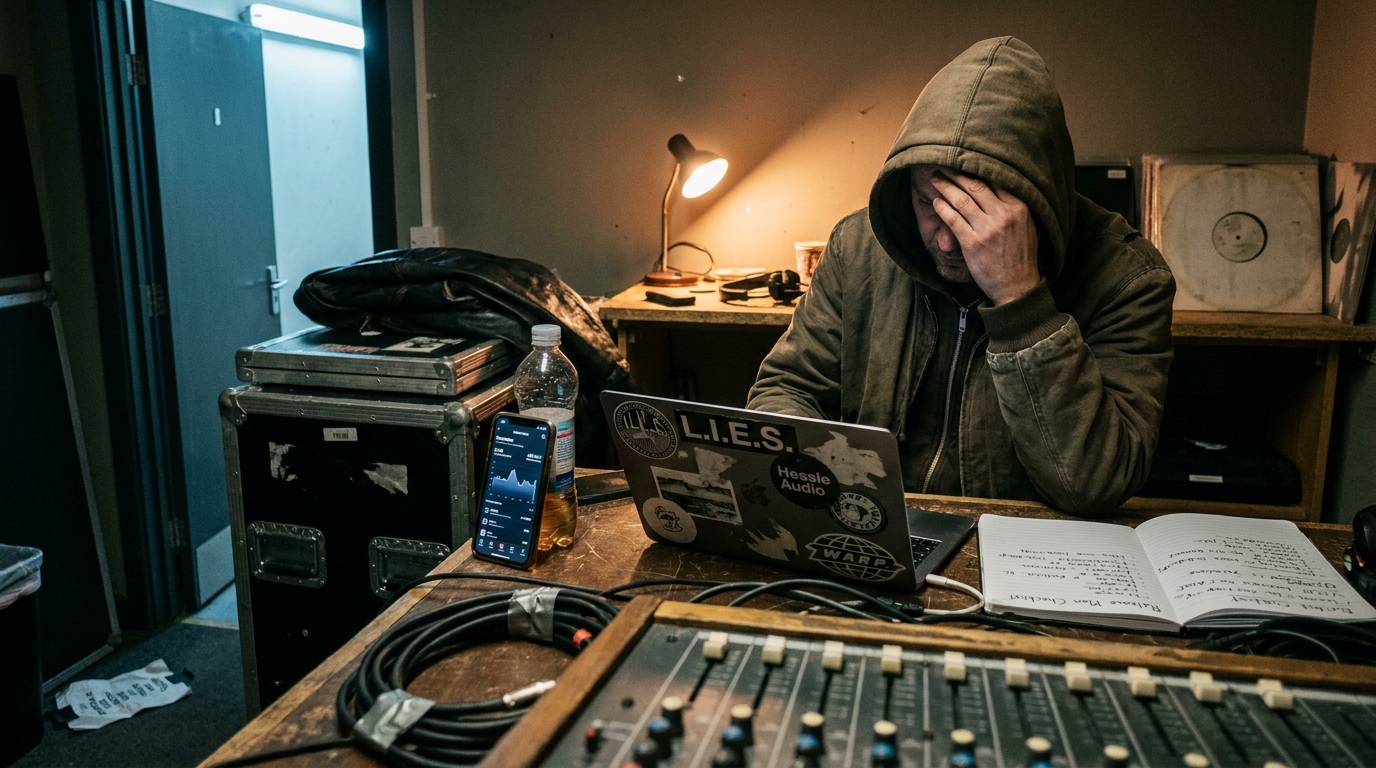
Here is every channel that moves electronic music right now, compared honestly. Costs are directional and assume an independent artist or small label doing focused work.
| Channel | Cost to start | Time to first results | Best for | Realistic ceiling |
|---|---|---|---|---|
| TikTok sound campaigns | 300 to 500 dollars | 1 to 3 weeks | Melodic, vocal, and high-energy tracks | Viral sound, millions of uses |
| Spotify algorithmic + playlists | Free to 500 dollars | 4 to 8 weeks | Consistent release schedules | Sustained discovery flywheel |
| Paid ads (Meta, TikTok, Google) | 300 dollars per month | 2 to 4 weeks | Building retargetable audiences | Scales with budget |
| DJ support and promo pools | Free to 150 dollars per release | 1 to 2 months | Club-oriented records | Peak-time festival support |
| Labels and demos | Free | 2 to 6 months | Credibility and infrastructure | Scene-defining releases |
| Festivals and live | Highly variable | 3 to 12 months | Converting fans to superfans | Career-level breakthroughs |
TikTok sound campaigns
TikTok is the highest-speed channel in electronic music right now, and the reason is structural: the sound is the ad. A Luminate study found 96 percent of analyzed artists showed a statistically significant link between TikTok views and streaming volume, with an average 11 percent stream increase within three days of a TikTok spike.
The working method is creator seeding: paying dozens of mid-size creators to use your sound in native content, so the algorithm learns which audiences react to it. Based on 2,400+ campaigns run by our founding team, sound-led creator content reliably outperforms artist-face content for electronic releases, often dramatically. Nobody needs to know what you look like for your drop to travel.
If you want the mechanics in full, read our complete guide to TikTok music promotion in 2026, see what realistic spend looks like in our breakdown of TikTok promotion costs, and learn how the audio object itself travels in our explainer on how TikTok sound promotion works. If you would rather have the seeding run for you, that is exactly what our TikTok sound campaigns do.
Spotify: algorithmic first, playlists second
Spotify's real prize is not any single playlist. It is the algorithmic layer — Release Radar, Discover Weekly, Radio, and autoplay — which responds to save rates, completion rates, and playlist adds from real listeners. Electronic music does disproportionately well here because listeners consume it in long mood-based sessions.
The practical order of operations: drive real, engaged listeners to the track from outside (TikTok, ads, your own channels), let strong engagement signals accumulate, and pitch every release through Spotify for Artists at least seven days before release day — the full release-day sequence is in our step-by-step guide to releasing a song on Spotify. Editorial is a lottery ticket; the algorithm is a system you can feed. Independent playlist curators are worth approaching only when their playlists have organic, verifiable engagement — more on the fake ones below.
Release cadence matters more on Spotify than anywhere else. The algorithm favors artists who give it fresh signals every six to ten weeks, and each release re-triggers Release Radar for your entire follower base. A single into an EP into a remix package beats one big drop followed by silence.
One more number to respect: since April 2024, Spotify pays no recording royalties on tracks with fewer than 1,000 streams in the trailing twelve months. Promotion is not optional anymore; it is the difference between a release that pays anything and one that pays literally nothing. Our Spotify campaigns are built around feeding the algorithmic layer with real listeners rather than chasing placements.
Paid ads
Meta and TikTok ads are the most controllable channel on this list. They will not make a bad track work, but they turn a reacting track into a compounding one: you retarget everyone who engaged, build lookalike audiences from your savers, and grow an owned audience you can hit on every future release.
Sensible starting spend is around 10 dollars per day, focused on one or two countries where your genre already has density. What each spend level actually buys is covered in our honest breakdown of what a music promotion budget gets you.
DJ support and promo pools
This is the most undervalued channel in electronic music because it does not show up on a dashboard. Build a promo list of 100 to 300 DJs who actually play your subgenre, send private links three to six weeks before release, and ask for one thing only: play it and tell me if it works.
Feedback from working DJs is also free A&R. When I send an Underkntrl promo out and twelve DJs independently tell me the break is too long, the break is too long. Track your supports, quote them in your label pitches, and thank every DJ personally — this scene runs on reciprocity.
Labels and demos
A good label buys you three things you cannot easily buy alone: an audience that trusts the imprint, distribution and playlist relationships, and scene credibility that converts into bookings. A bad label buys you nothing and locks your rights for years, so read every contract. To judge whether a label can actually promote you, look at how it operates — our music label marketing guide shows what a competent label's machinery looks like from the inside.
Demo strategy is simple but slow: target 10 to 20 labels that release music that genuinely sounds adjacent to yours, send finished tracks with a two-line email, and follow up once. If you are deciding between self-releasing and signing, our label services page explains how we work with imprints, and the same logic applies in reverse when you pitch one.
Festivals and live
Live is where electronic careers become durable, and the IMS Business Report confirms it is still where most of the industry's money sits. For promotion purposes, think of every show as content and data: capture video for weeks of posts, collect emails and follows on site — a download gate on your unreleased edits does this on autopilot between shows — and use hometown draw as your proof when pitching bigger promoters.
You do not start at festivals. You start at local nights, prove you can pull 50 people, then 150, and let promoters watch the numbers climb. My entire booking history at Temple of Sinners was built on watching which local artists actually moved tickets.
What EDM Promotion Costs: Budget Reality by Tier
Nobody publishes honest numbers, so here are mine. These tiers assume a single release cycle of roughly eight weeks.
| Tier | Budget per release | Where it goes | Realistic outcome |
|---|---|---|---|
| Zero budget | 0 dollars | DJ promos, demos, own content, Spotify pitching | Slow scene traction over 6 to 12 months |
| Starter | 150 to 500 dollars | Small TikTok seeding or focused ads | First real data, a few thousand engaged listens |
| Serious | 500 to 2,000 dollars | TikTok seeding plus ads plus content | Genuine shot at algorithmic pickup |
| Professional | 2,000 to 10,000 dollars | Multi-channel, multi-week coordinated push | Playlist traction, DJ support, label attention |
| Label-scale | 10,000 dollars and up | Everything above plus PR and radio | Chart positions, festival-tier visibility |
Three honest notes on this table. First, money multiplies quality; it never substitutes for it, and no tier saves a track that DJs will not play twice. Second, one release at 1,000 dollars beats five releases at 200 dollars, because concentrated signals are what trip algorithms and get screenshots worth sending to labels.
Third, spend on channels that leave assets behind. Ads that build a retargetable audience, creator videos that stay live, and DJ relationships all keep paying after the campaign ends. Rented spikes do not.
If you want a managed version of the serious and professional tiers, our campaign packages map almost exactly onto this table. If you would rather run it yourself with our tooling, the self-serve platform exists for exactly that.
Scams and Fake Promo: The Red Flag List
The EDM promotion market is full of services that exist to farm desperate artists. I have watched producers I respect lose entire release budgets to them, and in the worst cases lose their catalogs. Here is how to spot them.
| Red flag | What they promise | What actually happens |
|---|---|---|
| Guaranteed streams | "50,000 streams for 99 dollars" | Bots. Flagged, streams removed, release at risk |
| Playlist networks | "Placement on 40 playlists" | Botted playlists with zero real listeners |
| Guaranteed editorial | "We get you on Spotify editorial" | Impossible to guarantee; nobody can sell this |
| Fake DJ promo blasts | "Sent to 10,000 DJs" | Scraped email lists that mark you as spam |
| Pay-to-play blogs | "Guaranteed review coverage" | Sites no fan or gatekeeper actually reads |
| Follower packages | "Real Instagram growth" | Dead accounts that poison your ad targeting |
The platforms are no longer passive about this. Spotify removed more than 75 million spam tracks in the twelve months through September 2025, and since 2024 it has charged labels and distributors a per-track penalty when artificial streaming is detected. Distributors now terminate accounts over it, which means botted promo can cost you your entire catalog, not just one release.
The simple filter: real promotion buys exposure to real humans who can say no. Anyone guaranteeing a specific outcome — a stream count, a placement, a viral moment — is either lying or botting, because no honest operator controls those outcomes. It is exactly why our own campaigns are structured around measurable delivery against verifiable data rather than promised stream counts; promising the numbers themselves is the scam signature.
Playlist checks take two minutes: follower count versus actual plays on the tracks inside, whether followers grew in unnatural jumps, and whether the curator answers basic questions about their audience. A 60,000-follower playlist generating 30 streams a day is a cardboard prop.
The 90-Day EDM Promotion Plan
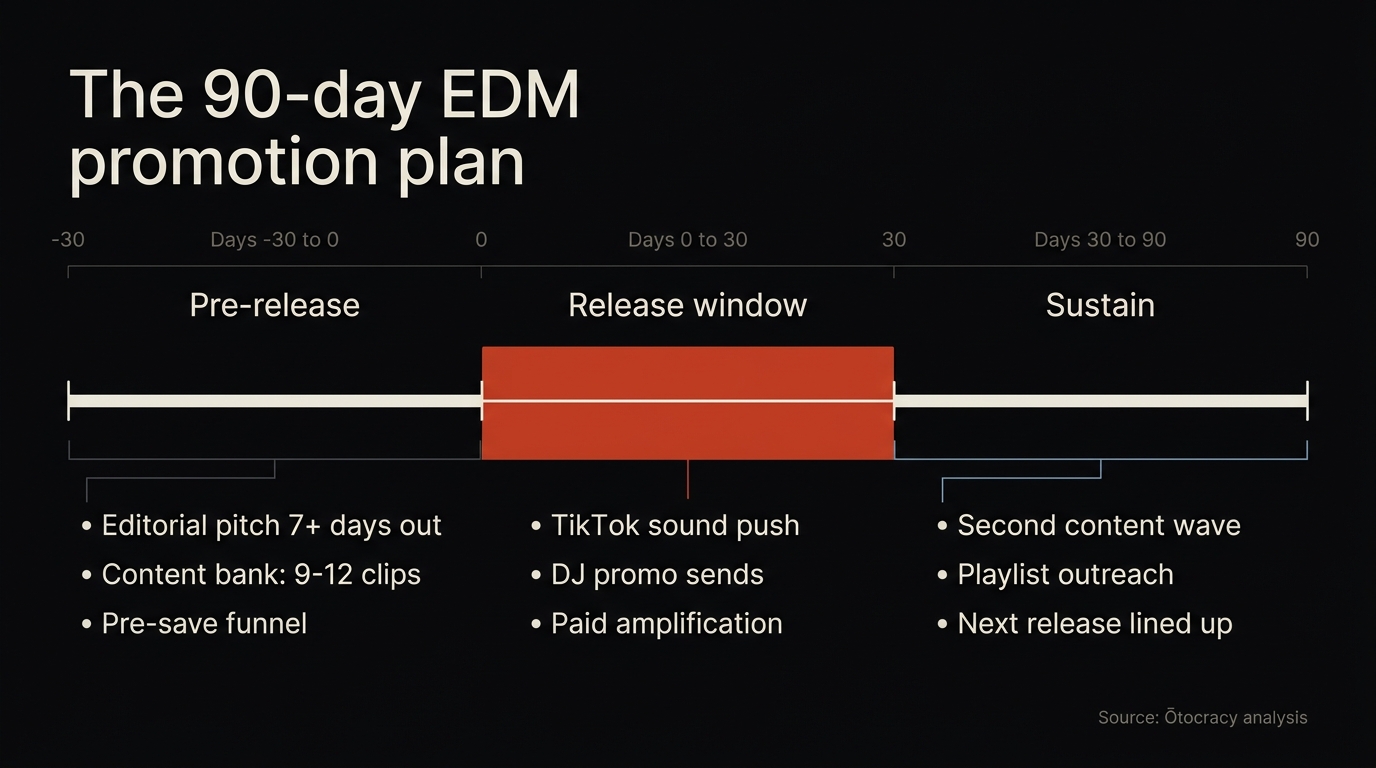
Here is the plan I would run today with one strong finished track and a starter-to-serious budget. It compresses everything above into three phases.
| Phase | Days | Focus | Success signal |
|---|---|---|---|
| Seed the scene | 1 to 30 | DJ promos, content bank, pre-save, Spotify pitch | 10 to 20 DJ support confirmations |
| Launch and push | 31 to 60 | Release, TikTok seeding, ads, curator outreach | Save rate above roughly 5 percent, algorithmic pickup |
| Convert momentum | 61 to 90 | Retargeting, label and booking outreach, next release prep | Label replies, booking inquiries, follower growth |
Days 1 to 30: seed before you spend
Finish the track properly, then build a promo list of at least 100 relevant DJs and send private links with a personal note. Film 20 to 30 short-form clips in one or two batch sessions so you never scramble for content mid-campaign. Set the release date at least four weeks out, pitch it in Spotify for Artists the moment distribution clears, and open a pre-save.
Days 31 to 60: launch loud, then feed what reacts
Release on a Friday, post daily on short-form, and start creator seeding within the first week so external traffic hits while the track is freshest in Release Radar. Run modest ad spend to your two strongest markets — for most European electronic artists the Netherlands is the market to start in — and watch saves and completion rate more than raw streams — those are the signals the algorithm actually reads. When a specific clip or sound variant outperforms, move budget onto it fast and starve everything else.
Days 61 to 90: convert numbers into scene position
Momentum is a currency you spend immediately or lose. Package your DJ supports, streaming growth, and best-performing content into a one-page pitch, then send it to labels, bookers, and bigger DJs while the graph still points up. Start the next release cycle before this one fully cools, because in electronic music catalogs break artists, not singles.
For a deeper tactical version of this playbook, including the free-channel grind in more detail, read our companion piece on how to promote EDM music.
Promotion Changes by Sub-Genre
The plan above is the general case. Sub-genres diverge far more than most artists expect. Hardstyle runs on the event calendar rather than on releases, drum and bass has a real media and radio layer that most genres lack, and techno diverges most of all — its records reach listeners through DJs rather than playlists, so the sequence inverts and the lead time roughly doubles. The techno promotion playbook covers that order, and afro house runs on its own clock again.
Frequently Asked Questions
How much does EDM promotion cost in 2026?
Meaningful promotion starts around 300 to 500 dollars per release for focused TikTok seeding or ads. A serious independent push runs 500 to 2,000 dollars, and professional multi-channel campaigns run 2,000 to 10,000 dollars. Below roughly 100 dollars, most paid options are either ineffective or outright scams, so use free scene channels instead.
What is the best promotion channel for EDM right now?
TikTok sound campaigns offer the fastest results for melodic and high-energy tracks, since 51 percent of 16 to 24 year olds discover music there according to MIDiA Research. But DJ support chains remain the highest-value channel for club-oriented records, because supports convert into labels, bookings, and festival slots that streams alone never deliver.
Are paid Spotify playlist placements safe?
Mostly no. Any playlist selling guaranteed placement is likely botted, and Spotify removed more than 75 million spam tracks in the year through September 2025 while penalizing artificial streams. Legitimate curator outreach — pitching real playlists with verifiable engagement and accepting rejection — is safe. Paying for guaranteed adds is the red flag itself.
Do I need a label to promote EDM music?
No, but a good one accelerates everything. Labels provide built-in audiences, distribution relationships, and scene credibility that converts into bookings. Self-releasing with a proper promotion budget is fully viable in 2026, and strong self-released numbers actually improve your label negotiating position later. Sign for reach and credibility, never out of desperation.
How long does EDM promotion take to work?
Expect first signals within two to four weeks on TikTok and ads, and four to eight weeks for Spotify's algorithmic layer to respond. Scene traction through DJ support and labels takes three to twelve months of consistent releasing. Careers compound across release cycles, which is why one 90-day campaign should always flow into the next.
Can I promote an EDM track with no budget?
Yes, slower. Send personal DJ promos, pitch every release through Spotify for Artists, post short-form content daily, and submit demos to genuinely adjacent labels. The support-chain channels are free by design; they cost consistency instead of cash. Zero-budget artists should expect six to twelve months of grinding before measurable scene traction appears.
Here is the uncomfortable truth I will leave you with: most EDM promotion fails before it starts, because nobody diagnosed what the release actually needed. Before you spend a euro, get a free promotion audit from Otocracy — Spotify, SoundCloud or YouTube — — we will look at your track, your numbers, and your position in the scene, then tell you exactly which channels deserve your budget and which would burn it. It costs nothing, it takes minutes, and it is the same first step we run on every campaign we take on.