Afro House Promotion: The Fastest-Rising Genre (2026)
Afro house promotion in 2026: the IMS demand data, why records break in rooms before platforms, the label map, and the release timeline the genre rewards.
Quick Answer
Afro house promotion runs on a different clock than the rest of dance music. The genre jumped from 23rd to 4th among the most-searched producer genres in a single year per the IMS Business Report 2025, and by 2025 it was the 7th most downloaded genre on Beatport and the 2nd most searched on Splice, up from 10th in 2023. That is demand climbing faster than the supply of competent promotion. The mechanic that breaks these records is not a playlist pitch — it is floor testing. Adam Port and Stryv's "Move" on Keinemusik went viral after being played at Keinemusik events, then hit number one in Belgium, Portugal and Switzerland and went Diamond in France. Based on 2,400+ campaigns run by our founding team, afro house rewards long lead times and DJ-first seeding, and punishes the release-day blitz that works for festival EDM.
I started playing afro house in sets about two years before it became the thing everyone claims to have always played. The records that worked did not arrive through a promo pool. They arrived from other DJs, usually as unreleased WAVs, usually months before anyone could buy them.
That is not nostalgia, it is the distribution mechanic. Afro house still breaks the way house music broke in the nineties — through rooms, through crates, through people who play to actual crowds — and then platforms catch up afterwards. Promotion that ignores this order tends to fail expensively.
This page covers what the demand data actually says, how records travel in this genre, where they get signed, and the release timeline that suits it. For the wider channel map that applies to every electronic subgenre, the complete EDM promotion guide is the hub; this is the genre-specific layer on top of it.
What the Afro House Numbers Actually Say
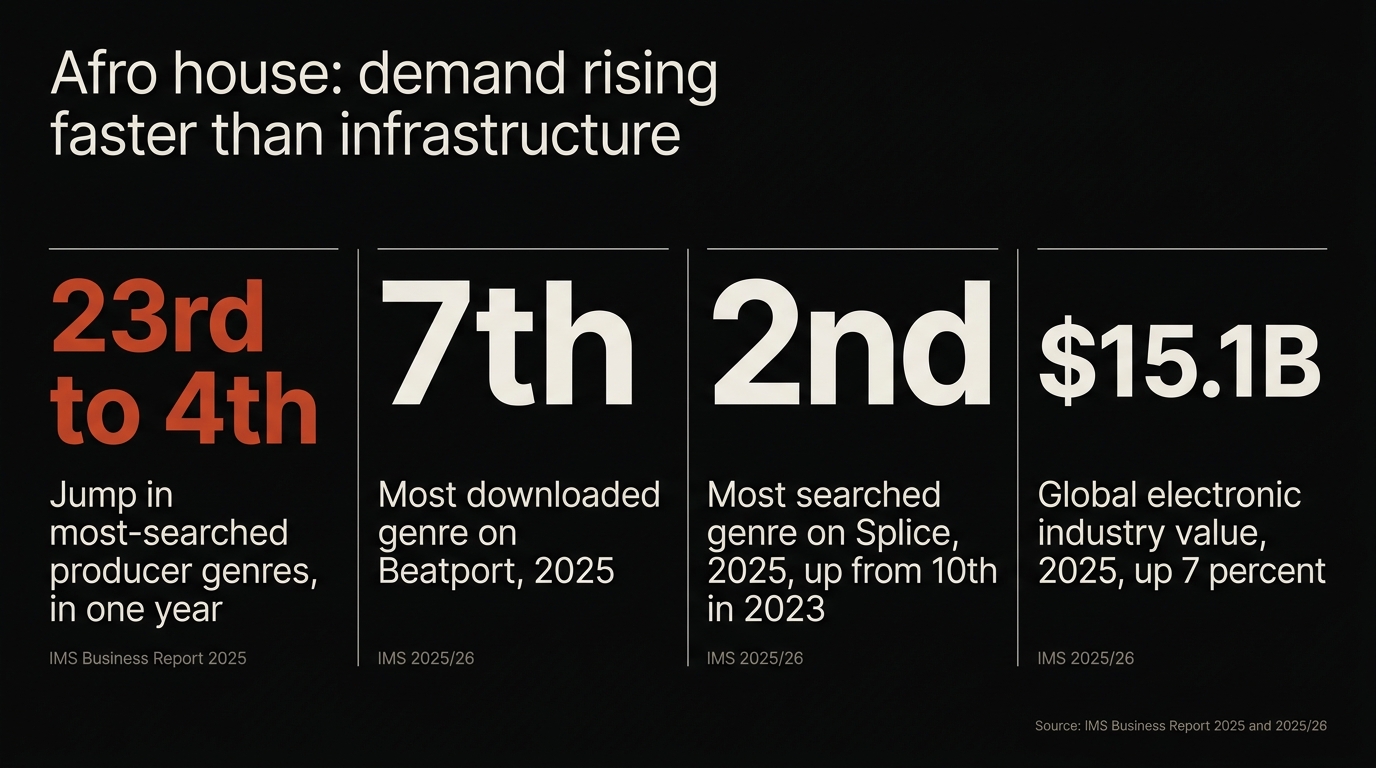
Two separate signals, one year apart, both pointing the same way.
The IMS Business Report 2025 tracked producer search behaviour and found afro house had climbed from 23rd to 4th among the most-searched genres in a single year. That measures what producers want to make.
The following report, IMS 2025/26, measured what people buy and use: afro house finished 2025 as the 7th most downloaded genre on Beatport and the 2nd most searched on Splice, up from 10th in 2023. It sits inside a global electronic industry that reached 15.1 billion dollars in 2025, up 7 percent.
| Signal | Position | Source |
|---|---|---|
| Producer genre searches, one-year jump | 23rd to 4th | IMS Business Report 2025 |
| Beatport most downloaded genres, 2025 | 7th | IMS 2025/26 |
| Splice most searched genres, 2025 | 2nd, up from 10th in 2023 | IMS 2025/26 |
| Global electronic industry value, 2025 | 15.1 billion dollars, up 7 percent | IMS 2025/26 |
Read those together and the strategic picture is specific. Producer interest is running ahead of the commercial infrastructure. There are more people making afro house than there are labels, curators and promoters who understand how to move it — which is the exact market condition where a well-executed release outperforms its budget.
It also means the window is narrowing. A genre that is 2nd on Splice is no longer a secret. Sample-pack demand is a leading indicator of saturation, because it tells you how many bedroom producers are about to arrive.
How Afro House Breaks: Rooms First, Platforms Second
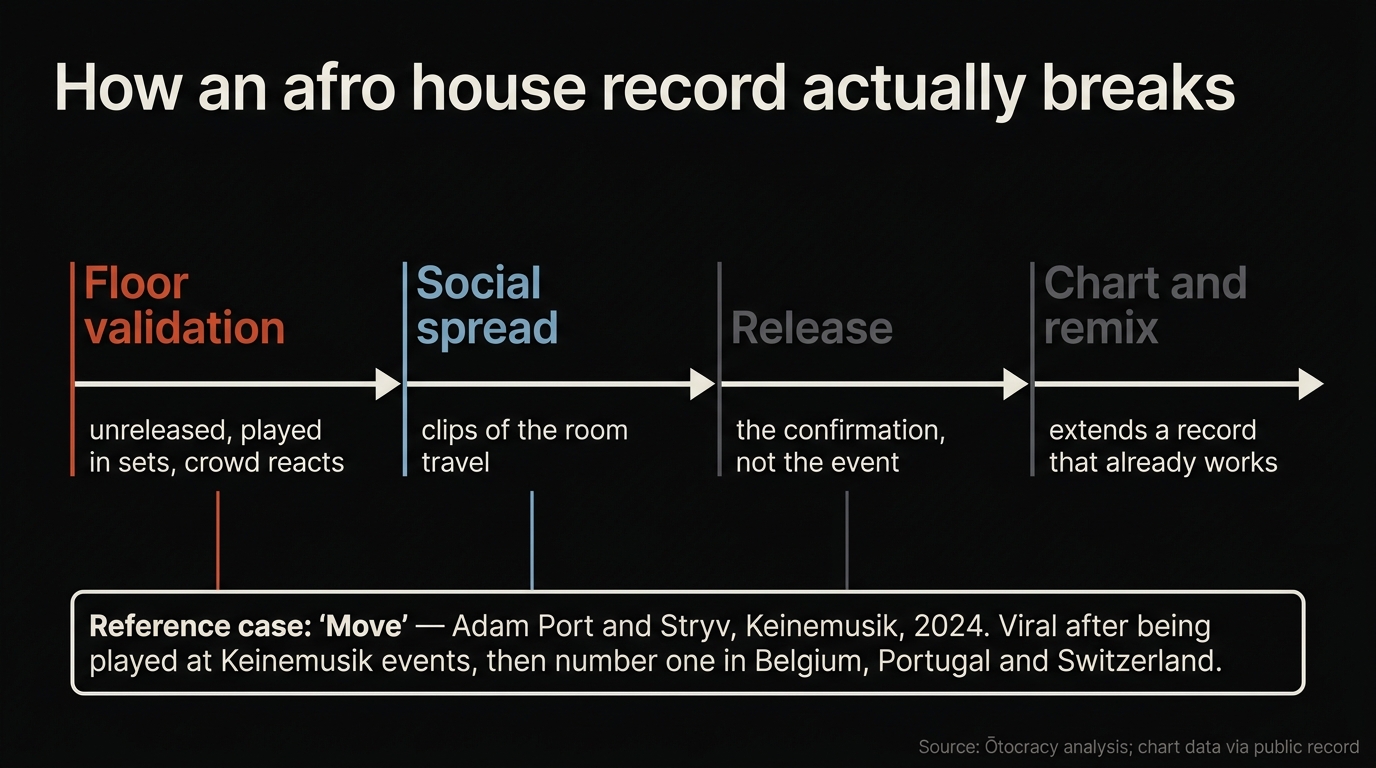
The reference case is worth studying properly.
"Move" by Adam Port and Stryv, featuring Malachiii, came out on Keinemusik on 7 June 2024. It went viral on social media after being played at Keinemusik events — the record was already moving crowds before it was purchasable. It then went to number one in Belgium, Portugal and Switzerland, top ten in Austria, Germany and the Netherlands, and Diamond in France, with a Camila Cabello remix in October taking it top ten in the UK.
The order matters more than the outcome. Floor validation came first. Social spread came second. Chart performance came third. The remix extended a record that had already proven itself rather than manufacturing one that had not.
Most artists invert this. They finish a track, set a release date six weeks out, and spend everything they have in the seven days around it. In afro house that timing is close to the worst possible use of a budget, because the genre's tastemakers — DJs — cannot help you on a record they first heard the day it dropped.
The practical version:
- Get the record into sets three to six months before release. Unreleased, watermarked if you are nervous, sent directly to DJs who actually play the genre.
- Watch for the second play. One DJ playing your track as a favour means nothing. A DJ playing it twice, unprompted, means it works on a floor.
- Collect the evidence. Clips of the record playing to a reacting crowd are the single most useful promotional asset this genre produces, and they cost nothing.
- Only then set a release date. With floor validation in hand, the label conversation and the playlist pitch both change character entirely.
Based on 2,400+ campaigns run by our founding team, the afro house records that converted best came into their release week with existing DJ support, and the ones that struggled were technically excellent tracks nobody had heard in a room.
The Label Map: Where Afro House Records Get Signed
The genre's labels split into recognisable tiers, and pitching the wrong tier is the most common wasted effort I see.
| Label | Base | Character |
|---|---|---|
| Soulistic Music | South Africa | Black Coffee's imprint; the genre's spiritual home |
| Keinemusik | Berlin | Collective and party series; brought afro house to European main stages |
| MoBlack Records | Global | Championing African electronic music since 2011; the volume leader for afro-powered house |
| Get Physical Music | Berlin | Long-running house institution, consistently among afro house's top sellers |
| Yoruba Records | US | Pioneering spiritual and deep house lineage |
Two things about pitching these. First, study the catalogue before you send anything — every one of these labels has a distinct tolerance for how much percussion, how much vocal, and how much pop structure a record can carry. Second, a demo with documented DJ support is a fundamentally different submission to a demo without it, and it is the difference that gets replies.
If you run a label yourself and the roster problem is scale rather than signings, that is a different conversation — we handle multi-release campaigns for labels as one pipeline rather than one release at a time.
Afro House Promotion on Spotify: Playlists and Algorithm Behaviour
Afro house has an unusual streaming profile, and it works in your favour if you plan for it.
The records are long. Seven-minute arrangements with slow builds are normal in this genre, and that changes the metrics that matter. Completion rate on a seven-minute record will always look worse than on a three-minute pop edit, so the signal to watch is save rate and repeat listens rather than completion.
The listening context is also different. A meaningful share of afro house streaming happens in long-session contexts — sets, background listening, sustained play — which is exactly the behaviour Spotify's systems read as genuine engagement. A track that holds a listener for four minutes of a seven-minute record is doing better than the raw percentage suggests.
Two practical consequences. Release a shorter radio edit alongside the extended mix if the track has any crossover potential, because they serve different systems. And pitch the extended version to DJ-facing stores and the edit to editorial, rather than sending one file everywhere.
The general mechanics of pitching, cadence and curator vetting are covered in Spotify promotion for EDM artists — the genre-specific adjustment is simply to stop reading completion rate as your primary health metric.
Afro House is also one of the 15 genres eligible for Beatport's Hype programme, which puts small labels into a chart field of comparable labels rather than against majors — the eligibility rules and the traps are worth reading before subscribing.
One store-level note that people outside the genre miss: Traxsource matters here in a way it does not for most electronic subgenres. Afro house and soulful house buyers use it heavily, and a Traxsource chart position carries real weight with the DJs you are trying to reach, independent of anything Beatport says.
Short-Form Strategy for a Genre Built on Long Blends
There is an obvious tension between seven-minute records and fifteen-second video, and most afro house artists resolve it badly by cutting to the loudest moment.
The moment that travels in this genre is rarely the drop. It is usually the percussion break, the vocal entry, or the point where the groove shifts — the passage a crowd physically responds to. If you have floor footage, you already know which second that is, because you can see it happen.
That is the practical advantage of doing the room work first. Artists in other genres have to guess which eight seconds carry a record. In afro house you can watch a crowd tell you, then cut exactly that.
The sound-page mechanics of turning that clip into something creators reuse are covered in how TikTok sound promotion works. The genre-specific part is only the selection: pick the transition, not the peak.
Timing: Why Afro House Promotion Rewards Patience
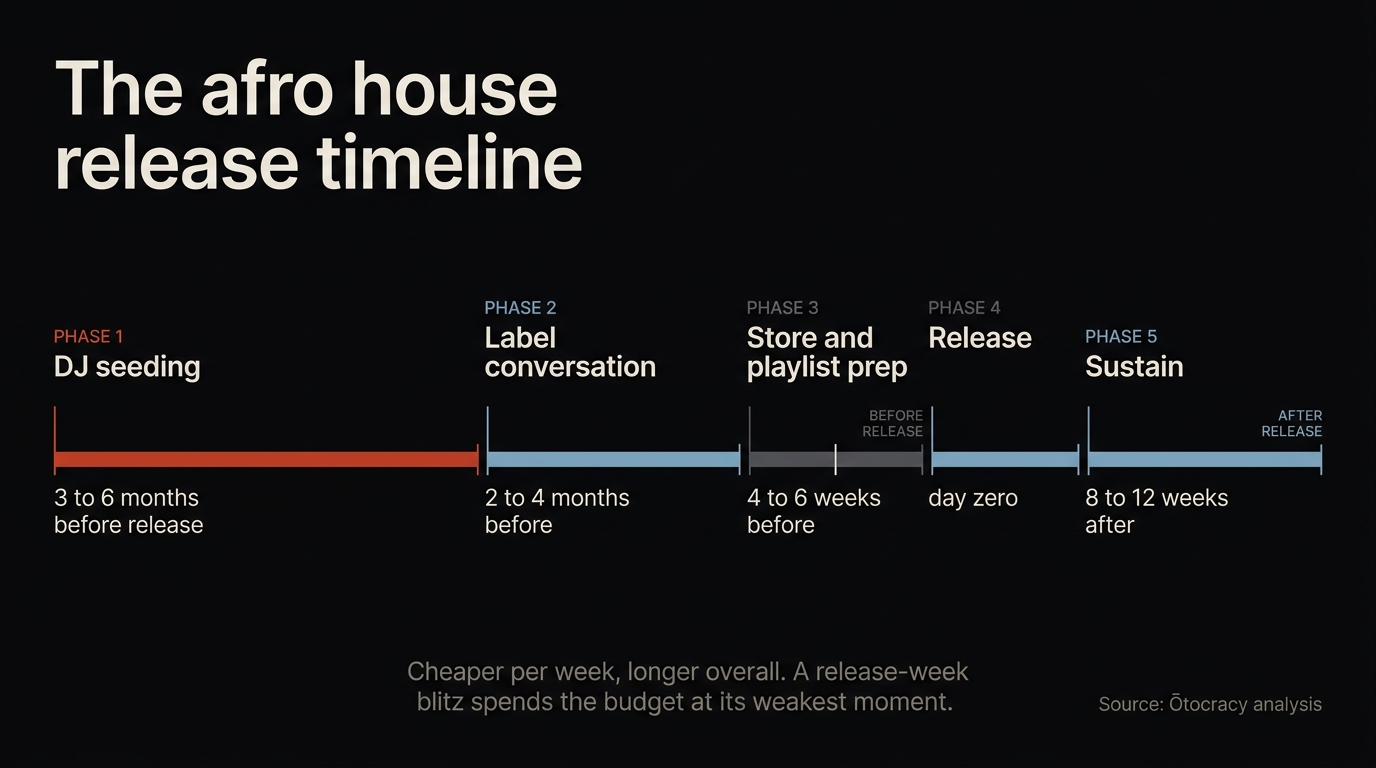
Every genre has a natural campaign length, and afro house has one of the longest in electronic music.
| Phase | Timing | What happens |
|---|---|---|
| DJ seeding | 3 to 6 months before release | Unreleased sends, floor testing, collecting reactions |
| Label conversation | 2 to 4 months before | Pitch with documented support |
| Store and playlist prep | 4 to 6 weeks before | Metadata, edit versions, pitch submission |
| Release | Day zero | The confirmation, not the event |
| Sustain | 8 to 12 weeks after | Continued DJ play, clips, remix conversations |
Compare that to a festival-EDM single, where most of the value is compressed into release week, and the resource implication is obvious. Afro house promotion is cheaper per week and longer overall. Budget accordingly: a release-week blitz in this genre spends the money at precisely the moment when it can do the least work.
If you are unsure whether your current streams are coming from real listening or from playlist padding, the free audit breaks the sources down before you commit a budget to the next release.
Honest Limits of Riding a Genre Wave
A rising genre lifts records that are already good. It does not fix records that are not.
The uncomfortable part of the data above is that producer interest rose faster than anything else. Afro house being 2nd on Splice means the market is filling with technically competent tracks built from the same sample packs, and sounding like the genre is now the baseline rather than an advantage.
The records that broke did not break because they were afro house. "Move" worked because it was a genuinely strong song that happened to arrive in a rising genre with a collective behind it that could put it in front of crowds. The genre was the tailwind, not the engine.
There is also a question worth asking directly, given where this music comes from. If you are making afro house from outside the scenes that built it, collaboration and credit are not decoration — the artists and labels doing this properly are visibly connected to the communities the sound came from, and the ones treating it as a trend to arbitrage tend to get read that way.
If the record is right and you want the campaign run properly rather than improvised around a release date, that is what Otocracy's campaign packages are built for.
Frequently Asked Questions
Is afro house still growing in 2026?
The demand signals remain strong: 7th most downloaded genre on Beatport and 2nd most searched on Splice in 2025, up from 10th in 2023 per IMS. Producer interest is rising faster than commercial infrastructure, which means opportunity now and saturation later.
How do I get afro house DJs to play my track?
Send unreleased, send directly, and send early — three to six months before release. Target DJs who actually play the genre rather than large accounts, and treat a second unprompted play as your real signal that the record works on a floor.
Which labels should I pitch afro house to?
Soulistic Music, Keinemusik, MoBlack Records, Get Physical and Yoruba Records anchor the genre at different points, from South African roots to Berlin main stages. Study each catalogue first — they differ sharply on percussion, vocals and pop structure — and always pitch with documented DJ support attached.
Why is my afro house track's completion rate low on Spotify?
Because the records are long. A seven-minute arrangement will always show worse completion than a three-minute edit, and that is a format artefact rather than a quality signal. Watch save rate and repeat listens instead, and consider releasing a shorter edit alongside the extended mix for editorial contexts.
Does Traxsource still matter for afro house?
More than for most electronic subgenres. Afro house and soulful house buyers use the store heavily, and a Traxsource chart position carries genuine weight with exactly the DJ audience you are trying to reach — independent of anything your Beatport performance happens to say.
How long should an afro house campaign run?
Considerably longer than a festival-EDM single — roughly three to six months of DJ seeding before release, then eight to twelve weeks of sustain afterwards. The genre spends less per week across more weeks, because its tastemakers need real lead time to adopt a record.