Techno Promotion in 2026: A Scene-First Playbook
How techno records break in 2026: the Beatport genre split that decides your chart, DJ-first seeding, the label route, and why playlists come last.
Quick Answer
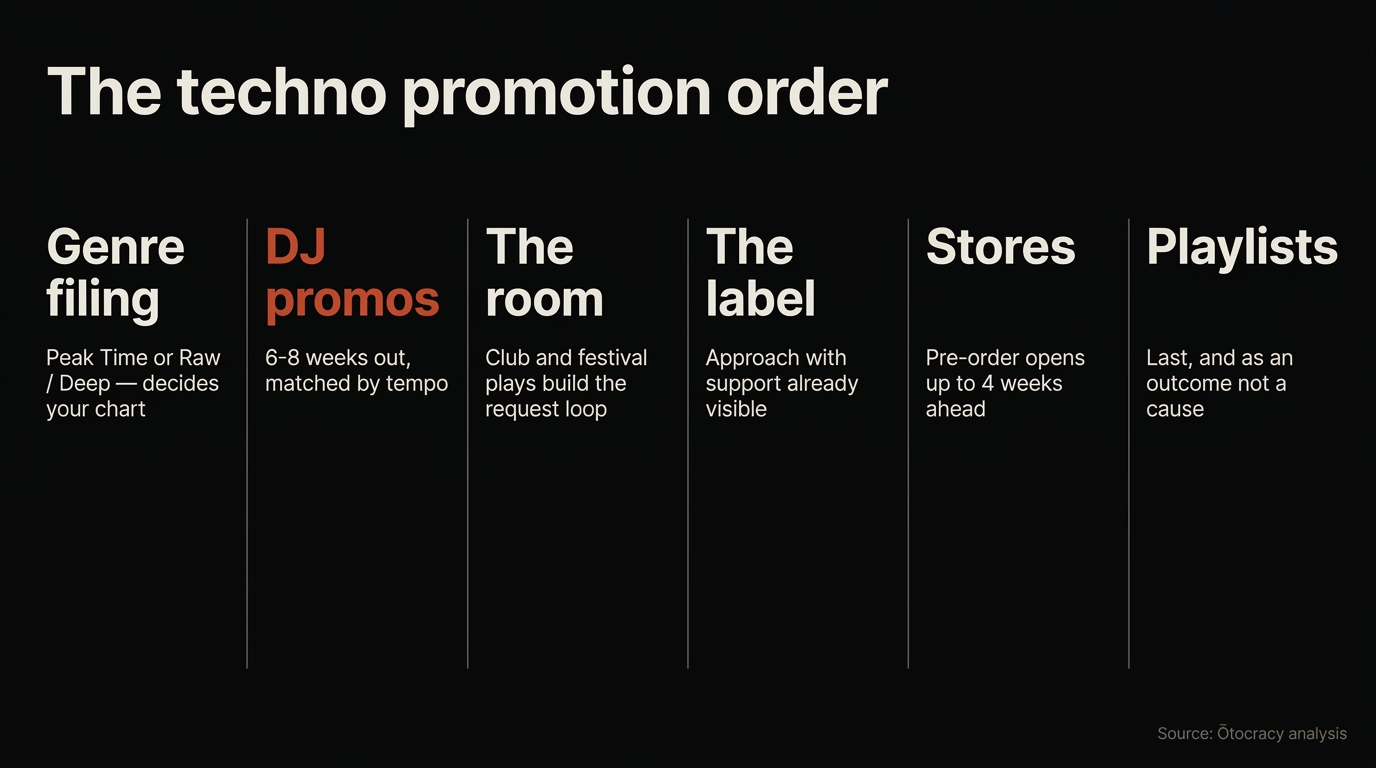
Techno records break through DJs, not through playlists, and the sequence that works runs in the opposite order to how most artists run it. Before anything else, one metadata decision sets the ceiling: Beatport files techno as two separate genres — Techno (Peak Time / Driving) and Techno (Raw / Deep / Hypnotic) — so your filing decides which chart you compete in and, for labels, whether Beatport's Hype programme is even available, since only the Peak Time / Driving side appears on its eligible-genre list. After that the order is promos to DJs who actually play your tempo, then the club and festival circuit, then the label, then stores, and only then streaming playlists. Techno rewards long lead times and punishes the release-day blitz that works for festival EDM. Plan six to eight weeks, not one.
Most techno gets promoted like it is house with a faster kick. It is not, and the promotion sequence that works reflects a different economy.
House and mainstage records can be pushed to an audience directly. Techno reaches its audience through a filter of DJs, and those DJs are making decisions weeks before anyone hears the record in a room. Get the order wrong and you spend a budget on people who were never going to be the mechanism.
I run Temple of Sinners and Underkntrl and play the circuit, so this is the order I actually use.
Techno Is Two Genres, and the Filing Decides Your Ceiling
Start here, because it is a one-time decision made in a hurry that constrains everything downstream.
Beatport does not have a genre called "techno". It has Techno (Peak Time / Driving) and Techno (Raw / Deep / Hypnotic), and they are separate charts with separate audiences and different competition.
| Peak Time / Driving | Raw / Deep / Hypnotic | |
|---|---|---|
| The sound | Main room, festival-scaled, high energy | Stripped, dubby, loopy, darker |
| Who buys it | Festival and big-room DJs | Club and underground DJs |
| Competition | Heaviest on the platform | Thinner, easier to place |
| Beatport Hype eligible | Yes, it is on the list | No, it is not |
That last row surprises people. Beatport's Hype programme — the subscription that lets small labels chart against other small labels — lists Peak Time / Driving among its eligible genres and does not list Raw / Deep / Hypnotic. If you run a hypnotic techno label, the accelerator most commonly recommended to small labels is simply not available to you. The full eligibility breakdown has the rest of the list.
Two practical rules. File the record where it actually sits, not where you wish it sat — a stripped hypnotic cut filed as Peak Time competes with Drumcode releases and loses. And confirm what your distributor actually submitted, because the filing you requested and the filing that landed are not always the same thing.
Where the Scene Actually Lives
Techno's centre of gravity is European and it is physical. That shapes where promotion has to happen.
The label map is unusually legible. Adam Beyer's Drumcode, founded in Stockholm in 1996, defines the main-stage end. Soma Records in Glasgow has been putting out functional, raw techno since the early nineties and is home to Slam. Second State, Pan-Pot's label, sits between peak-time and deeper, more atmospheric work. Klockworks anchors the Berlin axis. Knowing which of those poles your record sits nearest is most of your targeting problem solved.
Germany is the largest market and Berlin is the reference point, but the circuit is wider than that — the Netherlands, Belgium, Spain, Italy and the UK all carry real club economies for this music.
The consequence for promotion: your record needs to reach DJs playing rooms in those markets, and almost none of that happens on Instagram.
The DJ-First Sequence
This is the part that is genuinely different from every other electronic genre, and it is why lead time matters so much.
Six to eight weeks out: promos. Private links to DJs who play your specific tempo and register. Not the biggest names in techno — the working DJs whose sets your record fits. A 130 BPM hypnotic cut sent to a 145 BPM hard techno DJ is not a near miss, it is noise.
Build the list from evidence, not aspiration. Look at what DJs have actually played recently in tracklisting archives, find the ones supporting records adjacent to yours, and start there. Ten DJs who play your register beat two hundred who do not.
Four to six weeks out: the room. A record that gets played is a record that gets requested. Techno's feedback loop still runs through people hearing something loud and asking what it was. If you play yourself, that starts with you.
Then the label. Support from real DJs is the single most persuasive thing in a demo email, and it is why the promo round comes first. The pre-pitch sequence covers the mechanics; the short version is that a label wants to see a record already moving.
Across the 2,400+ campaigns run by our founding team, this ordering is the reliable difference in techno specifically. Records pushed to consumers first and DJs second underperform records that ran the other way round, and the gap is not small.
Stores Before Streaming
Techno buyers still buy. That makes Beatport a live commercial channel rather than a vanity chart, and it wants a calendar rather than a budget.
Set the release as a pre-order as early as your distributor allows — Beatport spreads sales from the four weeks before release across the first charting week, which turns accumulated promo demand into a sustained position instead of a release-day spike. The chart mechanics go through this properly, including the delivery cutoff that decides whether your record is even eligible for a store feature.
Free downloads still function here in a way they do not in most genres. Edits, dubs and unreleased tools circulate constantly, and a download gate converts that circulation into email addresses you keep. Techno DJs are one of the few audiences that will genuinely give you an address for a file.
Tempo Is a Targeting Decision
Worth saying plainly because it decides who your promo list should contain.
Techno has stratified by tempo more sharply in the last few years than in the decade before it. The hard and fast end has pulled well clear of the 128-132 range that defined club techno for years, and the hypnotic end has largely stayed put. Those are different rooms, different promoters and largely different DJs.
The practical consequence is that BPM is a filter, not a detail. A promo list built by genre alone sends a 130 hypnotic record to DJs playing 150, and the response rate reflects it. Sort by tempo before you sort by name.
Across the 2,400+ campaigns run by our founding team, tempo mismatch is the most common reason a promo round with a good record produces nothing — the list was built from who the artist admired rather than from who plays their register.
Playlists Come Last
Not never. Last.
Editorial and algorithmic playlists reach listeners, and listeners are the end of the techno funnel rather than the start. A record with DJ support and club plays walks into playlist consideration with a story. A record with nothing but a pitch does not.
The practical read: pitch playlists, but do not build a plan around them, and do not spend money on playlist placement before the DJ round has happened. Money spent there first buys you streams from people who will not follow you into a room.
What Does Not Work
Five things I watch people spend money on every year.
Buying followers or streams. Techno's gatekeepers read ratios, and the discrepancy is obvious to anyone who looks. It also does nothing for the DJ layer, which is the layer that matters.
Mass promo blasts. Sending to four hundred DJs with a generic message gets you filtered. Techno promo lists are small and relationships are long.
Paying for playlist placement on an unreleased track with no support behind it.
Genre-hedging the filing to reach a bigger chart. You do not reach a bigger chart, you lose a smaller one you could have won.
Promoting a record before the master is finished. In a genre where the same DJs see everything, one weak promo costs you the next three.
If you are unsure whether your profile reads as a coherent project before you send promos, our SoundCloud profile audit walks the check an A&R does in fifteen seconds, and the free audit breaks down where your existing listeners actually come from.
The Other Harder Styles
Techno's sequence is not universal even among adjacent genres, and it is worth knowing where it stops applying.
Hardstyle shares the DJ-first logic but is far more event-driven: the festival calendar, not the release date, anchors the plan, and the label ecosystem is concentrated in the Netherlands and Belgium.
Drum and bass has something techno does not — a working media layer, with specialist radio and platforms that break records without an algorithm involved.
Frequently Asked Questions
How do you promote techno music in 2026?
DJ-first. Send private promos six to eight weeks ahead to DJs who play your specific tempo and register, get the record into rooms, then approach labels with that support as evidence, then set up stores with a pre-order, and pitch streaming playlists last. Reversing that order is the most common and most expensive mistake.
Which Beatport genre should a techno record use?
Whichever one it actually sits in. Beatport splits techno into Peak Time / Driving and Raw / Deep / Hypnotic, with separate charts and very different competition. Filing a stripped record as Peak Time to reach a bigger chart means competing against the largest techno labels and placing nowhere.
Can a hypnotic techno label join Beatport Hype?
Not based on Beatport's published eligible-genre list, which includes Techno (Peak Time / Driving) but not Techno (Raw / Deep / Hypnotic). Labels in the raw and hypnotic space should confirm current eligibility with Beatport directly before subscribing.
How long before release should techno promotion start?
Six to eight weeks. Promos go out first, club plays follow, and the store pre-order window opens up to four weeks ahead. A one-week release blitz works for some festival-facing EDM and does not work here.
Do playlists matter for techno?
Less than for most electronic genres, and later in the sequence. Playlists reach listeners, but techno's discovery mechanism is DJs playing records in rooms. Pitch playlists, but treat them as an outcome of momentum rather than a way to create it.
How do I find the right DJs to send promos to?
Work from evidence. Check recent tracklists for records adjacent to yours in tempo and register, and build a list of the working DJs who actually played them. Ten well-matched DJs are worth more than two hundred names scraped from a follower list.
Should techno artists release on their own label or sign to one?
Both work, and the deciding factor is distribution of attention rather than ownership. A self-released record with real DJ support outperforms a signed record with none. Sign when the label brings an audience and a promo list you cannot reach yourself; self-release when it would only bring a logo.
How much does techno promotion cost?
Far less than most genres if the sequence is right, because the expensive part — reaching listeners through paid media — comes last and is optional. The promo round costs time rather than money. Budget matters at the store and streaming stage, once DJ support already exists.
The Bottom Line
Techno rewards patience and punishes shortcuts more than any other electronic genre, because the people who decide whether a record travels are a small, well-connected group who see everything.
Get the genre filing right, run the promo round properly, and let the label and store conversations follow the support rather than precede it. That sequence takes six to eight weeks and costs very little.
Techno also has the most conversational audience on SoundCloud — it is commented on more than tech house or hard dance at almost every account size, which we measured across 11,525 artists in SoundCloud benchmarks by genre.
The wider genre picture is in the complete EDM promotion guide, and if you want the release executed rather than explained, our campaign packages cover the paid layer once the DJ layer is doing its job.