How to Pitch a Label Before ADE 2026: The 6-Week Plan
A&Rs do not sign from conversations at ADE, they sign from records they already heard. The six-week pitch calendar that makes the meeting a follow-up.
Quick Answer
Labels at Amsterdam Dance Event do not sign records from conversations held during the week. They sign records they already heard, and the meeting confirms a decision that was mostly made beforehand. That makes the six weeks before ADE the part that matters: get the finished track in front of a shortlist of A&Rs in late September, so the October conversation is a follow-up rather than an introduction. ADE 2026 runs 21-25 October, which leaves roughly seven weeks from early September. The sequence that works is a short list of genuinely matched labels, one private link each, a three-sentence email, and a follow-up timed to the week before the event when calendars are being filled. Pitching cold during ADE week itself is the most common approach and the least effective, because everyone you are trying to reach is already booked.
Every year I watch artists arrive in Amsterdam with a USB stick and a plan to hand it to someone.
I have been on both sides of that. Running Temple of Sinners and Underkntrl, and playing the week myself, the pattern has never changed: the records that get signed around ADE were sent weeks earlier. The meeting is where somebody confirms a decision they had mostly already made.
So this is not a guide to working the week. That is a separate problem with its own answer. This is what you do in the seven weeks before it, so that the week is worth having.
Why the Pitch Happens Before the Week
Three reasons, and none of them are about how good your record is.
Nobody listens properly during ADE. An A&R at ADE is running back-to-back meetings across a conference with over 11,000 professionals in town. They are not opening a link on their phone between sessions and forming a considered opinion about your mixdown.
Calendars close early. Meetings get booked two to three weeks out, and the good ones earlier. By the time you are standing in a lobby in October, the person you wanted has a full week.
An introduction is not a pitch. If the first time somebody hears your name is in a five-minute conversation, you have spent that meeting explaining who you are. If they have already heard the track, you spend it talking about the release.
The goal of the pre-ADE pitch is not a signing. It is to make your name a thing they recognise before the week starts.
The Six-Week Calendar
Counting back from 21 October 2026. If you are reading this in early September, you are at the top of it.
| When | What | Why then |
|---|---|---|
| Weeks 7-6 out | Finish the record. Master it. Stop revising | Nothing below works on an unfinished track |
| Week 5 | Build the shortlist — 10-15 labels, genuinely matched | Research takes longer than people budget |
| Week 4 | Send the first wave. One link each, personalised | Late September, before the ADE rush |
| Week 3 | Second wave to the non-responders. Once | The inbox has moved on; one nudge is fair |
| Week 2 | Request meetings with anyone who replied | Calendars are filling but not yet full |
| Week 1 | Confirm, plan the week, prepare what you will play | Logistics, not outreach |
| ADE week | Show up, follow through, do not pitch cold | The work is already done |
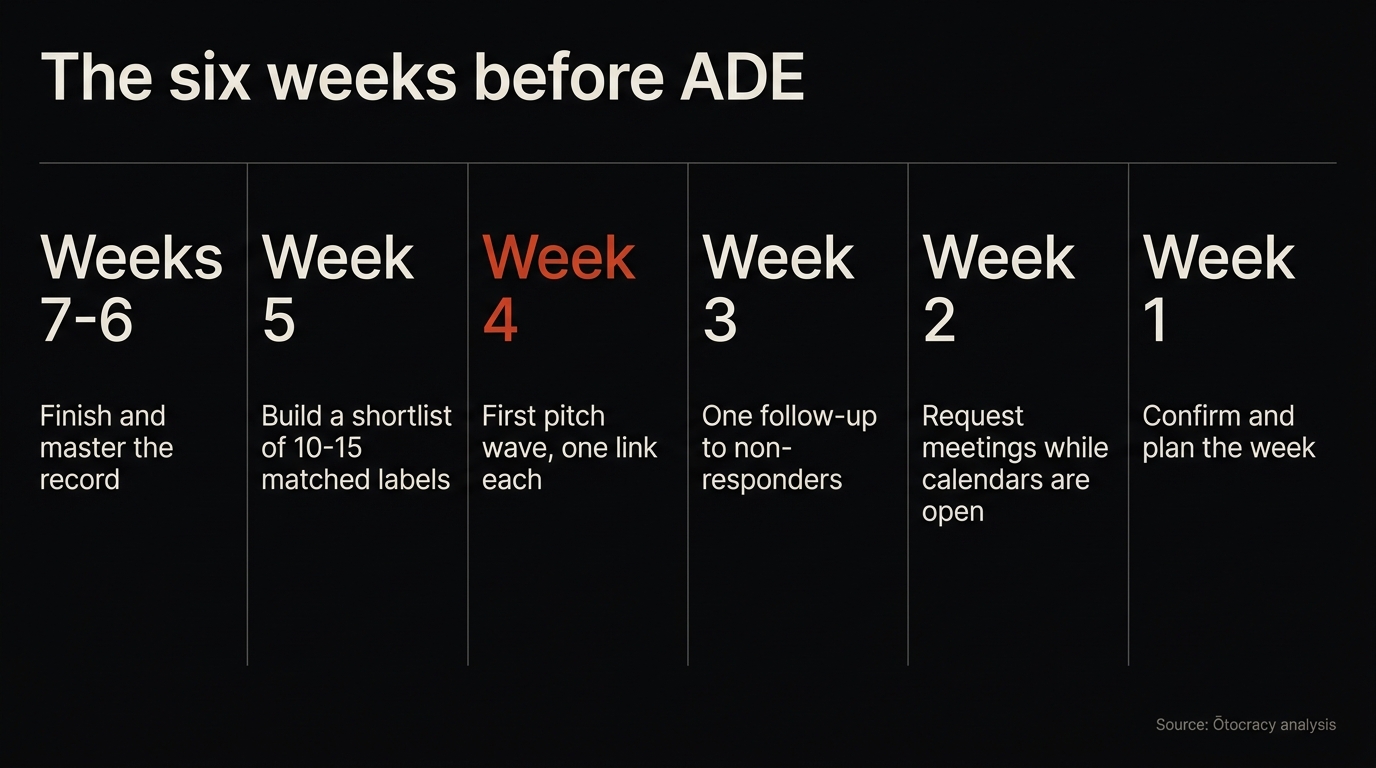
The single most common failure is compressing this into the final week. The second most common is starting it with a track that is not finished.
Building a Shortlist That Is Not a Spray
Ten well-chosen labels beat a hundred. This is the part that takes real hours and the part everybody skips.
A label belongs on your list only if you can answer three questions about it. What did they release in the last six months? Which of their releases sounds like it lives in the same room as your track? Who actually does their A&R, by name?
If you cannot answer all three, you are not pitching a label — you are emailing a logo. Across the 2,400+ campaigns run by our founding team, the pitches that convert are the ones where the artist could explain, unprompted, why that specific label and not the one beside it.
Two practical filters. Check what a label has put out recently rather than what it is famous for, because rosters drift. And check whether they are actually at ADE, because a label that is not in Amsterdam does not belong in an ADE-timed pitch at all.
The ADE Pro database is the obvious tool if you hold a pass — it is searchable year-round and it tells you who is attending. The guide to the access tiers covers what that gets you.
What Goes in the Email
Three sentences. I mean that literally.
One: who you are and one credible thing about you. Two: what the track is and why it fits them, referencing a specific recent release of theirs. Three: the link and what you are asking for.
That is the whole message. What follows is what to leave out, which matters more.
- No attachments. A private streaming link, always. Nobody downloads a WAV from a stranger.
- No press kit. A twelve-page PDF is a way of saying you do not know which fact matters.
- No "downloaded for" lists. Everyone in dance music knows a download is not a play.
- No release plan you have not started. They will ask, and the answer will be visible.
- No follow-up-to-the-follow-up. Two messages total. A third makes you a problem to be managed.
Keep the subject line factual. The genre, the artist name, and the word demo does more than anything clever.
What They Actually Do With the Link
The honest version, because it changes what you send.
They open it on the way to something else. They give it somewhere between twenty and ninety seconds. If it survives that, they open your profile in another tab and look at whether you exist as a project — recent uploads, whether it looks like one artist or a folder, whether the last three releases have any coherence.
That second step is why a good track from a messy profile stalls. Before you send anything, spend twenty minutes reading your own page the way they will: our SoundCloud profile audit walks the exact sequence, and the part that matters here is Step 5, which is the fifteen-second look an A&R gives your page before opening a track.
If they like it, the reply is short and non-committal. That is normal and it is not a rejection. It is an opening.
Is the Record Actually Ready
The uncomfortable question, and the one that decides everything above.
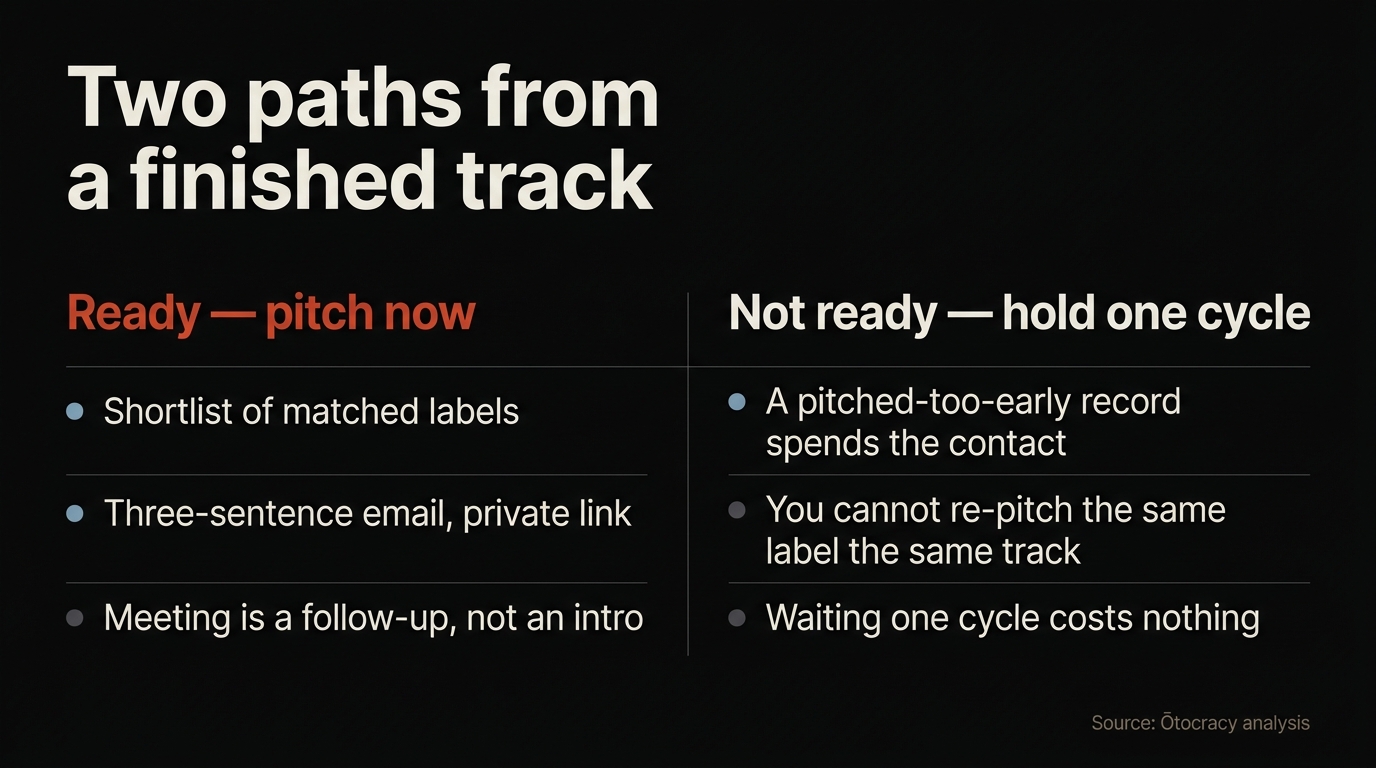
A pitch sent for an unfinished track burns the contact permanently. You do not get to re-pitch the same label the same record three months later when it is better — you have spent that name.
So the honest sequence is: finish, then check, then pitch. If you are not certain, our demo readiness check is a free second opinion before you spend a contact, and the A&R submission route is open year-round if you would rather have it read properly than fire it into an inbox in October.
Waiting one cycle costs you nothing. A pitched-too-early record costs you the label.
Timing the Send Inside the Week
One detail that costs nothing and changes reply rates: send on a Tuesday or Wednesday morning, European time, and never on a Friday.
A&R inboxes fill on Friday with promos for the following week's releases, and anything landing then is competing with the whole industry's weekly send. Monday is triage. Tuesday and Wednesday are when people actually listen to things.
Across the 2,400+ campaigns run by our founding team, send timing is one of the few free variables in outreach — it costs nothing to move an email by two days, and almost nobody bothers. The same logic applies to the follow-up: a week later, same part of the week, not a random Sunday night.
Converting a Reply Into a Meeting
Someone answered. Now the ADE part starts, and it is much simpler than the pitch.
Ask for twenty minutes, name two or three windows during the week, and say where you can be. Do not ask them to find time — give them time to accept. Daytime, near the conference, is the answer that gets taken.
If they cannot meet, ask whether anyone from their team is around. This works far more often than it should, and a junior A&R with time is worth more than a head of A&R with none.
And if the answer is no, keep it warm. The record you send in March lands with someone who has heard of you.
Five Ways This Goes Wrong
- Pitching during ADE week. Everyone is booked and nobody is listening properly.
- The mass BCC. Visible instantly, and it tells a label they were not chosen.
- Pitching an unfinished track because the deadline felt like a reason.
- No follow-up at all. One nudge is expected; silence after the first email reads as indifference.
- Treating the meeting as the goal. The meeting is a checkpoint. The release is the goal.
Frequently Asked Questions
When should I pitch labels before ADE?
Start about six weeks out, with the first wave landing in late September for a 21-25 October event. Calendars fill two to three weeks before ADE, so a pitch that arrives in the week before the event has missed the window it was meant to open.
Should I pitch labels during ADE itself?
No, not cold. A&Rs spend the week in back-to-back meetings and will not evaluate a track properly between sessions. Use the week to meet people who already heard the record, and treat any in-person contact as follow-up rather than first contact.
How many labels should I pitch before ADE?
Ten to fifteen genuinely matched ones. If you cannot name their recent releases and the person who does their A&R, the label does not belong on the list — volume does not compensate for a bad fit, and a visible mass send actively hurts.
What should a pre-ADE pitch email contain?
Three sentences: who you are with one credible detail, what the track is and why it fits that specific label, and a private streaming link with a clear ask. No attachments, no press kit, no long release plan.
Do I need an ADE Pro Pass to pitch labels?
No. Pitching happens by email weeks earlier and costs nothing. A pass helps for the Pro database and daytime access during the week, but it is not what gets a record heard.
What if nobody replies?
Send one follow-up and stop. Non-response is usually about timing and inbox volume rather than the record. Keep the list, finish the next track, and pitch the same labels again in a few months — the second approach from a name they have seen before performs better than the first.
The Bottom Line
ADE is not where you find a label. It is where a decision that started in September gets confirmed over coffee.
Seven weeks is enough time to finish a record, build a real shortlist, send two waves and fill a week with meetings that exist before you land. It is not enough time to do all of that in October.
Start with the record. If it is ready, pitch it properly. If you are not sure, check it first — and if you want to be in the room with a reason for people to remember you, the Ōtocracy Artist Pass for ADE 2026 is built for exactly that problem.