ADE 2026: The Artist's Guide to Amsterdam Dance Event
ADE 2026 runs 21-25 October for its 30th edition. What the week offers an emerging artist, what it costs, and how to work it so you leave with something.
Quick Answer
Amsterdam Dance Event 2026 runs 21-25 October, and it is the 30th edition — an anniversary year with Jean-Michel Jarre as guest of honour. The scale is the point: ADE 2025 drew 600,000 visitors to more than 1,200 events across 300+ venues, with 3,400+ artists performing. The 2026 first wave alone announced 350+ names, from David Guetta and Armin van Buuren to Amelie Lens and Jeff Mills. For an emerging artist, none of that is the opportunity. The opportunity is that every label manager, A&R, booker and promoter you have ever emailed is physically in one city for five days, and most of them are standing in a hotel lobby with nothing to do between meetings. ADE rewards artists who arrive with a plan and a reason to be in the room. It punishes the ones who buy a party ticket and hope.
I have been going to ADE for years — as a DJ, as a label owner, and as someone being interviewed on a beanbag with a Nexus mic in my hand. I have also watched a lot of producers fly to Amsterdam, spend €2,000, take some photos outside a club, and go home with nothing. That gap is not about talent. It is about understanding what the week is actually for.
This guide is the artist-side version of ADE that nobody publishes, because most ADE coverage is written for people who want to know which party to attend. This one assumes you are trying to build a career.
What ADE Actually Is (And What It Is Not)
Amsterdam Dance Event is two events sharing a name and a calendar slot.
The conference runs during the day. Panels, keynotes, workshops, business hubs, matchmaking sessions, and the ADE Lab programme aimed at emerging professionals. This is where the industry does business. It is centred on venues like Felix Meritis and the Andaz Hotel, and it is quiet, sober, and full of people wearing lanyards.
The festival runs at night. In 2025 that meant 1,200+ events across 300+ venues, from Awakenings and DGTL to a boat with forty people on it. This is where the music happens and where almost none of the business does.
The mistake nearly every first-timer makes is buying into the second one and expecting the first one's outcomes. You will not get signed at 3am in Shelter. You will get signed because someone met you at 2pm on Thursday and then heard your record.
| ADE Conference (day) | ADE Festival (night) | |
|---|---|---|
| Runs | Wed-Sat, roughly 10:00-19:00 | Wed-Sun, roughly 22:00-06:00 |
| Who is there | Labels, A&Rs, bookers, distributors, press, tech | Fans, artists, everyone |
| Access | ADE Pro Pass (€725 + fee) | Individual tickets per event, sold by promoters |
| What it produces | Meetings, deals, contacts | Memories, photos, a hangover |
| Where it happens | Felix Meritis, Andaz, business hubs | 300+ venues city-wide |
Both are worth doing. But if you are spending money to advance a career rather than to have a holiday, the day programme is the product and the night programme is the perk.
The three tiers nobody explains
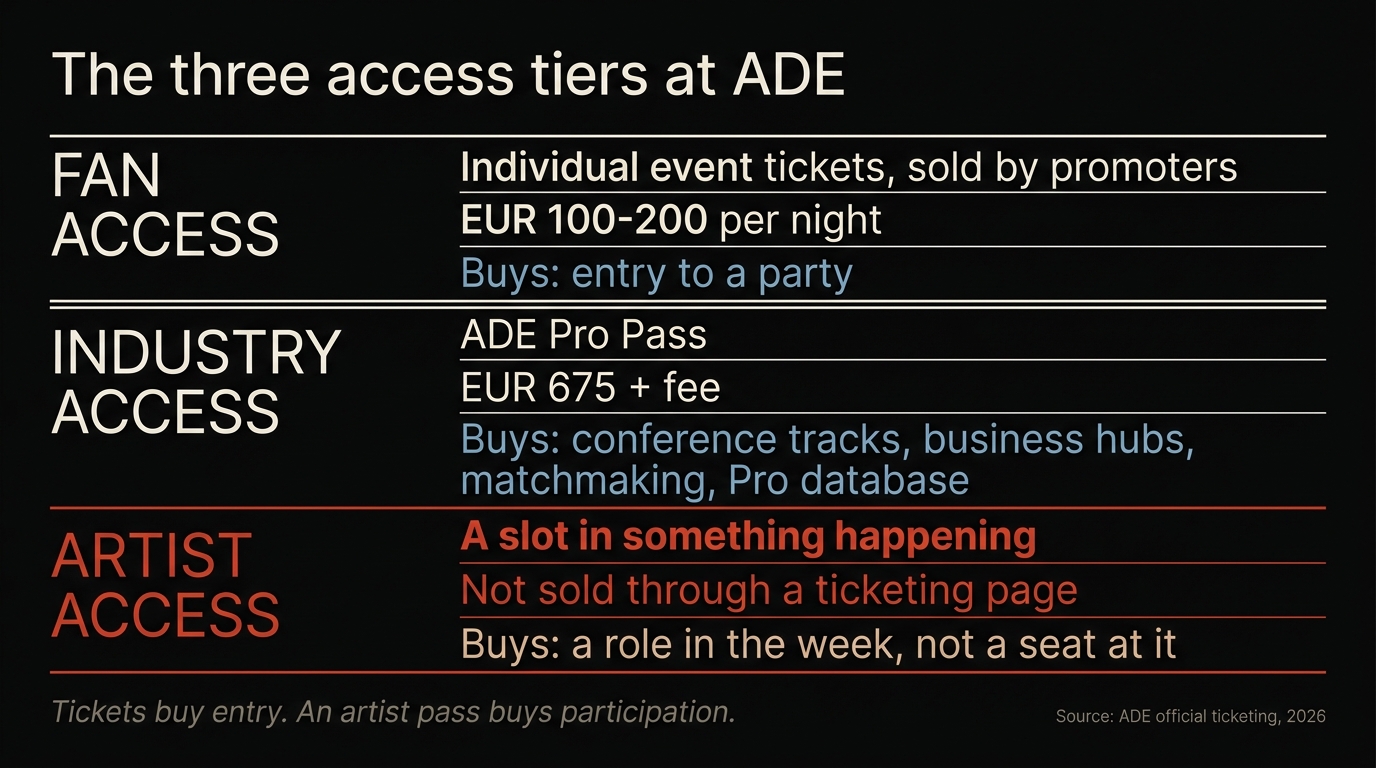 Tickets buy entry. An artist pass buys participation.
Every price you will see quoted for ADE belongs to one of three categories, and confusing them is the most expensive mistake in the week.
| Tier | What it is | Typical cost | What it actually buys |
|---|---|---|---|
| Fan access | Individual event tickets, sold by promoters | €100-200 per night | Entry to a party. Nothing else |
| Industry access | ADE Pro Pass | €725 + fee | Conference tracks, business hubs, matchmaking, the Pro database |
| Artist access | A slot in something happening — a showcase, a media lounge, a panel | Varies | A role in the week rather than a seat at it |
Fan access is what most people buy and what most ADE coverage is written about. Industry access is what companies buy. Artist access is the one nobody explains, because it is not sold through a ticketing page — it comes through allocations, invitations and relationships.
That third tier is the one that changes outcomes, and it is why two artists can spend the same €2,000 in the same city and come home with completely different weeks. One attended. The other was on a schedule.
The 30th Edition: What Is Different in 2026
ADE launched in 1996, which makes 2026 the 30th edition. That matters practically, not just symbolically — anniversary years pull higher industry attendance, more press, and more one-off programming.
The confirmed anchors so far:
- Jean-Michel Jarre is guest of honour. He headlines an opening concert at AFAS Live presented by MOJO and Insomniac, and appears in a keynote interview at ADE Pro. It coincides with the 50th anniversary of Oxygène.
- The first-wave lineup announced 350+ artists, spanning techno, house, progressive, melodic and disco — David Guetta, Armin van Buuren, Adam Beyer, Amelie Lens, Marcel Dettmann, Helena Hauff, Jeff Mills, Oscar Mulero, Adriatique, Joseph Capriati, The Blessed Madonna, The Martinez Brothers, alongside emerging names like Aldonna, Bella Claxton and BASHKKA.
- Escape marks its own 40th anniversary, one of several venue milestones folded into the anniversary programming.
More waves land before October. But the strategic read is already clear: a 30th-anniversary ADE means more senior people in the city than a normal year, which means the hotel-lobby economy — the part that actually matters — is denser than usual.
We break down what the anniversary edition changes for artists specifically separately, because the answer is more interesting than "there's a big concert".
What the Week Costs, Honestly
Nobody plans properly because nobody writes the number down. Here it is.
| Line item | Realistic range | Notes |
|---|---|---|
| ADE Pro Pass | €725 + fee | Official price, verified 4 Sep 2026; was €675 on an earlier tier |
| Individual event tickets | €100-200 per night | Sold by promoters, not ADE; headliners sell out fast |
| Accommodation | €60-120/night hostel, €200-300/night hotel | ADE week is peak pricing in Amsterdam |
| Flights | €200-600 | Depends heavily on origin and how late you book |
| Food, drink, transport | €200-400 | Five days in a city centre |
| Total for the week | €1,500-2,500 | Consistent with We Rave You's cost breakdown |
That is a real budget. For most independent artists it is a meaningful percentage of their annual music spend, which is exactly why it deserves the same scrutiny as a campaign. Based on 2,400+ campaigns run by our founding team, €2,000 is roughly what a serious multi-platform release push costs — so the honest question is not "can I afford ADE", it is "does this week beat spending the same money on the release".
We answer that properly in our honest breakdown of whether ADE is worth it for emerging artists. The short version: it depends entirely on whether you show up with a reason to be met.
How to Actually Work the Week
Here is the structure that works, and I have run it enough times to know where it breaks.
1. Decide what you want before you book anything
"Networking" is not a goal. "Three conversations with A&Rs who release melodic techno on labels between 5K and 50K monthly listeners" is a goal. The first version produces business cards. The second produces follow-ups.
Write down five target companies. Not five dream labels — five realistic ones, where your record would genuinely fit their catalogue.
2. Have the record finished
The single most common ADE failure is arriving with nothing to send. A conversation with an A&R that ends in "I'll send you something soon" is a conversation that produced nothing, because in the two weeks after ADE that person has 300 unread emails and no memory of you.
Have a finished, mastered track and a private link that works on a phone with bad reception.
3. Build the meeting list before you fly
Most meetings at ADE are arranged before ADE, not during it. The Pro database and matchmaking sessions exist for exactly this. So does LinkedIn, two weeks out, with a short and specific message.
4. Live in the daytime
This is the hard one, because the parties are extraordinary and the industry is not awake at 4am. Pick your nights. Two big ones across five days is plenty. The rest of your energy belongs to the hours when people can actually hear you speak.
5. Follow up within 72 hours
Everyone means to. Almost nobody does. The artists who convert ADE meetings into releases are, overwhelmingly, the ones who sent a short email on the Monday after with the track attached and a one-line reminder of where they met.
Our artist playbook for promoting EDM covers the follow-up mechanics in more depth — the principles are identical whether the contact came from a conference or a cold email.
The Part Most Artists Get Wrong: Visibility
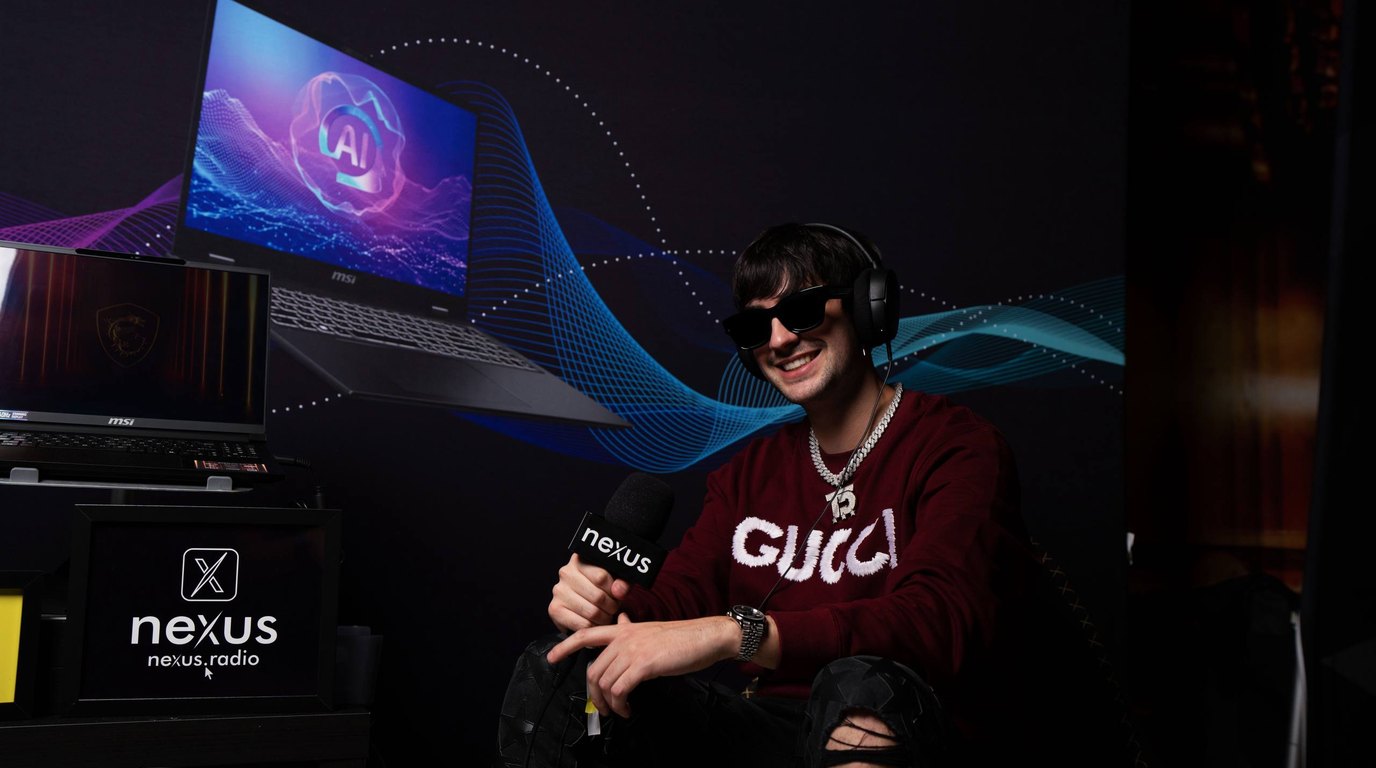 Being visible during the week is a rented audience that costs nothing.
There is a second reason to go to ADE that has nothing to do with meetings, and it is the reason I keep going back.
For five days, the entire electronic music internet is looking at Amsterdam. Every label, every magazine, every fan account is posting ADE content. Attention is concentrated in a way it never is in February.
An artist who is visible during that window — photographed, interviewed, published, tagged, posting — borrows a slice of attention that costs nothing to rent and compounds afterwards. An artist who attends and posts one blurry story from a dancefloor does not.
This is the same timing logic that runs through all of our release advice. As we cover in the complete EDM promotion guide, a track that peaks in the ADE window does more for a career than the identical track peaking in January — because the industry is watching in October and it is not watching in January.
How to actually get that coverage is its own subject, and we wrote it up in how artists get press and interviews during ADE.
The ŌTOCRACY Artist Pass: What It Actually Includes
I said above that artist access is the tier nobody explains, because it does not come through a ticketing page. Here is the version I run, stated plainly, because vagueness about what something includes is the thing I hate most in this industry.
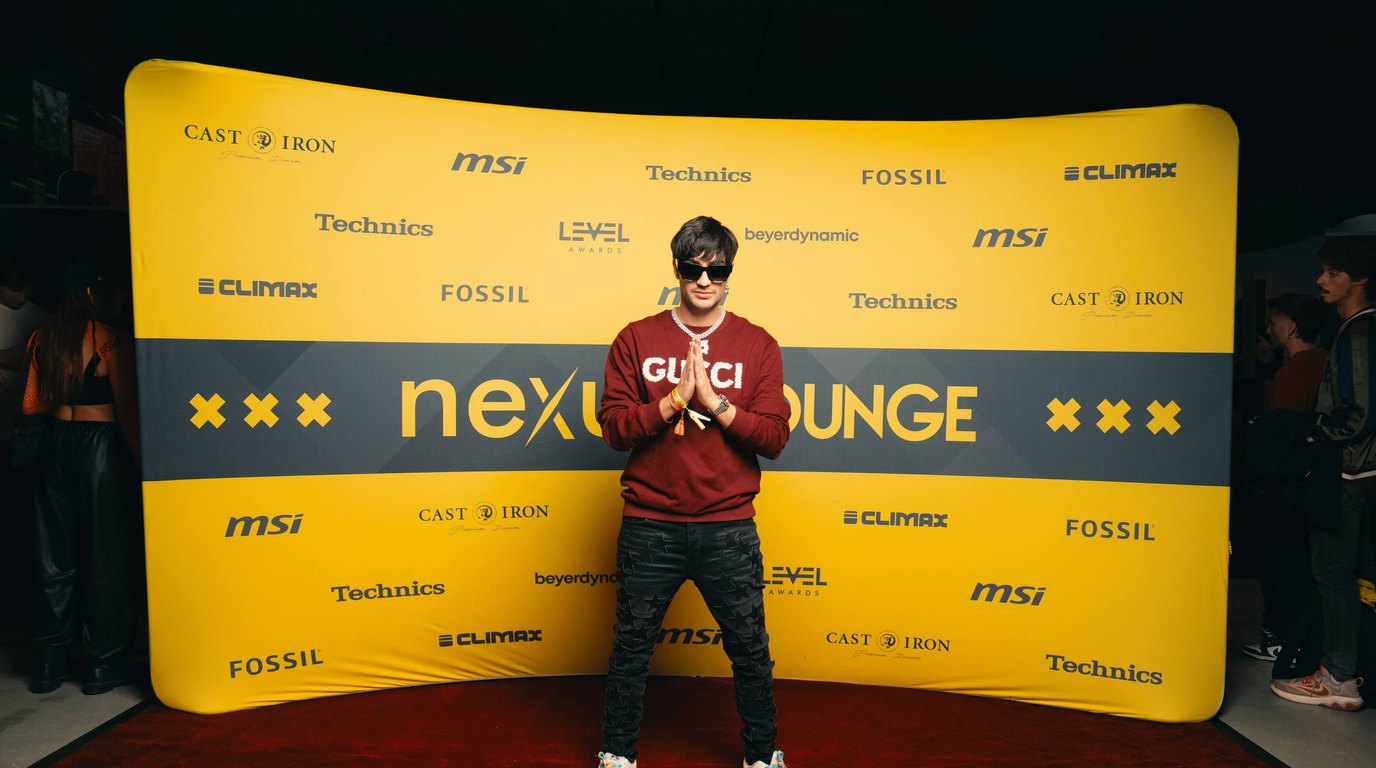
Every year I get a limited allocation of artist spots for the Nexus Lounge — the Nexus Radio media lounge that has run inside ADE's official programme in previous editions, and which brings together hundreds of established and emerging artists from the electronic scene across the week. I have historically given those spots away. This year they are a properly packaged service, and there are 25 of them at €200.
What a pass covers:
- Access to the Nexus Lounge during ADE — the room itself, with hundreds of artists, industry professionals and press moving through it
- A professional interview with Nexus Radio, recorded on site. Interviews typically run on the Thursday and Friday, 22-23 October
- A professional editorial photoshoot — real press photography, not phone shots
- Open bar for Ōtocracy members
- Freebies and products from the event sponsors — past sponsor studios have included Technics, KEF, MSI, Climax, Zoku, beyerdynamic and Fossil
- Publication of your photos and interview on the Nexus site, an established outlet — which means your name and your content sitting on a domain that is not your own, with the search and credibility value that carries
- ŌTOCRACY amplification — our channels run hard all week, and participating artists get tagged and featured in our stories during one of the busiest attention windows of the year for electronic music
- Me, personally, on the day — reception, onboarding, and making sure you are introduced to people rather than standing in a corner holding a drink
That is not a €200 ticket. Tickets to attend ADE start at €100-200 for a single night and buy you a room you leave at 4am. This is an artist visibility and networking package with content production built into it, and the honest reason it is priced at €200 is that the allocation is limited and I would rather it went to 25 artists who will use it than be given away to whoever asks first.
Twenty-five passes. Not a hundred, not unlimited. Artists are selected, so message me and tell me what you make. Everything above, plus checkout, is on the Artist Pass page — or message me on WhatsApp and I will tell you straight whether it makes sense for where you are — including if the answer is that you should spend the €200 on finishing your record instead.
Where the Netherlands Fits
ADE is not a festival that happens to be in Amsterdam. It is the annual summit of a country that is an EDM home market — Dutch producers hold seven of DJ Mag's top 20 spots, and the domestic infrastructure around dance music has no European equivalent.
If you are planning to release into that market, going to ADE without understanding the market is a wasted trip. Our Netherlands promotion guide covers the streaming economics, the radio ecosystem, and the local creator landscape — the context that makes an ADE conversation land instead of bounce.
A Realistic Five-Day Plan
| Day | Daytime | Evening |
|---|---|---|
| Wed 21 Oct | Arrive, collect pass, walk the Pro venues, low-stakes first meetings | Opening programming — go, but leave early |
| Thu 22 Oct | Peak business day. Stack your best meetings here | One good show |
| Fri 23 Oct | Panels relevant to your lane, matchmaking, media/interviews | The big night, if you are having one |
| Sat 24 Oct | Follow-ups with people you actually connected with | Second big night, or rest |
| Sun 25 Oct | Closing programme, quiet coffees — often the best conversations of the week | Travel |
Thursday and Friday are the load-bearing days. If your budget only stretches to three nights, arrive Wednesday and leave Saturday.
Based on 2,400+ campaigns run by our founding team, the artists who get the most out of a concentrated window are the ones who decided what they wanted from it before it started — the same discipline that separates a campaign with a target from a campaign with a budget.
There is a full first-timer's checklist covering what to pack, what to prepare, and what to have on your phone before you land.
Whichever tier you buy, the record has to be in front of people before the week starts — pitching labels before ADE is the part that decides whether any of this access converts.
ADE Lab On Track: Applications Are Open
The cheapest structured route into ADE for a producer or performer is not a pass at all.
ADE Lab On Track asks you to choose a path — Producer Track or Performing Artist Track — and runs three full days of sessions at the ADE Lab Village in Westerpark. Applications are open as of early September 2026.
It is an application rather than a purchase, which cuts both ways: no guaranteed entry, but no €725 committed before you know whether you are in. For an artist whose honest answer to "why am I going" is to learn and to be seen by people slightly ahead of me, this is a better-fitting door than the Pro Pass, and it is the one most first-timers do not know exists.
Apply early. Tracks with a capped cohort and a free application always close before the people who were thinking about it get round to it.
Frequently Asked Questions
When is ADE 2026?
Amsterdam Dance Event 2026 runs Wednesday 21 October to Sunday 25 October 2026. It is the 30th edition of the event, which launched in 1996, with Jean-Michel Jarre as guest of honour and an opening concert at AFAS Live.
Do I need an ADE Pro Pass as an artist?
Only if you intend to do business during the day. The Pro Pass (€725 + fee) covers the conference, business hubs, matchmaking and the year-round Pro database. If you are coming purely for shows, individual event tickets from promoters are the cheaper route.
Can you get signed at ADE?
Rarely on the spot, frequently as a consequence. Deals come from a conversation at ADE followed by a track that lands in an inbox the week after. Artists who arrive with finished music and follow up within 72 hours convert at a completely different rate than those who do not.
Is ADE worth it for an unsigned artist?
It can be, if you have a clear objective, finished music, and meetings arranged before you fly. At €1,500-2,500 for the week it is a genuine investment, and it is wasted on anyone treating it as a party with a conference attached.
How far in advance should I book?
Accommodation and flights, as early as possible — Amsterdam hits peak pricing during ADE week. The Pro Pass has already stepped from €675 to €725 this cycle, so waiting has a price. Meetings should be requested two to three weeks out, once people's calendars open.
What is the Nexus Lounge at ADE?
The Nexus Lounge is a media lounge run by Nexus Radio that has appeared in ADE's official programme in previous editions, bringing together hundreds of established and emerging electronic artists for interviews, photography and networking across the week. ŌTOCRACY holds 25 artist passes for 2026 at €200.
What is the ADE Lab?
ADE Lab is the strand aimed at emerging artists and professionals — demo feedback, sessions with established producers, and structured access to industry figures. Tickets have historically started from around €35, which makes it the cheapest serious entry point into the day programme.
ADE is the one week a year where the distance between an independent artist and the people who decide things collapses to walking distance. That is genuinely rare, and it is why the week is worth taking seriously — but the collapse only happens for artists who arrive with a finished record, a short list of realistic targets, and a reason for someone to remember them on the Monday. Everything else is an expensive holiday in a beautiful city.
If you want to know what the same budget buys as a campaign instead, Otocracy's free audit reads your profile source by source and tells you where the next €2,000 would actually move the needle.