Music Promotion in the Netherlands: 2026 EDM Guide
Music promotion in the Netherlands, decoded for EDM artists: ADE, festivals, radio, Dutch playlists, TikTok seeding, and the per-stream payout math.
Quick Answer
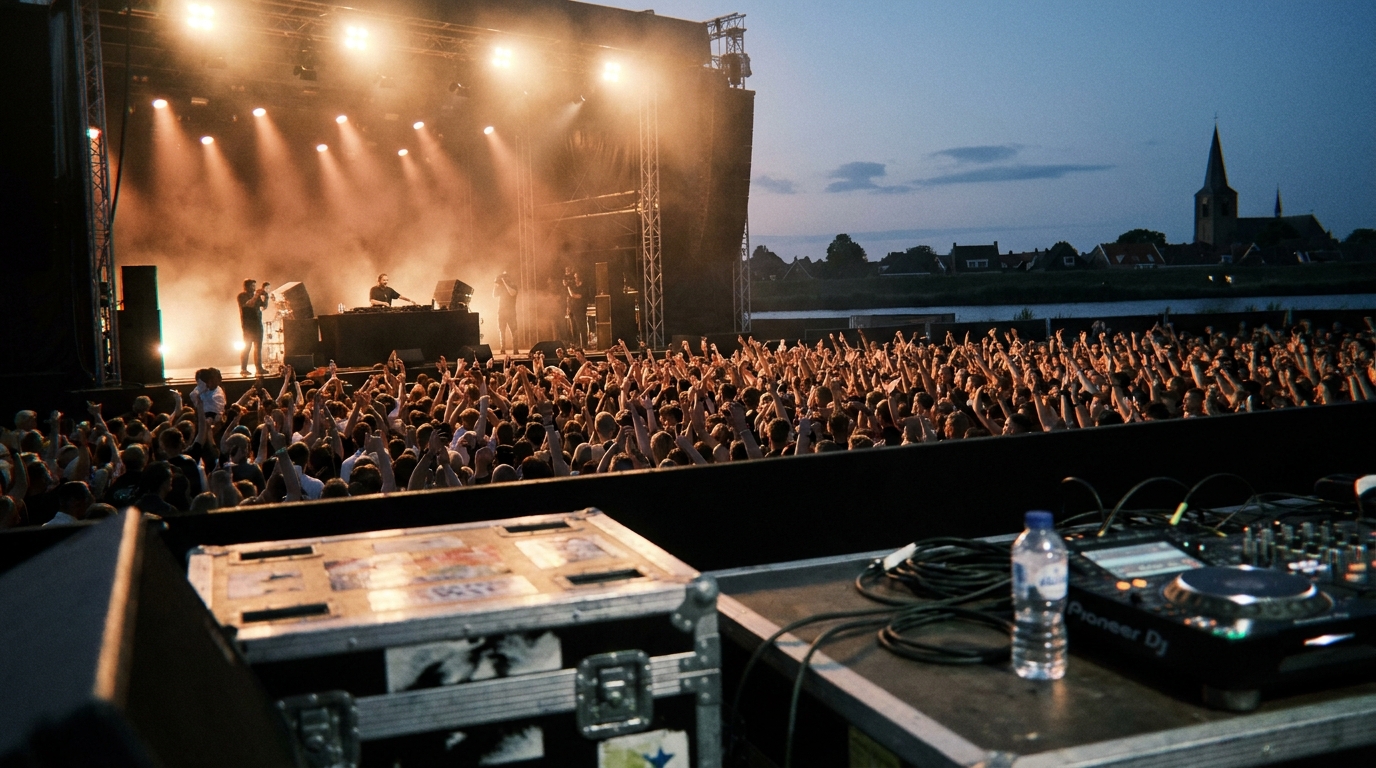
Music promotion in the Netherlands works differently because the country is an EDM home market, not a satellite. Dutch producers hold seven of DJ Mag's top 20 spots, and Amsterdam Dance Event drew a record 600,000 visitors across 1,200-plus events in October 2025 (Amsterdam Dance Event). The Dutch recorded-music market reached roughly €334 million in 2024, up 12 percent, with streaming at €278 million, or 83 percent of sales (NVPI). That means three things for a campaign: streaming pays toward the top of the observed $0.003-0.005 band because premium subscription share is high, editorial and radio (SLAM!, Radio 538) still break dance records, and the festival calendar from ADE to Mysteryland gives every release a real-world moment to ride. Promote in English, seed sound through Dutch TikTok creators, and time drops to the scene's own calendar rather than a generic global one.
I have played the European circuit for years, and no market rewards electronic music the way the Netherlands does. Most promotion advice treats it as one more territory on a global plan, which wastes the single biggest advantage a dance artist can have: a country where EDM is native culture, not an import. This guide covers what that changes at every layer — the scene, the streaming ecosystem, the creators, the payout math, and how to run a campaign that fits the Dutch calendar instead of fighting it.
Why Music Promotion in the Netherlands Starts From a Home-Field Advantage
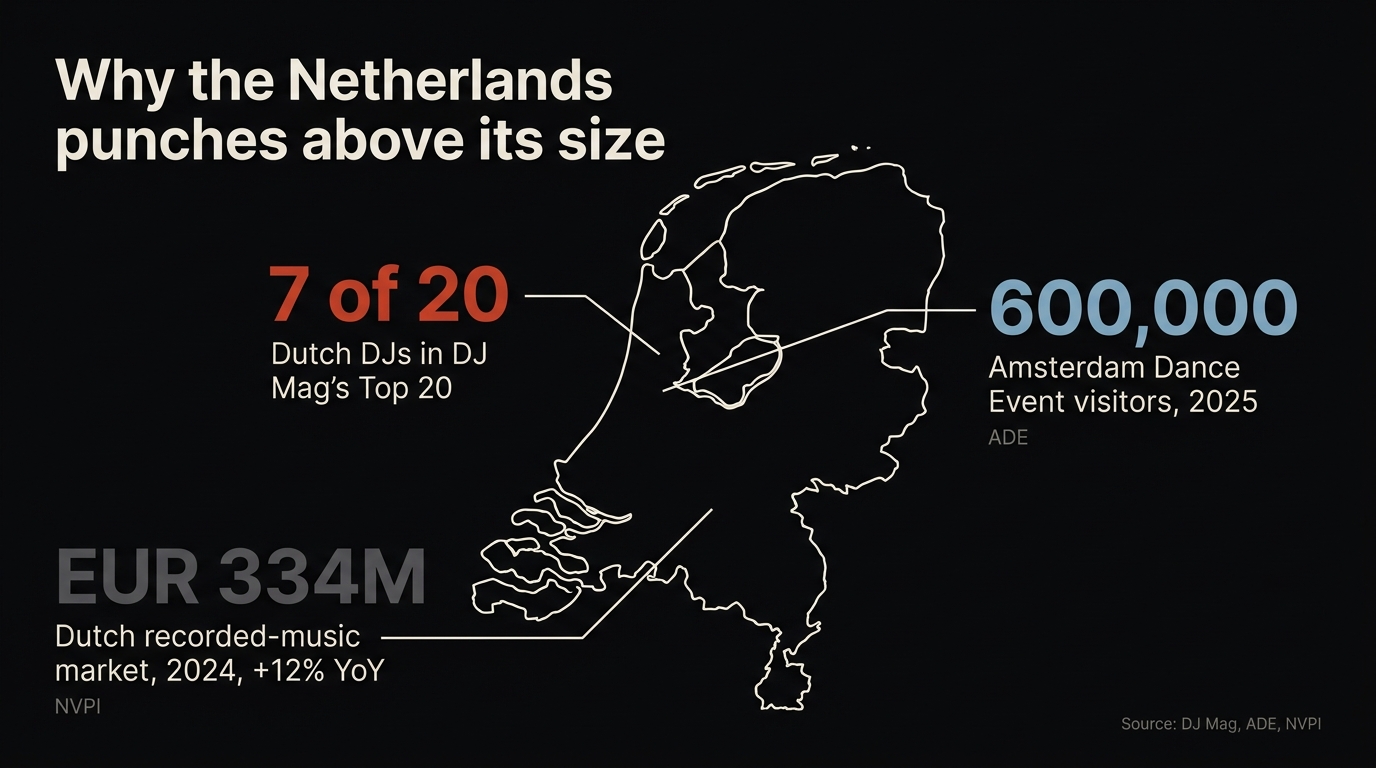
Start with who runs this genre. In the DJ Mag Top 100, Martin Garrix has taken number one five times — equalling the record held by fellow Dutchman Armin van Buuren — and seven of the top 20 acts come from the Netherlands, alongside Tiësto, Afrojack, Don Diablo, and Oliver Heldens (DJ Mag; iamexpat). No country of 18 million people has any business dominating a global genre this way, and the Dutch do.
That dominance built infrastructure. The country produced the promoters, the festival brands, the radio formats, and the audience literacy that most markets never developed, so a dance release lands into a system already tuned to receive it. The commercial upside is real too: Dutch recorded-music revenue reached roughly €334 million in 2024, up 12 percent year on year, with streaming alone at €278 million (NVPI, via NL Times).
For an artist, the practical read is simple. English-language promotion works natively here, the audience already understands sub-genres, and every channel — radio, festival, playlist, TikTok — has a dance-specific lane. Before you build a Dutch plan, it helps to have the channel-by-channel model straight, which is what our complete EDM promotion guide lays out end to end.
The Festival, Club, and Radio Scene That Feeds Everything
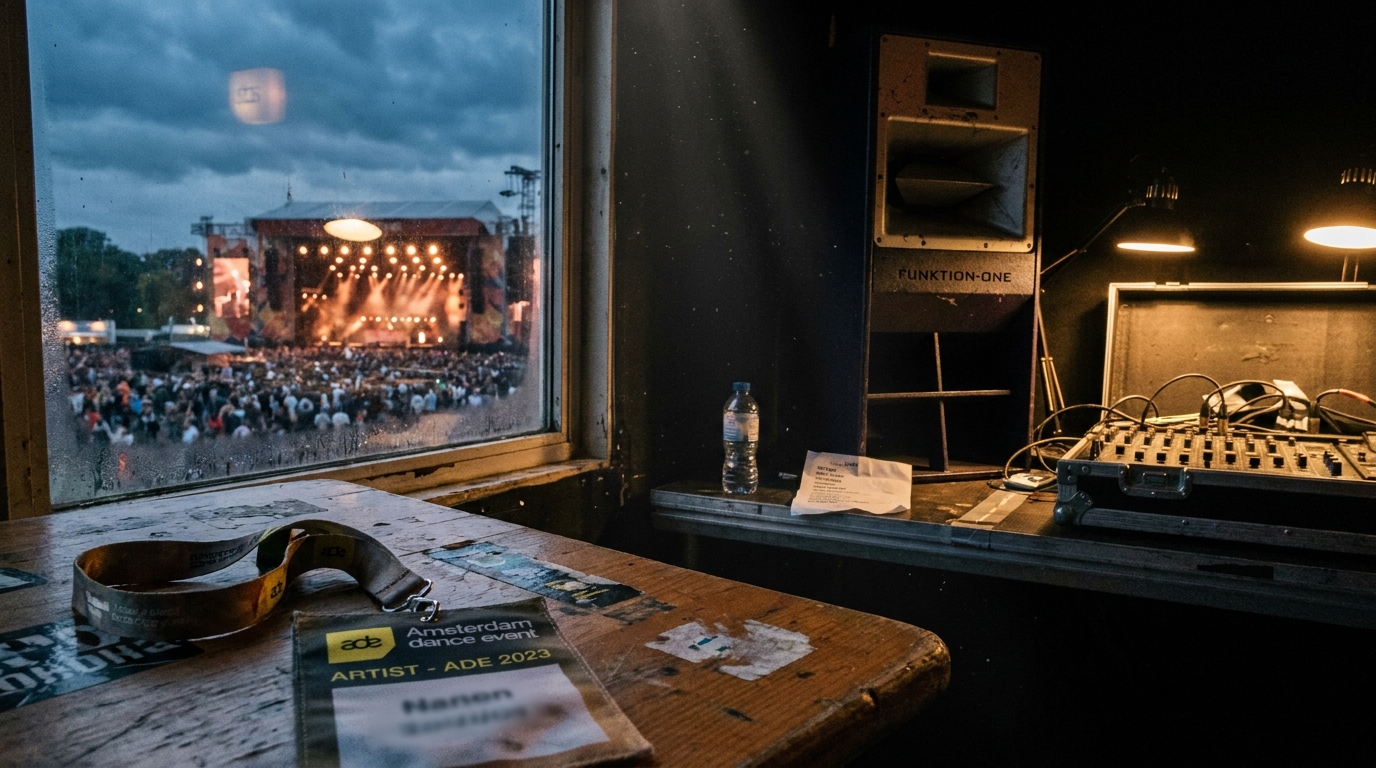
The spine of the market is Amsterdam Dance Event. The 30th edition ran 22-26 October 2025 and pulled a record 600,000 visitors to more than 1,200 events at over 300 locations, with roughly 3,500 artists and speakers and attendees from 140-plus countries (Amsterdam Dance Event; iamexpat). ADE 2026 is set for 21-25 October — mark it, because it is the one week a year the entire industry is physically in one city. Our artist's guide to ADE 2026 covers how to actually work that week.
Around ADE sits a festival calendar no neighbor matches. Mysteryland, founded by ID&T in 1993, is the world's longest-running electronic music festival and hosts more than 100,000 visitors from over 100 nationalities; Defqon.1 runs the hardstyle world out of Biddinghuizen at around 65,000 fans a day; Awakenings anchors techno at Spaarnwoude (Wikipedia; Music Festival Wizard). These are not just parties — they are release moments and playlist triggers.
Then there is the club circuit that keeps the scene alive between festivals. Amsterdam alone runs Shelter under the A'DAM Tower, RADION with its Funktion-One rig and garden parties, Thuishaven on the industrial western edge, and De Marktkantine for bigger techno and house nights (Resident Advisor). A track that works on those floors earns credibility the algorithm cannot fake.
Radio still breaks dance records here, which is rare in 2026. SLAM! is a national commercial station built specifically around breaking new dance music, Radio 538 has carried dance in prime rotation since the early 1990s and once hosted Tiësto's Club Life, and public station NPO 3FM covers pop and alternative crossover (Wikipedia). Here is how the pillars stack up.
| Channel | Anchor examples | What it does for a release |
|---|---|---|
| Festivals | ADE, Mysteryland, Defqon.1, Awakenings | Real-world moment plus playlist and press triggers |
| Clubs | Shelter, RADION, Thuishaven, De Marktkantine | Floor credibility and DJ support |
| Radio | SLAM!, Radio 538, NPO 3FM | Genuine dance airplay and daytime reach |
| Editorial | Spotify NL dance lists, curator networks | Discovery that feeds the algorithm |
The Dutch Streaming and Local Playlist Ecosystem
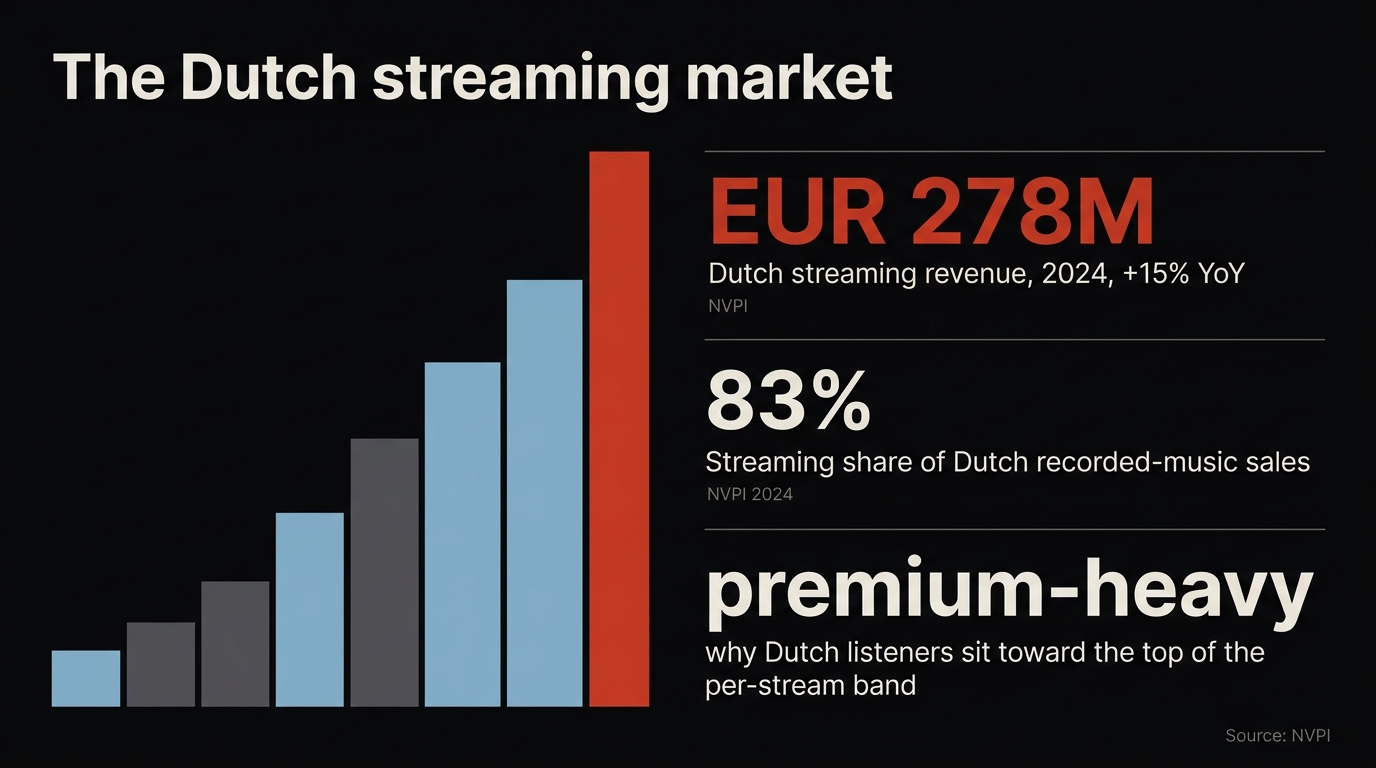
The Netherlands is a streaming-first country by a wide margin. Streaming made up 83 percent of Dutch recorded-music revenue in 2024, growing 15 percent to more than €278 million, partly on higher subscription prices — a sign of a premium-heavy, high-value listener base (NVPI). For a dance artist, that means Spotify Netherlands behaves like a core market, not a long-tail one.
Editorial coverage follows the culture. Dutch dance lists on Spotify are deep and sub-genre aware, and the same mechanics apply here as everywhere: you pitch the release, editors route it on your metadata, and the lasting value is the algorithmic response from those listeners' saves and completions. The full pitch process, deadline, and metadata discipline is covered in our Spotify promotion guide for EDM artists.
One local nuance matters. Dutch listeners lean heavily international, so English-language and instrumental dance tracks are not disadvantaged here the way vocal pop in a minority language can be — you are competing on the same surfaces as global acts, which is both the opportunity and the difficulty. Based on 2,400+ campaigns run by our founding team, save rate on a Dutch audience is the earliest reliable signal that a track will hold on Radio and Discover Weekly after any editorial slot rotates out.
If you are unsure how much of your current Dutch traffic is real listeners versus dead playlist weight, Otocracy's free AI audit breaks your profile down source by source before you spend another euro. Getting that read right is the difference between scaling a working track and pouring budget into a leak.
The Dutch TikTok and Creator Scene
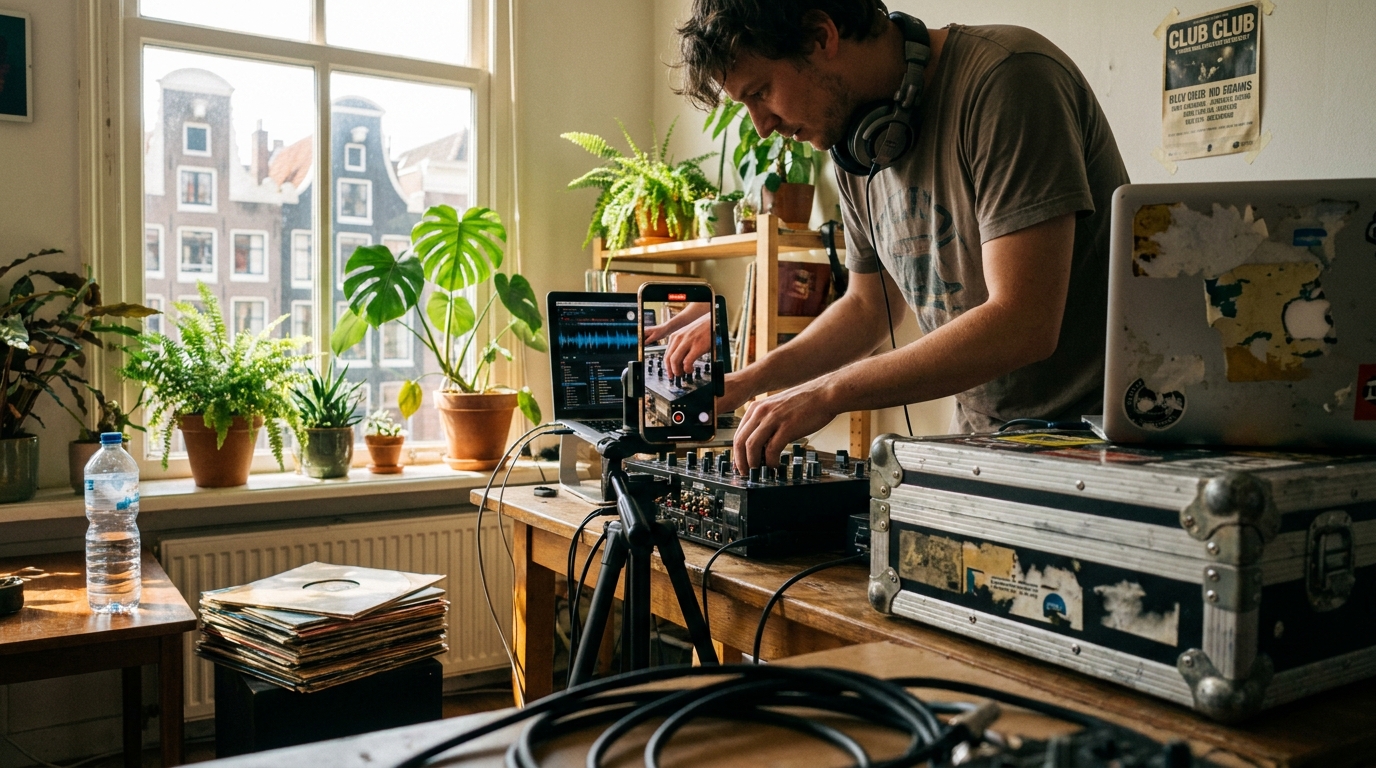
TikTok is where Dutch discovery starts for younger listeners. TikTok ads reached about 37.5 percent of Dutch adults aged 18 and over at the start of 2025, and the platform counts millions of active Dutch users with engagement rates several times higher than Instagram or YouTube (DataReportal; Searchlab). For a dance track, that reach is the top of the funnel that later shows up as Spotify Netherlands streams.
The creator base is large and trackable — thousands of Dutch TikTokers with sizeable, locally concentrated audiences, spanning dance edits, festival content, and lifestyle niches that pair naturally with electronic music (Modash). You do not need the biggest accounts; you need creators whose audience is Dutch and whose content already lives near the club and festival world.
The move that works is sound seeding, not a one-off influencer post. You place your official sound with a cluster of mid-tier Dutch creators, let it attach to formats their audiences already make, and measure carryover to streams — the exact mechanics are in our breakdown of how TikTok sound promotion actually works. The wider platform playbook, from hooks to posting cadence, sits in our TikTok music promotion guide.
Time the seeding to the calendar. A sound seeded in the weeks around ADE or a major festival compounds, because Dutch feeds are already saturated with dance content and your track rides a wave the whole country is watching.
Per-Stream Payouts and How the Dutch Market Compares
Per-stream payout is not a published rate anywhere, but observed estimates across payout statements and royalty trackers consistently land at $0.003-0.005 per stream, varying by listener country and account type. The Netherlands sits toward the top of that band, because streaming already accounts for 83 percent of Dutch recorded-music revenue and the market skews premium — paid subscribers pay more per stream than free-tier listeners (NVPI). A Dutch stream is simply worth more than the global average one.
That payout quality changes the math on a campaign. When each stream is worth more and the audience is premium, real listeners acquired through ads or creator seeding return more per euro spent — which is exactly why buying fake streams is even more self-defeating here than elsewhere. Now set the Netherlands against its two big neighbors, because a regional plan usually touches all three.
| Dimension | Netherlands | Germany | Belgium |
|---|---|---|---|
| Scene identity | EDM and hardstyle homeland; 7 of DJ Mag top 20 are Dutch | Techno heartland (Berlin, Mannheim) | Festival powerhouse anchored by the Tomorrowland brand |
| Anchor event | ADE, 600,000 visitors (Oct 2025); Mysteryland | Time Warp (Mannheim); Mayday (Dortmund) | Tomorrowland, ~400,000 per edition |
| Radio and editorial | SLAM!, Radio 538, NPO 3FM break dance | Club-driven, less radio-led for dance | Studio Brussel, MNM |
| Language of promo | English works natively | German often needed for local reach | Dutch (Flanders) and French (Wallonia) split |
| Per-stream tier | High, premium-heavy | High; Europe's largest recorded-music market | Upper-mid |
The takeaway from that table is that the Netherlands is the cheapest of the three to promote into per unit of result, because you avoid a language localization step, the audience is dance-literate, and the payout tier is strong. Germany is bigger but demands German-language adaptation for real depth — the German market guide breaks that trade-off down city by city; Belgium splits across two language regions.
How to Run a Music Promotion Campaign in the Netherlands
Sequence beats spend. Start by confirming the track works on Dutch ears — a small ad test to a Netherlands audience tells you whether saves and completion hold before you commit real budget. What each spend tier buys, from a €500 validation test upward, is broken down line by line in our guide to what a music promotion budget actually buys.
Then stack the channels in order. Pitch the release to Spotify editorial on time for the Dutch dance lists, seed the official sound with mid-tier Dutch TikTok creators, and point ad traffic at a smart link so the resulting listens land while the release is fresh. Each layer feeds the next — creator views drive searches, searches drive streams, streams drive algorithmic pickup.
Time everything to the calendar. A release aimed at the ADE window in October, or slotted against the summer festival run, borrows attention the whole country is already paying — the single most Netherlands-specific lever you have. Based on 2,400+ campaigns run by our founding team, calendar timing moves campaign efficiency more in this market than in any other European territory we run.
If you want the Dutch execution handled against a target you can hold us to, Otocracy's campaign packages map each of these layers to a scope and a projection. The system is the same one that breaks records here every October — run at campaign scale, on your release.
Frequently Asked Questions
Why is the Netherlands such an important market for EDM artists?
It is a home market, not a satellite. Dutch acts hold seven of DJ Mag's top 20 spots, Amsterdam Dance Event drew a record 600,000 visitors in October 2025, and streaming made up 83 percent of a €334 million recorded-music market in 2024 — so dance releases land into infrastructure built for them.
Should I promote in Dutch or English in the Netherlands?
English works natively. Dutch listeners lean heavily international, so English-language and instrumental dance tracks compete on the same surfaces as global acts without a localization penalty. That is a genuine cost advantage over Germany, where German-language adaptation is often needed to reach real local depth.
What does a Spotify stream pay in the Netherlands?
There is no published rate, but observed estimates land at $0.003-0.005 per stream, and the Netherlands sits toward the top of that band. The reason is structural: streaming is already 83 percent of Dutch recorded-music revenue and the market skews premium, so paid subscribers lift the average per-stream value.
When is the best time to release music in the Netherlands?
Time drops to the scene's calendar. The Amsterdam Dance Event window in late October — 21-25 October in 2026 — and the summer festival run around Mysteryland, Defqon.1, and Awakenings borrow attention the whole country is already paying, which is the most Netherlands-specific timing lever available.
How do I use Dutch TikTok creators to promote a track?
Seed the official sound, do not buy a single post. Place it with a cluster of mid-tier creators whose audience is genuinely Dutch and near the club or festival world, let it attach to formats they already make, and measure stream carryover. TikTok ads reach roughly 37.5 percent of Dutch adults, so the top-of-funnel is there.
Does radio still matter for dance music in the Netherlands?
More than in most markets. SLAM! is a national station built around breaking new dance music, Radio 538 has carried dance in prime rotation since the early 1990s, and NPO 3FM covers crossover. Dutch daytime radio genuinely moves dance records, which is rare elsewhere in 2026.
The Netherlands is the one European market where EDM is native culture, and that changes the whole plan: promote in English, ride the festival and ADE calendar, seed sound through Dutch creators, and treat radio and premium-heavy streaming as real channels rather than afterthoughts. Get the sequence and the timing right and each euro works harder here than in any neighboring territory. Start by confirming your track holds on a Dutch audience, then scale what works with Otocracy's campaign packages.