Should You Release a Track Around ADE? [2026 Data]
The ADE window concentrates industry attention like no other week in dance music. When releasing into it helps, when it buries you, and how to time it.

Quick Answer
The Amsterdam Dance Event window — 21-25 October 2026 — concentrates industry attention on electronic music more than any other week in the calendar. ADE 2025 drew 600,000 visitors, 3,400+ artists and 1,200+ events, with attendees from 140+ countries. That makes it a genuine timing lever, but not the one most artists assume. Releasing during ADE week is usually a mistake: you are competing against 1,200 events and every major label's own announcements for the same attention. Releasing two to four weeks before is the version that works, because it gives you a current record to point at during the week itself, and momentum that peaks while the people who make decisions are actually watching. Based on 2,400+ campaigns run by our founding team, calendar timing moves campaign efficiency more in electronic music than in any other genre we run.
Timing is the cheapest lever in music promotion. It costs nothing to move a release date, and it changes outcomes more than most of the things artists spend money on.
ADE is the clearest example of that in the entire dance calendar. Here is how to use it, and how to avoid the obvious trap.
Why the ADE Window Is Different
Most of the year, an independent release competes for attention against everything else being released. During ADE week, something structurally different happens: the industry — not just the audience — is paying concentrated attention to electronic music for five days.
The numbers behind that concentration, from ADE 2025:
| Metric | ADE 2025 |
|---|---|
| Visitors | 600,000 |
| Events | 1,200+ |
| Venues | 300+ |
| Artists and speakers | 3,400+ |
| Countries represented | 140+ |
For 2026, the first wave alone announced 350+ artists, and the 30th-anniversary edition is drawing more senior industry attendance than a normal year — which we cover in what the anniversary changes for artists.
That is not an audience opportunity. It is a decision-maker opportunity. The A&Rs, bookers, playlist curators and label heads whose attention normally costs a fortune to reach are, for one fortnight, actively scanning the genre.
The Trap: Releasing During ADE Week
The intuitive move is to drop the record on the Thursday of ADE. It is almost always wrong.
During ADE week you are competing against:
- 1,200+ events all promoting themselves
- Every major label's own ADE announcements and showcase reveals
- Every artist playing the week posting content
- The event's own press machine
Your release does not ride that wave. It drowns in it. Attention is concentrated, but it is also completely spoken for — and the people you want are physically in meetings and clubs, not sitting at a desk listening to submissions.
There is also a practical problem: everyone you meet during the week asks what you have out. If your answer is "it comes out Thursday", you have nothing for them to hear in the conversation where they are actually interested.
What Works: Two to Four Weeks Before
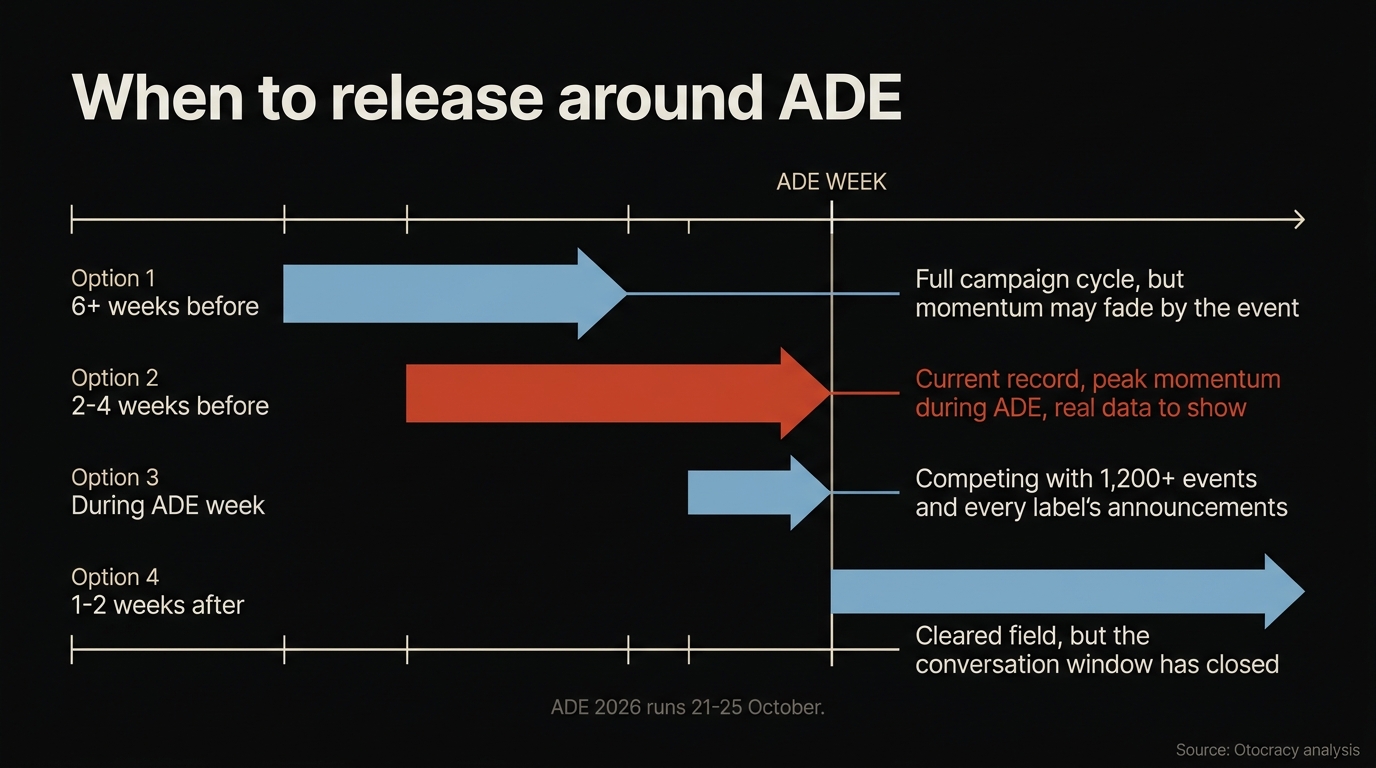 Release early October. Arrive with something current and measurable.
Release in late September or the first week of October. Three things follow.
1. You arrive with a current record. When someone asks what you are working on, you send a link to something that is out, has some early data behind it, and is genuinely recent. That is a far stronger position than a promise.
2. Your campaign peaks in the right window. A promotion push typically takes two to three weeks to reach full delivery. Start in late September and your reach curve peaks in exactly the fortnight the industry is watching.
3. You have data to show. Two weeks of save-rate and repeat-listener data is a real signal, and it is the kind of evidence an A&R can act on. A record released the day before means nothing to anybody.
| Release timing | What you gain | What you lose |
|---|---|---|
| 6+ weeks before ADE | Full campaign cycle, plenty of data | Momentum may fade by the event |
| 2-4 weeks before | Current record, peak momentum during ADE, real data | Nothing meaningful |
| During ADE week | The feeling of being timely | Attention, listening bandwidth, conversational leverage |
| 1-2 weeks after | A cleared field, industry back at desks | The ADE conversation window entirely |
The two-to-four-week slot is the answer for most artists. The only common exception is deliberately releasing a week or two after ADE, when inboxes are being cleared and the field is quieter — a legitimate strategy if your goal is submission response rates rather than in-person conversations.
The Campaign Sequence
 Five days when the whole industry looks at one city.
If you are aiming a release at the ADE window, this is the sequence that works.
- 8 weeks out (late August). Master finished. Artwork done. Distribution submitted — most distributors want two to four weeks' lead for editorial consideration anyway.
- 5 weeks out (mid September). Pre-save live. Begin seeding short-form content. Our TikTok promotion guide covers the mechanics of building sound momentum before a drop.
- 2-4 weeks out (late Sept / early Oct). Release. Campaign goes live across platforms.
- ADE week (21-25 Oct). The record is out, the data exists, and you are in Amsterdam pointing at it.
- Week after. Follow-up emails carry a link to something real with two to five weeks of performance behind it.
For the underlying release mechanics — editorial windows, pre-save behaviour, the first-28-days logic — our Spotify release guide has the full sequence, and it applies whether or not ADE is your target.
When Not to Use This Lever at All
Timing amplifies. It does not create.
If the record is not good enough, releasing it into the ADE window makes the disappointment more expensive, not less. If your profile has streaming history you cannot explain, putting yourself in front of A&Rs actively checking profiles is a liability rather than an opportunity — the detection habits are covered in how labels audit for fake streams.
And if you are not actually going to ADE, the timing argument weakens considerably. You retain some benefit from releasing into a period of elevated genre attention, but you lose the part that mattered most: having the conversation.
The ŌTOCRACY Artist Pass — Nexus Lounge, ADE 2026. €200, 25 only. Timing a release into ADE only pays if you are in the room to point at it — and that works considerably better from an interview chair than from a queue. Lounge access, a Nexus Radio interview (usually 22-23 Oct), an editorial photoshoot, sponsor freebies, open bar for Ōtocracy members, publication on the Nexus site, amplification across ŌTOCRACY's channels all week, and Thomas on the day handling reception and introductions — the full list is here. Release in early October, then spend the week talking about it on a microphone. Twenty-five passes, artists selected. See what the pass includes and claim one → — or message us on WhatsApp if you would rather ask first.
The Wider Calendar Point
ADE is the sharpest example of a general rule in electronic music: the scene runs on a calendar, and releases timed into it consistently outperform identical releases dropped into dead months.
The other anchors worth building around are Miami Music Week in March, the start of festival booking season, and the summer run. A record that peaks in September, right before ADE, does more for a career than the same record peaking in January — a point we make at length in the complete EDM promotion guide.
Based on 2,400+ campaigns run by our founding team, calendar timing shifts campaign efficiency more in this genre than any single targeting or creative variable, and it is free.
Frequently Asked Questions
When should I release a track for ADE 2026?
Two to four weeks before the event, so late September or the first week of October 2026. That gives your campaign time to reach peak delivery during ADE week itself, and gives you a current record with real data to point at in conversations.
Is it bad to release during ADE week?
Usually, yes. You compete against 1,200+ events, every major label's announcements, and the event's own press machine for the same attention. You also have nothing already out when people ask during the week what they should listen to.
Does releasing around ADE help if I am not attending?
Partially. You still benefit from elevated industry attention on electronic music during the window, but you lose the main advantage, which is having a current record to discuss in person with the people making decisions.
How long before ADE should my campaign start?
Roughly eight weeks out for mastering and distribution, five weeks for pre-save and short-form seeding, and release at two to four weeks out. Distributors typically want two to four weeks' lead for editorial consideration regardless.
Is releasing after ADE ever the right call?
Occasionally. The one to two weeks after ADE are quieter, and industry inboxes are being processed rather than ignored. If your strategy is submission response rates rather than in-person conversations, that window has genuine merit.
ADE is a timing lever, not a magic window. Used properly it means releasing in early October, arriving in Amsterdam with something current and measurable, and spending five days pointing at it. Used badly it means dropping a record into the single most crowded week of the dance calendar and wondering why nobody noticed.
If you want a read on whether your next release is ready to be timed into a window this valuable, run the free audit — and our campaign packages handle the push that should be peaking while you are in the room.