Music Promotion in Germany: 2026 Guide for EDM Artists
Music promotion in Germany for EDM artists: the club and festival calendar, streaming reality, the radio that still matters, and the language question.
Quick Answer
Germany is Europe's largest recorded-music market and the least radio-dependent of the major dance markets. BVMI reported German recorded-music revenue of 2.42 billion euros in 2025, up just 2.3 percent after 7.2 percent growth the year before, with streaming now 84.4 percent of the total. The growth slowdown matters for promotion planning: the market is large and mature rather than expanding, so share comes from other artists rather than from new listeners arriving. Germany's dance infrastructure is club-first — Berghain and the Berlin circuit, Time Warp in Mannheim at number 14 in DJ Mag's Top 100 Festivals 2026, Parookaville at number 10 — and its dedicated electronic radio, sunshine live, is a genuine national channel with 32 subchannels. Based on 2,400+ campaigns run by our founding team, campaigns that treat Germany as one market underperform campaigns that treat it as several cities.
Germany is the market most artists assume they understand because they have played Berlin once. Then the campaign runs, the numbers come back flat outside two postcodes, and the conclusion is that German audiences are hard.
They are not hard. They are decentralised. Germany does not have a single cultural capital the way France or the Netherlands does — Berlin, Cologne, Hamburg, Munich, Mannheim and Leipzig each carry their own scene, their own venues and their own local media, and a campaign built for one of them will land softly in the other five.
This page covers what the market data actually says, the calendar that sets the release timing, the streaming and radio ecosystem, the language question, and how to structure a campaign that reaches past Berlin. The channel mechanics that apply everywhere are in the complete EDM promotion guide; this is the German layer.
Why Music Promotion in Germany Runs on Clubs, Not Radio
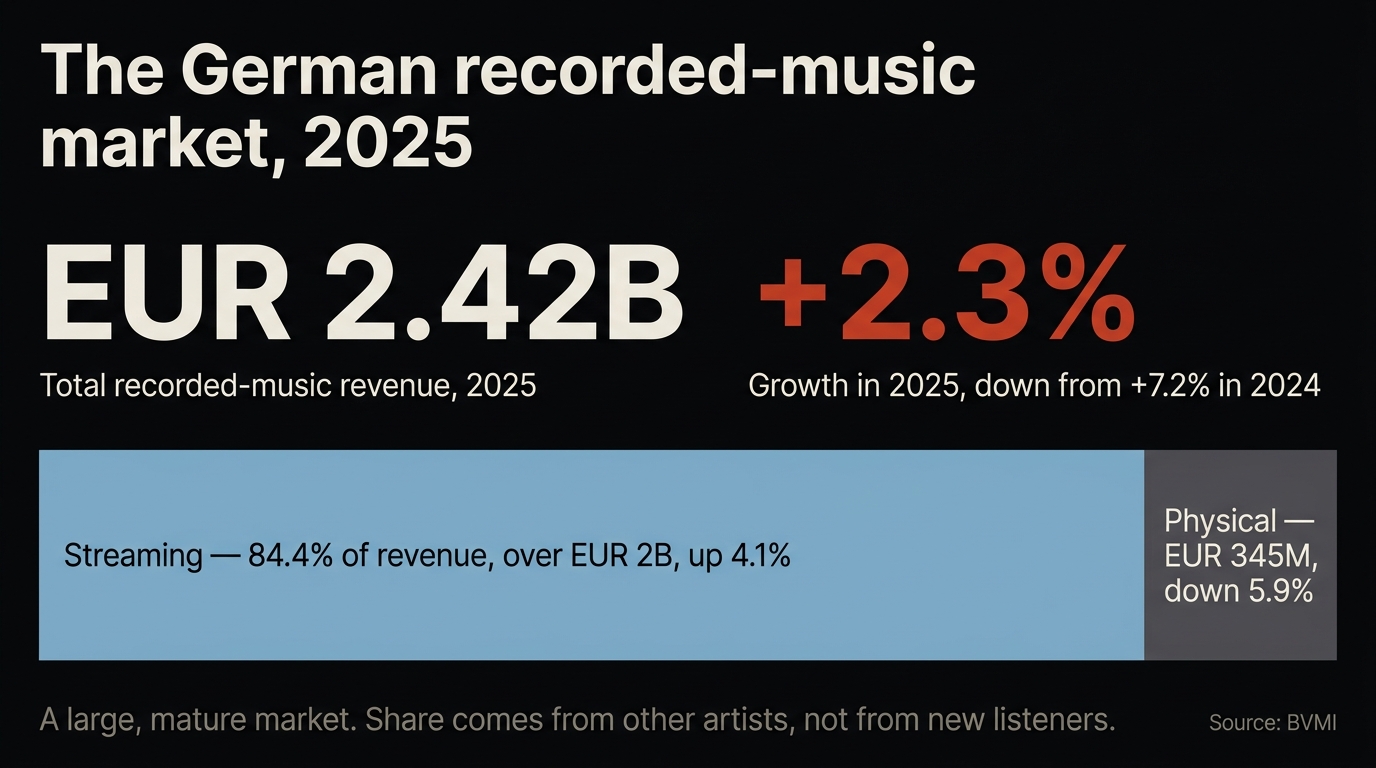
The commercial picture first, because it changes the strategy.
| Metric | 2025 | Change |
|---|---|---|
| Total recorded-music revenue | 2.42 billion euros | up 2.3 percent |
| Growth the previous year | — | up 7.2 percent |
| Streaming share of revenue | 84.4 percent, over 2 billion euros | up 4.1 percent |
| Physical revenue | 345 million euros, 14.2 percent of total | down 5.9 percent |
| Vinyl within physical | 44.2 percent share | up 2.8 percent |
Source: BVMI, the German recorded-music industry association.
Two things follow. First, Germany is a streaming market now by any reasonable definition, so a promotion plan built around physical or download sales is planning for 14 percent of the money.
Second, and more strategically: growth fell from 7.2 percent to 2.3 percent in a single year. A market growing at 2.3 percent is not handing out new listeners. Every stream you gain is one somebody else did not get, which means differentiation matters more here than in a market where the tide is still lifting everyone.
The dance-specific consequence is that clubs and festivals carry proportionally more weight in Germany than in markets where daytime radio breaks records. German dance culture is built around rooms and residencies rather than playlists — which is slower to work with and considerably more durable once it does.
The Club and Festival Circuit That Sets the Calendar
Berlin is the obvious entry point and the most competitive one. Berghain remains the reference room, with residents including Marcel Dettmann alongside newer names like Fadi Mohem. Tresor is returning in new spaces after leaving its original location, //about blank has moved to larger premises with an expanded techno programme, and POP in Friedrichshain has opened focused on underground techno and live acts.
The mistake is stopping there. Cologne, Hamburg, Munich, Leipzig, Frankfurt and Mannheim all sustain their own circuits, and a record supported in three secondary cities travels further than one played twice in Berlin.
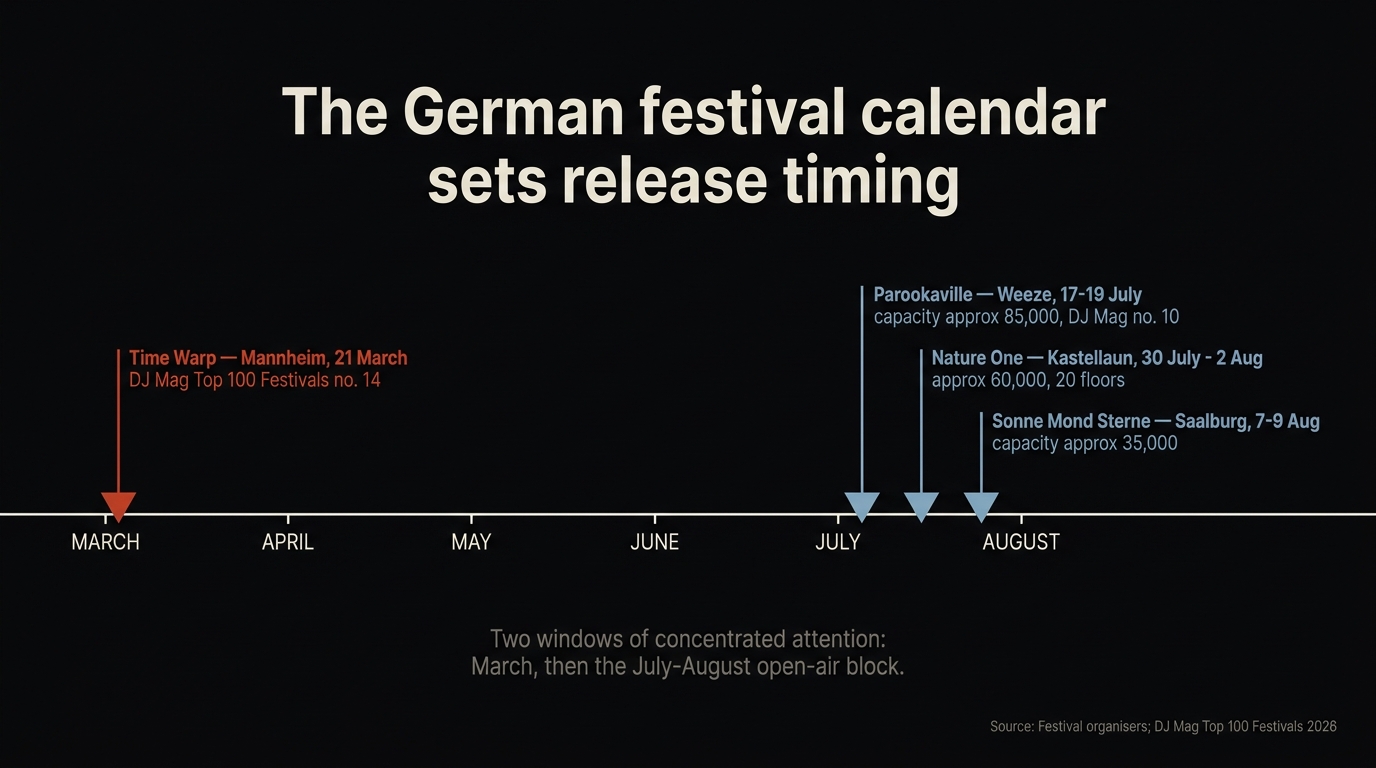
The festival calendar is where release timing gets decided:
| Festival | Location | 2026 dates | Scale and standing |
|---|---|---|---|
| Time Warp | Mannheim, Maimarkthalle | 21 March | 19-hour techno institution; number 14 in DJ Mag's Top 100 Festivals 2026; every edition sold out since 2008 |
| Parookaville | Weeze | 17 to 19 July | Capacity around 85,000 across all stages; number 10 in DJ Mag's Top 100 Festivals 2026 |
| Nature One | Kastellaun, former Pydna missile base | 30 July to 2 August | Around 60,000 visitors, 20 floors; celebrated its 30th edition in 2025 |
| Sonne Mond Sterne | Saalburg-Ebersdorf | 7 to 9 August | Capacity around 35,000; long-running open-air institution |
Time Warp in March and the July-August open-air block are the two moments the German dance audience is paying concentrated attention. A techno or tech-house release landing four to six weeks before Time Warp has a natural window; the same record in mid-December does not.
German Streaming, Playlists, and the Language Question
With streaming at 84.4 percent of revenue, the platform layer is where the volume is — and it comes with a decision most international artists get wrong.
Electronic music is one of the few genres where English-language or instrumental releases work natively in Germany. You do not need German vocals to break a techno record here. What you often do need is German-language promotion — copy, creator briefs, ad targeting and pitch text — because the audience past the metropolitan, English-fluent core responds measurably better to being addressed in German.
The practical split we use: keep the record in whatever language it is, localise everything around it. That is a cheap adaptation with a real return, and it is the single biggest difference between a German campaign and a Dutch one, where English works end to end.
On playlisting, the German editorial ecosystem rewards genre precision over broad dance placement. Techno, tech house, trance and hardstyle all have distinct German listener bases that do not overlap as much as the umbrella term suggests — pitching a melodic techno record as generic "dance" wastes the pitch. The general pitching discipline and curator vetting is covered in Spotify promotion for EDM artists.
German Radio for Electronic Music
Germany is unusual in having a genuinely national commercial radio station dedicated to electronic music.
sunshine live, based in Mannheim, is a nationwide private station built entirely around electronic dance music, running 32 subchannels spanning techno, house, trance, EDM and adjacent genres, with shows from names including Paul van Dyk and Armin van Buuren. For an electronic artist it is a real promotional target rather than a token one, and the subchannel structure means genre-specific records have somewhere precise to land.
1LIVE, the WDR public station for North Rhine-Westphalia, aims at the 14 to 39 demographic with an average listener age of 34 and runs dedicated music programming including DJ Session. It is regional rather than national, but NRW is Germany's most populous state, and 1LIVE support carries weight well beyond it.
The honest framing: radio is a supporting channel in German dance, not the engine. It confirms records that clubs have already moved. Treat a sunshine live add as validation and reach, not as a substitute for the room work.
There is also a public-broadcaster layer worth understanding. Germany's regional public stations each serve their own state, which means there is no single national playlist add to chase the way there is in smaller markets. That fragmentation is usually described as a problem, and for a major label pushing one record nationally it is. For an independent electronic artist it is closer to an advantage: regional stations have room for records that would never clear a national playlist committee, and a record supported across three regional stations reaches a genuinely large audience without ever passing a national gatekeeper.
The German TikTok and Creator Scene
German-language creator content is its own ecosystem, and it is less saturated than the English-language equivalent — which is the opportunity.
The pattern that works is scene-native rather than scale-first. Creators tied to specific city scenes, festival culture and club aesthetics convert far better for electronic records than large general-entertainment German accounts, whose audiences have no particular relationship with the music.
Two German-specific notes. Festival content has an unusually long season here because the open-air calendar runs from spring into late summer, so footage from one festival remains usable for months. And club-culture content carries a documentary tone in Germany that reads as more authentic than the polished hype edit that works in other markets.
The sourcing and vetting process is the same everywhere — how to vet TikTok creators covers it — and the German adaptation is simply to brief in German and weight toward city-scene accounts.
Per-Stream Payouts and How Germany Compares
Per-stream payout is not published by any platform, but observed estimates across payout statements and royalty trackers consistently land in the $0.003 to $0.005 band, varying by listener country and account type. Germany sits toward the upper end: it is Europe's largest recorded-music market, streaming is 84.4 percent of it, and the subscriber base skews paid rather than ad-supported.
That makes a German listener genuinely valuable — and makes the 2.3 percent growth figure the number to plan around, because you are competing for existing listeners rather than recruiting new ones.
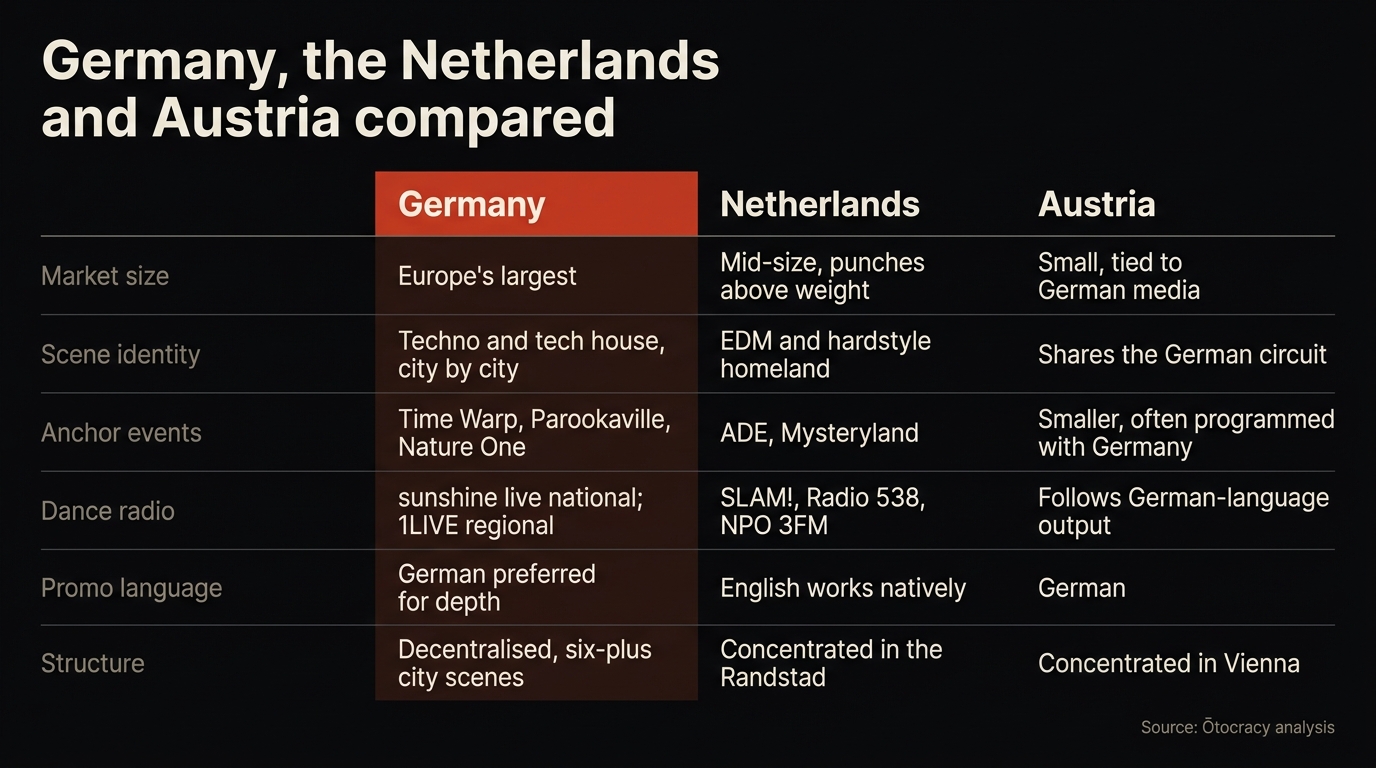
| Dimension | Germany | Netherlands | Austria |
|---|---|---|---|
| Market size | Europe's largest recorded-music market | Mid-size, punches far above weight | Small, closely tied to German media |
| Scene identity | Techno and tech house heartland, city by city | EDM and hardstyle homeland | Shares German-language media and much of the circuit |
| Anchor events | Time Warp, Parookaville, Nature One, Sonne Mond Sterne | ADE, Mysteryland | Smaller circuit; often programmed alongside Germany |
| Dance radio | sunshine live nationally; 1LIVE regionally | SLAM!, Radio 538, NPO 3FM | Largely follows German-language output |
| Promo language | German strongly preferred for depth | English works natively | German |
| Structure | Decentralised across six-plus city scenes | Concentrated around the Randstad | Concentrated around Vienna |
The regional play most artists miss: German-language promotional assets work across Germany, Austria and German-speaking Switzerland with almost no additional cost. The localisation you pay for once covers roughly 100 million people. Set against the Netherlands — covered in the Dutch market guide — Germany costs more to enter properly and returns considerably more scale when it works.
How to Run a Music Promotion Campaign in Germany
The sequence that fits the market:
- Pick cities, not the country. Choose two or three scenes that match your subgenre — Berlin and Leipzig for techno, Cologne and Mannheim for house and tech house, Hamburg for broader electronic — and concentrate rather than spreading thin.
- Time against the festival calendar. Four to six weeks before Time Warp in March, or before the July-August open-air block, depending on subgenre.
- Get the record into German DJ hands first. The club-first market rewards this more than most; the record should be circulating before the release date.
- Localise the promotion, not the music. German ad copy, German creator briefs, German pitch text — the track itself can stay exactly as it is.
- Pitch by subgenre, never as "dance". German editorial and curator ecosystems are genre-precise, and a vague pitch reads as an artist who does not know their own record.
- Treat radio as confirmation. sunshine live and 1LIVE amplify records with existing momentum rather than creating it.
Based on 2,400+ campaigns run by our founding team, the German campaigns that worked were narrower than the artists initially wanted — fewer cities, one subgenre, one clear window — and the ones that disappointed tried to address all of Germany at once with English-language assets.
If you are unsure whether your existing German listeners are real or the residue of a playlist push, Otocracy's free audit separates the sources before you spend anything. For artists who want a German campaign planned around the actual calendar, our campaign packages cover it, and labels moving several releases a year into the German market can run the whole roster through one pipeline.
Frequently Asked Questions
How big is the German music market?
Germany is Europe's largest recorded-music market, generating 2.42 billion euros in 2025 according to BVMI. Growth slowed sharply to 2.3 percent from 7.2 percent the previous year, and streaming now accounts for 84.4 percent of all recorded-music revenue in the market.
Do I need German-language music to succeed in Germany?
No — electronic and instrumental records work natively. What you generally do need is German-language promotion: ad copy, creator briefs and pitch text. Localising around the record rather than the record itself is a cheap adaptation with a measurable return outside the major cities.
When is the best time to release music in Germany?
Time the release against the calendar that matters for your subgenre. Four to six weeks before Time Warp in Mannheim in March suits techno and tech house, while the July and August open-air block covers Parookaville, Nature One and Sonne Mond Sterne.
Does radio still matter for electronic music in Germany?
More than in most markets, because sunshine live is a genuinely national electronic station with 32 subchannels, and 1LIVE reaches Germany's most populous state. Both work as confirmation and reach for records that clubs have already moved, rather than as a starting engine.
Which German cities should I target first?
Pick by subgenre rather than by size. Berlin and Leipzig lean techno, Cologne and Mannheim carry house and tech house, and Hamburg spans broader electronic. Concentrating on two or three scenes consistently outperforms spreading a budget across the whole country.
Is German promotion worth the localisation cost?
Usually yes, because the assets travel further than people expect. German-language creative works across Germany, Austria and German-speaking Switzerland — roughly 100 million people between them — so a localisation you pay for once ends up serving three markets rather than one.