SoundCloud Profile Audit: A 20-Minute Self-Check (2026)
How to audit your own SoundCloud profile in 20 minutes: reach, follower quality, engagement and catalogue, checked against 2,000 measured profiles.

Quick Answer
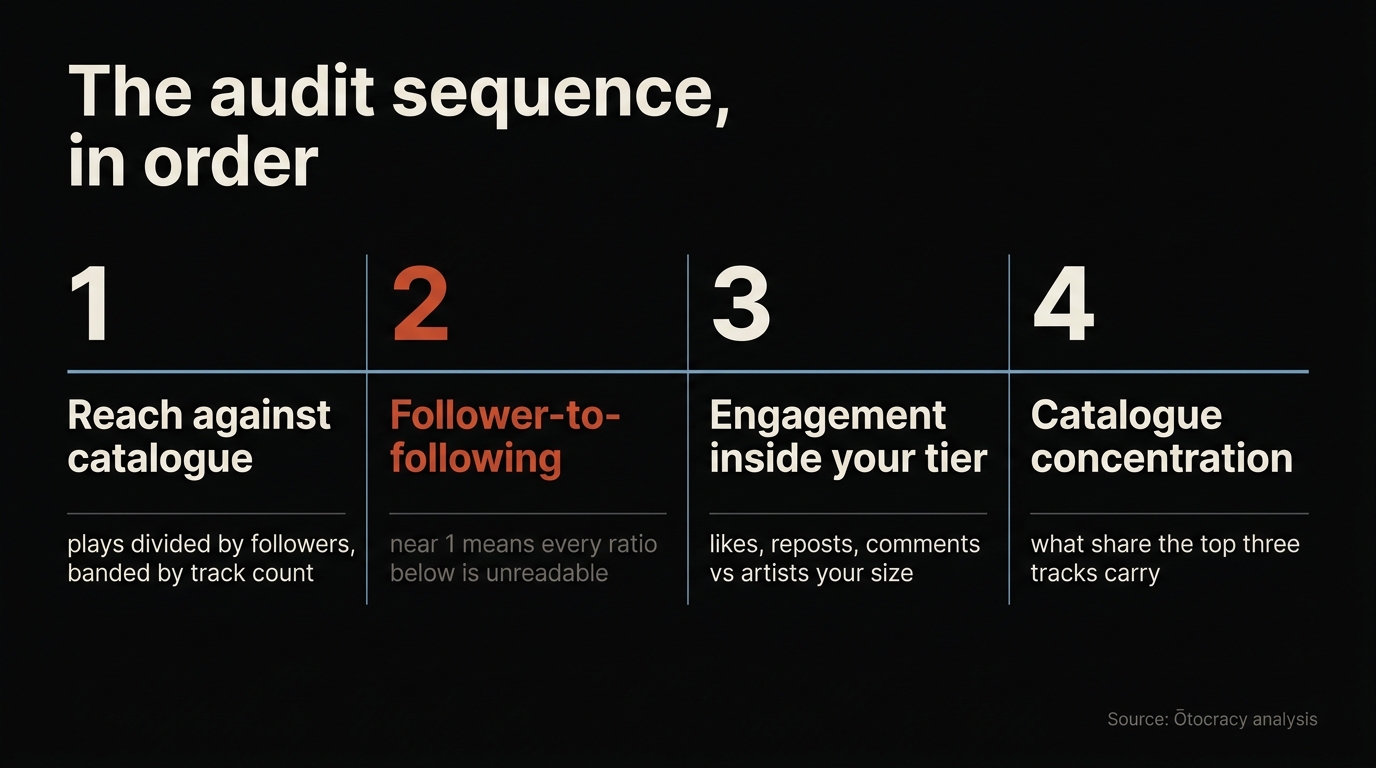
A SoundCloud profile audit is a structured read of four numbers — reach, follower quality, engagement and catalogue concentration — checked against what artists your size actually post rather than against a screenshot from a bigger account. It takes about twenty minutes by hand. The order matters: place your plays-per-follower against your catalogue size first, because catalogue size drives that ratio harder than follower count does, then check follower-to-following before you interpret anything else. A follower-to-following ratio near 1 means the denominator is inflated and every ratio downstream of it is unreadable. Only then are engagement rates worth looking at, and only inside your own follower tier. The benchmarks below come from 2,000 public profiles sampled on 28 August 2026. The audit tells you which of three problems you have: reach, audience quality, or promotion cadence.
I have opened a lot of SoundCloud profiles with an A&R hat on — for Temple of Sinners, for Underkntrl, and every time somebody sends a demo asking why nothing is moving. The read takes about twenty minutes and it almost never starts where the artist expects.
It does not start with the music. It starts with whether the numbers on the page can be trusted at all, because half the profiles I open have a denominator problem that makes every other statistic meaningless.
Here is the same order I use, with the benchmarks to check yourself against.
What an Audit Is Actually For
An audit answers one question: is the problem reach, audience, or cadence?
Those three need completely different responses. Reach problems are promotion problems. Audience problems mean the followers you have are not listeners. Cadence problems mean you are uploading faster than you can push anything.
Artists routinely treat all three as the same problem and buy the same solution for it. Across the 2,400+ campaigns run by our founding team, mismatching the diagnosis to the spend is the single most expensive mistake we see before anyone talks to us.
Before You Start
Open your profile in a logged-out browser window so you see what everybody else sees. Write down four things:
- Follower count
- Number of accounts you follow
- Total public tracks
- Total plays across the profile
That is the whole input. You do not need SoundCloud Pro and you do not need a third-party tool for the first pass.
Step 1: Place Your Reach Against Catalogue Size
Divide total plays by follower count. Then find your row by track count — not by follower count, which is the mistake almost every comparison makes.
| Catalogue size | 25th percentile | Median | 75th percentile |
|---|---|---|---|
| Under 50 tracks | 0.403 | 0.922 | 2.184 |
| 50 to 150 tracks | 0.133 | 0.315 | 0.680 |
| 150 to 400 tracks | 0.057 | 0.154 | 0.336 |
| Over 400 tracks | 0.014 | 0.026 | 0.057 |
Catalogue size predicts this ratio far better than audience size does, and the spread between the top and bottom band is roughly 35-fold. A prolific producer compared against a five-track EP artist will always look broken. The reasoning behind the denominator is worked through in SoundCloud plays per follower.
Note where you land — bottom quartile, middle, top quartile — and move on. Do not act on it yet.
Step 2: Check Whether the Followers Are Real
Divide followers by the number of accounts you follow.
Measured medians run from 0.3 in the smallest band up to 3,922 for accounts over 100,000 followers. The number itself is less important than the shape: a ratio hovering near 1 at any meaningful follower count means a large share of your audience arrived through reciprocal follows.
This is the step that decides whether the rest of the audit is worth doing. Follow-for-follow accounts inflate your denominator without ever playing anything, so a profile built that way shows a poor plays-per-follower ratio and weak engagement no matter how good the music is. If this is your shape, the audit is finished — the problem is audience quality, and no amount of promotion spend fixes a list of people who were never listening.
Step 3: Read Engagement Inside Your Tier
Only now do likes, reposts and comments mean anything. Compare them against your own follower tier, never against a global figure.
| Follower tier | Median like rate | Median repost rate | Median comment rate |
|---|---|---|---|
| Under 500 | 4.3% | 0.09% | 0.14% |
| 500 to 1k | 4.0% | 0.23% | 0.33% |
| 1k to 2.5k | 4.2% | 0.35% | 0.36% |
| 2.5k to 5k | 4.2% | 0.32% | 0.28% |
| 5k to 10k | 4.0% | 0.32% | 0.33% |
| 10k to 25k | 3.7% | 0.26% | 0.13% |
| 25k to 50k | 3.7% | 0.28% | 0.12% |
| 50k to 100k | 3.5% | 0.22% | 0.08% |
| Over 100k | 3.1% | 0.16% | 0.05% |
Two things to know before you judge yourself against these. Like rate drifts down as accounts grow rather than up, so a falling like rate through a growth phase is normal. And repost rate peaks in the 1,000-to-2,500 band and declines above it — reposting is most active among small and mid-sized artists, not large ones.
If you have been comparing your comment rate against the 0.5% to 2% figure that circulates on promo blogs, stop. No tier in our sample has a median that reaches 0.5%. We took that claim apart in SoundCloud engagement rate benchmarks.
Step 4: Find Which Tracks Carry the Profile
Sort your tracks by plays and add up what the top three represent as a share of your total.
If three tracks carry most of the profile, you have a catalogue that peaked rather than a career that is compounding. That is common and it is fixable, but it changes what to do next: the job is transferring attention from those tracks to newer ones, not acquiring more strangers.
If plays are spread evenly and all of them are low, the problem is upstream — nothing is getting pushed hard enough to break out at all.
Step 5: Read the Page Like an A&R Would
Close the analytics and look at the profile itself. This is the part no tool measures and the part that decides whether a label listens past thirty seconds.
- Does the avatar and header read as a coherent project, or as a folder?
- Is the genre obvious within one screen? "Techno" is not a genre in 2026 — melodic, hard, industrial and hypnotic are different rooms with different audiences.
- Do the newest three uploads look like the same artist?
- Is there one clear next action in the bio, or four dead links?
- Are edits, bootlegs and unreleased IDs mixed in with original work without any hierarchy?
When I am deciding whether to reply to a demo, this takes fifteen seconds and it happens before I open the track.
Step 6: Decide What It Told You
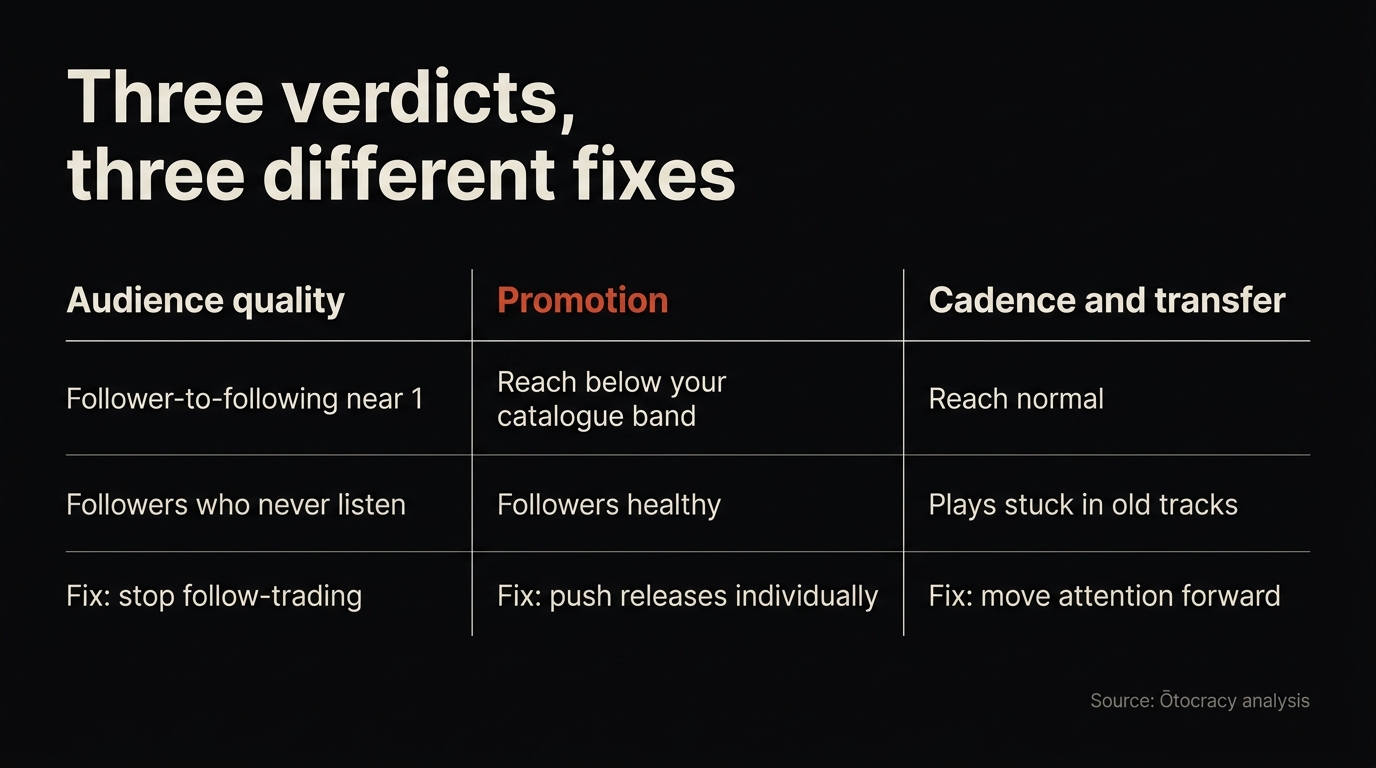
The audit resolves to one of three verdicts.
| What you found | The problem | What to do about it |
|---|---|---|
| Follower-to-following near 1 | Audience quality | Stop follow-trading. Rebuild around people who actually play the music |
| Reach below your catalogue band, followers healthy | Promotion | Push individual releases properly instead of relying on the profile |
| Reach normal, plays concentrated in old tracks | Cadence and transfer | Move attention from the catalogue peaks onto new work |
The order is what makes it work. Across the 2,400+ campaigns run by our founding team, the briefs that went wrong were almost always the ones where a cadence problem got treated as a reach problem, and the budget went to strangers instead of to the people already listening.
For the second and third, a free download on a track people already want is the cheapest bridge I know — it converts plays you are already getting into email addresses that survive whatever the platform does next. The mechanics are in what a download gate is, and you can build one on Ōtocracy Gates without paying anything.
If the verdict is promotion and you want it run rather than explained, our campaign packages cover the release-level push. The wider strategic picture lives in the complete EDM promotion guide.
What to Re-Check After a Campaign
The audit above is a baseline. The follow-up is narrower, and the mistake most people make is re-running the whole thing a week later and reading noise.
Plays per follower barely moves inside a month, because both halves of the fraction change together. Ignore it until the next quarter.
What does move on a campaign timescale is engagement on the pushed track specifically, follower-to-following if the campaign brought in follows, and the concentration figure from Step 4 — a campaign that worked shows up as the new release climbing toward the top of your catalogue, not as a change in the profile average.
If a campaign moved plays but nothing else, that is worth knowing quickly. Plays without likes, reposts or comments is the signature of traffic that was not really listening, and it is the same shape whether the cause was a bad ad audience or something worse.
What an Audit Cannot Tell You
It cannot tell you whether the music is good. Nothing on this page measures that and anybody selling you a score that claims to is selling you a number they invented.
It cannot tell you why a specific track underperformed — that needs release-level data, not profile-level.
And it cannot compare you against SoundCloud as a whole. Our benchmark sample is snowballed through reposts and follows, so it carries a follower floor and describes working artists rather than the platform's long tail. Every band here means "typical for artists your size", not "typical for everyone".
Frequently Asked Questions
How do I audit my SoundCloud profile?
Write down followers, accounts followed, track count and total plays. Divide plays by followers and compare against your catalogue-size band. Then check follower-to-following to confirm the audience is real, read engagement inside your follower tier, and check how concentrated your plays are across tracks.
What is a good plays-per-follower ratio on SoundCloud?
It depends on catalogue size, not follower count. Median is 0.92 for profiles under 50 tracks, 0.315 for 50 to 150 tracks, 0.154 for 150 to 400, and 0.026 past 400 tracks.
How can I tell if my SoundCloud followers are fake?
The clearest single signal is a follower-to-following ratio near 1 at a meaningful follower count, which points at reciprocal follow-trading. Purchased followers usually show as a normal ratio with unusually low plays-per-follower and near-zero engagement.
Do I need SoundCloud Pro to audit my profile?
No. Every number in the first pass — followers, following, track count and total plays — is visible on a public profile. Pro adds listener geography and referral sources, which matter for release-level analysis rather than a profile audit.
How often should I audit my profile?
Once a quarter, and again after any campaign. More often than that and you are reading noise, since the ratios move slowly by design.
Where do these benchmarks come from?
A stratified sample of 2,000 public SoundCloud profiles taken on 28 August 2026, roughly 223 per follower tier, with each artist's full catalogue read. The complete percentile tables are published on our benchmarks page.
The Bottom Line
Most artists audit in the wrong order — engagement first, then reach, then a conclusion about the music. Doing it backwards means interpreting ratios that a bad denominator has already made meaningless.
Follower quality first, reach against catalogue second, engagement inside your tier third. The verdict is almost always one of three, and each of the three costs a different amount to fix.
And judge the third step against your own scene where we have measured it — techno, tech house and hard dance each have a different normal, set out in SoundCloud benchmarks by genre.
If you would rather have it done automatically, the free SoundCloud audit runs the same sequence and places your profile against every band in the sample.