How Beatport Charts Work: The 2026 Guide for Labels
How the Beatport Top 100 and genre charts are actually calculated, how often they update, and the pre-order rule that decides where a release starts.

Quick Answer
Beatport's Global Top 100 and Genre Top 100 charts rank tracks by sales, and Beatport updates them every day. Every track on the store is eligible; there is no submission, no editorial gate, and no playlist equivalent standing between a release and a chart position. The lever Beatport documents itself is the pre-order: a release can go up for pre-order as far as four weeks ahead, and every sale generated in the 28 days before release date is spread across the first week of charting rather than landing on day one. That turns a month of accumulated demand into sustained chart presence instead of a single spike. Genre charts matter more than the global chart for most independent labels, because the sales volume required is far lower and the DJs digging there are looking for exactly that sound. Smaller labels have a third option, the Hype charts, with its own eligibility rules.
Beatport charts are the KPI most electronic labels are actually judged on, and the mechanism behind them is documented publicly, in plain language, by Beatport itself.
Very little of the advice circulating about them reflects that documentation. So this is the mechanism, sourced to Beatport's own support pages, and what it implies for how a label schedules a year of releases.
What the Charts Measure
The Global Top 100 lists the 100 most popular tracks across every genre on Beatport, ranked on sales. The Genre Top 100 charts break the same measure down by genre.
Beatport states the qualifying condition plainly: every track on Beatport is eligible to enter the Top 100 charts. There is no pitch, no curator approval, and no gatekeeper. This is the single most important structural difference between Beatport and the streaming platforms a label deals with the rest of the week.
On Spotify, editorial placement is a decision somebody makes about your record. On Beatport, a chart position is an outcome of what people bought. The first can be influenced by relationships. The second responds only to demand inside a window.
| Beatport Top 100 | Spotify editorial playlists | |
|---|---|---|
| Entry condition | Sales, any track eligible | Editorial selection |
| Who decides | Buyers | Playlist curators |
| How to enter | Sell in the window | Pitch and wait |
| Update cadence | Daily | Weekly cycles, curator-led |
| What it signals | Current DJ demand | Curator confidence |
Updates Are Daily
Beatport's support documentation states that the Top 100 and Genre Top 100 charts update every day, based on sales.
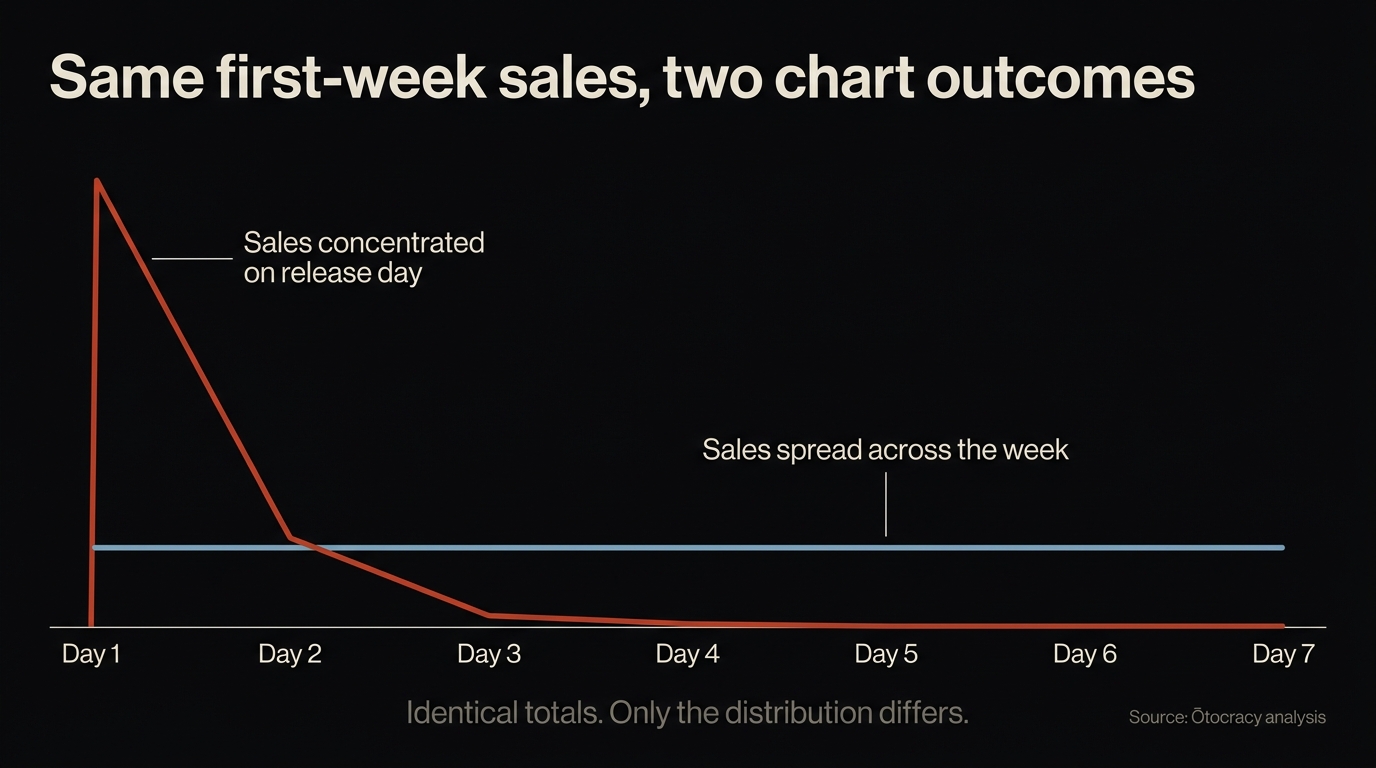
Daily refresh has a practical consequence that monthly-planning labels miss. A chart position is not a prize awarded at the end of a campaign — it is a running readout that moves every 24 hours. A release can enter, climb, and fall inside a single week, and the shape of that curve is set by how sales are distributed across days rather than by the total.
Two releases with identical first-week sales can chart completely differently. The one whose sales arrive evenly holds a position for days. The one whose sales all land on Friday spikes and drops.
The Pre-Order Rule
This is the part worth reading twice, because it is the one genuine structural lever Beatport publishes and the one most independent labels leave unused.
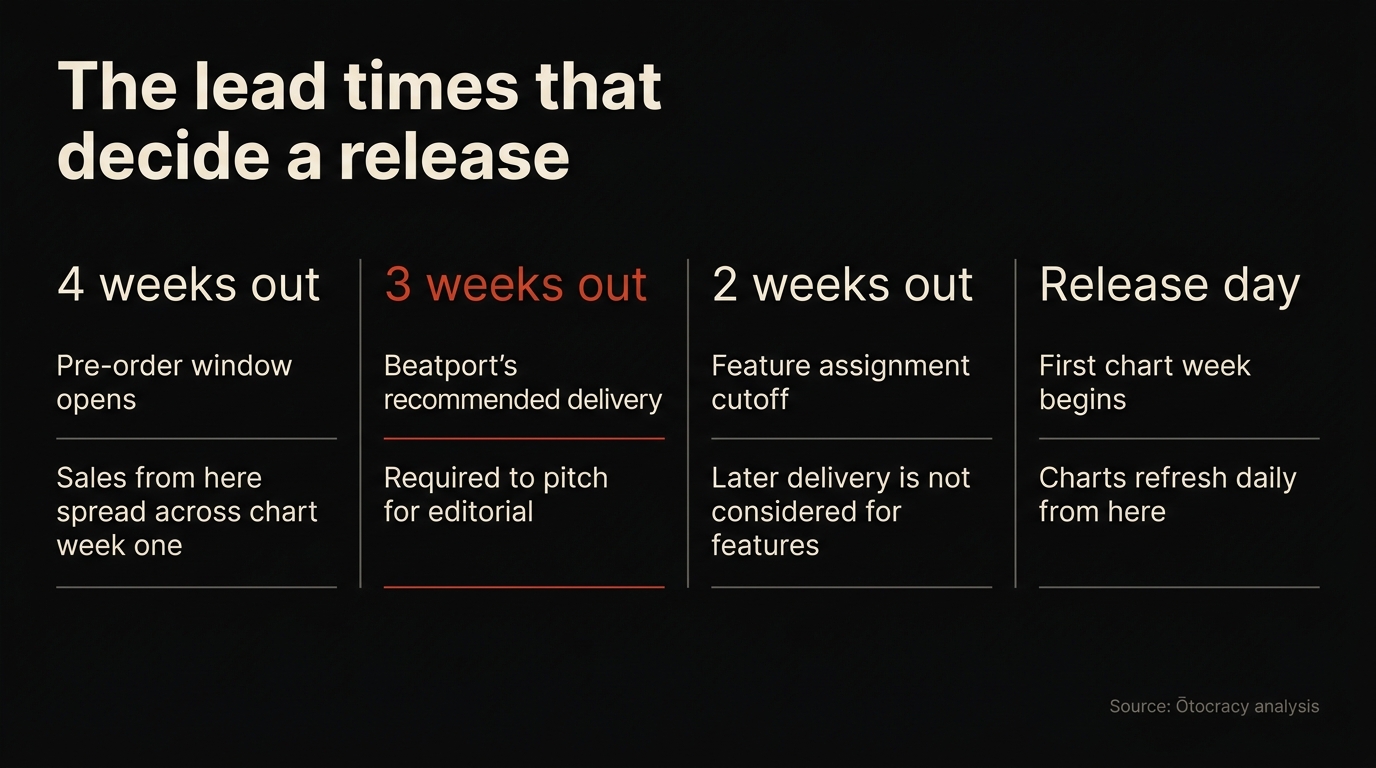
Beatport's own guidance on entering the Top 100 is to set the track up as a pre-order with your distributor and share it ahead of release date. Pre-orders can currently be set up as far as four weeks before release, and — in Beatport's words — all sales generated within the 28 days prior to release date are spread out across the first week of charting.
Read that mechanically. Pre-order sales do not dump into day one. They are distributed across the first charting week. A label that accumulates four weeks of pre-order demand converts it into a sustained position rather than a one-day spike, which is exactly the curve shape that holds a chart place.
The implications for a release calendar:
- Lead time is the constraint. A release delivered to a distributor with two weeks' notice cannot use a four-week pre-order window. The chart outcome is partly decided before any promotion runs.
- Promotion before release date is not wasted. On streaming, pre-release attention mostly converts to a release-day number. On Beatport, it accumulates into the charting week directly.
- DJ support pre-release compounds. Beatport specifically points at including the track in DJ Charts on the platform ahead of release, alongside the pre-order.
Delivery Lead Time Decides More Than the Pre-Order
The pre-order window is not the only thing an early delivery buys, and the second mechanism is stricter than the first.
Beatport states it works two weeks in advance when assigning features for the Friday store update, and that anything delivered after that point will not be considered for features — explicitly, whether you are a Hype label or not. Its own recommendation is to deliver at least three weeks ahead of the Beatport release date if you intend to pitch for editorial support.
Stack that against the four-week pre-order window and the calendar resolves itself. A release delivered three to four weeks out can use the pre-order distribution and remain eligible for a store feature. A release delivered inside two weeks has forfeited the second entirely, before anyone has heard it.
Across the 2,400+ campaigns run by our founding team, this is the most common unforced error in a label calendar — not a bad record or a thin budget, but a delivery date that quietly disqualified the release from half of what was available to it.
Genre Charts Are the Realistic Target
For almost every independent label, the Global Top 100 is the wrong goal and the genre chart is the right one.
The global chart aggregates every genre on the platform, so entering it means outselling releases from the largest labels in dance music that week. A genre chart requires only outselling other releases in the same genre, and the audience reaching it is more useful — Beatport describes genre charts as the place DJs dig deeper into the sounds they specifically like.
For a label, that is the whole argument. A genre chart position reaches DJs who play your genre. A global position reaches everyone, most of whom will never play your record. Across the 2,400+ campaigns run by our founding team, the reach that converts into bookings and A&R conversations is consistently the specific kind, not the broad kind.
Genre choice at delivery therefore carries real weight, and it is a metadata decision made once, usually in a hurry. A track filed under a broad genre competes with everything in it. The same track filed accurately competes in a smaller, better-matched field.
Where Hype Fits
Beatport runs a third chart ecosystem for smaller labels: the Hype charts, which only labels enrolled in the Hype programme can enter. Eligibility is capped by sales, so the field is other emerging labels rather than established ones.
A track can chart on both a Genre Top 100 and a Hype chart at the same time if it has enough sales — Beatport confirms this directly. The two are not alternatives.
Hype has its own eligibility rules, genre restrictions and a couple of traps worth knowing before subscribing. We covered it in full in Beatport Hype for labels.
What This Means Across a Release Year
The honest math for a label running 12 to 24 releases a year is that chart strategy is mostly calendar strategy.
Four-week pre-order windows require delivery roughly six weeks ahead of release once distributor lead times are accounted for. A label that works two weeks ahead structurally cannot use the mechanism, no matter how good the records are. Fixing the calendar costs nothing and changes what every subsequent release is capable of.
Spacing matters too. Two releases from the same label charting in the same genre in the same week compete with each other for the same buyers. Across a roster, that is an avoidable own goal, and it is the most common scheduling error we see when we take on a label's calendar — the release plan was built around when records were finished rather than around when they could perform.
What Charts Do and Do Not Prove
A Beatport chart position is evidence of concentrated demand in a genre over a short window. That is genuinely useful: it opens A&R conversations, supports booking negotiations, and gives press a hook.
It is not evidence of a durable audience. Streaming and an owned fan list measure that, and they move on completely different timescales. A label reading a chart peak as proof of long-term growth will be surprised a quarter later.
Treat it as one instrument among several. The catalogue view and the budget view answer questions charts cannot, and a release plan built only around chart weeks tends to under-invest in everything that compounds.
Anyone selling a guaranteed chart position is selling something they cannot deliver — the chart is computed from sales, and nobody controls what strangers buy. Be specific about that when you hear the promise.
Frequently Asked Questions
How are Beatport charts calculated?
By sales. The Global Top 100 ranks the 100 most popular tracks across all genres, and the Genre Top 100 charts rank the same measure within each genre. Beatport states that every track on the store is eligible to enter, with no submission or editorial approval.
How often do Beatport charts update?
Every day, based on sales, according to Beatport's own support documentation. A chart position is a running daily readout rather than a weekly result.
How far in advance can I set up a Beatport pre-order?
Currently up to four weeks before release date. Beatport states that all sales generated within the 28 days prior to release are spread out across the first week of charting, rather than landing on release day.
Do pre-order sales count toward the charts?
Yes, and the distribution is the point. Rather than counting on the day they occur, pre-order sales from the 28-day window are spread across the first charting week, which supports a sustained position instead of a single-day spike.
Should a label target the Global Top 100 or a genre chart?
For almost all independent labels, the genre chart. It requires far lower sales volume and reaches DJs specifically digging that sound, which is the audience that converts into plays, bookings and A&R interest.
Can a track chart on both a genre chart and a Hype chart?
Yes. Beatport confirms a track can chart on both the Top 100 and Hype simultaneously if it has enough sales. They are separate chart ecosystems, not alternatives.
The Bottom Line
Beatport charts reward two things a label controls completely: delivering early enough to use a four-week pre-order window, and choosing the genre a record can actually compete in. Neither costs money and both are decided before promotion starts.
Everything else is demand, and demand is what the rest of the release plan is for.
Labels running several releases a month can see the calendar, the chart movement and the campaign receipts in one place through Ōtocracy's roster tools — and how a label month is built walks through the structure. If you want to see what free downloads are moving in the scene right now, the Ōtocracy Top 100 ranks live gates by actual download volume.
Chart mechanics above are sourced from Beatport's own support documentation and were verified on 4 September 2026. Beatport changes platform rules periodically — confirm current behaviour with your distributor before building a calendar around it.