TikTok vs Spotify Ads for EDM: What Each Actually Buys
TikTok creator campaigns and Spotify Ads solve different problems for electronic artists. What each buys, what it costs, and which one your release needs.

Quick Answer
TikTok creator campaigns and Spotify Ads are not alternatives — they buy different things and fail in different places. TikTok buys discovery among people who have never heard you, and it builds an asset that persists: an official sound page that accumulates every video anyone makes with the track. Spotify Ads buys reach to people already inside Spotify, targeted by interest and listening behaviour, delivered as audio, video, display or the newer carousel formats through Spotify Ads Manager, which carries a $250 minimum per campaign and audio CPMs commonly in the $15 to $25 range. Nothing persists after the budget stops. For a release with no existing audience, TikTok is usually the correct first spend, because Spotify's minimum buys impressions from people who have no reason to care yet. For a catalogue with listeners already on Spotify, ads convert better and retargeting becomes available. Sub-genre decides more than budget does: festival-facing EDM works on both, and underground techno works on neither.
The question comes up on nearly every release plan, and it is usually framed as which channel is better. That framing produces bad answers, because the two are not competing for the same job.
One buys attention from people outside your audience. The other buys attention from people already inside a platform where your music lives. Confusing the two is how a budget gets spent on the wrong problem.
Here is the comparison, channel by channel, with the sub-genre caveat that decides most of it.
What Each Channel Actually Is
| TikTok creator campaigns | Spotify Ads | |
|---|---|---|
| What you buy | Creators posting with your sound | Impressions or reach inside Spotify |
| Who sees it | People outside your audience, by interest graph | Spotify users, targeted by listening behaviour |
| Formats | Creator video, sound-first | Audio, video, display, carousel (beta since March 2026) |
| Entry point | Per-creator pricing | $250 minimum per campaign via Spotify Ads Manager |
| Typical pricing model | Per creator, per deliverable | CPM — commonly $15 to $25 for audio |
| What persists afterwards | An official sound page that keeps accumulating | Nothing |
| Objectives available | Sound adoption, video volume | Awareness, reach, or clicks |
The last two rows are the ones that matter and the ones nobody weighs properly.
The Asset Question
This is the real structural difference between the two.
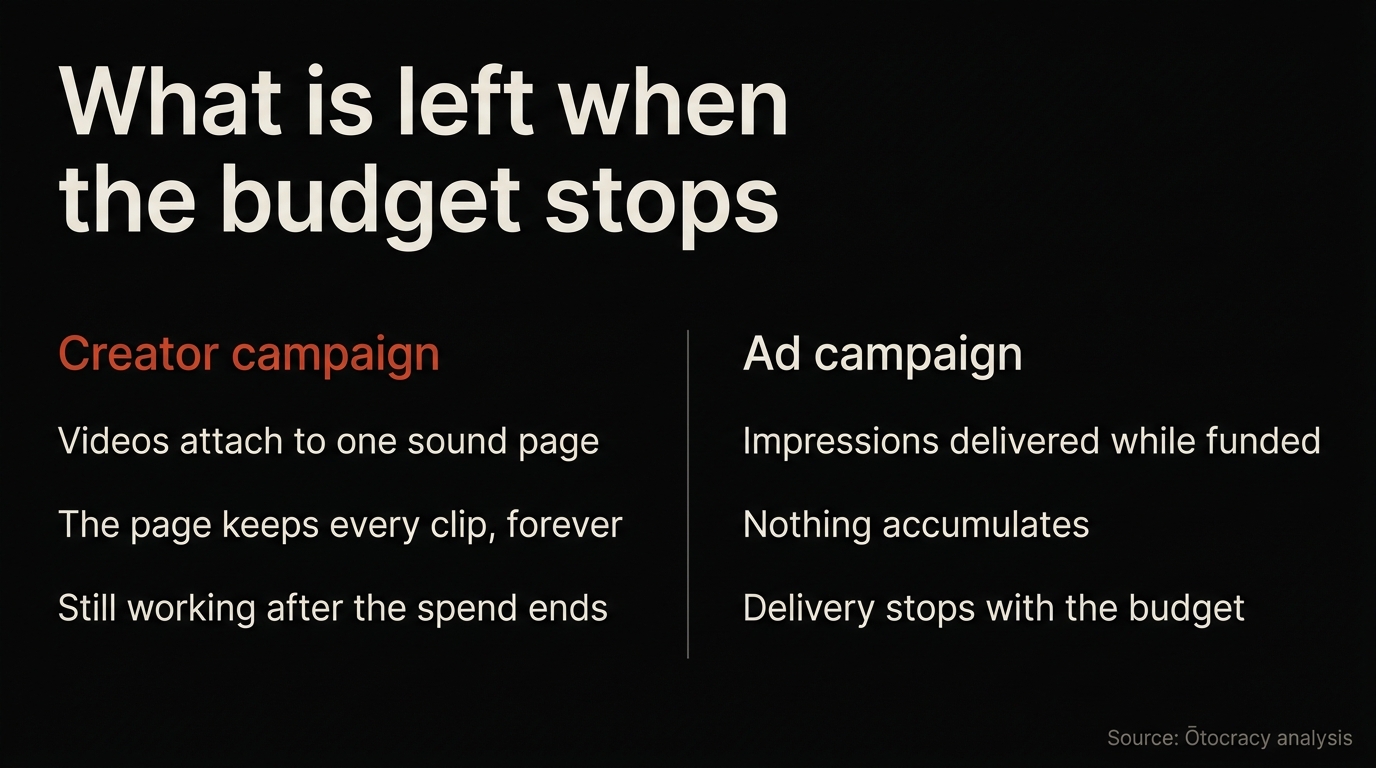
A TikTok creator campaign produces videos, and every one of those videos attaches to a single sound page — assuming the creator selected your track in-app rather than baking the audio in. That page keeps every clip that ever used the track. A creator who posts in March is still adding to the page a fan finds in November. It is shareable, it is evidence for a label or booker, and it routes to streaming.
A Spotify Ads campaign produces impressions. When the budget stops, the delivery stops, and there is no page, no accumulation and nothing to send anybody. That is not a criticism — it is what an ad platform is — but it changes how you should think about the spend. TikTok spend partly buys an asset. Spotify spend buys reach and nothing else.
The sound page mechanics go through what that asset actually contains.
Sub-Genre Decides More Than Budget
The single most common mistake is treating "EDM" as one audience. It is not, and the two channels perform very differently across it.
| Sub-genre | TikTok | Spotify Ads |
|---|---|---|
| Festival and mainstage | Strong — the audience is native to the platform | Works, competes with large budgets |
| Future house, bass house | Reasonable | Reasonable |
| Melodic house and techno | Mixed — some crossover, thin at the underground end | Better for catalogue push |
| Peak-time and hard techno | Weak — the scene does not live there | Weak — discovery runs through DJs |
| Raw, deep and hypnotic techno | Very weak | Very weak |
That bottom half is the part generic music-marketing advice will not tell you. Techno's discovery layer is DJs playing records in rooms, not either of these channels — which is why the techno promotion playbook runs a completely different sequence, with promos and the club circuit ahead of any paid spend.
Spending a festival-EDM playbook on a hypnotic techno record is the most reliable way to waste a budget that I know of.
Which One Your Release Needs
Three questions settle it faster than a spreadsheet.
Does anybody already listen to you on Spotify? If your monthly listeners are near zero, ads are pushing a track at strangers inside a platform built for people with existing intent. TikTok's job is precisely to reach people who have not heard you. Start there.
Is the record clippable? A hook that lands in the first five seconds and survives a phone speaker. Not every good record is clippable, and a track that is not should not be forced into a creator campaign to prove a point.
Is there a catalogue behind it? Ads convert far better when a new listener has somewhere to go afterwards. One single with nothing behind it converts a click into a single play and a dead end.
Across the 2,400+ campaigns run by our founding team, the reliable order for a new artist is discovery first and ads second, and the reliable order for an artist with existing listeners is the reverse. The budget size barely changes it.
Running Them Together
They compound in one specific direction, and the sequencing is not symmetrical.
TikTok first, ads second works: the creator campaign generates people searching your name, and a retargeting-capable ad campaign catches the ones who did not convert immediately. Spotify Ads Manager supports pixel tracking for retargeting, which is what makes the second half work.
Ads first, TikTok second mostly does not: you are paying for impressions from an audience that has no reason to look for you yet, then trying to build discovery afterwards from a standing start.
| Budget shape | What I would do |
|---|---|
| Small, one release, no audience | TikTok creator seeding only. Ads later, or not at all |
| Small, catalogue exists | Spotify Ads to the catalogue, organic TikTok alongside |
| Split across a release cycle | TikTok in weeks 1-3, ads with retargeting from week 3 |
| Underground techno, any size | Neither first — promos and the club circuit, then reassess |
Working with under a hundred euros a week, the self-serve tier runs the same funnel structure at independent scale, and what each budget band actually delivers is broken down in music promotion budget.
Measuring Them Is Not the Same Job
The metrics are not interchangeable, and comparing the wrong pair is how people conclude the cheaper channel won.
For a creator campaign the number that matters is sound-page growth — videos attached to your official sound, and whether that count keeps rising after the paid clips stop. View counts across creator videos tell you what you bought, not what it did. A campaign with high views and a flat sound page delivered nothing.
For Spotify Ads the number is what happens after the click: saves, follows and whether a listener returns without being paid for again. Impressions and reach are inventory, not results, and both are guaranteed by the buy.
Across the 2,400+ campaigns run by our founding team, the single most common reporting error is comparing a TikTok view count against a Spotify impression count as though they were the same unit. They are not, and the channel with the cheaper unit always looks like it won.
The comparison people actually want — cost per new listener — is only meaningful within a channel, not across. TikTok's cost includes an asset that keeps working; Spotify's does not, and pretending otherwise flatters the ad spend.
Where Each One Fails
TikTok fails when the sound is broken. A campaign run against a missing, unlinked or split sound produces views and no sound page, and that spend cannot be recovered — check why your song might not be showing before you brief anybody. It also fails when creator selection is done on follower count rather than whether that creator's audience plays your genre.
Spotify Ads fail when there is no destination. An audio ad driving to a profile with one track, no Canvas and a blurry photo converts a click into nothing. They also fail on thin targeting: interest categories are broad, and for a specific electronic sub-genre the reachable audience can be much smaller than the platform's estimate suggests.
Both fail identically in one respect: neither creates demand for a record nobody wants. Paid channels amplify a signal; they do not manufacture one.
Frequently Asked Questions
Is TikTok or Spotify Ads better for promoting music?
Neither, in general — they buy different things. TikTok buys discovery among people who have never heard you and builds a sound page that persists. Spotify Ads buy reach among people already using Spotify and stop delivering when the budget does. New artists usually need the first, catalogue artists the second.
How much do Spotify Ads cost in 2026?
Spotify Ads Manager carries a $250 minimum per campaign with no platform fee on top, and audio inventory commonly prices in the $15 to $25 CPM range. Campaigns are built around awareness, reach or click objectives.
What is Spotify Ad Studio called now?
It is Spotify Ads Manager. The self-serve platform now covers audio, video, display and carousel formats, with carousel added in beta in March 2026, alongside split testing and automated bidding.
Do Spotify Ads work for techno?
Poorly, and so does TikTok. Techno discovery runs through DJs playing records rather than through either channel, so the effective sequence is DJ promos and club plays first, with paid spend considered only once a record is already moving.
Can I run TikTok and Spotify Ads at the same time?
Yes, and the order matters. TikTok first then ads with retargeting works, because the creator campaign generates people who searched your name and the ad catches those who did not convert. The reverse sequence usually does not.
Which is better value on a small budget?
For an artist with no existing Spotify audience, TikTok creator seeding, because Spotify's $250 campaign minimum buys impressions among people with no reason to care yet. For an artist with catalogue and listeners, ads convert better at the same spend.
Does a TikTok campaign help my Spotify numbers?
Only if the conversion path works. The sound page has to link cleanly to your artist profile and the track has to be live and searchable, otherwise a trend produces recognition with nowhere to go. Fixing that path is worth more than extra creator budget.
The Bottom Line
Stop comparing them on cost per result, because they are not producing the same result. One buys strangers and leaves you a page that keeps working. The other buys attention inside a platform where your music already lives and stops the moment you stop paying.
Decide on audience state and sub-genre, not budget. No existing listeners means discovery first. Existing listeners with catalogue behind them means ads first. And if you make underground techno, the honest answer is that the money belongs somewhere else entirely.
If you want a read on which state you are actually in, the free audit breaks down where your listeners are coming from before you commit anything, and our campaign packages run either side once the answer is clear.
Spotify Ads Manager formats, minimums and 2026 feature additions verified 5 September 2026. Platform pricing changes — confirm current rates before budgeting.