YouTube Ads for Music Promotion: Costs and Setup (2026)
YouTube ads for music promotion in 2026: what a view costs by format, CPV and CPM benchmarks, campaign setup, and where music ad budgets quietly leak.
Quick Answer
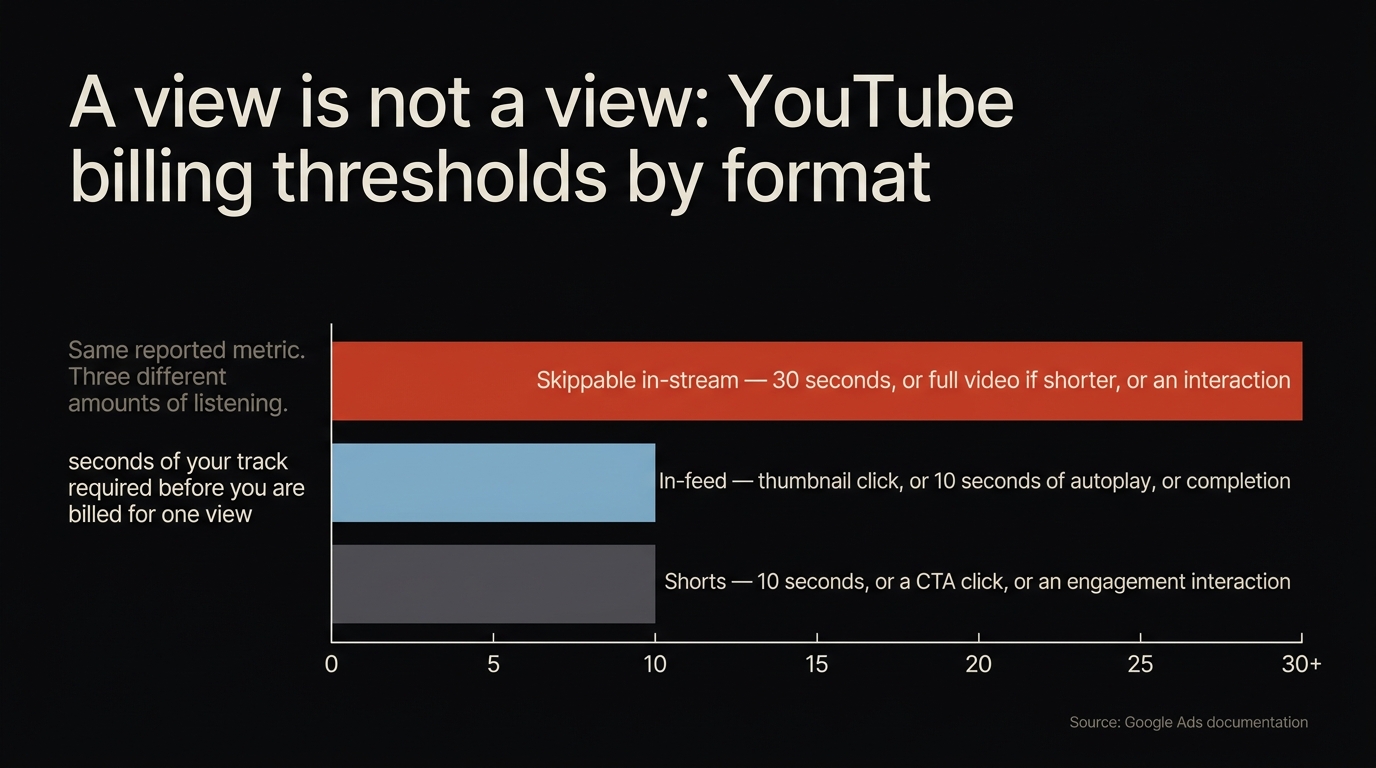
YouTube ads for music promotion are priced per view, and the trap is that YouTube defines a view three different ways depending on format. Per Google Ads documentation, a skippable in-stream view requires 30 seconds of watching or the full video if shorter. An in-feed view requires a thumbnail click or 10 seconds of autoplay. A Shorts view requires 10 seconds, a call-to-action click, or an engagement interaction. So the same reported view can mean 30 seconds of your track or 10. Market benchmarks put skippable in-stream CPV around $0.05 and Shorts CPV at $0.10 to $0.30, with YouTube CPMs averaging roughly $5 to $10. Based on 2,400+ campaigns run by our founding team, the cheapest reported CPV almost always buys the shallowest listening, and per euro of actual attention the in-stream 30-second view usually wins for music.
A €500 YouTube campaign and a €500 Meta campaign do not buy the same thing, and neither do two €500 YouTube campaigns running different formats. The delivery gap is measurable, and it comes down to one definition most artists never check.
YouTube sells views. YouTube also defines a view three separate ways. If you do not know which definition your campaign is buying, your cost-per-view number is not comparable to anything — including your own previous campaign.
This page covers the definitions, the 2026 cost benchmarks, how to build the campaign, and where music budgets leak. For how this sits alongside other channels in a release budget, what a music promotion budget actually buys has the allocation tables.
What a "View" Actually Means on YouTube
This is the whole game, so it goes first.
Google's documentation on cost-per-view bidding states you pay "when a viewer watches 30 seconds of your video, or the entire duration of the video if it's shorter than 30 seconds, or interacts with your video, whichever comes first." That is the in-stream definition. The other formats are looser.
| Format | What counts as a billable view | Listening depth |
|---|---|---|
| Skippable in-stream | 30 seconds, or full video if shorter, or an interaction | Deepest |
| In-feed video | Thumbnail click, or 10 seconds of autoplay, or completion | Medium, but intent-led |
| Shorts | 10 seconds, or a CTA click, or an engagement interaction | Shallowest |
For a clothing brand this distinction is a rounding error. For music it is the entire proposition. You are not buying impressions, you are buying seconds of somebody hearing your track — and a format that bills at 10 seconds is charging you for roughly a third of the exposure that an in-stream view delivers.
The practical consequence: never compare CPV across formats without normalising. A $0.10 Shorts view and a $0.05 in-stream view are not a 2x price difference in your favour. Per second of audio delivered, the in-stream view is often the cheaper of the two.
YouTube Ads for Music Promotion: Which Campaign Type Fits
Google Ads splits video campaigns into two families, and music sits comfortably in one of them.
| Campaign type | Formats served | Bidding | Fit for music |
|---|---|---|---|
| Video views | Skippable in-stream, in-feed, Shorts | Target CPV | The default for a release |
| Video reach — Efficient Reach | Bumper, skippable in-stream, in-feed, Shorts | Reach-optimised | Broad awareness, weak for listening |
| Video reach — Non-skippable Reach | Bumper, 15-second non-skippable | Reach-optimised | Brand moments, not tracks |
| Video reach — Target Frequency | Bumper, skippable or non-skippable in-stream | Frequency-optimised | Tour and event announcements |
Video views is the campaign type built for what a release needs: it optimises toward people likely to actually watch, and you pay per view rather than per thousand impressions. Bumper ads — the 6-second non-skippable format — have a real use for tour announcements and almost none for making somebody hear a track, because six seconds is not a listen.
One setup note that costs people money: Shorts ads are only available in multi-format campaigns, and multi-format is enabled by default. If you do not want your budget flowing into 10-second Shorts views, that is a deliberate configuration decision you have to make, not a default you inherit.
What YouTube Ads Cost in 2026: CPV and CPM Benchmarks
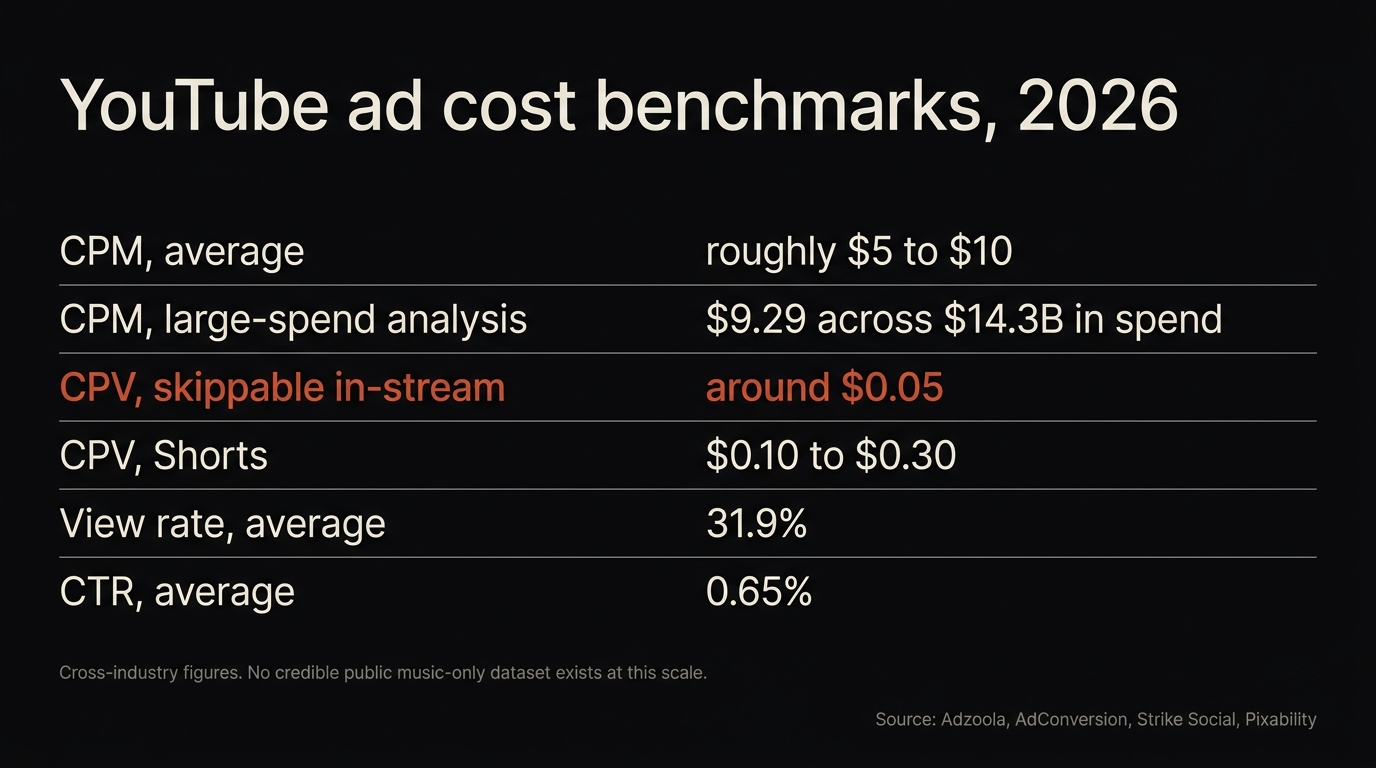
Market benchmarks, with their sources, because unsourced numbers in this category are usually somebody's sales page.
| Metric | Benchmark | Source |
|---|---|---|
| CPM, average | roughly $5 to $10 | Strike Social / market compilations |
| CPM, large-spend analysis | $9.29 average across $14.3B in spend | Adzoola |
| CPV, skippable in-stream | around $0.05 | AdConversion, $1M+ spend, 2023-2024 |
| CPV, Shorts | $0.10 to $0.30 | Market benchmarks |
| View rate, average | 31.9% | Strike Social |
| CTR, average | 0.65% | Pixability / Strike Social |
Two honest caveats. These are cross-industry figures, not music-specific ones — no credible music-only YouTube dataset exists publicly at this scale, and anyone presenting one is usually selling campaigns. And some widely circulated YouTube benchmark breakdowns by demographic trace back to a 2018 report, so treat granular slices with suspicion even where the headline averages hold.
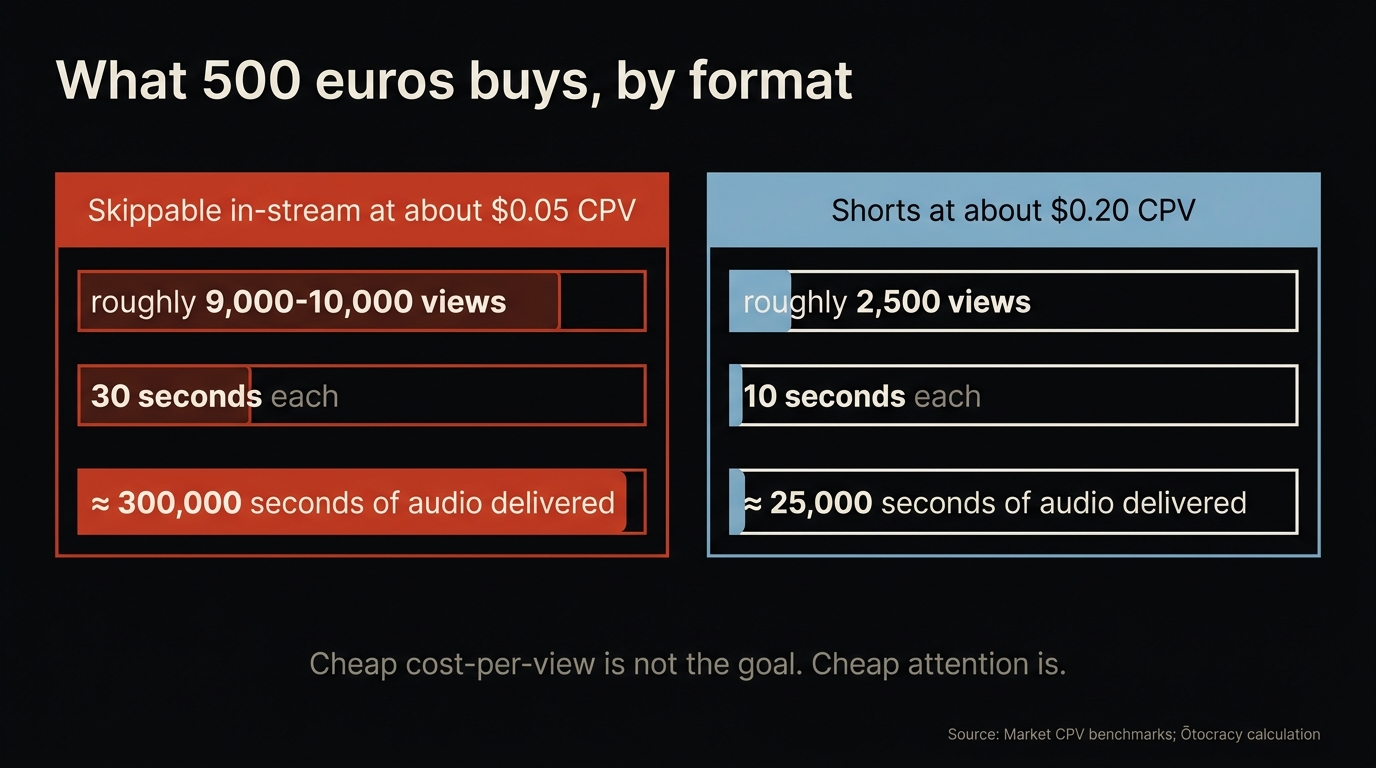
What this means in practice. At $0.05 CPV in-stream, €500 buys roughly 9,000 to 10,000 thirty-second views, allowing for exchange rate and auction variance. At $0.20 Shorts CPV the same €500 buys about 2,500 ten-second views. The first number is not five times better than the second — it is closer to fifteen times better measured in seconds of audio delivered.
The math is the math. Cheap CPV is not the goal; cheap attention is.
The Format Trap for Music: Shorts Views Are Not Listens
Shorts is where most music ad budgets quietly underperform, and the reason is structural rather than a targeting mistake.
A Shorts view bills at 10 seconds. Ten seconds of a track is roughly enough for a hook to start and not resolve. It is sufficient to build recognition across many exposures, which is a legitimate goal, and insufficient to convert somebody into a listener on a single exposure, which is usually the goal artists actually have.
Use Shorts deliberately, for what it does:
- Recognition campaigns before a release, where frequency across weeks matters more than depth on any single view.
- Retargeting audiences who already heard the track, where 10 seconds is a reminder rather than an introduction.
- Never as the primary format for a cold-audience conversion campaign on a new record.
For the actual job of making somebody hear enough of a track to want it, skippable in-stream at 30 seconds is the format that matches the objective. It costs more per view on paper and less per outcome in practice.
Building the Campaign: Targeting for Electronic Music
Audience construction on YouTube runs on different inputs than Meta, and the electronic-music-specific version is narrower than most guides suggest.
Start with channel placements, not interests. YouTube lets you target specific channels, and for electronic music this is the strongest signal available. The channels that matter are label channels, mix series, festival channels and the big genre aggregators — places where somebody is already sitting through long-form electronic music voluntarily.
Finding those channels is the tedious half of the job, and it is what the free YouTube audit now does for you: it reads what YouTube itself classifies your channel as, searches that, and returns real channels in the same room with their current subscriber counts. That is the placement list, already built and checkable — every channel on it links out so you can judge the fit yourself.
Use custom segments built from search behaviour. People searching for a specific artist, label or subgenre are a materially better audience than anyone in a broad "music lover" affinity category.
Keep the video short enough to be watched and long enough to bill honestly. A 30-second creative means every billable in-stream view is a complete view of your asset. Going longer means paying for views where the listener leaves at 30 seconds having heard less than you built.
Lead with the hook, not the intro. Skippable in-stream gives you five seconds before the skip button. If the drop or the vocal has not arrived by then, you are paying for the skips of people who would have liked the track.
Exclude your existing audience from cold campaigns. Subscribers and prior viewers are the cheapest people for the auction to serve, so an unexcluded campaign will happily spend its budget re-reaching people who already know the record. That produces a flattering CPV and no new listeners. Build the exclusion before the first euro, not after the first report.
On pacing: give the campaign a daily budget it can actually spend and a flight long enough to leave the noisy opening period behind. Roughly two weeks at a steady daily rate produces more usable signal than the same total spent aggressively across four days, because the auction spends the opening days calibrating and those numbers are not representative of anything you will see later.
The pixel and measurement foundations are the same discipline as Meta, and if you have not set those up, the Meta ads guide covers the account-level groundwork that applies to both platforms.
Measurement: Connecting YouTube Spend to Streams

YouTube will report views. It will not report whether those views produced listeners, and the gap between those two things is where most of the honest evaluation lives.
- Send traffic to a smart link, not to a streaming service directly. One link per campaign and per format, so in-stream and Shorts performance are separable.
- Watch Spotify for Artists listener source rather than raw stream count. The number that matters is whether external-source listeners rose during the flight.
- Compare cost per engaged second, not cost per view. Divide spend by the format's billing threshold multiplied by views. It is a rough number and it is far more comparable than CPV.
- Run one format at a time on a first campaign. Multi-format on a cold account produces a blended CPV that tells you nothing about which format worked.
- Give it a proper flight length. A campaign that runs four days and stops has spent most of its budget in the noisiest period of delivery.
Based on 2,400+ campaigns run by our founding team, artists who separate formats on their first YouTube flight make better decisions on their second one, and artists who run everything blended usually conclude that YouTube does not work.
If you want to know whether your current views are coming from real discovery or from padding before you spend anything on ads, the free YouTube audit reads the like and comment rates against your view count first — the shape that separates the two.
When YouTube Ads for Music Promotion Are the Wrong Tool
Three situations where the honest answer is to spend the money elsewhere.
You have no video asset worth running. YouTube is a video platform and a static image with audio over it performs like a static image with audio over it. If the budget for a visual does not exist, a creator-led channel like TikTok will do more with the same money — the TikTok cost breakdown has that comparison.
Your budget is under a few hundred euros. YouTube's auction needs volume to settle. A very small flight spends most of its life in unstable delivery and teaches you almost nothing.
You are trying to force a sound to spread. YouTube ads put your video in front of people. They do not make other people make videos with your track, which is a fundamentally different mechanic and the reason TikTok exists in a release plan at all.
Where YouTube genuinely wins for music: long-form content, back-catalogue discovery, tour and event announcements with Target Frequency, and retargeting audiences who already showed interest elsewhere. It is a depth channel, not a discovery lottery.
For artists who want this planned and run rather than learned through a first expensive flight, Otocracy's YouTube campaigns are built around the format-and-measurement discipline above, and sit inside the wider campaign packages when a release needs more than one channel.
Frequently Asked Questions
How much do YouTube ads cost for music in 2026?
Market benchmarks put skippable in-stream CPV around $0.05 and Shorts CPV at $0.10 to $0.30, with CPMs averaging roughly $5 to $10. These are cross-industry figures — no credible public music-only dataset exists at scale, so treat any music-specific claim with scrutiny.
What counts as a view on YouTube ads?
It depends on format. Skippable in-stream requires 30 seconds or the full video if shorter, or an interaction. In-feed requires a thumbnail click or 10 seconds of autoplay. Shorts requires 10 seconds, a CTA click, or an engagement interaction, per Google Ads documentation.
Should I run YouTube Shorts ads for a music release?
Only deliberately. A Shorts view bills at 10 seconds, which builds recognition across repeated exposure but rarely converts a cold listener on one view. For making somebody actually hear a track, skippable in-stream at 30 seconds matches the objective far better.
Which Google Ads campaign type is best for music?
Video views campaigns, which serve skippable in-stream, in-feed and Shorts on target CPV bidding, are the default for a release. Video reach subtypes optimise for reach or frequency instead, which suits tour announcements and brand moments considerably more than getting a record properly heard.
How long should a YouTube music ad be?
Around 30 seconds for in-stream, so that every billable view is a complete view of your asset rather than a partial one. Longer creatives mean paying full price for views where the listener left at the 30-second billing point having heard less of the track than you actually produced.
Do YouTube ads increase Spotify streams?
Only with measurement in place to tell. Send traffic through a per-campaign smart link and watch listener source in Spotify for Artists rather than raw stream counts. Without that instrumentation, any claimed connection between YouTube spend and streams is guesswork.